Archive: 2011

Last week Nathan and PJ introduced us to Americans Elect 2012 by asking the question: “Can we elect a ‘wikipedia’ president?” The idea is seemingly straightforward- define the broad categories you find most important (your “colors”), answer questions to determine the popular positions of most Americans, and find candidates that most closely resemble your opinions on the issues. The result is a “third party” candidate on the ballot in all 50 states with a platform that most people agree with.

I have reservations about this process, and they fall into three categories. 1)Poorly designed questions. These questions are confusing and might not elicit the responses people intend to give. 2) Leading questions. To be fair, the language that Americans use to talk about politics is full of pre-defined frames and evocative images that push people in certain directions. It is virtually impossible to create a set of questions that extracts the thoughts of individuals with total neutrality. Our thoughts are like electrons- the act of observation changes their behavior. 3) The reinforcement of ineffective partisan thinking. From the Americans Elect website: more...

I have been thinking through ideas on this blog for my dissertation project about how we document ourselves on social media. I recently posted some thoughts on rethinking privacy and publicity and I posted an earlier long essay on the rise of faux-vintage Hipstamatic and Instagram photos. There, I discussed the “camera eye” as a metaphor for how we are being trained to view our present as always its potential documentation in the form of a tweet, photo, status update, etc. (what I call “documentary vision”). The photographer knows well that after taking many pictures one’s eye becomes like the viewfinder: always viewing the world through the logic of the camera mechanism via framing, lighting, depth of field, focus, movement and so on. Even without the camera in hand the world becomes transformed into the status of the potential-photograph. And with social media we have become like the photographer: our brains always looking for moments where the ephemeral blur of lived experience might best be translated into its documented form.

I would like to expand on this point by going back a little further in the history of documentation technologies to the 17th century Claude glass (pictured above) to provide insight into how we position ourselves to the world around us in the age of social media. more...

PJ Rey and I have been following the 2012 presidential campaign on this blog with social media in mind. We watch as President Obama and the republican contenders try to look social-media-y to garner dollars and votes. However, the social media use has thus far been more astroturfing than grassroots. There have been more social media photo-opts to appear tech-savvy than using the web to fundamentally make politics something that grows from the bottom-up. Presidential politics remain far more like Britannica than Wikipedia.

But this might all change, at least according to Thomas Friedman yesterday in the New York Times. He describes Americans Elect, a non-profit attempting to build an entire presidential campaign from the ground up. This might be our first glimpse of an open and social presidential web-based campaign. From their website,

Americans Elect is the first-ever open nominating process. We’re using the Internet to give every single voter — Democrat, Republican or independent — the power to nominate a presidential ticket in 2012. The people will choose the issues. The people will choose the candidates. And in a secure, online convention next June, the people will make history by putting their choice on the ballot in every state.

more...

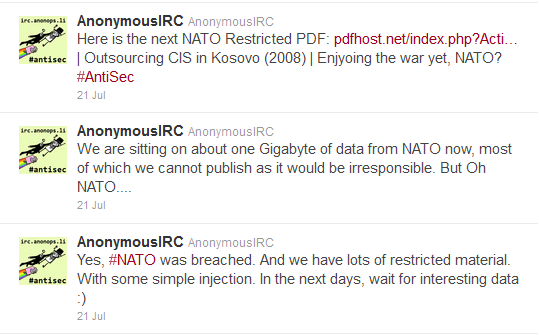
The Anonymous Twitter Feed Announcing the NATO Breach


On July 21st, 2011, Anonymous—the 4chan-associated hacker collective with a cyber-libertarian bent—announced that they had breached NATO’s secure database and retrieved roughly a gigabyte of restricted data.  To verify their claim, Anonymous posted a “NATO restricted” document to Twitter.  Interestingly, Anonymous has been very cautious in leaking the documents it has obtained, publicly declaring that it would be “irresponsible” to publish most of it.  Much of what has be published is “Redacted, for sanity.” more...

YouTube Preview Image

Recently I saw an episode of TLC’s “My Strange Addiction,” (lets not go into how exploitative this show is) and was first introduced to a man named Davecat. Davecat is a man with a synthetic partner, a growing trend where people marry anatomically correct, fully functional, mostly silicon, lifesize (sex) dolls. I call them sex dolls because they are clearly created in the image of a sexualized female ideal (small hips, large breasts, busty lips, flawless skin, long legs).

more...

Check out The Big Ideas podcast over at The Guardian UK today for a quick discussion of his work. The CBC has a very good article. Also, check out some Cyborgology posts on McLuhan, including his 1969 Playboy interview, Sheppard Fairey’s redesign ofThe Medium is the Message and perhaps most interesting is a website cataloging McLuhan’s video appearances.

How relevant is McLuhan today? In which disciplines? How about outside of academia?

more...

The original work described in this post was done in collaboration with Audrey Bennett and Ron Eglash and funded by the National Science Foundation’s GK-12 grant-funded Triple Helix Program. You can read all of the dispatches from Ghana on the3Helix fellows’ blog.

Cell phone towers are a constant site in Kumasi, Ghana.

Alternate universes can be a lot of fun. We can make Superman land in the USSR, put goatees on normally clean-shaven cast members, and revisit moments in history and play the “what if” game. It is the stuff of science fiction and fantasy. But there is much more to be said about the various parallel universes that might exist. At least, that’s what a lot of social theory has us believe.

At the end of the 20th century social scientists released dozens of books and articles with the words “social construction” in the title. Social constructionism became a very useful tool for the post-modern author who wanted to deconstruct such difficult topics as organic chemistry or high-energy physics.  Their premises were rather straightforward and were unceremoniously summarized and simplified by Ian Hacking in his book “The Social Construction of What?” (2000). Hacking writes:

more...

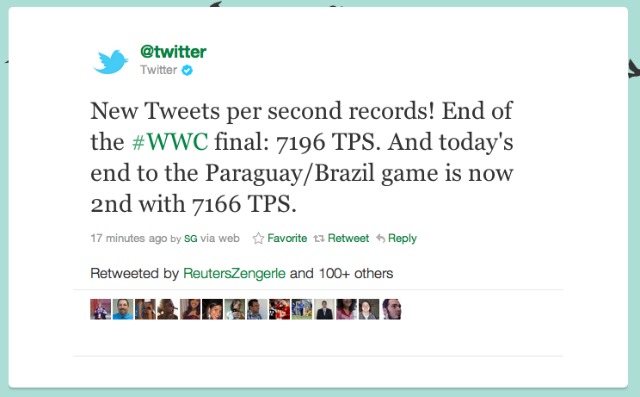
Twitter users set two new records for tweets per second on Sunday during the FIFA Women’s World Cup. The top spot goes to the championship game between USA and Japan, with 7,196 tweets per second at the end of the match. The Paraguay vs. Brazil game takes the number-two spot with 7,166 tweets per second. Putting this in context, this surpasses both the super bowl (4,063 tweets per second) and the 2010 Men’s World Cup final (3,283 tweets per second). If soccer is the world’s game, we see here a global community, where physically and geographically dispersed people come to share in a conversation. Moreover, we see the increasing integration of new technologies as an integral part of social experience, as tweets about the game became part of the event itself, and the event, by setting a new tweets/second record, became part of technological history.


The orange represents the intensity of Flickr images taken and geotagged to a particular area. The blue is Twitter use. Looking at New York City above, we see that people tweet from different places than they photograph. For example, tourists photograph some areas while people tweet more from work and home.

More images after the jump. Viamore...

Nope.  It’s not a reference to some long-forgotten 80s movie.  On June 23, 2009, former Secretary of Defense Robert Gates signed a memorandum creating US Cyber Command, a separate sub-command unit of U.S. Strategic Command (STRATCOM) headed by a four-star general, (currently, Gen. Keith B. Alexander). And, despite all its digital dualist rhetoric (exemplified by the rampant use of terms like “cyberspace” and “cyber-attackers”), Cyber Command should viewed as a major step toward the augmentation of warfare.  With the launch of Cyber Command, the US has quietly moved toward developing new first strike capacities that may, ultimately, prove more strategically important than even the nation’s nuclear arsenal.

While most media coverage has tended to focus on Cyber Command’s defensive postures (e.g., protecting classified data, securing the power grid, etc.), Cyber Command is also developing offensive capabilities to target and cripple other nations’ communication, transportation, and utility grids.  This demonstrates that, in the augmented warfare of the future, an effective assault on atoms will also require a simultaneous assault on bits.

Cyber Command’s capacities, however, are far from fully developed.  A recent report by the Government Accountability Office concluded that the Cyber Command “has not fully defined long-term mission requirements and desired capabilities to guide the services’ efforts to recruit, train and provide forces with appropriate skill sets.”

Watch CBS sensationalize cyber-warfare and make the digital dualist fallacy of comparing cyberspace to land and sea.