Archive: 2011

This is the first of a two-part series dedicated to answering the question “Do we need a new World’s Fair?” It is an honest question that I do not have an answer to. What I aim to do here is share my thoughts on the subject and present historical data on what these sorts of events have done in the past. In the first part, I explore what previous World Fairs have accomplished and what we must certainly avoid. The second part will investigate what a new 21st century fair might look like, and how it would help our economy. Part 1 is here.

Our Generation's Only Exposure to the Concept of the World's Fair. (Copyright Paramount Pictures and Marvel)

Yesterday we looked at the last few World Fairs that were held in the United States. Those  20th century fairs demonstrated technologies that today we take for granted as common-place. Everything from Juicy Fruit gum to fluorescent lighting has been introduced to the world through these massive fairs. World Expos still take place, but are now found in China, Japan and South Korea. The 2012 expo will be held in Seoul, South Korea. The latest World’s Fair, Expo 2010, was held in Shanghai, China and set historic records as the largest and most well-attended expo. But the success of the Shanghai Expo doesn’t quite translate to America’s shores. As The Atlantic’s Adam Minter wrote last year:

To American ears, the concept of a World’s Fair sounds archaic, and when applied to Shanghai, a contemporary symbol of all that is new, vibrant, and even threatening, it’s disconcerting. But in Shanghai, where the future is an obsession, this reported $46 billion hat-tip to the past makes perfect sense: just as New York once announced its global pre-eminence via World’s Fairs in 1939 and, again, in 1964, the organizers of Expo 2010 view the six month event as nothing less than Shanghai’s coronation as the next great world city. more...

This is the first of a two-part series dedicated to answering the question “Do we need a new World’s Fair?” It is an honest question that I do not have an answer to. What I aim to do here is share my thoughts on the subject and present historical data on what these sorts of events have done in the past. In the first part, I explore what previous World Fairs have accomplished and what we must certainly avoid. The second part will investigate what a new 21st century fair might look like, and how it would help our economy. Part 2 is here.

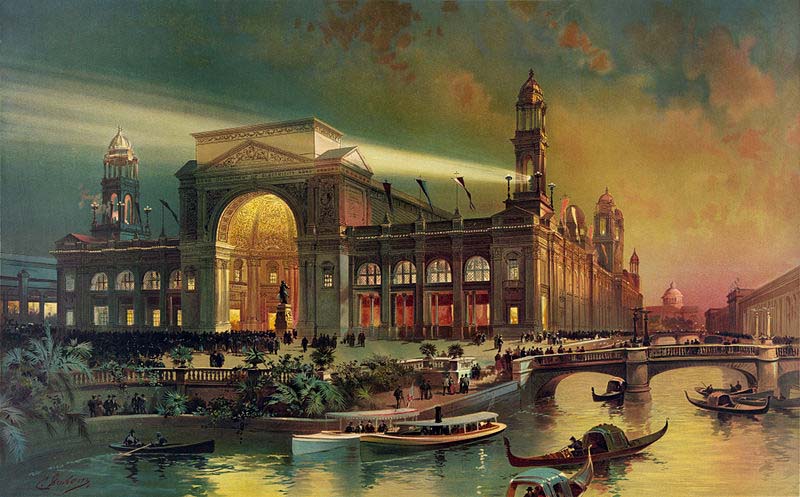
electrical building
By Charles S. Graham (1852–1911). Printed by Winters Art Litho. Co. (Public domain c/o Wikipedia.)

A “World Fair” is first and foremost, a grand gesture. They are typically months if not a few years long. Think of them as temporary theme parks, or the the olympics of technological innovation. They are extravagant, optimistic, and brash. But let’s be clear here. All of the World Fairs held in Paris, Chicago, New York, and Seattle had sections that are deeply troubling. The 19th century fairs had human zoos and “freak shows.” The 20th century fairs were, in many ways, launchpads for the corporate take-over of the public realm and the plundering of the very cities that hosted them (more on that later). But that does not mean the form is totally useless or inherently bad. In fact, a new American World Fair might be just what we need. more...

This brief essay attempts to link two conceptualizations of the important relationship of the on and offline. I will connect (1) my argument that we should abandon the digital dualist assumption that the on and offline are separate in favor of the view that they enmesh into an augmented reality and (2) the problematic view that the Internet transcends social structures to produce something “objective” (or “flat” to use Thomas Friedman’s term).

Instead, recognizing that code has always been embedded in social structures allows persistent inequalities enacted in the name of computational objectivity to be identified (e.g., the hidden hierarchies of Wikipedia, the hidden profit-motive behind open-source, the hidden gendered standpoint of computer code, and so on). I will argue that the fallacy of web objectivity is driven fundamentally by digital dualism, providing further evidence that this dualism is at once conceptually false, and, most importantly, morally problematic. Simply, this specific form of digital dualism perpetuates structural inequalities by masking their very existence. more...

Can an identity have a homepage?

Many have long argued that identity is the result of both  (1) performative work on the part of the individual as well as (2) the influence of society with all of its history, structures, institutions, norms and so on. We do not produce our identities in a vacuum, they are influenced by society. And we do not blindly consume our identities from the options given to us; humans are complex beings who creatively tweak, mix and remix to achieve something always unique. Not just producers or consumers,  it is best to think of ourselves as identity prosumers. Here, we will show how this process is made most explicit when identities are prosumed through social media technologies. more...

I am attempting to organize a session on online play, gaming & leisure at the Eastern Sociological Society Meetings, February 23-26, 2012 in New York City.

If you’re working on a relevant project, submit a title and a 200-250 word abstract (anything over 250 words will not be accepted) here. I’ll review the submissions on October 1st and see if we have enough to make a proposal.  Feel free to submit you papers through the ESS general submissions process as well if you plan to attend regardless of whether we are able to get a panel into the program. more...

I shot this video at the University of Maryland’s 2011 Summer Social Webshop and am posting it here with Ezster’s permission.  This presentation is particularly interesting because she describes the arc of her research throughout her career thus far, noting specific topical and methodological shifts.

Cyborgology Editors Nathan and PJ have teamed up with Dr. Chris Donoghue to organize a session (or sessions, or perhaps a mini-conference, depending on the number of quality submissions) on social media at the Eastern Sociological Society Meetings, February 23-26, 2012 in New York City.

If you follow Cyborgology, Theorizing the Web, or know anyone who wants to present on social media at a Sociology conference, please see our Call for Abstracts. All we need is a title and a 200-250 word abstract (anything over 250 words will not be accepted). Papers will be competitively chosen.

Submit your abstracts here.

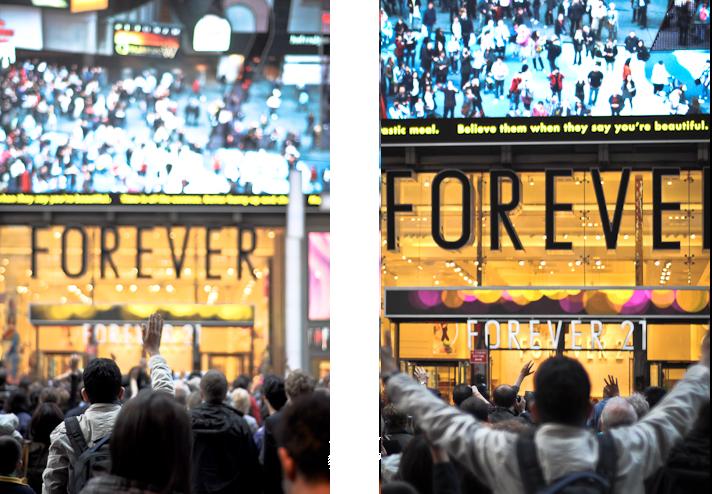
Crowds in Times Square waving at themselves on the big screen. Photos in this post by nathan jurgenson.

Something interesting has been happening in Times Square this summer. As has been occurring for a century, the crowds gather with necks perched upward looking at all the famously illuminated billboards. But now there is a new type of buzz in the crowd: they stand together facing the same direction, cameras held high and their hands waving even higher. They are not just watching celebrities or models in this the most expensive ad-space in the world; today, they are watching themselves on the big screen.

This is all part of a new billboard for the company Forever 21 currently in use in Times Square in the heart of New York City. It struck me that this billboard is nothing short of a consumer-capitalism-happening, and started snapping photos and thinking about what this all might mean. more...

[Edit 09/07/11 @ 5:03PM EST]  It has been mentioned in the comments, and elsewhere, that while the Postal Service is facing a solvency problem, that problem is the direct result of Republican-led legislation that burdens them with excessive overhead. I completely agree with this sentiment. The 109th Congress, passed the “The Postal Accountability and Enhancement Act” in 2006, which you can read in full here. The law requires that the USPS  pre-fund 75 years-worth of pensions, and prohibits them from selling  goods that are not directly used for sending letters and packages. I suggest you read more about this legislation here and here. I encourage all of you do to your own research and post what you find in the comments.]

galveston federal building

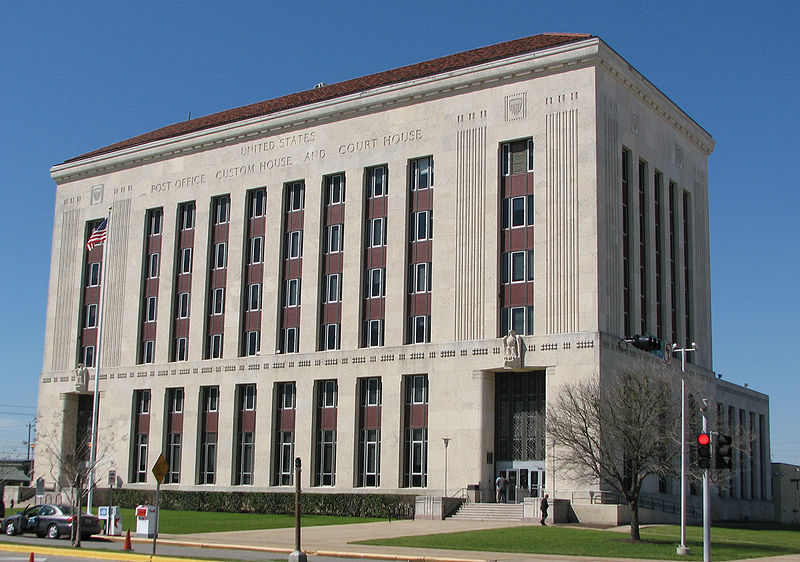
Photo Credit: Wikipedia – The Galveston Federal Building, built in 1937, is a multi-purpose building with many different government agencies. Don’t bleed the Post Office dry, make it a 21st Century Civic Center

Reading the news lately, makes it seem as though the Post Office is giving its final economic death rattle. Post Master General Patrick Donahoe spoke at a Senate hearing yesterday, and according to the Christian Science Monitor:

Donahoe reiterated a list of cost-cutting measures he has been proposing in recent months to erase the agency’s deficit, which could reach up to $10 billion this fiscal year. They include eliminating Saturday mail delivery, closing as many as 3,700 postal locations, and laying off 120,000 workers – nearly one-fifth of the agency’s work force. (This doesn’t include another 100,000 jobs lost to attrition that the agency does not plan to replace, for a total of 220,000 lost positions.)

These  are  disgraceful solutions to what could be considered an exciting opportunity to innovate. The Internet is being blamed for many of the Post Office’s problems, and it is safe to say that email has put a significant dent in their revenues. But revenues are only half the story. Expenditures are equally important. Duany, Plater-Zyberk, and Speck in their book Suburban Nation relay a conversation with a former (unnamed) Postmaster General who explained that most of our postage goes to the gas for the trucks and vans that carry mail to the suburban fringes of municipalities. Indeed, the USPS has the largest civilian truck fleet in the world. In an era of austerity, we need to look for ways to reduce spending while maintaining affordable services. I just think we need to spend less money on machines, and more on people. The internet can help us do this.

more...

Scientists in London  are working on an oral (rather than topical) form of sunscreen. Specifically, they are synthesizing sun-propelling properties from coral to work in the body as a  defense for the human skin against the sun’s damaging rays. This truly is a cyborg technology in Donna Haraway’s use of the term. It is a melding of human, animal, and machine. By ingesting the pill, the human biology is altered. This biological alteration in the human body is caused by its interaction and so enmeshment with the body and biology of the coral–an animal that was altered and synthesized using machine technology in a lab. Beyond a nice illustration of Haraway, the coral-based, human altering, technology reminds us that “nature” and “technology” are not mutually exclusive.