Search Results For "victoria's secret"

Prison Labor and Taxpayer Dollars

American companies that once looked to places like Mexico and China for cheap labor are bringing those jobs back to the U.S.  Why? Because prison labor is much, much cheaper.  Paid between 93¢ and $4.73 per day, and collecting no benefits, prisoners are a cheap labor source for about 100 companies (source).

What does this have to do with you?

If you have insurance, invest, use utilities, have a bank, drive a car, send a child to school, go to a dentist, call service centers, fly on planes, take prescription drugs, or use paper, you might be benefiting from prison labor.

If you’ve bought products by or from Starbucks, Nintendo, Victoria’s Secret, JC Penney, Sears, Wal-Mart, K-Mart, Eddie Bauer, Wendy’s, Proctor & Gamble, Johnson & Johnson, Fruit of the Loom, Motorola, Caterpiller, Sara Lee, Quaker Oats, Mary Kay, or Microsoft, you are part of this system.

When prisoners are in state and federal prisons, the U.S. taxpayer is subsidizing low wages and corporate profits, since they are paying for prisoners’ room, board, and health care.  When prisoners are in private prisons, prison labor is a way to make more money off of the human beings caught in the corrections industry.  In other words, prison labor is an efficient way for corporations to continue to increase their profits without sharing those gains with their employees.

For an extensive list of the companies contracting prison labor, click here.  You might also find interesting the video clips, embedded in this news story, of promotional videos by prison corporations that attempt to sell the idea of prison labor to companies:

Lisa Wade is a professor of sociology at Occidental College. You can follow her on Twitter and Facebook.

From Our Archives: Love Your Body Day

The Hall of Fame

Disability
Body Types
Gender
Race/Ethnicity/Color

The Hall of Shame

Body Types
Hair
Transsexuality
Heightism
Disability

Sexual Objectification (Part 1): What is It?

This is the first part in a series about how girls and women can navigate a culture that treats them like sex objects. Cross-posted at Ms.,  BroadBlogs, and Caroline Heldman’s Blog.

Around since the 1970s and associated with curmudgeonly second-wave feminists, the phrase “sexual objectification” can inspire eye-rolling. The phenomenon, however, is more rampant than ever in popular culture.  Today women’s sexual objectification is celebrated as a form of female empowerment.  This has enabled a new era of sexual objectification, characterized by greater exposure to advertising in general, and increased sexual explicitness in advertisingmagazinestelevision showsmoviesvideo gamesmusic videostelevision news, and “reality” television.

What is sexual objectification?  If objectification is the process of representing or treating a person like an object (a non-thinking thing that can be used however one likes), then sexual objectification is the process of representing or treating a person like a sex object, one that serves another’s sexual pleasure.

How do we know sexual objectification when we see it?  Building on the work of Nussbaum and Langton, I’ve devised the Sex Object Test (SOT) to measure the presence of sexual objectification in images.  I proprose that sexual objectification is present if the answer to any of the following seven questions is “yes.”

1) Does the image show only part(s) of a sexualized person’s body?
Headless women, for example, make it easy to see her as only a body by erasing the individuality communicated through faces, eyes, and eye contact:
We get the same effect when we show women from behind, with an added layer of sexual violability. American Apparel seems to be a particular fan of this approach:

2) Does the image present a sexualized person as a stand-in for an object?

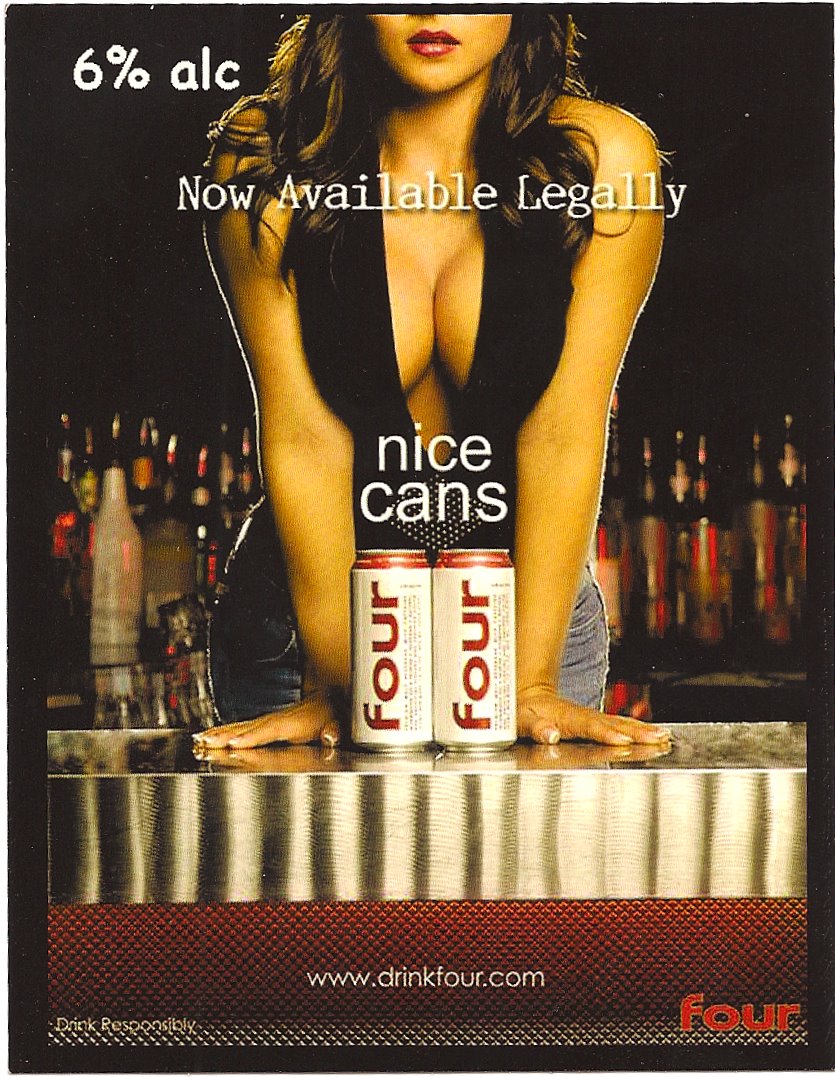
The breasts of the woman in this beer ad, for example, are conflated with the cans:

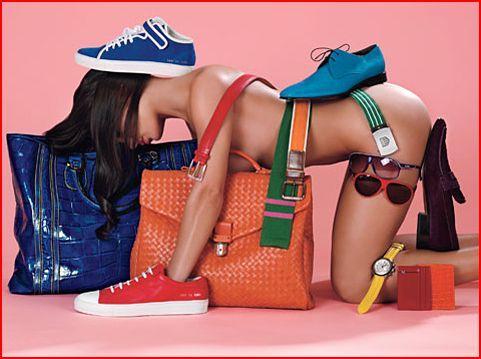
Likewise, the woman in this fashion spread in Details in which a woman becomes a table upon which things are perched. She is reduced to an inanimate object, a useful tool for the assumed heterosexual male viewer:
Or sometimes objects themselves are made to look like women, like this series of sinks and urinals shaped like women’s bodies and mouths and these everyday items, like pencil sharpeners.

3) Does the image show a sexualized person as interchangeable? 
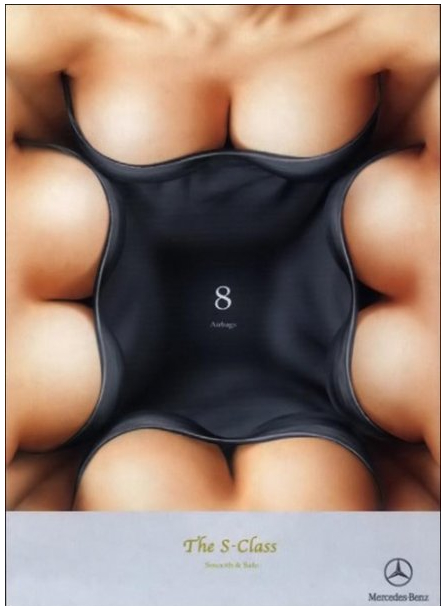
Interchangeability is a common advertising theme that reinforces the idea that women, like objects, are fungible. And like objects, “more is better,” a market sentiment that erases the worth of individual women. The image below advertising Mercedes-Benz presents just part of a woman’s body (breasts) as interchangeable and additive:

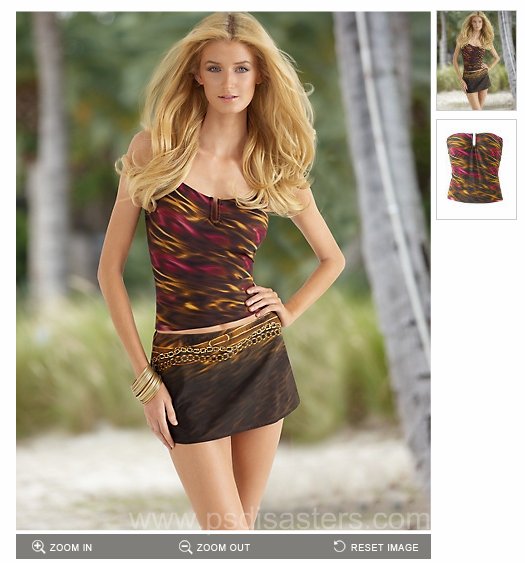
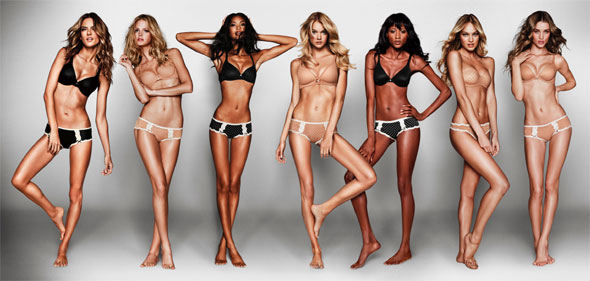
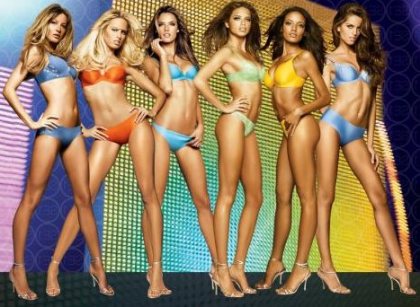
This image of a set of Victoria’s Secret models, borrowed from a previous SocImages post, has a similar effect. Their hair and skin color varies slightly, but they are also presented as all of a kind:

4) Does the image affirm the idea of violating the bodily integrity of a sexualized person that can’t consent?

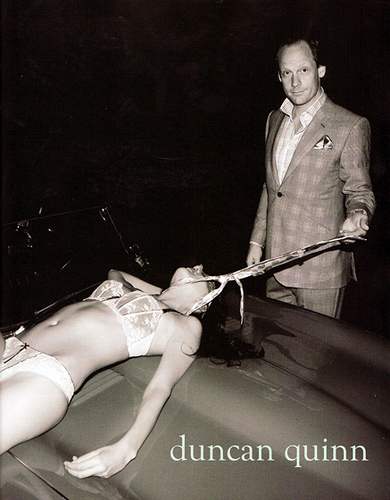
This ad, for example, shows an incapacitated woman in a sexualized positionwith a male protagonist holding her on a leash. It glamorizes the possibility that he has attacked and subdued her:

5) Does the image suggest that sexual availability is the defining characteristic of the person? 

This ad, with the copy “now open,” sends the message that this woman is for sex.  If she is open for business, then she presumably can be had by anyone.

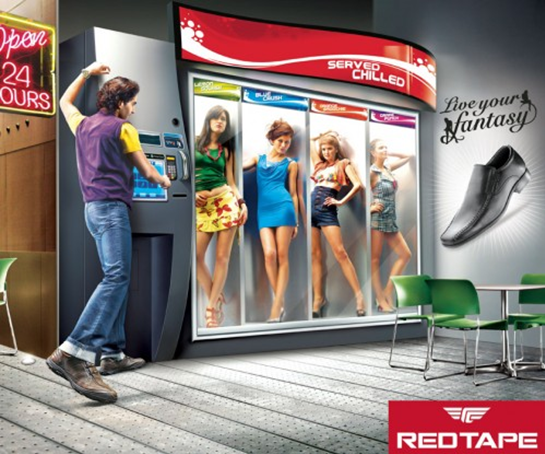
6) Does the image show a sexualized person as a commodity (something that can be bought and sold)?

By definition, objects can be bought and sold, but some images portray women as everyday commodities.  Conflating women with food is a common sub-category.  As an example, Meredith Bean, Ph.D., sent in this photo of a Massive Melons “energy” drink sold in New Zealand:
In the ad below for Red Tape shoes, women are literally for sale:

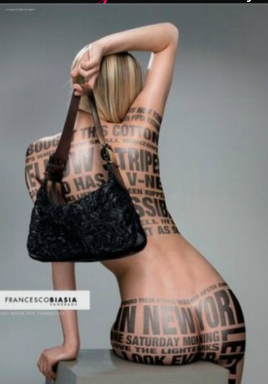
7) Does the image treat a sexualized person’s body as a canvas?

In the two images below, women’s bodies are presented as a particular type of object: a canvas that is marked up or drawn upon.

——————

The damage caused by widespread female objectification in popular culture is not just theoretical.  We now have over ten years of research showing that living in an objectifying society is highly toxic for girls and women, as is described in Part 2 of this series.

Caroline Heldman is a professor of politics at Occidental College. You can follow her at her blog and on Twitter and Facebook.

“Sexy” according to Victoria’s Secret

Victoria’s Secret has released this year’s list of the sexiest womenin 18 categories. Alongside the obvious, 16 of the 21 women are blond, er “blond.” Maybe 15.  Whatever. Have at it in the comments.

Also, Britney’s back? When did that happen?

Thanks to Dolores R.

—————————

Lisa Wade is a professor of sociology at Occidental College. You can follow her on Twitter and Facebook.

Behind the “Perfect” Body: Models and BodyBuilders

In a link sent in by Anjan G., Victoria’s Secret model Adriana Lima explains what she does in the months prior to walking the catwalk (source).   Here’s a summary:

  • For months before the show, she works out every day with a personal trainer; for the three weeks before, she works out twice a day.
  • A nutritionist gives her protein shakes, vitamins and supplements to help her body cope with the work out schedule.
  • She drinks a gallon of water a day.
  • For the final nine days before the show, she consumes only protein shakes.
  • Two days before the show, she begins drinking water at a normal rate; for the final 12 hours, she drinks no water at all.  She loses up to eight pounds during this time.

The result:

Lima’s training and nutrition regimen reveal that the look that is believed by some to be the epitome of feminine accomplishment — the look required to be a Victoria’s Secret Angel — is accompanied by significant physical strain.  Lima looks as she is supposed to on the runway, but she is also dehydrated and hungry.

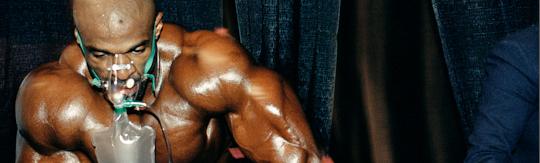
The story reminded me of this photograph, taken by Zed Nelson.  It shows Ronnie Coleman, immediately after walking off the stage at the Mr. Olympia competition, breathing through an oxygen mask.  He would take first place.  Explaining the photograph, Nelson writes:

Oxygen administered to exhausted contestants during final round of judging. The strain of intense dieting, dehydration and muscle-flexing, places high levels of strain on the heart and lungs, rendering many contestants dizzy, light-headed and weak.

Bodybuilders often have extreme and rigid exercise and diet plans in the months preceding a contest.  In those months, a male bodybuilder’s goal is to make himself appear as strong as possible. He must balance his body’s functional needs with his aesthetic goals, and sometimes the latter wins over the former.

Male bodybuilders and female models, then, represent aesthetic extremes of masculinity and femininity, but their bodies aren’t the natural extension of male and female physicalities. Instead, achieving the look require significant sacrifice of one’s body.  In other words, they look fit and strong, but looks can be deceiving.

See also:  criticism of female body builders and the right to consume women’s beauty.

—————————

Lisa Wade is a professor of sociology at Occidental College. You can follow her on Twitter and Facebook.

Line ‘Em Up: A Visual Trope

Okay so I did a google search one day and I stumbled across two images that… well, I just have to show them to you:

(Victoria’s Secret models, found here)

(Disney fairies, found here)

I seriously don’t want to make too big of a deal out of this. I really don’t.  I highly doubt that one of these images was modeled after the other or that there was some deliberate attempt to link Victoria’s Secret with Disney or sexy models with little girls.

That said, the two images point to a common visual trope. In this trope, a group of sexy women get lined up (often touching each other).  They look almost identical, with the exception of a tiny bit of variation in skin color and hair.  And they’re costumed in such a way as to make them look both alike and different (e.g., all in underwear of different colors).

The effect is to erase their individuality, but multiply the impact of the image. We don’t see a five or six women, we see Woman with a capital “W” (or Fairies in the second case).  It’s like seeing a buffet from afar, you see Food, but not necessarily macaroni and cheese, little tuna sandwich triangles, fried okra, and fruit salad.

Let’s call it the there’s-no-such-thing-as-too-much-conformity-to-the-male-gaze trope.  Or, I-like-my-women-like-I-like-my-collectibles (lots of ‘em, all of a type, and on display).  Or, women-come-in-a-rainbow-of-colors-just-kidding.

Do you have a better name for it?

UPDATE: Here’s another one, sent in by Ann T. (says Ann’s boyfriend, “I know it makes ME think of cancer”):

And here’s one I found on the Ms. blog:

Caroline Heldman counts this as a form of sexual objectification.  In these cases, women are shown as interchangeable, like objects.  And, she writes, “like objects, ‘more is better,’ a market sentiment that erases the worth of individual women.”

—————————

Lisa Wade is a professor of sociology at Occidental College. You can follow her on Twitter and Facebook.

Victoria’s Secret Says to Love Your Photoshopped Body

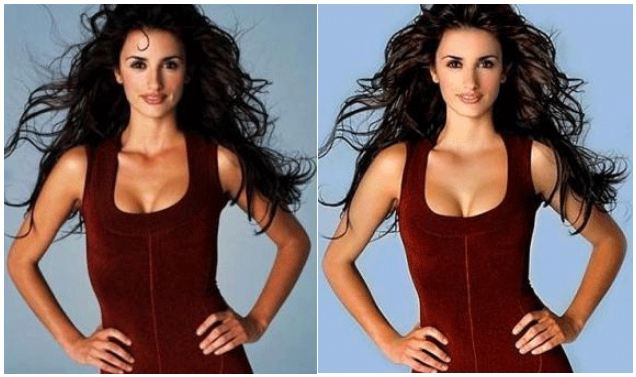
Katrin discovered a particularly ironic bit of photoshopping.  The first picture is of Rosie Huntington-Whiteley on a photo shoot, the second is her ad for the Victoria’s Secret “I Love My Body” ad campaign.  Notice that the body she is supposedly loving has significantly less more cleavage than the body we see in the first photo.  Apparently even models’ bodies are unlovable without re-touching (or surgery?).

—————————

Lisa Wade is a professor of sociology at Occidental College. You can follow her on Twitter and Facebook.

Fat Scandals

This intense scrutiny of celebrity women’s bodies demonstrates the kind of pressure all women are under, the expectation that women’s bodies are for others and not themselves, and the entitlement to judging women’s bodies that both men and women in our culture appear to share.

Below is our series on fat scandals:

(1)  Czech model Karolina Kurkova (who models for Victoria’s Secret) horrified the Brazilian press by showing up to walk the runway at a recent Brazilian fashion show looking “fat,” or what counts as fat in the industry. Just Google her name and tons of stories about the controversy come up. Here are some photos of her offending body (found here):

(2) Here is a video of model Ali Michael, who appearing on The Today Show to discuss being shut out of the Paris fashion shows this year (after being wildly successful last year) because she was told her legs were too “plump” for the runway:

Tatiana, an model who writes for Jezebel.com (her name is a a pseudonym), writes about the problems in the modeling industry and the need to unionize.

(3)  In July of 2008, gossip columnists wondered whether Eva Longoria was pregnant or just fat (see here and here). The offending body:

See all the pics here.  Tip from Jezebel.

NEW!

(4)  In early 2009, Jessica Simpson was the target.  Here’s the terrible transition (via Shakesville):

jsimpson

Included in the New York Post’s 50 Fat Celebrities list.  And the rag also ran this cartoon:

carton

Media Matters highlighted this obnoxious Fox News coverage (found here):