race/ethnicity: Whites/Europeans

Matthew Yglesias featured two figures from the Pew Economic Mobility project.  They show how long different types of people tend to take to recover from income loss (within 1 year, 2-4 years, or 5-10 years).

This figure shows that people who are older, have more education, or are poor, working, or middle class have a harder time recovering from tough economic times:
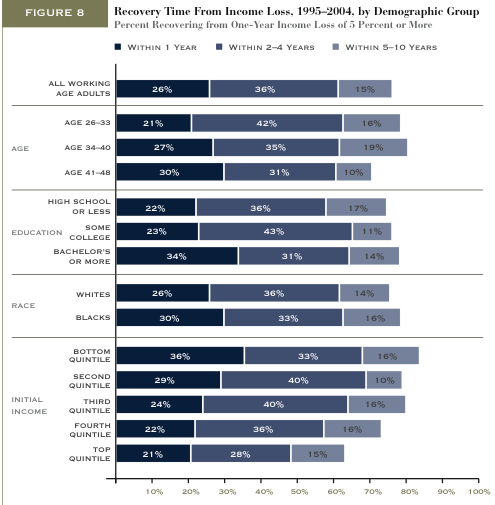
recovery

This figure shows how marital status is related to recovery.  Most dramatically, people who get married before recovering financially (especially men), women who split with a partner, and women who are single have a more difficult time recovering.
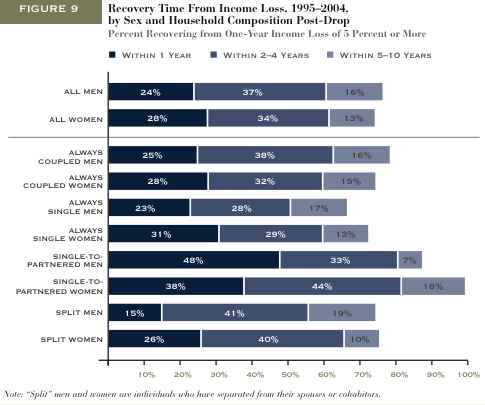
recoverygender

Something to consider: As several commenters noted, I’m not sure how they defined “recovery” from income loss.  If you never made a lot of money to begin with, does recovery simply mean returning to a state of low income?  Then, does the income for an initially high income person need to return to its high state for it be counted as a “recovery”?

(Just FYI: I revised my interpretation of these figures.  Thanks to the early commenters who noticed I’d misinterpreted.  It was really late at night when I wrote this post!)

—————————

Lisa Wade is a professor of sociology at Occidental College. You can follow her on Twitter and Facebook.
picture1

picture2

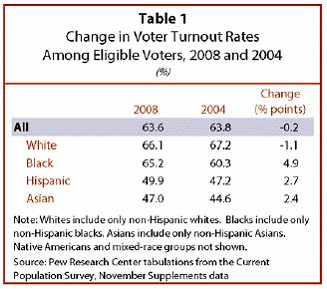
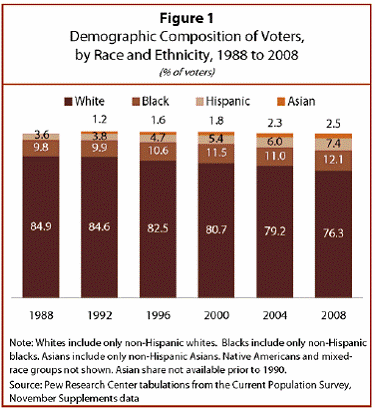
Thomas Sander at the Social Capital Blog writes: “Obviously the $1,000,000 question is whether these behavioral changes are likely to continue beyond the Obama candidacy.” I think the answer to this, at least as far as racial composition goes, is yes. What we see here is a two decade long trend, not a blip inspired by Obama.

Data compiled by the the Pew Research Center, via Thick Culture.

Lisa Wade, PhD is an Associate Professor at Tulane University. She is the author of American Hookup, a book about college sexual culture; a textbook about gender; and a forthcoming introductory text: Terrible Magnificent Sociology. You can follow her on Twitter and Instagram.

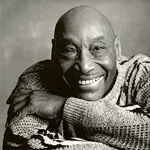
frankie-bioThis post is dedicated to Frankie Manning.  Frankie died this morning of complications related to pneumonia   He was one month shy of his 95th birthday.  I will really miss him.  Frankie is a lindy hop legend.  He choreographed the clip below and is the dancer in the overalls.

In the 1980s, there was a lindy hop revival.  Lindy hop is a partner dance invented by African American youth in Harlem dancing to swing music in the early 1930s. Named after the “hopping” of the Atlantic by Charles Lindbergh Jr., it became wildly popular in the 1930s and ‘40s, traveling from the East to the West Coast and from black to white youth. Since its resurgence, Lindy Hoppers have enjoyed a national scene with websites, workshops, competitions, and city-wide social events that draw national and international crowds.

Though lindy hop was invented by African Americans, lindy hoppers today are primarily white.  These contemporary dancers look to old movie clips of famous black dancers as inspiration.  And this is where things get interesting:  The old clips feature profoundly talented black dancers, but the context in which they are dancing is important. Professional black musicians, choreographers, and dancers had to make the same concessions that other black entertainers at the time made. That is, they were required to capitulate to white producers and directors who presented black people to white audiences. These movies portrayed black people in ways that white people were comfortable with: blacks were musical, entertaining, athletic (even animalistic), outrageous (even wild), not-so-smart, happy-go-lucky, etc.

So what we see in the old clips that contemporary lindy hoppers idolize is not a pure manifestation of lindy hop, but a manifestation of the dance infused by racism. While lindy hoppers today look at those old clips with nothing short of reverance, they are mostly naive to the fact that the dancing they are emulating was a product made to confirm white people’s beliefs about black people.  Let’s look at how this plays out:

This clip, from the movie Hellzapoppin’ (1941) is perhaps the most inspirational clip in the contemporary lindy hopper’s arsenal:

By the way, the dancers are in “service” outfits because of the way lindy hop scenes featuring black dancers were included in movies.   Typically they would have no relationship to the plot; they would occur out of nowhere and then disappear.  This was so that the movie studios could edit out the scene when the movie was going to be shown to those white audiences that were hostile to seeing any positive representation of black people at all.  If you want to see how the scene above emerged (black “help” suddenly discovering musical instruments and spontaneously congregating), you can watch the extended clip here.

The clip features a dance troop called Whitey’s Lindy Hoppers. You can see other famous dance segments in Boy! What A Girl! and Day At The Races.

The clip below, from the Ultimate Lindy Hop Showdown (2006), reveals how powerfully contemporary lindy hoppers have been influenced by clips like the ones above.  Watch for how the styling, moves, and trick reflects the clips above:

Another good example can be found here (but the angle, audio, and visual quality are not very good).

So we have a set of (mostly) white dancers who naively and wholeheartedly emulate a set of black dancers whose performances, now 70 to 80 years old, were produced for mostly white audiences and adjusted according to the racial ethos of the time.  On the one hand, it’s neat that the dance is still alive; it’s wonderful to see it embodied, and with so much enthusiasm, so many years later.  And certainly no ill will can be fairly attributed to today’s dancers.  On the other hand, it’s troubling that the dance was appropriated then (for white audiences) and that it is that appropriation that lives on (for mostly white dancers).  Then again, without those dancers, there would likely be no revival at all.  And without those clips, however imperfect, the dance might have remained in obscurity, lost with the bodies of the original dancers.

As a white lindy hopper myself, for over ten years now, who desperately loves this dance, I find this to be a deep conundrum.

I don’t know what Frankie would have had to say about this critique.  But I do know that he loved lindy hop to his last days and he was grateful for the revival.  Here he is dancing with Dawn Hampton, another legend of lindy hop, at the age of 94:

I’lll miss you, Frankie. And I’ll keep on dancing, embodying, with ambivalence, all the great contradictions of the dance and the history of this country.


UPDATE: A couple commenters asked how, exactly, the dance was changed in order to appeal to white audiences.  This is actually really difficult to say, since few films of social dancing (black dancers dancing only for other black dancers) exist.  But we have some theories.  Evan, in the comments, had this suggestion:

For white audiences of the time, Jazz was Hot Black jungle music – Black people were sex crazy hedonists, and you can see it in the moves, the exaggerated body undulation. the speed. the sweat. the rhythmical drum.

It was like watching a tribe around a fire.

I’m with Evan.  I’d like to also add that, as a person with a trained eye for lindy hop, I see two things in those clips:

(1) I see incredibly effective technique. Unbelievable strength and precision. It’s fantastic.  (By the way, Frankie explained that, by the time they got to the take you see in the Hellzapoppin’ clip, they’d performed that routine more than 20 times in a row… they were amazing athletes.)

(2) But I also see, layered onto and facilitated by that technique, an effort to make the dance appear more out-of-control than it is. They are wild-ing the dance.

At least, that’s how it looks to me.

More than that, though.  As a dancer who has also been inspired by those clips, I know how to do that.  I know how to exaggerate the out-of-control look.  I won’t go into the technical details (I did, and then deleted!), but it’s do-able.  And it’s not that it’s not cool… adding the drama is fun and exciting to watch… but there’s a historical reason why lindy hop has that dimension and that is worth thinking about.

Lisa Wade, PhD is an Associate Professor at Tulane University. She is the author of American Hookup, a book about college sexual culture; a textbook about gender; and a forthcoming introductory text: Terrible Magnificent Sociology. You can follow her on Twitter and Instagram.

Toban B. wrote in with an observation about Facebook avatars. The default avatar is “white” and appears to be male:

d_silhouette

In contrast to the individual avatar, Facebook’s illustration of global connection uses orange avatars of both sexes:

capture12

“Evidently,” Toban writes, “the orange is supposed to be a sort of compromise skin colour.”

So when Facebook wants to represent global humanity, the avatars are orange and of mixed sex; when Facebook is charged with representing an individual, the avatar is white and male.  This is not random or accidental.  Globally, as Facebook, ironically, reminds us, people are not “white.”  Representing people in this way centers men, Western countries, and whiteness (because there are non-white people in Western countries, too) and marginalizes women, non-Western countries, and non-whites (though one might argue that at least ALL of the avatars aren’t white and male).

UPDATE: I write this update in August of 2010.  Since then it appears that Facebook has added a generic female avatar.  This one was sent in by Amber F. (it’s her mom, Ginger’s, profile):

See our other posts on how whiteness and maleness are the characteristics we attribute to “person,” unless there are reasons to do otherwise, herehere, and here.


Kelly Zen-Tie Tsai asks Obama to include the even-less-visible minorities (by which she doesn’t mean the purple, blue, and green):

Via Stuff White People Do, where there is also a nice discussion.

We’re pleased to feature a post by Robert Hariman.  Robert is a professor of Rhetoric and Public Culture in the Department of Communication Studies of Northwestern University.  Robert blogs at No Caption Needed, where we saw this great post:

—————————

I am suspicious of references to “the Arab Street,” particularly when the phase is applied–as it often is–to nations and other vast swaths of territory that are not Arab or not exclusively Arab. Several years ago Christopher Hitchens declared that it was a vanquished cliche but he was misusing it himself and not surprisingly as he was blowing the war trumpet for the Bush administration. And he wasn’t speaking of its persistence as a visual convention.

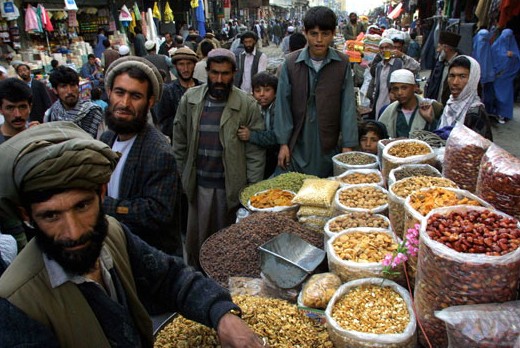
The caption of this photograph at The Guardian says only, “Nowruz celebrations in Afghanistan.” Nowruz is the name of the Iranian New Year, which is celebrated in a number of countries by people of several faiths. The baskets of dried fruits eaten during the holiday provide the only visual connection to the colorful festivities, and you have to know more than the paper tells you to see that. For many viewers, this will a thoroughly conventional image of the Middle East.

That image is one of throngs of working class men massed together in the street. What little business is there is in the open air markets lining each side of the densely packed urban space. We see small batches of everyday goods on display–probably to be bartered for, no less. The open baskets of food are a sure marker of the underdeveloped world. (Imagine how many packages it would take to wrap up all that fruit for individual snacks to be sold in the US; and even in Whole Foods the unpackaged food is in closed bins.) Everything fits together into a single narrative, but the masses of men and boys make the scene politically significant. This is the place where collective delusions take hold, where mobs are formed, and where unrest can explode into revolutionary violence and Jihad.

Which is why I get a kick out of this photograph of another Nowruz celebration.

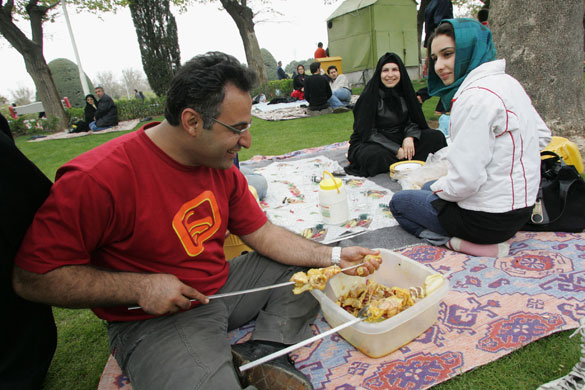
The caption reads, “An Iranian man skewers chicken for grilling as he picnics with his family.” My first thought when I saw the image was to check and make sure it wasn’t taken in Chicago. This also is a very familiar scene: grass, blankets, families and friends, plastic containers of food, dad getting ready to do the grilling.

What is astonishing is that I was able to see them at all. A typical summer holiday photo becomes a radical disruption of Western visual conventions when taken in Iran and shown in the US. Of course, it wasn’t shown in the US: this, too, is from the UK paper.

In this photo, there is no Arab street nor Iranian masses dominated by Mullahs and demagogues. A middle class tableau reveals that so much of what is in fact ordinary life for many people in Iran and elsewhere in the Middle East is never seen in the US. And it isn’t seen because it doesn’t fit into simplistic categories, outdated stereotypes, and a dominant ideology. All that is shown and implied in the cliches is of course also there, but it is there as part of a much more complex and varied social reality.

As evidence of how things might appear a bit different, notice how seeing the second image can affect perception of the first one. In the second, it seems evident that the family is posing for the photograph. They’re doing exactly what they would have been doing but now with the additional, amused awareness that it is, for a moment, also an act. And sure enough, if you look back to the first photo, you can see the same thing. And if you can see that, they no longer need appear as a mass, or poor, or threatening, or anything but people enjoying a holiday. Much like people in the US were doing this past weekend to celebrate St. Patrick’s day, thronged together, in the street.

Photographs by Natalie Behring-Chisholm/Getty Images and Behrouz Mehri/AFP-Getty Images.

Racism is ingrained in the Midwest; we’ve normalized it. Take, for example, my earlier post on Tony Zirkle, the Chinese_stereotype.jpgHoosier Republican congressional candidate who spoke at a dinner honoring Hitler’s birthday. (He also publicly advocated for racial segregation.) Zirkle lost, of course, but the fact that he had no problem publicly stating his racism – without thinking that others would object – shows just how commonplace overt racism can be here.

One of the best examples is the “U-Washee” in Richmond, Indiana. The laundromat is, literally, built on racist stereotypes of Chinese people and no one gives it a passing glance. It’s 1940’s era cartoon stereotype mascot, what Margaret Cho calls “feng shui hong kong fooey font,” and the extra “ee”s at the end of words in the business’s name and posted notices all combine to form one hellish timewarp into a past America most areas have forgotten but we tend to accept as typical – and no one utters a peep.

Losing Sight of the Past

lost_clothes.jpg

While Americans tend to think of the South when the subject of racism comes up, the Midwest is no stranger to our own brand of anti-minority bigotry. The Klu Klux Klan was headquartered in Indiana for many years. The former national Grand Dragon, D.C. Stephenson‘s, home is blocks from mine; he more or less ran our state government in the 1920’s. One July 1923 Klan rally hosted by Stephenson in nearby Kokomo drew an estimated 50,000 people.

Bigotry flourished around the nation thanks to Stephenson’s efforts. He influenced governors, state legislators and congressmen. It wasn’t until he abducted, forcibly intoxicated, assaulted and raped a white neighbor woman who later died that he became a societal pariah. (One witness said her body looked like she’d “been chewed by a cannibal.” He was sentenced to life in prison.) No one knows if there were any African-American victims too; they were never considered.

Racism is part of our heritage too.

Don’t Get Too Worked Up

so_sorry.jpg

The reader who sent in these photos described his encounter at the laundromat. While he was taking the pictures, another customer walked up to him to ask, “You’re not from around here, are you?” It wasn’t meant in a threatening manner, but more of a bemused “Well, this is Indiana…” general excuse.

It’s often said that one thing Hoosiers fear most is change. We use it as a crutch to continue any bad behaviors we want to tacitly condone. Smoking rate too high? Our citizens are stressed over the economy. Rate of overweight people per capita one of the highest in the nation? It’s the diet. No protections whatsoever for gays and lesbians? These type of things take time.

Apparently almost 50 years isn’t quite enough.

Rewarding Bigotry

Chinese_reward.jpg

Another interesting aspect to this story is the financial angle. The unemployment rate in Richmond is 9.8%. Very few small businesses are succeeding. The “U-Washee” is entirely built around this racist theme and to remove the associations would cost a small fortune – new signage inside and out, a new name, changed business records with resultant legal fees, etc.

The owner is an elderly white man who’s barely making ends meet as energy costs and business expenses have skyrocketed while income has stayed the same. He’ll wash, dry and fold your clothes for you for $1 per pound. He provides a service the community needs. How do you wash your clothes if you don’t have a car to drive miles to another laundromat? There are three* other laundromats in the city of 40,000 people.

How does the community deal with the issue without cutting off their nose to spite their face in these desperate economic times?

Large Issues to Deal With

big_bundles.jpg

Confronting racism is never an easy task. Adding in poverty, employment and basic living issues only compounds the problem. If no one is complaining, why stir up trouble?

0.8% of Richmond’s population is Asian according to the US Census Bureau. They’re not complaining. The citizens obviously aren’t either. A quick Google search for “U Washee Richmond” shows exactly one relevant link – a listing for the pay phone. No other blog posts. No outrage in the newspaper. No protests outside the business.

What right do I have to interject myself in their affairs?

The Stain That Will Not Wash Away

rain_soft.jpg

I’ve not reached out to the “U-Washee” before posting these pictures and commentary. I plan to do it though, because someone has to speak up. I won’t demand or threaten. My goal is to help the owner move his business past the anti-Chinese racist stereotypes and not to shut the place down.

Someone has to speak up. Someone has to be first and break the cycle of complacency – the “I’m better than those poor deluded people” theory that too often excuses the continuation of prejudices and vices. Someone has to speak up.

Otherwise this stain will never wash away.

*Commenter AWB has pointed out that two laundries I thought were closed are open. I corrected the number of laundries in the town.

—————————-

Bil Browning is a long-time LGBT activist and writer.  He is the co-owner and Editor-In-Chief of The Bilerico Project – an LGBT political blog recently named one of four “must reads” by the Washington Post.  He and his partner, Jerame Davis, live with their teenage daughter in Indianapolis, Indiana.  We asked Bil if we could reproduce this post from his blog and he said “yes.”

If you would like to write a post for Sociological Images, please see our Guidelines for Guest Bloggers.

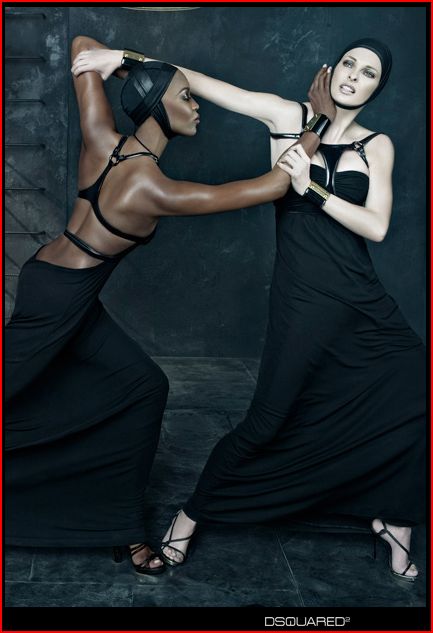
Bri a sent in this ad, found in Interview Magazine, and we’d like to know what you think of it:

capture

It reminds me, somewhat, of this post featuring a billboard for Playstation with a black and white woman fighting.