race/ethnicity: Whites/Europeans

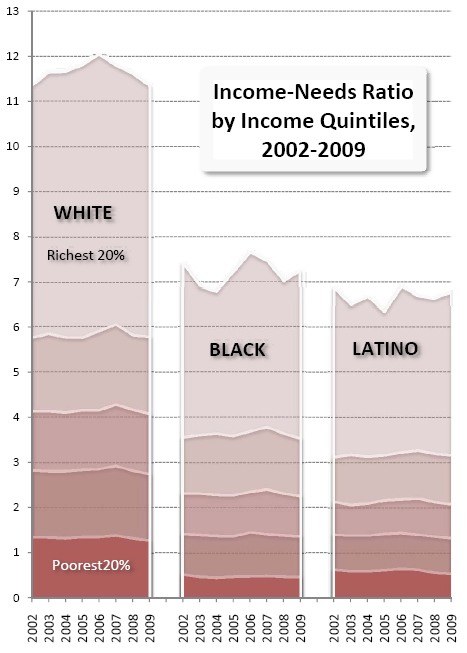
Yesterday I posted the news that the percent of Americans in poverty reached nearly 15% in 2009.  Philip Cohen, at Family Inequality, used the same Census data to give us an idea of how both wealth and poverty are distributed across U.S. racial groups.  We know that Blacks, Latinos, American Indians and some, but not all, Asian sub-groups are poorer, on average, than Whites.  Cohen offers us a different way of looking at this, however, by plotting the income-to-needs ratio for Whites, Blacks, and Latinos over the last 8 years.

That income-need ratio is, by definition, 1.0 at the poverty line, and numbers above that are multiples of needs, so 3.0 is income of 3-times the poverty line.

That ratio sits along the vertical axis, with time at the horizontal:
This, Cohen explains, “…allows us to see the size of the White advantage…”  He continues:

So, for example, the richest 5th of Whites are above 11-times the poverty line, while the poorest 5th of Whites are (on average) just above the poverty line. In contrast, the richest 5th of Blacks and Latinos are around 7-times the poverty line, and 40% of both groups are below 1.5-times the poverty line.

It’s not simply, then, that Blacks and Latinos are disproportionately poor.  Their poor are also poorer than the poor Whites and their rich are less rich than rich Whites.

Lisa Wade, PhD is an Associate Professor at Tulane University. She is the author of American Hookup, a book about college sexual culture; a textbook about gender; and a forthcoming introductory text: Terrible Magnificent Sociology. You can follow her on Twitter and Instagram.
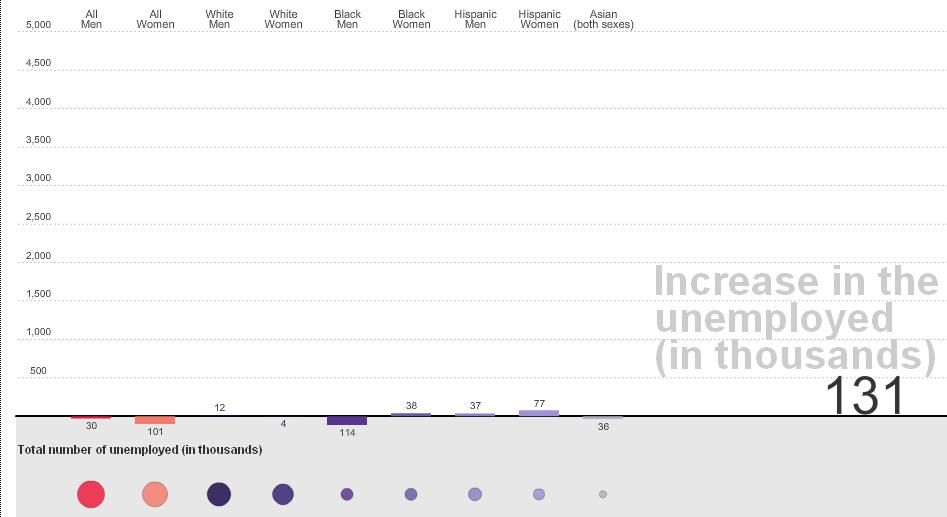
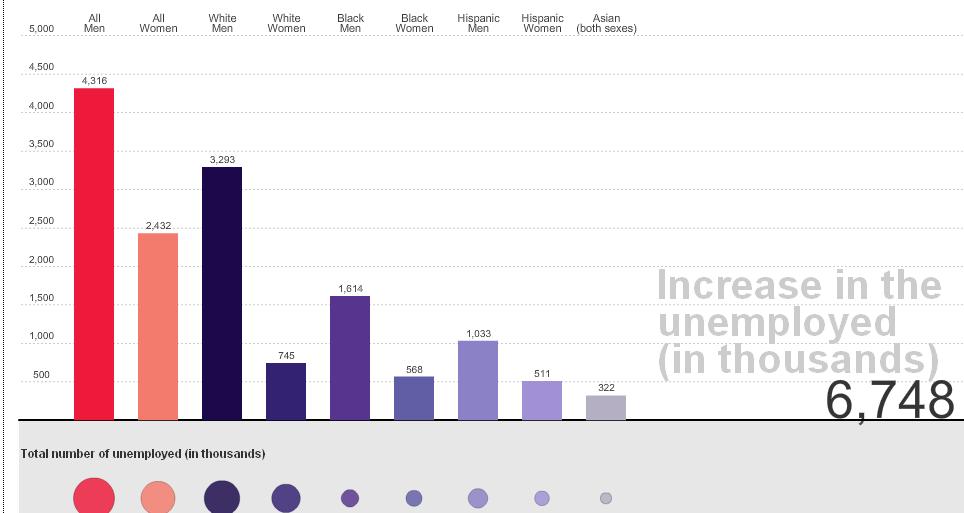
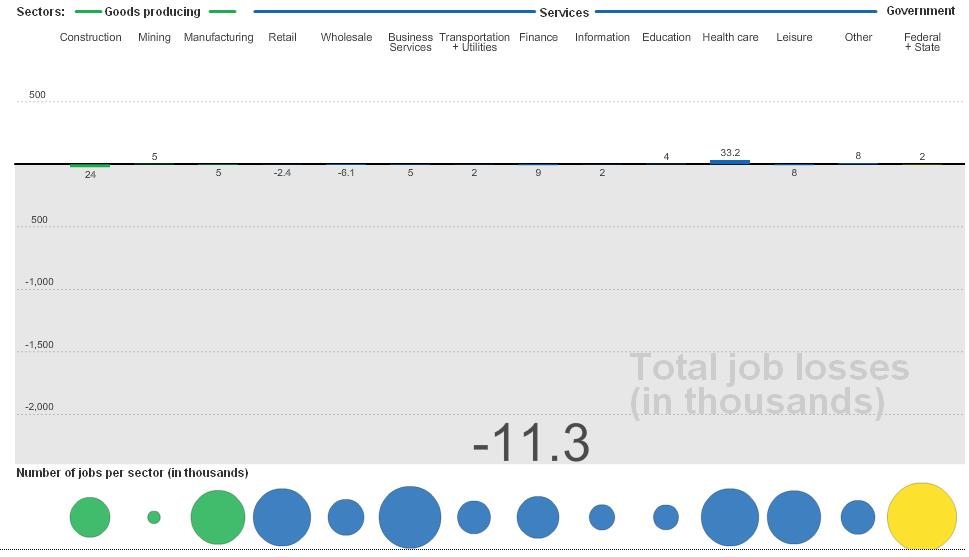
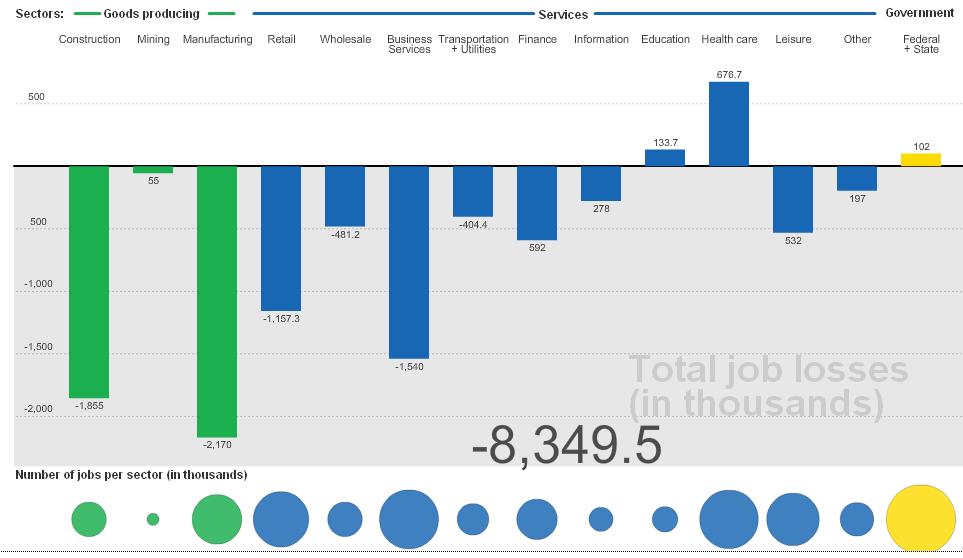
Rachel sent in a link to a post about the recession by Tim Cavanaugh at Reason that led me to an interactive graphic at the Wall Street Journal that lets you track job loss by either sector or by race/ethnicity and sex from December 2007 to August 2010.

Here is the race/ethnicity and sex data for January 2008 (for reasons I cannot understand, Asians are not separated out by sex, and as usual, American Indians aren’t included):

And here’s the breakdown for January 2010:

Unfortunately, the numbers aren’t weighted by the number of total workers per category, so we don’t have any way to know how these raw numbers translate into percentages of workers losing their jobs.

By economic sector, for January ’08:

January ’10:

[On a nitpicky note, the sector graphs show job losses in negative numbers, which would work if it showed total change in # of jobs. But I think we’d be thrilled if we had -8… thousand job losses, as the graph is labeled. Just a small sloppy labeling issue.]

As the data show, and as we’ve discussed before, the economic recession has disproportionately affected men. But Cavanaugh cautions that it might be a little soon to declare men an at-risk species or lament the bad luck of being born male. Presumably, if men’s over-representation in construction, for instance, has meant they suffered more than women from the real estate bust, if you felt like it you could turn it around and argue that perhaps they disproportionately benefited from the boom that preceded it. Additionally the employment sectors are pretty broad; “retail” or “finance” will include some specific occupations that are fairly gender balanced, some that are dominated by men, and some dominated by women. And overall loss in retail jobs doesn’t tell us if the losses are spread equally across occupations within the sector.

Should we care about the suffering of men and their families in the recession? Of course. And to the degree that men are disproportionately represented in occupations that are prone to boom/bust cycles, we’re likely to continue to see greater volatility in their employment rates than women’s, sometimes to their advantage, sometimes not. But we might want to be a little careful and look at some more in-depth data before we declare, as some commentators seem to want to do, that women have basically escaped the recession. If nothing else, men and women aren’t islands; lots of us share household expenses, and a woman whose husband loses his job but keeps her own doesn’t exactly avoid any negative consequences of the recession.

Related posts: more comparisons of joblessness, race and recession, unemployment and education level, not everyone suffers during a recession, the gender employment gap,

During the 19th the United States received many new residents from China.  Sometimes they came voluntarily; sometimes they were imported forcibly.  The term “Shanghaied” originally described the forced stealing of Chinese men to come work in America.  Many of them worked on the transcontinental railroad, built between 1863 and 1869.  Ninety percent of the workers on the central Pacific track, for example, were Chinese.

After the railroad was completed, however, many Chinese went to work in industries in which they competed with white American workers, especially mining, and they became scapegoats for white unemployment.  For some examples of anti-Asian propaganda, see our collection of “yellow peril” posters and cartoons.

Animosity towards the Chinese culminated in the Chinese Exclusion Act of 1882.  The Act meant that Chinese in America, most of whom were adult men, had little hope of reuniting with their families if they stayed in the U.S.; it also allowed the U.S. to deny re-entry if a Chinese person already in the U.S. left the country; and it excluded the Chinese in America from getting U.S. citizenship.

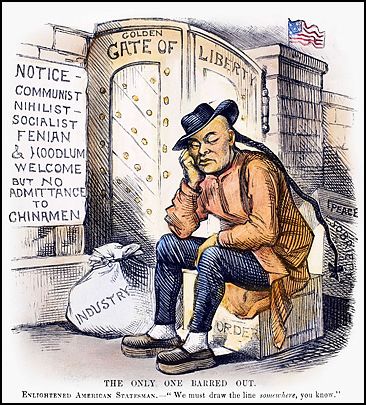
The Chinese Exclusion Act is an ugly moment in U.S. history that was supported by many Americans.  But this support wasn’t universal.  The political cartoon below attacks the Act.  “No admittance to Chinamen,” it reads.  But “communist nihilist-socialist fenian & hoodlum [are] welcome.”  The punchline reads, sarcastically, “We must draw the line somewhere, you know.”

(Image from Time.)

The Fenian, by the way, were Irish political groups, suggesting that the embrace of one minority group did not necessarily translate into the embrace of others.   Or maybe the cartoon was meant to go the other way: “If we’re going to exclude the Chinese, let’s exclude others as well.”

UPDATE: Loki offered the following helpful correction to my description of the word “Shanghaid”:

A bit of disagreement: The verb to Shanghai someone was more often used with respect to the practice of crimps or other people to use force, intimidation or outright kidnapping to man merchant ships during the 18th century.

I’m not about to claim that there weren’t cases of people from Shanghai being forcibly relocated to the US to work on the railroad – but the term refers to one of the abuses of common sailors that was considered usual practice in the age of sail.

Wikipedia article here, for some background of the maritime history of the term: http://en.wikipedia.org/wiki/Shanghaiing

Lisa Wade, PhD is an Associate Professor at Tulane University. She is the author of American Hookup, a book about college sexual culture; a textbook about gender; and a forthcoming introductory text: Terrible Magnificent Sociology. You can follow her on Twitter and Instagram.
In 1989 Peggy McIntosh published an essay that is assigned in nearly every Sociology of Race and Ethnicity course in America.  Titled White Privilege: Unpacking the Invisible Knapsack, the essay included a list of things that white people, but not others in a white-dominated society, can count on.  Here are a few:

I can avoid spending time with people whom I was trained to mistrust and who have learned to mistrust my kind or me.

If I should need to move, I can be pretty sure of renting or purchasing housing in an area which I can afford and in which I would want to live.

I can go shopping alone most of the time, pretty well assured that I will not be followed or harassed.

I can turn on the television or open to the front page of the paper and see people of my race widely represented.

I can be sure that my children will be given curricular materials that testify to the existence of their race.

Whether I use checks, credit cards or cash, I can count on my skin color not to work against the appearance of financial reliability.

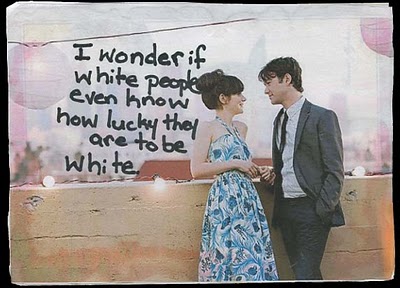
I thought of Peggy McIntosh when I saw this personal confession at PostSecret:

For more on white privilege, see our posts on Colin Powell being called a traitor, Sotomayor’s Supreme Court hearings, the privilege to shoplift, and “flesh” and “nude” colors.

Lisa Wade, PhD is an Associate Professor at Tulane University. She is the author of American Hookup, a book about college sexual culture; a textbook about gender; and a forthcoming introductory text: Terrible Magnificent Sociology. You can follow her on Twitter and Instagram.
Trigger warning: racial violence and racist language.

A disturbing picture of racial slaughter emerges in the days following Katrina, at the hands of private residents and police officers. Racially-motivated murders were carried out in Algiers Point, a predominately white enclave nestled in mostly black Algiers, not far from Gretna. This part of the city is connected to the rest of New Orleans by bridge and ferry only, and it did not experience flooding. After the storm, a band of 15 to 30 white men formed a loose militia targeting anyone whom they deemed “didn’t belong” in their predominately white neighborhood (source). They blocked off streets with downed trees, stockpiled weapons, and ran patrols.

At least eleven black men were shot, although some locals expect that the actual number is much higher. On July 16, 2010, Roland Bourgeois was charged with shooting three black men in Algiers in the days following Katrina (source). He allegedly came back to the militia home base with a bloody baseball cap from Ronald Herrington, a man he shot, and told a witness that “Anything coming up this street darker than a paper bag is getting shot.”

To date, this is the only arrest of militia members, but the FBI is investigating the situation and will likely make more arrests given that two Danish filmmakers interviewed multiple residents who admitted shooting black people. In “Welcome to New Orleans,” militia member Wayne Janak smiles at the camera: “It was great! It was like pheasant season in South Dakota. If it moved, you shot it.” A woman nearby adds “He understands the N-word now… In this neighborhood, we take care of our own.” Many of the victims reported that militia members called them racial epithets during attacks, and a family member of militia members reports that her uncle and cousins considered it a “free-for-all—white against black,” and her cousin was happy they were “shooting niggers.”

Malik Rahim, a long-time Algiers resident and activist who co-founded Common Ground Relief after the storm, took me on a tour of bodies in his neighborhood a week or so after the storm. I only made it through one viewing – a bloated body of a man under a piece of cardboard with a gunshot wound to his back. I assumed that this death was being investigated, but should have known otherwise given that the state had essentially sanctioned these actions with a “shoot to kill” order that allowed civilians to make their own assessments of who should live or die.

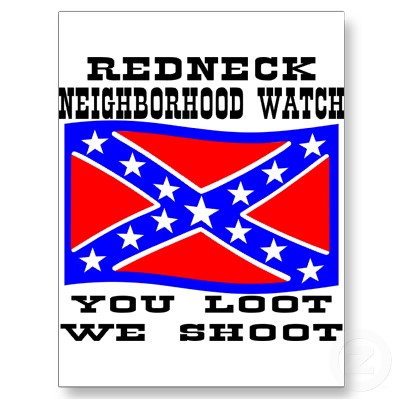
One of Many New Orleans Vigilante T-Shirts Slogans:

Cross-posted at Caroline Heldman’s blog.

Caroline Heldman is a professor of politics at Occidental College. You can follow her at her blog and on Twitter and Facebook.

Presumably many of you have heard about the controversy that has arisen about a conversation between Laura Schlessinger (aka Dr. Laura) and a female African American caller. Corina C. sent in some links to posts on the topic. Trigger warning for harsh, racist language.

Here’s a recording of the conversation (found at Media Matters) in which Schlessinger responds to the caller’s concerns about comments from her White husband’s friends and relatives by suggesting she is “hypersensitive” and isn’t in a position to be concerned about comments she considered racist because “Turn on HBO, listen to a black comic, and all you hear is nigger, nigger, nigger”:

Selected parts of the transcript:

CALLER: I was a little caught back by the N-word that you spewed out, I have to be honest with you. But my point is, race relations —

SCHLESSINGER: Oh, then I guess you don’t watch HBO or listen to any black comedians.

SCHLESSINGER: Yeah. We’ve got a black man as president, and we have more complaining about racism than ever. I mean, I think that’s hilarious.

SCHLESSINGER: Chip on your shoulder. I can’t do much about that.

CALLER: It’s not like that.

SCHLESSINGER: Yeah. I think you have too much sensitivity —

CALLER: So it’s OK to say “nigger”?

SCHLESSINGER: — and not enough sense of humor.

SCHLESSINGER: …You know what? If you’re that hypersensitive about color and don’t have a sense of humor, don’t marry out of your race. If you’re going to marry out of your race, people are going to say, “OK, what do blacks think? What do whites think? What do Jews think? What do Catholics think?”…And what I just heard from Jade is a lot of what I hear from black-think — and it’s really distressting [sic] and disturbing. And to put it in its context, she said the N-word, and I said, on HBO, listening to black comics, you hear “nigger, nigger, nigger.” I didn’t call anybody a nigger. Nice try, Jade. Actually, sucky try. Need a sense of humor, sense of humor — and answer the question. When somebody says, “What do blacks think?” say, “This is what I think. This is what I read that if you take a poll the majority of blacks think this.” Answer the question and discuss the issue…Ah — hypersensitivity, OK, which is being bred by black activists. I really thought that once we had a black president, the attempt to demonize whites hating blacks would stop, but it seems to have grown, and I don’t get it.

There are a number of things going on here. In Racism without Racists: Color-Blind Racism and the Persistence of Racial Inequality in the United States, Eduardo Bonilla-Silva discusses the various ways that Whites, in particular, downplay racial discrimination through a number of rhetorical and discursive strategies, several of which Schlessinger draws on in this exchange. For instance, she naturalizes the behavior the caller is concerned about: if you marry someone of another race, you just have to accept that their friends and family are going to consider you a representative of your entire race and constantly interact with you through the lens of your racial/ethnic background. That’s just to be expected, and if it starts to bother you, you’re “hypersensitive.” In fact, you ought to be sure and constantly educate yourself about all social trends as they relate to African Americans, so that if someone has any questions about what “Blacks think,” you can quickly tell them.

Think about the level of mental energy that is being expected here. Schlessinger is saying that it is the responsibility of minorities to know what members of their race/ethnicity think, in the aggregate, about whatever topic anybody else might want to know. I, as a White woman, am not expected to be able to provide, at the drop of a hat, data on Whites’ opinions about anything. (Though I do find that people who find out I’m a sociologist often think I must have insight into every aspect of social life, leading to questions such as, “My sister-in-law likes to _____. What do you think causes that?” or “So what do you think _____ will be like in 50 years?”, neither of which I am usually prepared to address in the middle of getting some potato salad at a picnic or buying a soda at the gas station.) The underlying argument here is that it is minorities’ responsibility to patiently educate Whites about things related to non-Whites, and an unwillingness to take on that role is evidence that you have a “chip on your shoulder.”

Another frame Schlessinger draws on is the minimization of racism: we have a Black president now, so racism’s totally over. What’s your problem?

Schlessinger is also holding all members of a racial group responsible for the actions of any of them. She argues that the routines of some Black comedians invalidates this individual African American woman’s right to be upset by racialized language in any context. It doesn’t matter whether this woman approves of the comedians’ comments — or has ever heard any of them; all African Americans are treated as an undifferentiated group, and the behavior of some revokes the rights of any others to bring up issues they find problematic.

In an interview with The Hollywood Reporter, Schlessinger hints at another rhetorical strategy, the “some of my best friends are _____ and thus I can’t possibly be racially prejudiced” argument:

I went out to dinner with three friends after Larry King. One of my friends who is gay is sitting there with another friend who is black, and he looks up and says, “I wonder what the media would do with this? You’re with a black guy and a gay guy.” We laughed, because we all understand what this is really about — censoring a point of view.

So there you have it: a round-up of ways to frame non-Whites as overly sensitive and unilaterally responsible for improving race relations.

UPDATE: The comments section is closed. There were still a lot of people commenting, but much of it had descended into name-calling and accusations, and I can’t keep up with all of them to catch the truly offensive ones. I may reopen comments in 48 hours after a cooling-off period.

Last month the cast of Jersey Shore rang the opening bell at the New York Stock Exchange (NYSE). The public responded negatively.  Says one snarky observer on the NYSE’s Facebook page:

The kids of the Jersey Shore rang the opening bell at the New York Stock Exchange this week.  In a related story, civilization is down 500 points.

The trouble, it seems, comes from the weirdness of bringing together trivial-and-fake-“reality”-stars with the very-important-and-really-real-U.S.-financial-market.

Economic sociologist Brooke Harrington, however, thinks the two are less incongruent than they seem.  She writes:

I’d like to suggest that what seems so wrong with that picture of Snooki and company ringing the opening bell actually makes a lot of sense sociologically. If this meeting of worlds—entertainment and the stock market—seems strange, it may be because we’re so used to regarding the markets as “real,” rather than as a performance (or even as entertainment in their own right).

Markets, she explains, aren’t “more ‘real’ than ‘reality TV.'”  Instead, both the characters on Jersey Shore and markets are playing themselves.   The reality show stars respond to expectations of “Guido” and “Guidette” personalities.  Likewise, the market responds to  economists whose predictions often create the very reality that they anticipate.

Harrington brings in a fancy concept:

Both are engaged in producing what French sociologist and cultural theorist Jean Baudrillard calls “the simulacrum:” a copy without an original, a pretense that replaces and ultimately negates “reality” so successfully that we no longer care about what is real.

She finishes:

Theorized through this lens, the image of the Jersey Shore cast ringing the opening bell at the NYSE persists in memory not because it is represents a collision of worlds, but because it brings together two genres of performance whose entertainment value depends on their purported “reality.”

Lisa Wade, PhD is an Associate Professor at Tulane University. She is the author of American Hookup, a book about college sexual culture; a textbook about gender; and a forthcoming introductory text: Terrible Magnificent Sociology. You can follow her on Twitter and Instagram.
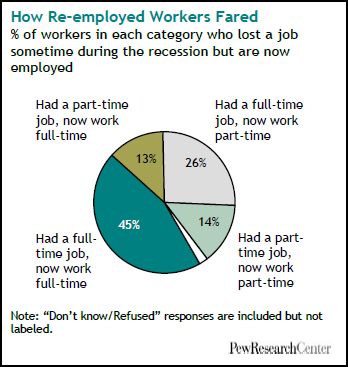
U.S. unemployment numbers only begin to describe how U.S. workers have suffered in this recession.  The Pew Research Center has some additional data on this experience.

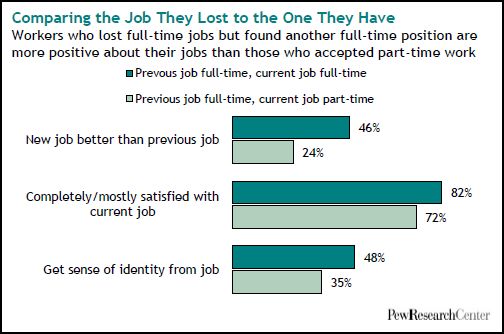
Twenty-six percent of full-time workers who became re-employed currently only work part-time.  Thirteen percent moved from part-time to full time work.  So, among the employed, there are 13 percent fewer full-time workers.

Americans who lost their jobs and became re-employed during this recession say that they’re making about the same, that the benefits are about equal, and many like their new job better:

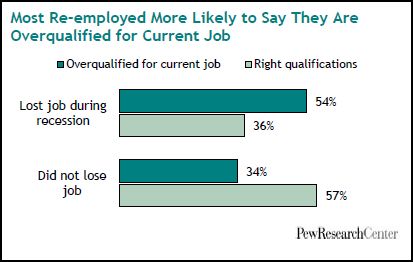
Still, the re-employed are more likely than the still-employed to say that they are overqualified for their current job:

People that moved from full- to part-time work are significantly less likely to be satisfied with their new position:

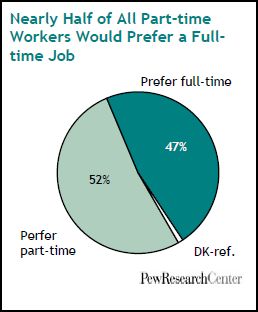
Forty-seven percent of part-time workers would like a full-time job:

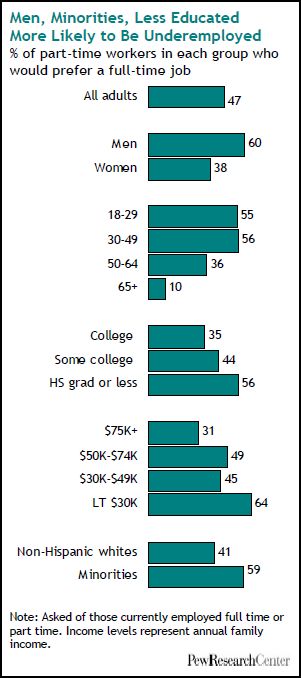
The term “underemployed” refers to this 47 percent of the population.   Men, young people, the less educated, lower income, and non-whites are more likely to be underemployed:

Lisa Wade, PhD is an Associate Professor at Tulane University. She is the author of American Hookup, a book about college sexual culture; a textbook about gender; and a forthcoming introductory text: Terrible Magnificent Sociology. You can follow her on Twitter and Instagram.