race/ethnicity: Whites/Europeans

Nicole sent in this Australian commercial for P&O Cruises. Nicole was struck by the obvious racial divide, in which the privileged customers are all White, while non-Whites serve them, either literally (and with a smile!) or as a form of cultural entertainment:

It’s another example of a common tourism marketing theme, in which supposedly “traditional” and/or “native” cultures are provided as cultural experiences to “modern” tourists. This commercial just stands out because of the particularly stark division of the world into those who are entertained and attended to, and those who do the attending.

Cross-posted at Love Isn’t Enough.

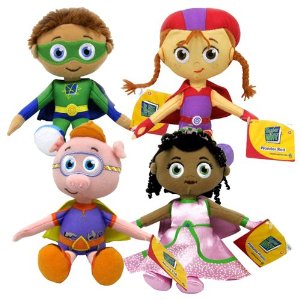
Brandy B. let us know about an interesting article by Isis the Scientist at Science Blogs on the apparent whitening of a children’s cartoon character for the Christmas toy market. PBS’s cartoon, “Super Why!”, includes a female character, Princess Presto, who has the power to spell. Here’s what she looks like:

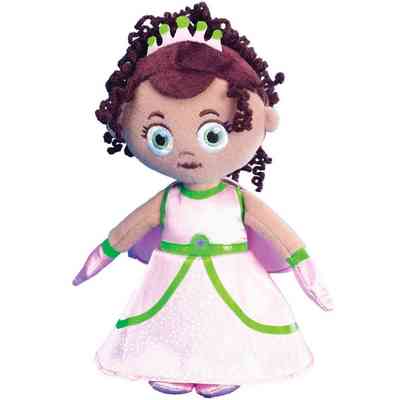
Yet the plush doll version of Princess Presto (who is supposed to have one White and one African American parent) looks significantly different:

I found another Princess Presto doll online as well:

I did find one set where she looks more like the original:

Isis the Scientists says that in comments to an article on the topic at the Orlando Sentinel, someone claiming to represent the company says the plush doll looks more like the original in person than the pictures online and says the following:

…The hair on the doll is more purple than black and this was an aesthetic choice…The placement of the facial features was intentionally tweaked to make the embroidered beanies look cute, so there is a slight difference from the onscreen character. The alterations were similarly made across all characters in the line, not just Princess Presto. There are almost always slight differences when translating the onscreen characters to off-air product especially with regard to colors because we have to use PMS or CMYK color choices for products.

Isis says BS — that having seen an actual version of the plush toy, it looks like it does in the photo, with very light skin, and that aside from that, other manufacturers seem to be able to make African American dolls just fine. And saying you changed things for “aesthetic” purposes doesn’t explain why you thought her existing characteristics were insufficiently aesthetically pleasing. Of course, we also don’t know for sure the person writing the comment was from PBS.

I tend to side with Isis here: the idea that technical limitations prevent making a more accurate representation of a dark-skinned doll is…sketchy, to say the least, and makes me think PBS needs to partner with a better toy design firm. And the choices about what the Princess Presto doll should look like in doll form put PBS in the position of appearing to think that a mixed-race character needs to be whitened to sell. PBS’s dolls exist in a marketplace where we’ve seen controversies about African American dolls being literally valued less than White dolls, and whatever their supposed reasons, it’s hard to get around the fact that all of the choices made in the name of aesthetics added up to a doll that looks awfully White.

A while back Kale let us know that the New York Public Library had made their images collection available online.The collection has images on a huge array of topics, from fashion to the military to slavery to insects to a whole category for stilts, and including political cartoons, illustrations from publications, photographs, and so on.

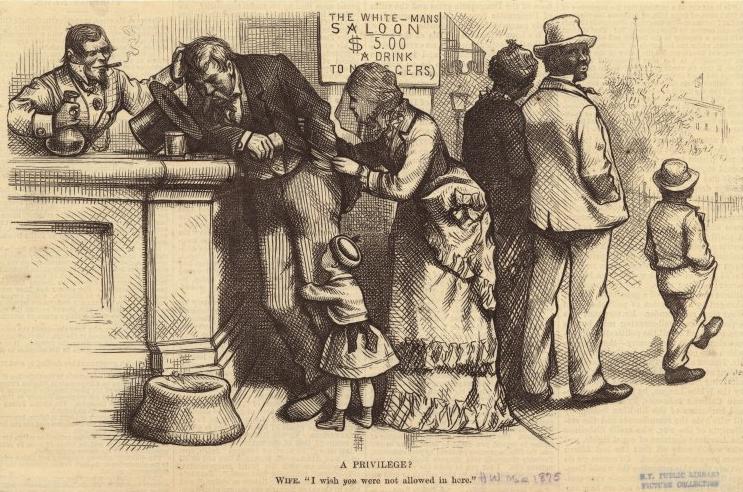
Kale found the collection particularly interesting as a way to look at historical racism and rhetoric about race relations in publications aimed at White readers. This 1875 cartoon, titled “A Privilege?”, presents segregation as actually protecting African Americans from the scourge of alcohol:

Text:

A PRIVILEGE?

Wife, “I wish you were not allowed in here.”

It’s a fascinating example of the use of institutionalized racial inequalities that hurt African Americans to, instead, garner sympathy for White women and children and present African Americans as, really, better off.

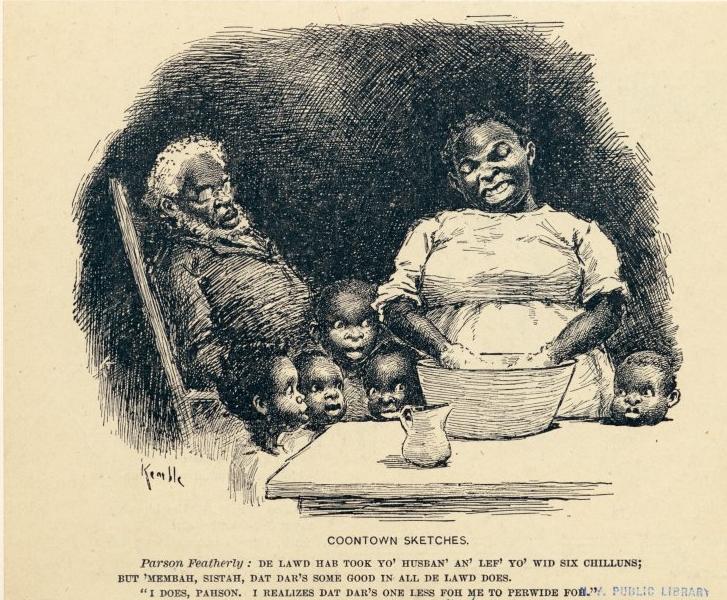
Another, published in Life in 1899, implies African American men are burdens on their families, making their wives take on the role of providing for everyone:

Text:

Parson Featherly: De Lawd hab took yo’ husban’ an’ lef’ yo’ wid six chilluns; but ‘membah, Sistah, dat dar’s some good in all de Lawd does.

“I does, Parson. I realizes dat dar’s one less for me to perwide foh.”

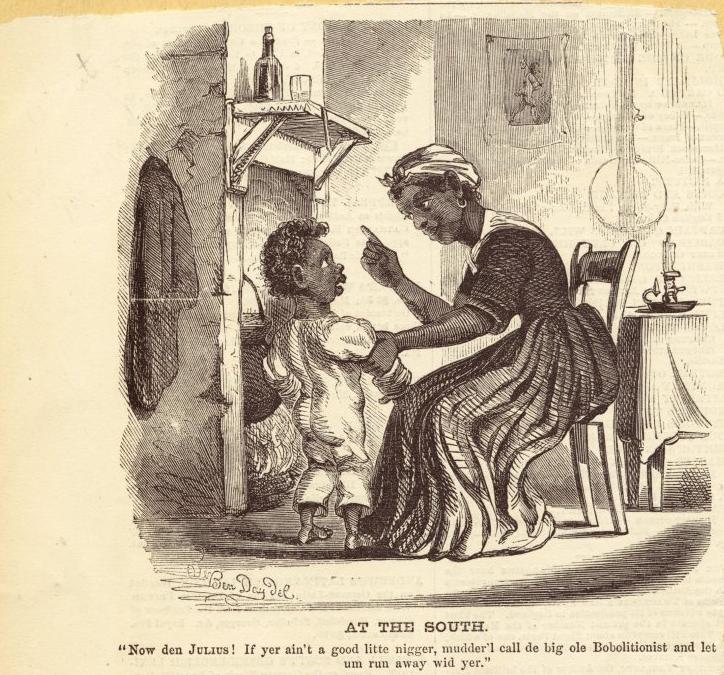
This 1860 cartoon from Harper’s Weekly shows an African American woman (presumably a slave) in the South using the “Bobolitionists” — that is, abolitionists, who wanted to outlaw slavery — as a threat, a type of monster that will come steal him if he’s not good:

Text:

“Now den Julius! If yer ain’t a good litte nigger, mudder’l call de big old Bobolitionist and let um run away wid yer.”

I’m sure it must have been very comforting to some readers to think of slaves viewing abolitionists as threats rather than potential allies.

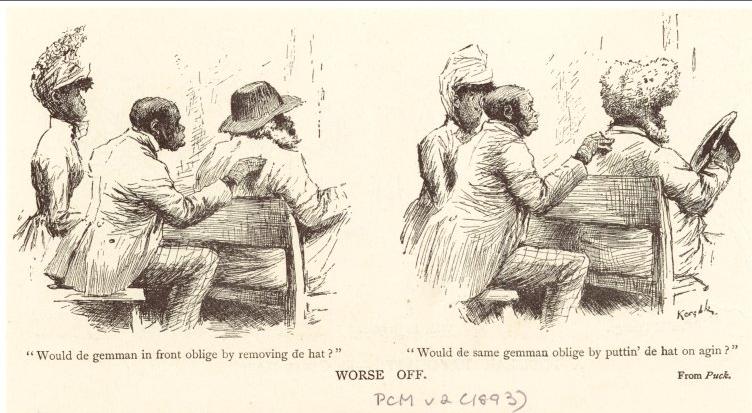
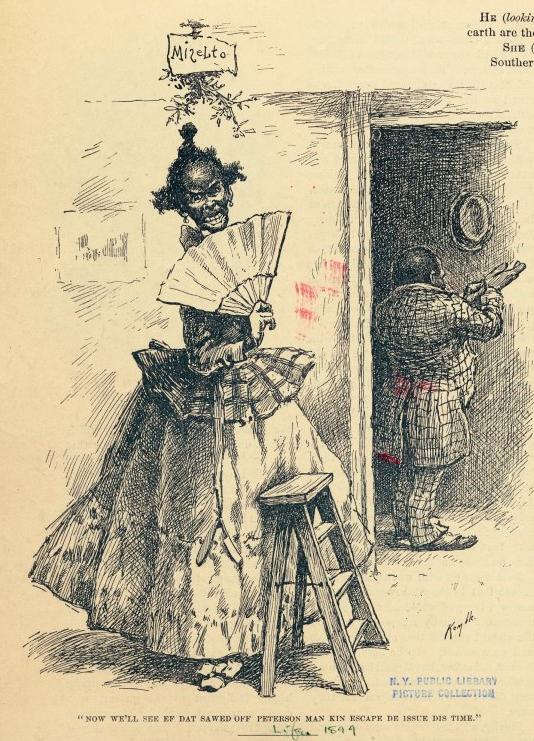
Other cartoons mock African Americans’ physical attributes, marking them as laughable or even grotesque:

Text:

“Would de gemman in front oblige by removing de hat?”

“Would de same gemman oblige by puttin’ de hat on agin?”

(Details.)

Text:

“Now we’ll see ef dat sawed off Peterson man kin escape de issue dis time.”

(Details.)

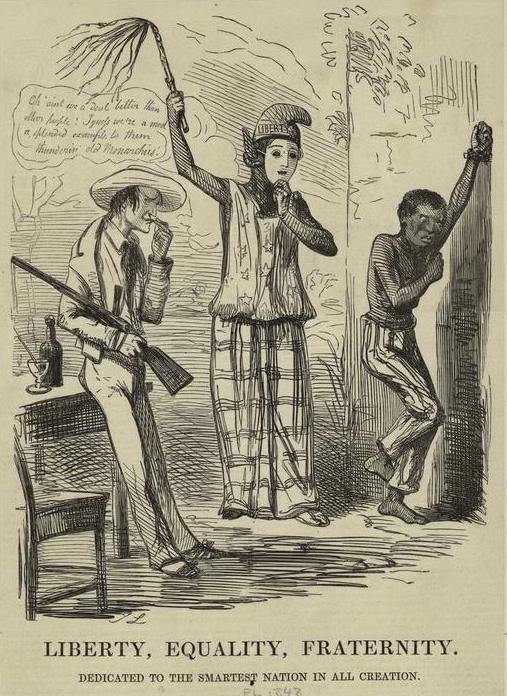
There are also examples that criticized U.S. race relations, such as this 1848 cartoon from Punch [Note: a reader thinks this might be about France, which banned slavery in 1848, but the NYPL has it listed as relevant to U.S. slavery, so there may be so lost context here]:

Enjoy!

[Note: A commenter has expressed concern that I ended this post with “Enjoy!” I apologize for my insensitivity. I meant it in terms of “Enjoy browsing this fascinating archive,” of which racist imagery is only a small part, not, I hope it would be clear, “Enjoy looking at racist cartoons!” I wasn’t thinking about how it might appear immediately after those set of images, and I should have been more careful.]

Lee D.T. sent in an Australian ad for Fernwood Fitness. It’s a great example of the sexualization of women of color, specifically (compared to white women). Notice that the white women in the ad simply exercise, but the ambiguously-raced woman with darker hair and skin gyrates, pumps, and poses.

See also a history of the hypersexualization and exploitation of black women by white people, the hot Latina, the fetishization of black women’s butts as symbolic of their (supposed) hypersexuality, the only thing important about black people is their butts, and the frequent exposure of black women’s bodies.

Lisa Wade, PhD is an Associate Professor at Tulane University. She is the author of American Hookup, a book about college sexual culture; a textbook about gender; and a forthcoming introductory text: Terrible Magnificent Sociology. You can follow her on Twitter and Instagram.

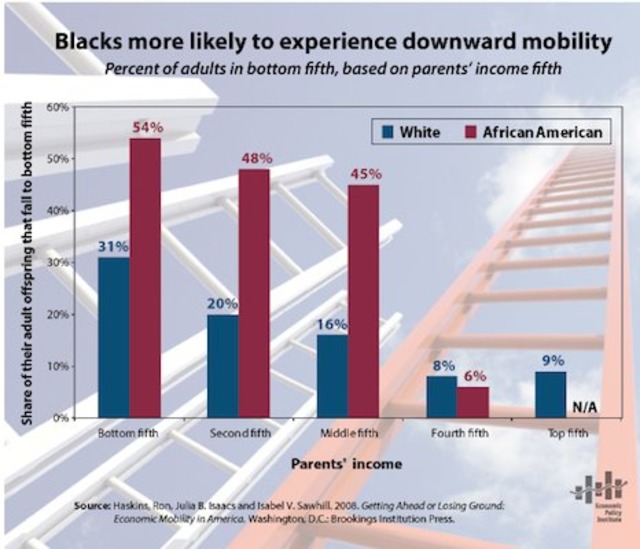
Kai Wright at Colorlines discusses an “arresting” graph demonstrating downward class mobility among black and whites.  The bars represent the proportion of parents’ children that end up in the bottom fifth of income earners by race and income of the parent.  On the far left, you see that 31% of whites and 54% of blacks born into the bottom fifth remain the bottom fifth.  Poor black children, then, are more likely than poor white children to stay poor.

The remainder of the bars represent downward mobility.  You can see that, in every case, black children are more likely to be poor as adults than white children, no matter what class they were born into.  Among those born into the middle fifth, the statistically middle class, 16% of whites and 45% of blacks end up in the bottom fifth of income earners.  For the richest white Americans, the chance of ending up poor is statistically zero; while nearly one in ten of black children born rich will end up poor.

Wright summarizes:

…economic mobility is not the same for everybody in America, and to the degree we can talk about a genuine black middle class, it’s not a terribly secure one.

Lisa Wade, PhD is an Associate Professor at Tulane University. She is the author of American Hookup, a book about college sexual culture; a textbook about gender; and a forthcoming introductory text: Terrible Magnificent Sociology. You can follow her on Twitter and Instagram.

Lester Andrist, at The Sociological Cinema, alerted me to a 9-minute short film revealing “Hollywood’s relentless vilification and dehumanization of Arabs and Muslims.”   Created by Jaqueline Salloum and Dr. Jack Shaheen’s book, Reel Bad Arabs, it is a stunning and disturbing collection of clips.  The depictions are grossly prejudiced and relentlessly violent.  Andrist summarizes:

It demonstrates the way Arabs and Muslims are consistently depicted as religious fanatics, perpetual terrorists, backwards, and irredeemably tribal… [T]he media consistently propagates the idea that the Muslim or Arab terrorist is not only a threat to life, but also Western civilization.
Taking the analysis a bit further, I think the clip also allows one to contemplate how these depictions of Arabs and Muslims are simultaneously about constructing an American national identity, and in particular, a masculine one. In several places, one sees how an American masculinity, characterized by stoicism and poise, is set in contradistinction to an irrational, Islamic fanaticism.
It’s really a worth a watch, but very disturbing.  Consider yourself warned:

The Media Education Foundation also made a full length documentary based on Shaheen’s book.  The 5-and-a-half-minute trailer is a good indication of its content.  It contains many similar disturbing depiction, including a discussion of Disney’s Aladdin, but also points to how Arabs are frequently shown as buffoons (“rich and stupid,” “oversexed,” and “uncontrollably obsessed with the American woman”).

See also our posts on how Arabs are portrayed in video games and Reel Injun, a documentary about the representation of American Indians in Hollywood.

Lisa Wade, PhD is an Associate Professor at Tulane University. She is the author of American Hookup, a book about college sexual culture; a textbook about gender; and a forthcoming introductory text: Terrible Magnificent Sociology. You can follow her on Twitter and Instagram.

Cross-posted at Ms. and Family Inequality.

In the early 1990s, Arline Geronimus proposed a simple yet profound explanation for why Black women on average were having children at younger ages than White women, which she called the “weathering hypothesis.”

It goes like this: Racial inequality takes a cumulative toll on Black women, increasing the chance they will have health problems at younger ages. So, early childbearing might pose health risks for White women, but for Black women it makes more sense to start earlier — before their health declines. Although it’s hard to measure the motivations of people having children, her suggestion was that early childbearing reflected a combination of cumulative cultural wisdom and individual adaptation (for example, reacting to the health problems experienced by their 40-something mothers).

She showed the pattern nicely with data from Michigan in 1989, in which the percentage of first births that were “very low birthweight,” increased with the age of Black women, but decreased for White women, through their twenties:

Source: My graph from Geronimus (1996).

If the hypothesis is correct, she reasoned, the pattern would be stronger among poor women, who experience more health problems, which is also what she found.

The most recent national data, for 2007, continue to show Black women have their first children, on average, younger than White women: age 22.7 versus 26.0. And the infant mortality rates, by mothers’ age, also show the lowest risk for White women at older ages than for Black women:

Source: My graph from CDC data.

Note that, for White women, mothers have children in the early thirties face less than half the infant-mortality risk of those having children as teenagers. For Black women, waiting till their lowest-risk age — the late 20s — yields only a 14% reduction in infant mortality risk. So it looks like waiting is much more important for White women, at least as far as health conditions are concerned.

The implications are profound. If you base your perceptions on the White pattern, it makes sense to discourage early childbearing for health reasons. But if you look at the Black pattern, it becomes more important to try to improve health problems at early ages — and all the things that contribute to them — rather than (or in addition to) trying to delay first births.

—————————-

Cohen’s previous posts featured on SocImages include ones on the recession and divorce datathe relationship between cell phone use and driving deathsmeasuring the number of welfare recipients, delusions of gender dimorphism, and the gender binary in children’s books.

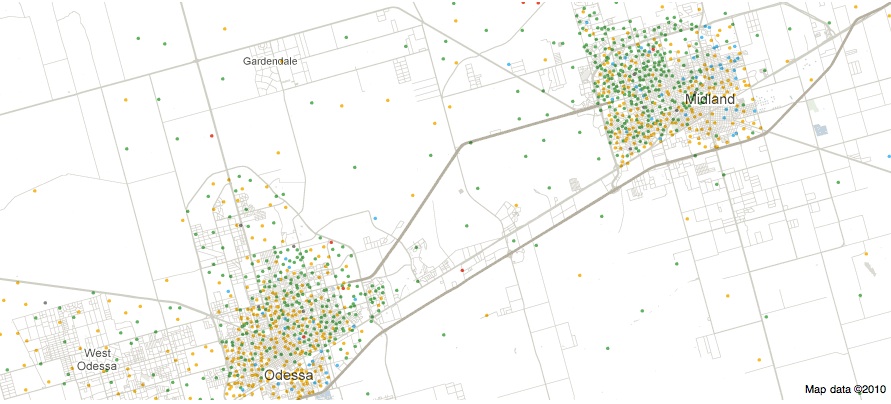
Back in September, I posted about some maps put together by Eric Fischer, using 2000 Census data, showing the racial/ethnic makeup of selected cities. As Jeff H., Eluned J., and Dmitriy T.M. pointed out, the NYT now has up an interactive map where you can see the racial/ethnic composition of any Census tract, using more updated Census Bureau data from 2005 to 2009. For instance, here’s a map of the neighboring cities of Midland and Odessa, Texas, which I picked for no reason other than that I just watched an episode of Friday Night Lights, which is set in a fictionalized version:

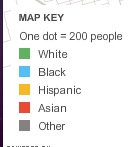
Color key:

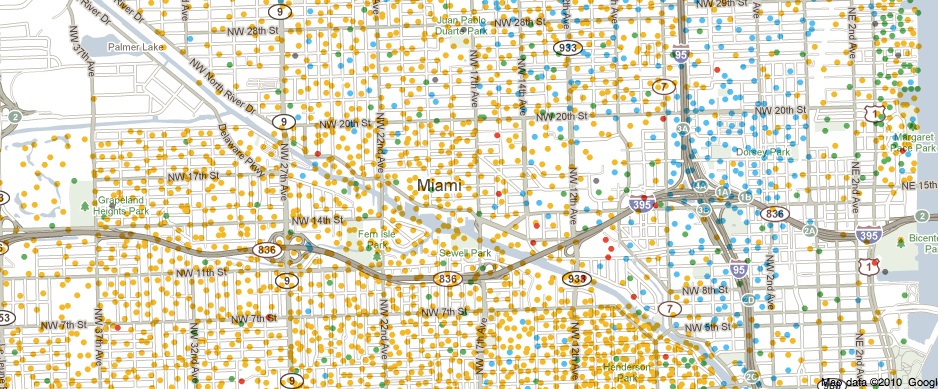
You can zoom in to get quite detailed information about individual neighborhoods. I zoomed in as far as I could on Miami (each dot now represents 50 people):

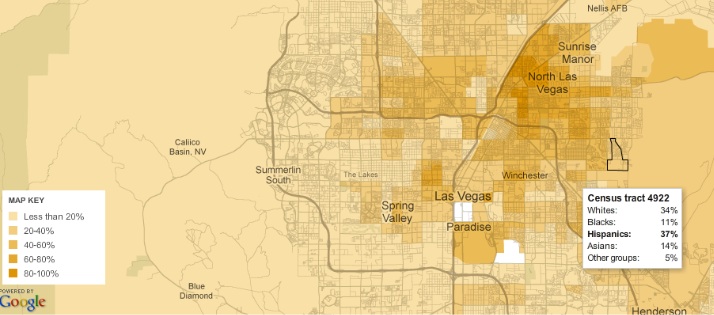
There’s also a tab that says “View More Maps.” It allows you to select to see just the distribution of Whites, Blacks, Hispanics, Asians, or the foreign-born population. Here’s the map of the Hispanic population of Las Vegas:

As you can see, if you hover over a Census tract, you can get specific data on its racial/ethnic makeup.

The foreign-born population of Seattle (if you hover over a tract, it will tell you the % foreign-born, as well as the % increase in the foreign-born population since 2000):

A great resource. Although I tried to look up my home town, and even zooming in to the smallest scale, it’s too small to have any data available.