race/ethnicity: Whites/Europeans

The NYT has posted an interesting interactive map showing the results of the last slave Census taken in the U.S., in 1860, which I discovered via Jessica Brown and Jim Yocom. The map, which shows county-level data, illustrates how slave ownership varied throughout the South
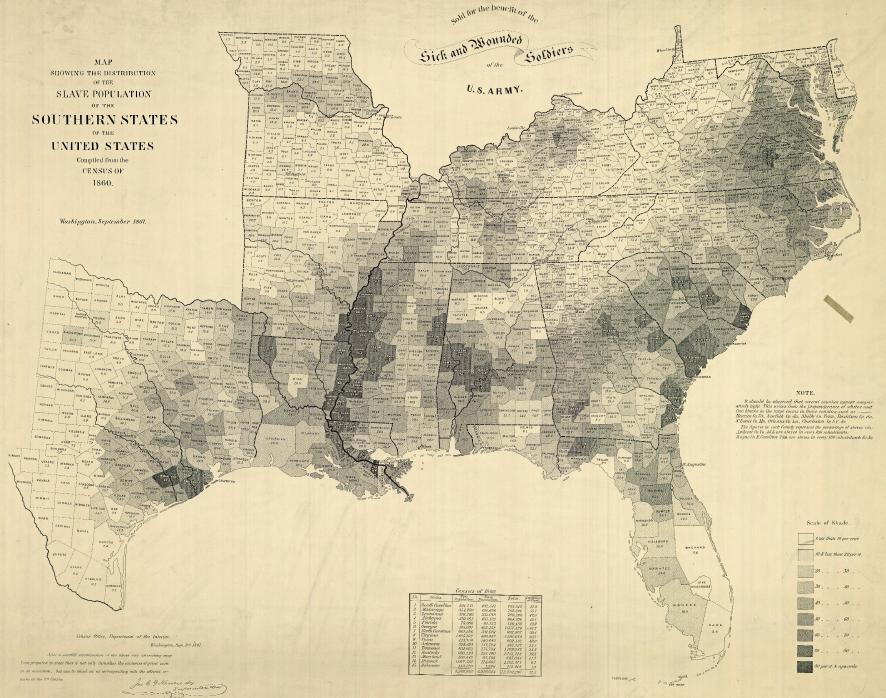
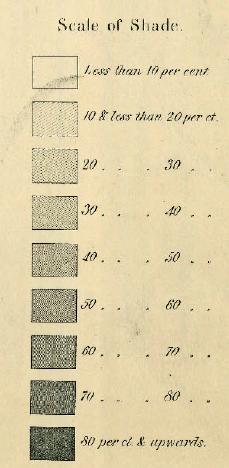
The shading (a new technique at the time, according to the NYT article) indicates what percent of the entire county’s population was enslaved:
You can see the percentage for each county, which is listed on the map, more easily if you zoom in on the pdf version. The cotton-belt area along the Mississippi River clearly stands out, as does Beaufort County, South Carolina, all with over 80% of the population enslaved. The highest rate I could pick out (the map got a little blurry as I zoomed) is in Issaquena County, Mississippi, where slaves appear to have made up 92.5% of the population.

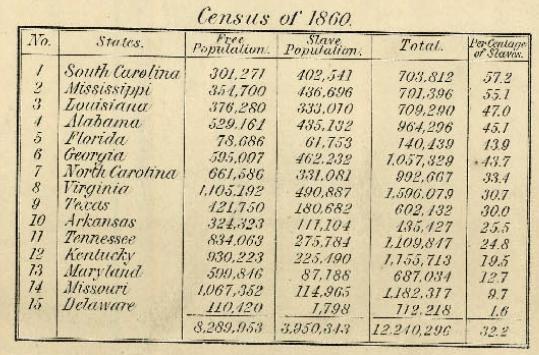
The map also included information on the overall population and % enslaved at the state level; in South Carolina and Mississippi, over half of the total state population was made up of slaves:
Also check out Lisa’s post on geology, the economy, and the concentration of slavery in the U.S.

As the NYT post points out, the map doesn’t show the dramatic increases in slavery in some areas. For instance, while Texas ranked fairly low in terms of the overall slave population, the number of slaves in the state had tripled between 1850 and 1860. The number had doubled in Mississippi between 1840 and 1860. Those growth rates make it rather hard to swallow the argument sometimes presented by those romanticizing the Confederacy that slavery was actually on the wane and would have soon been ended in the South anyway, without any need for federal interference, and wasn’t why the South seceded at all.

Jon Stewart and Larry Wilmore discussed this effort to frame discourses about the Civil War to erase the issue of slavery on The Daily Show:

Tim Wise answers just this question in this 2 1/2 minute clip featured on his website.  Sneak peak: His answer begins with “No. You should feel angry.”

Laurie J graciously pasted the transcript in the comments; I’ve added it after the jump.

more...

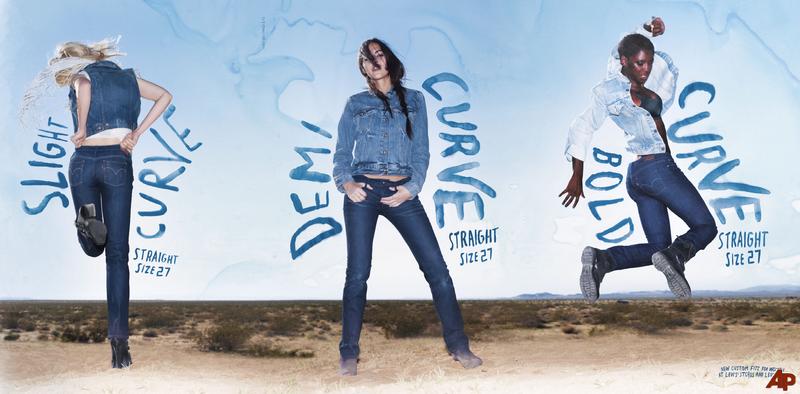
Hope and Kristi P. sent in another example of the way the idea of a “curvy” shape is associated with non-White bodies. This Levi’s ad for their Curve ID jeans shows models whose skin color gets progressively darker as they move from less to more curvy styles:

Notice also that curvy here means primarily having a larger butt. All three models are show in size 27 jeans, which generally are equivalent to about a size 4 (though of course, sizes vary greatly) — certainly larger than the average runway model, but still very small.

Question: does anyone have examples of non-White men depicted as uniquely or systematically “curvy,” or is this applied only to women?

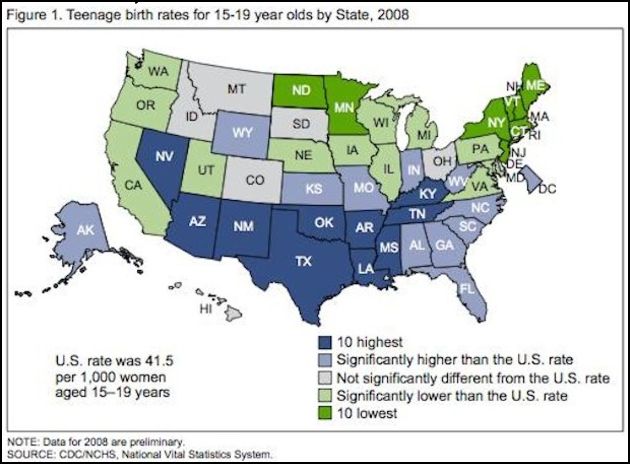
The Centers for Disease Control report that pregnancy rates for U.S. girls age 15-19 vary quite significantly by state: from 66/1,000 in Mississippi to 20/1,000 in New Hampshire (dark and light green represent states with teen pregnancy rates lower than the U.S. average; dark and light purple represent states in which it is higher):

The map shows that, on average, southern states tend to have higher teen pregnancy rates than others.

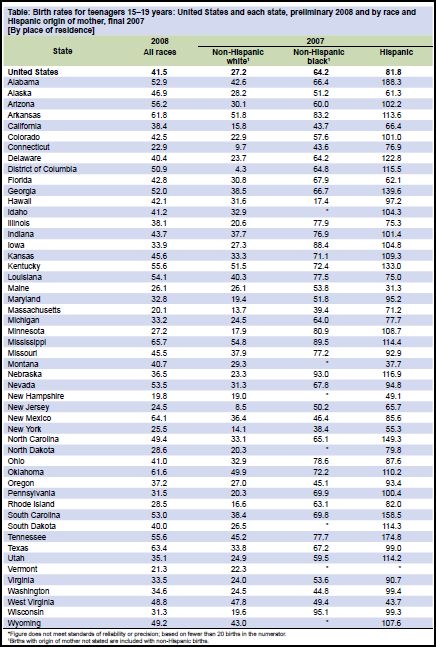
The Centers for Disease Control reports that the disparity can be explained, in part, by the fact that Blacks and Latinos tend to have higher rates of teen pregnancy than other racial groups such that states with higher proportions of Blacks and Latinos would have higher rates.  However, rates among different racial/ethnic populations also vary quite tremendously by state.  Among white teenagers the teen pregnancy rate ranged from 4/1,000 (in the District of Columbia) to 55/1,000 (in Mississippi), among Black teenagers, it ranged from 17/1,000 (in Hawaii) to 95/1,000 (in Wisconsin), and among Latinas it ranged from 31/1,000 (in Maine) to 188/1,000 (in Alabama).

Race, then, doesn’t predict differences in rates of teen pregnancy all by itself.  In fact, White teenagers are more likely to get pregnant in some states than Black and Latina teenagers in others.  There must be something region- or state-specific driving teen pregnancy rates.

The CDC doesn’t mention sex education, but Mike Lillis at The Hill compared teen pregnancy rates to a sex education policy report by the Guttmacher Institute.  He writes:

All five states with the highest teen birth rates have adopted policies requiring that abstinence be stressed when taught as part of sex education, HIV education or both, the group found. Only one of the five states (New Mexico) mandates that sex education be a part of students’ curriculum.

Of the four states with the lowest teen birth rates, none requires that abstinence be stressed to students, according to Guttmacher.

For your perusal, the CDC data, by state and race (# of pregnancies/1,000 girls 15-19):

Hat tip to Annie Shields at Ms. magazine.

Lisa Wade, PhD is an Associate Professor at Tulane University. She is the author of American Hookup, a book about college sexual culture; a textbook about gender; and a forthcoming introductory text: Terrible Magnificent Sociology. You can follow her on Twitter and Instagram.

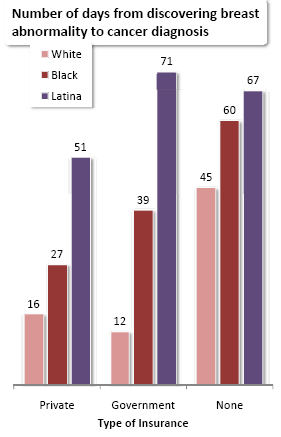
Black women and Latinas are more likely to die from breast cancer than white women.  This is, in part, because white women are more likely to have health insurance.  New research, however, illustrated by Philip Cohen at Family Inequality, suggests that even we control for types of insurance and whether women are insured, black women and especially Latinas wait longer than white women for a diagnosis of cancer after the discovery of a breast abnormality:

The authors of the study, Heather Hoffman and colleagues, did not attempt to explain the cause of the disparity.

See also our posts on racial disparities in life expectancy for people with Down’s Syndrome, rates of asthma, and kidney failure.

Lisa Wade, PhD is an Associate Professor at Tulane University. She is the author of American Hookup, a book about college sexual culture; a textbook about gender; and a forthcoming introductory text: Terrible Magnificent Sociology. You can follow her on Twitter and Instagram.

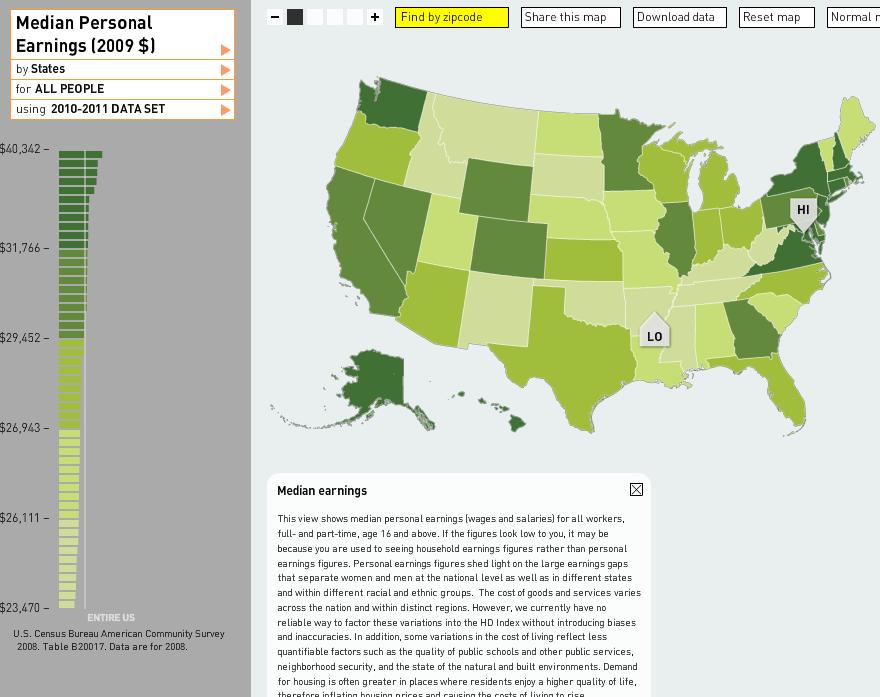
Dmitriy T.M. and Jeff H. sent in a link to Mapping the Measure of America, a website by the Social Science Research Council that provides an amazing amount of information about various measures of economic/human development in the U.S. Here’s a map showing median personal (not household) earnings in 2009:

The District of Columbia has the highest, at $40,342; the lowest is Arkansas, at $23,470 (if you go to their website, you can scroll over the bars on the left and it will list each state and its median income, or you can hover over a state).

You can break the data down by race and sex as well. Here’s median personal income for Native American women, specifically (apparently there is only sufficient data to report for a few states):

Native American women’s highest median income, in Washington ($22,181), is  lower than the overall median income in Arkansas, which is the lowest in the U.S. as we saw above.

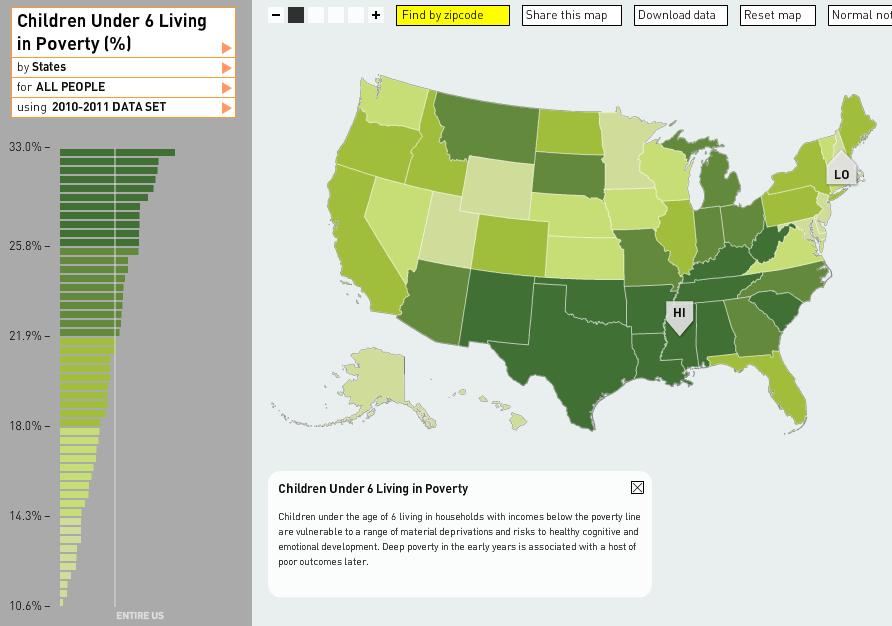
Here is the percent of children under age 6 who live below the poverty line (for all races):

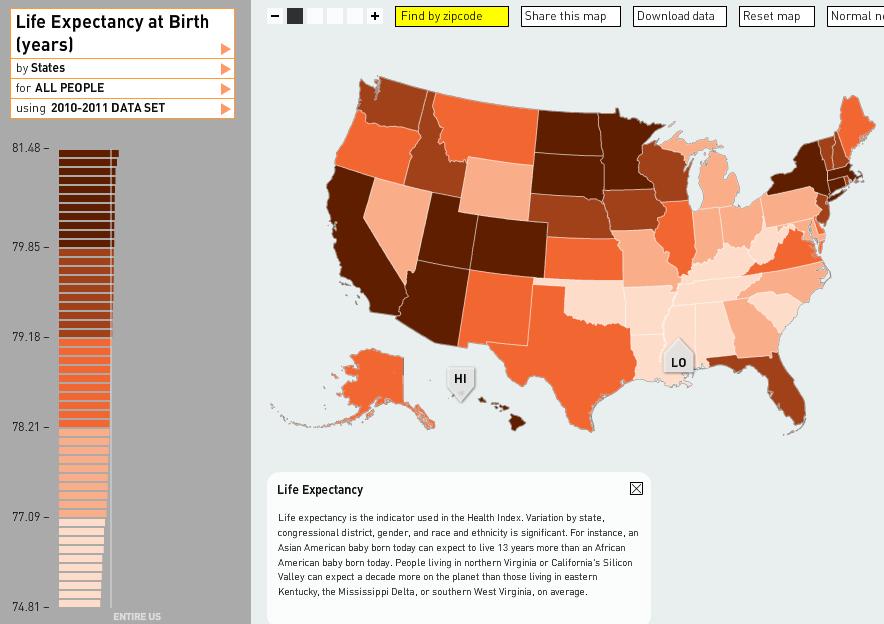
Life expectancy at birth differs by nearly 7 years between the lowest — 74.81 years in Mississippi — to the highest — 81.48 years in Hawaii:

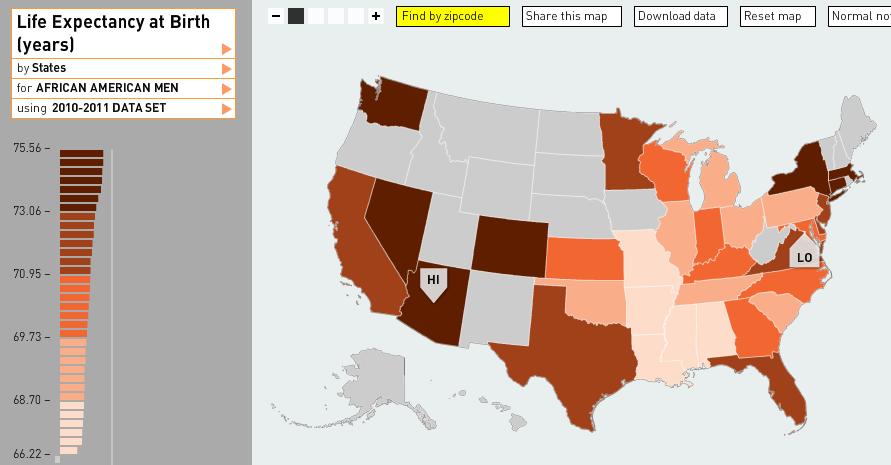
It’s significantly lower for African American men, however, with a life expectancy of only 66.22 years in D.C. (again, several states had insufficient data):

The site has more information than I could ever fully discuss here (including crime rates, various health indicators, all types of educational attainment measures, commuting time, political participation, sex of elected officials, environmental pollutants, and on and on), and it’s fairly addictive searching different topics, looking data up by zip code to get an overview of a particular area, and so on. Have fun!

Cross-posted at Jezebel.

In the article “And You Can Be My Sheikh: Gender, Race, and Orientalism in Contemporary Romance Novels,” Jessica Taylor discusses the “sheikh romance,” a type of romance novel that, Taylor argues, follows the following basic formula:

In an exotic land where it is rumoured that men still rule, a tall, dark and handsome sheikh meets a white woman who teaches him how to be ruled by love. (p. 1032)

Sheikh romances are generally set in fictional countries in the Middle East, with a male character described as a “sheikh,” “sultan,” or something along the lines of “king of the desert.” He is, of course, invariably rich and powerful. The female protagonist, on the other hand, is a White woman, usually from the U.S.

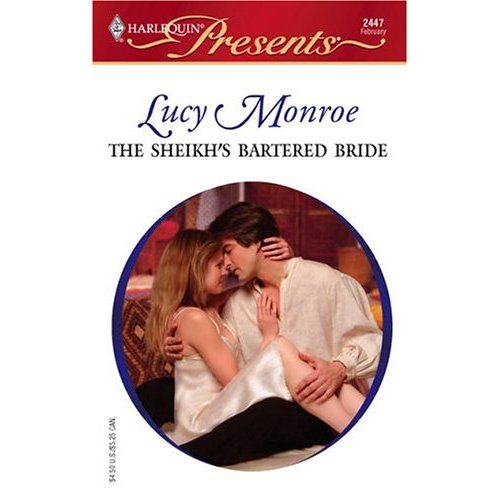
The topic is popular enough that Harlequin has a whole series, Desert Brides:

Another popular option is the Sons of the Desert series:

Taylor argues that these novels present a masculinized, exotic, and ultimately pre-modern Oriental Other that is contrasted with the modernized West.

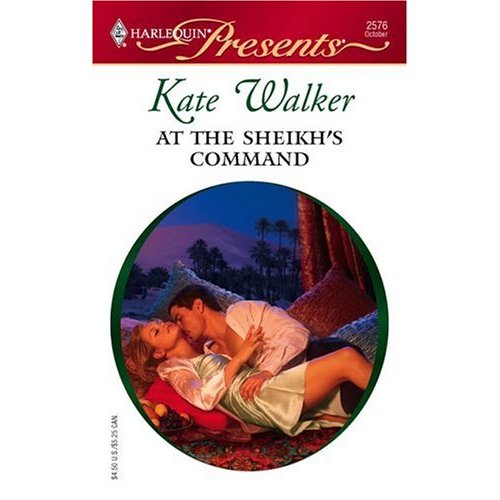
Some examples:

The blurb, from Amazon (elipses in original):

When Sheikh Khalid Fehr rescues innocent Olivia Morse from the hands of his country’s enemies, he guarantees her freedom by announcing she is his betrothed….Khalid has vouched for Liv with his honor… and this desert king is determined that his new wife will fulfill her marital duties, by his side as his regal queen…and as his captive virgin bride!

Description:

Abbie Cavanaugh’s brother is in jail. Abbie can obtain his freedom—but only if she marries the Sheikh of Barakhara. The explosive passion between Prince Malik and Abbie could turn a marriage of convenience into one of Eastern promise. But neither Abbie nor Malik knows the other’s real identity. Can their marriage survive once the truth is revealed?

Description:

After a whirlwind courtship, Sheikh Hakim bin Omar al Kadar proposes marriage. Shy, innocent Catherine Benning has already fallen head-over-heels in love and she accepts….

After their wedding day–and night–when the sheikh claims his virgin wife, Catherine and Hakim travel to his desert kingdom. There Catherine discovers that this is no love match for Hakim–he’s bought her!

For more examples, go to Amazon and search “sheikh romance.” Seriously, there are tons of them — Traded to the Sheikh, Stolen by the Sheikh, The Desert Prince’s Mistress, The Sheikh’s Virgin, Love-Slave to the Sheikh, The Sheikh’s Ransomed Bride (notice the recurring economic transaction theme?), and my new personal favorite book title ever, Hired: The Sheikh’s Secretary Mistress, described thusly:

Sheikh Amir bin Faruq al Zorha lives in New York, but the desert is where his heart lies. Now it’s time for him to marry….Grace Brown, Amir’s plain but indispensable assistant, isn’t exactly queen material. No matter how tempted Amir is to take her innocence, she’s off-limits. Until he returns to his homeland, where the barbarian prince replaces the businessman—and resolves that Grace will be his!

Taylor argues that the themes of these books reflect concerns about gender relations while also setting up an East/West dichotomy in which Western (usually specifically U.S.) women tame the “barbarian” desires of non-Western men. The male love interests are too masculine for current U.S. cultural norms; they attempt to control women in an obvious manner, to force them into marriage, and/or to acquire them by purchase or trade.

But they are ultimately redeemable “barbarian princes.” On the cover, they’re darker than the (generally blond) woman, but only slightly so. They are usually described as having lived in the U.S. or Europe, often during college. They seek to “modernize” their countries, often signaled by their disinterest in or opposition to the harems still maintained by other men in their countries. Referring to harems clearly links this fictionalized Middle East to the past, while the individual hero instead chooses monogamy with one White woman, signaling his modernization.

A woman, and love, tame the dangerous but desirable hero. Interestingly, femininity here is presented as preferable not just for women, but for the male character as well, as a necessary element to balance his hypermasculinity:

…the man is brought to acknowledge the pre-eminence of love and the attractions of domesticity…the theme of category romance is female power…By getting the hero to give in and fall in love with her, and admit it, she brings him into the “feminine” world view…the heroine “civilizes” the Arab hero into a domestic love and he thus becomes an acceptable husband for a white girl. (p. 1046-47).

Ultimately, then, the sheikh romance presents a backward East, a state signaled largely by gender relations. There are two types of Middle Eastern men: those who are redeemable, who can be modernized, and those who can’t. And adoption of a certain ideal of monogamous romantic love, which renders the hero’s hypermasculinity exotic but no longer scary, provides the key to modernizing otherwise barbaric cultures.

The article is in Journal of Popular Culture v. 40, no. 6 (2007), p. 1032-1051.

Enjoy Jennifer Lee, professor of sociology at UC Irvine, discussing how the American concept of race has been changing as we’re confronted with a more complex racial landscape. Are we forcing all racial groups into the pre-existing black/white binary?  A white/non-white binary?  A black/non-black binary?  Or something else?

Lisa Wade, PhD is an Associate Professor at Tulane University. She is the author of American Hookup, a book about college sexual culture; a textbook about gender; and a forthcoming introductory text: Terrible Magnificent Sociology. You can follow her on Twitter and Instagram.