race/ethnicity: Whites/Europeans


Reel Injun, a new documentary about the portrayal of American Indians in U.S. movies, has been earning high praise and notice from bloggers and film critics. About the film:

Hollywood has made over 4000 films about Native people; over 100 years of movies defining how Indians are seen by the world...

Travelling through the heartland of America, Cree filmmaker Neil Diamond looks at how the myth of “the Injun” has influenced the world’s understanding – and misunderstanding – of Natives.

With candid interviews with directors, writers, actors and activists, including Clint Eastwood, Jim Jarmusch, Robbie Robertson, Sacheen Littlefeather, John Trudell and Russell Means, clips from hundreds of classic and recent films, including Stagecoach, Little Big Man, The Outlaw Josey Wales, One Flew Over the Cuckoo’s Nest, and Atanarjuat the Fast Runner, Reel Injun traces the evolution of cinema’s depiction of Native people from the silent film era to today.

I can’t wait to see it.

The trailer:

Lisa Wade, PhD is an Associate Professor at Tulane University. She is the author of American Hookup, a book about college sexual culture; a textbook about gender; and a forthcoming introductory text: Terrible Magnificent Sociology. You can follow her on Twitter and Instagram.

White people should worry about racism.  They should worry about racism because it’s wrong.  But if that’s not enough of a motivation, they should worry about it for their own damn good.  Philip Cohen of Family Inequality shows us how so with a discussion of a recent paper published in the Journal of the American Society of Nephrology.

The Figure below illustrates the percentage of black (grey bar) and white (white bar) residents who went into end-stage renal disease (kidney failure; ESRD) before ever seeing a doctor specializing in kidneys (a nephrologist).  As we move from left to right, the zip codes in which patients live becomes increasingly populated by black people.

What we see is that, in any given neighborhood, black people are always less likely to get access to a kidney specialist before their kidneys fail; but also that white people living in a neighborhood with a higher percentage of blacks are less likely than whites in a more white neighborhood to see a specialist.  So much so that whites living in neighborhoods that are more than 50% black are less likely to see a specialist than blacks living in neighborhoods that are less than 25% black.

Cohen specifies that…

…the relationship still holds even when individual socioeconomic status, and local-area socioeconomic status, are controlled. So it’s not just a poverty effect.

Somehow places that are “blacker”, even when they are not poor, are serviced with inferior health care compared to places that are “whiter.”  And everyone suffers for it (though not necessarily equally).

Lisa Wade, PhD is an Associate Professor at Tulane University. She is the author of American Hookup, a book about college sexual culture; a textbook about gender; and a forthcoming introductory text: Terrible Magnificent Sociology. You can follow her on Twitter and Instagram.
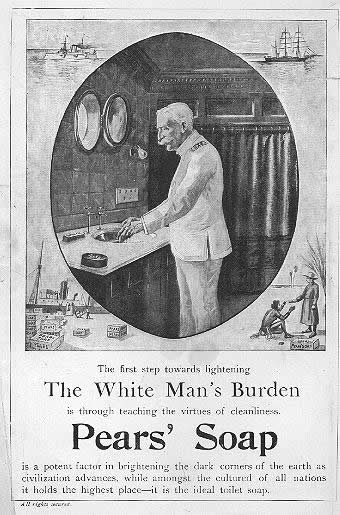
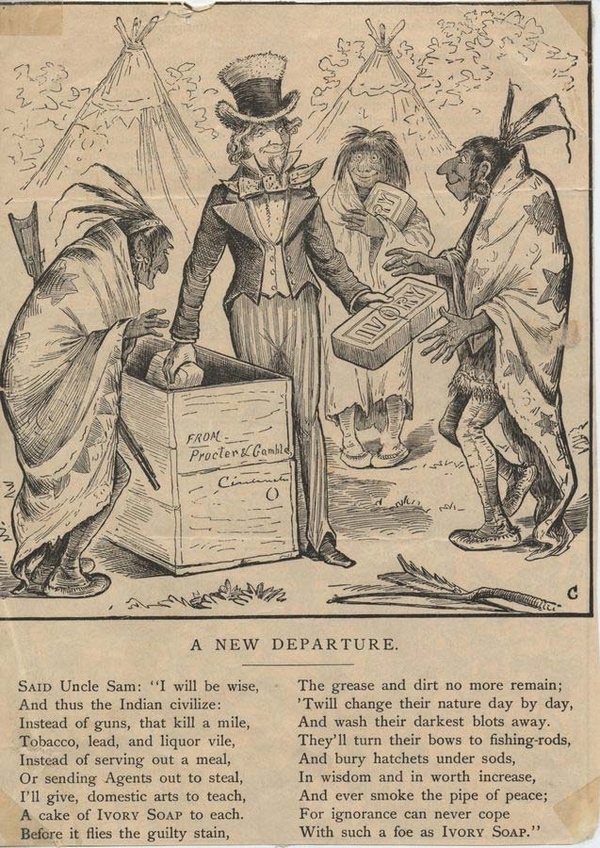
Monica Y. sent a collection of vintage ads and cartoons illustrating how soap and cleanliness has been used as a metaphor for colonization.  The first two ads show how soap manufacturers and colonialists alike colluded in suggesting that the colonized were unclean/uncivilized and needed to be cleansed/enlightened.

This first ad for Pears’ Soap reads:

The first step towards lightening The White Man’s Burden is through teaching the virtues of cleanliness.  Pears’ Soap is a potent factor in brightening the dark corners of the earth as civilization advances while amongst the cultured of all nations it holds the highest place — it is the ideal toilet soap.

The phrase “White Man’s Burden” refers to the colonial-era idea that white men were burdened with bringing civilization to the uncivilized.  See our post on a modern-day Pamper’s commercial invoking a white woman’s burden for another example.

This ad for Ivory soap depicts Uncle Sam (I think) passing out soap to American Indians (in blankets, no less) (text transcribed below):

Text:

A NEW DEPARTURE
SAID Uncle Sam: “I will be wise,
And thus the Indian civilize:
Instead of guns, that kill a mile,
Tobacco, lead, and liquor vile,
Instead of serving out a meal,
Or sending Agents out to steal,
I’ll give, domestic arts to teach,
A cake of IVORY SOAP to each.
Before it flies the guilty stain,

The grease and dirt no more remain;
‘Twill change their nature day by day,
And wash their darkest blots away.
They’re turn their bows to fishing-rods,
And bury hatchets under sods,
In wisdom and in worth increase,
And ever smoke the pipe of peace;
For ignorance can never cope
With such a foe as IVORY SOAP.”

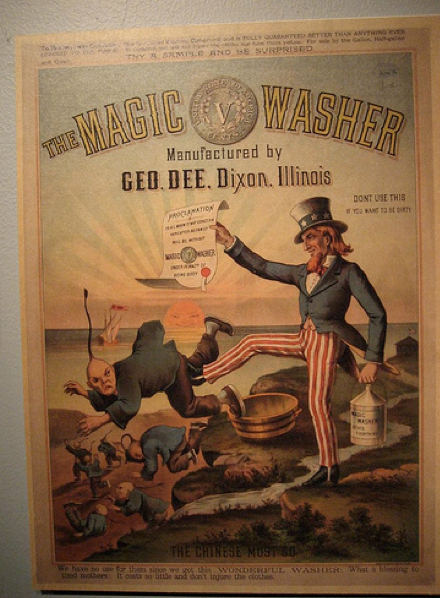
This political cartoon, circa 1886, uses the metaphor of washing to describe the cleansing of the Chinese from the U.S.  At the bottom it reads, “The Chinese must go.”

See also our set of vintage ads selling soap with depictions of African Americans as dirty.

Lisa Wade, PhD is an Associate Professor at Tulane University. She is the author of American Hookup, a book about college sexual culture; a textbook about gender; and a forthcoming introductory text: Terrible Magnificent Sociology. You can follow her on Twitter and Instagram.
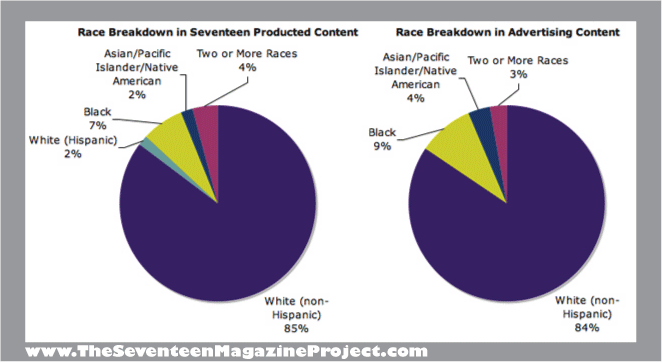
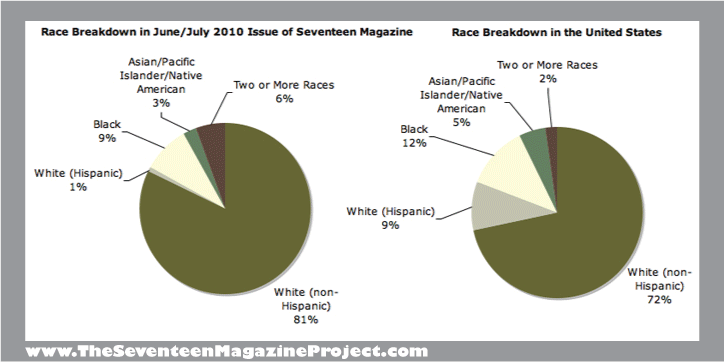
Jamie Keiles, of  the Seventeen Magazine Project and Teenagerie, wondered how racially representative Seventeen was compared to the U.S. population.  So she offered some data based on the May 2010 issue.  Her methods:

There are 332 faces in this month’s issue of Seventeen. I counted a face as a head with at least one visible eye. That is, backs of heads and disembodied mouths or eyes were not included in my data. I researched the races of the models and celebrities that I could identify. Those whose race I could not determine with reasonable certainty I’ve excluded from my data, making for 319 surveyed faces.
She found that Seventeen was not representative (it was nine percent more white than the U.S. population and especially under-represented Hispanics).  Still, she concluded that it was surprisingly representative, considering what she’d heard about the modeling industry.  Her findings actually reflect Ashley Mears’ argument that there is much more diversity among “commercial” models than “high end” fashion models.

Keiles was also surprised by the fact that, compared to the U.S. population, there were many models who identified as bi-racial.  My guess is that it’s because advertisers think (and perhaps know, but I’m not sure) that models whose identities are hard to discern appeal to a larger array of audience members who may see themselves in what is otherwise an “ambiguous” appearance.

Any ideas as to why white Hispanics are particularly underrepresented?  Is it possible that white Hispanic models simply identify publicly as “white”?  Other ideas?

Keiles finds a similar patterns when she looks by gender and by whether it was Seventeen content or advertiser content:

Lisa Wade, PhD is an Associate Professor at Tulane University. She is the author of American Hookup, a book about college sexual culture; a textbook about gender; and a forthcoming introductory text: Terrible Magnificent Sociology. You can follow her on Twitter and Instagram.
This 40-second commercial for HSBC bank, sent in by Michelle F., is an excellent example of the way that non-white and non-Western people are often portrayed as more deeply cultural, connected to the past, and closer to nature than their white, Western counterparts.  Sometimes this is done in order to demonize a culture as “barbaric,” other times it is used to infantilize them as “primitive.” In this case, it romanticizes.

Running on both English and Chinese language channels, the commercial contrasts the wise Chinese man with the young, white man.  The music, the boats, their clothing and hats, and their fishing methods all suggest that the Chinese are more connected to their own long-standing  (ancient?) cultural traditions, ones that offered them an intimate and cooperative relationship to nature. Simultaneously, it erases Chinese modernity, fixing China somewhere back in time.

Other posts on the modernity/traditional binary:

Caveman Courtship

The White Woman’s Burden
De-Racializing the Modernity/Tradition Binary

Africans as Props for White Femininity
Women’s Bodies and the Modernity/Tradition Binary

Which Images Represent India?
The Unseen Middle East

The Primitive and the Modern in Kanye’s Love Lockdown
Our review of Avatar, the Movie
Porn Producer with a Heart of Gold

What Counts as Indian Art?
Whites can Reconquer the America’s with Kahlua

Primitive Child Offers Cures for Modern Ills

Or browse our tag on the false modern/primitive binary.

Lisa Wade, PhD is an Associate Professor at Tulane University. She is the author of American Hookup, a book about college sexual culture; a textbook about gender; and a forthcoming introductory text: Terrible Magnificent Sociology. You can follow her on Twitter and Instagram.
Safa S.-Y., of Naked Lady in a White (Silk) Dress, and K. sent us a link to a story about the recent collaboration between MAC cosmetics and the Rodarte clothing line to create a collection of makeup and clothing the sisters who own and design for Rodarte said was inspired by the city of Juárez and female maquiladora workers:

…the sisters explained that a long drive from El Paso to Marfa, Texas, got them thinking they might like to explore their Mexican roots. From there, they became interested in the troubled border town of Ciudad Juárez; the hazy, dreamlike quality of the landscape there; and the maquiladora workers going to the factory in the middle of the night. And that, according to the designers, who certainly know how to romance a pitch, led to this conclusion: They’d build a collection off the idea of sleepwalking. [source]

The cosmetics received names such as Factory, Ghost Town, Juárez, and del Norte. The eyeshadows are meant to give wearers an ashen, tired appearance. After many in the fashion blogsphere criticized the line, both MAC and Rodarte issued apologies, said they will change the names of some of the products, and promised to donate a portion of proceeds to charities working in Juárez.

Just for some context, MAC is a mid-range cosmetics company; a single color of eyeshadow runs about $14.50, lipsticks are generally $13-15 but some are $18-19. This is less than high-end lines like Chanel and Estée Lauder, but more than drugstore brands such as Cover Girl. Rodarte, on the other hand, is a luxury fashion line, selling t-shirts for $120+, sweaters for nearly $3,000, and dresses for $4,000 or more. They do have a much cheaper Rodarte for Target line, however.

Safa argues that it is problematic that these companies, both completely beyond the financial resources of maquiladora workers (and most people in the U.S., for that matter, particularly Rodarte), to use pale White women made even paler with cosmetics to represent low-wage workers in Mexico, none of whom they met or spoke to. Most of the online critics point out that Juárez is quite dangerous, and hundreds of women, many workers at maquiladoras on their way to or from work, have been raped and killed (NPR had a story about the murders in 2003). These numbers don’t include women who simply disappeared, since authorities don’t have proof they were murdered without a body, though most officials and activists believe that at least some of those women were also killed. The vast majority of the crimes are unsolved.

Safa says,

These women [the Rodarte designers], who had never been to Juarez, but nearby Texas towns, entitled themselves and their clothing line to represent the stories of women they never met.

Female factory workers in Juárez thus become exoticized Others for U.S. companies to represent and claim to speak for — that is, they are supposedly concerned about the problems faced by Mexican women workers (or anyway, they said so after all the criticism) and by creating a line in which White women are made up to look like zombies, or as though perhaps they got punched in the eye, they are actually helping women in Juárez by bringing attention to them…in some undefined way that most women who buy their products are unlikely, I think, to pick up and which probably isn’t going to lead to much concrete action to improve these women’s lives.

I think Safa sums it up nicely, so I’ll let her have the last word:

Human suffering became a look of glamour.  They presented social consciousness in the form of consumerism, and with that, female oppression became another commodity that could be measured not in statistics, but in revenue sales.

Gwen Sharp is an associate professor of sociology at Nevada State College. You can follow her on Twitter at @gwensharpnv.

Cross posted at BlogHer.

Michaela M. alerted us to the news that Essence, the iconic fashion and lifestyle magazine for Black women, has hired an Australian-born, White woman, Elliana Placas, as its new Fashion Director.  Disappointed, former Essence fashion editor, Michaela Angela Davis, wrote:

If there were balance in the industry; if we didn’t have a history of being ignored and disrespected; if more mainstream fashion media included people of color before the ONE magazine dedicated to black women ‘diversified’, it would feel different.

In this 3-minute clip, Davis explains her position to Anderson Cooper:

The controversy over her hire is an example of a more widespread question about representation. Most agree that the presence of Black politicians, actors, models, teachers, professors, authors, and athletes (to name a few) is a good thing for Black people. It’s good, presumably, for two reasons. First, their presence in these roles normalizes Black achievement, beauty, intelligence, etc. The election of Barack Obama, for example, shows us that being Black and being the President of the United States are not mutually exclusive. The success of Tyra Banks and Alek Wek, similarly, upsets the notion that Black women aren’t beautiful.  It is good for all of us to be exposed to evidence that upsets negative stereotypes about Black people, stereotypes that all of us, no matter our color, unconsciously internalize to some degree (test your unconscious preferences here).

But there is a second reason why we often believe that representation is good. It is often presumed that people advocate for their own. Having a Black woman as Fashion Director, it is hoped, will mean that the content of the magazine will be empowering to Black women. That is, that the Director will be sensitive to the historic and ongoing racist idealization of white femininity that makes Black women’s bodies, hair, facial features, and skin color seem to need fixing.  Even if her racial politics are sound (and this is always a serious worry), she certainly does not have the experiences that Black woman in the U.S. often share nor, necessarily, the deep connection to the Black population that will make this a driving concern.

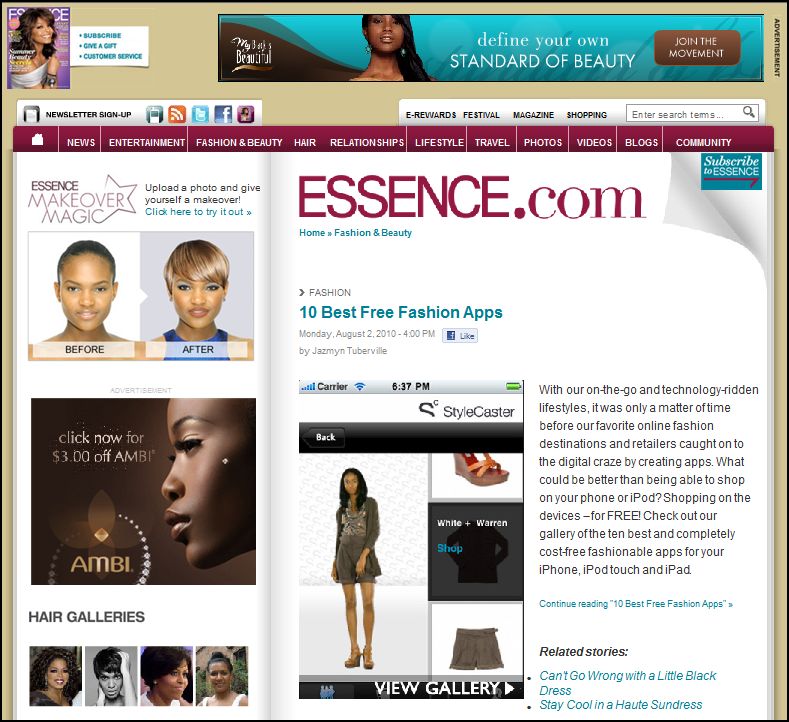
Essence‘s current Fashion and Beauty page with it’s August 2010 cover, featuring Janet Jackson, in the upper left corner:

The hiring of Placas is disappointing in the sense that it is a lost opportunity to put a Black woman in a position of power.  If, however, Placas is going to have this job, people concerned about the empowerment of Black women need to turn to evaluating her product.  The worry caused by her appointment is an opportunity to insist that Essence do right by Black women.  That is, Essence should be a refuge from racism.  One that, hopefully, does not subject Black women to the same sexism as White women in the name of equality.  Light skin does not preclude Placas from being able to do this, just as dark skin does not protect a person from internalizing and perpetuating colorism.

Ultimately, while having a darker-skinned, Black-identified person in the role of Fashion Director would be good, the production of a magazine that empowers Black women is also very important and this is something that Placas may be able to do.  It is up to us to insist that she does.

Lisa Wade, PhD is an Associate Professor at Tulane University. She is the author of American Hookup, a book about college sexual culture; a textbook about gender; and a forthcoming introductory text: Terrible Magnificent Sociology. You can follow her on Twitter and Instagram.

Crossposted at Jezebel.

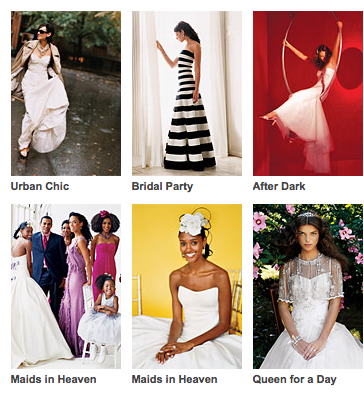
Sully R. drew our attention to a set of images of wedding-related dresses at brides.com. She searched through the thumbnails of brides in the entire gallery; out of 684, there were about 43 African American women, a few identified as Hispanic, and none, as far as she could tell, of Asian women. She also points out, “Of all the models that could be considered full-figured or curvy, most…were black.”

There’s something else going on here, the type of thing that just makes you wonder, given how much businesses spend on marketing and design and such, how it still made it through. Here is an image of the front page of the gallery, showing the only two thumbnails with Black women in them:

Did you catch it? The only two pictures that have Black women in them…are in the category “Maids in Heaven.” I’m sure this was referring to being a “maiden” or something of that sort (I first thought of “bridesmaid,” but then it’s a bride in one picture, so that doesn’t really make sense).

I can’t really fathom how no one noticed and thought, “maybe we should change that title, just to be safe.” It shows, at the very least, a remarkable insensitivity to part of the presumed audience —  not thinking about how the language of the categories might have different meanings depending on who it referred to and that for some groups, the use of “maid,” however innocuously meant, would have unpleasant connotations.

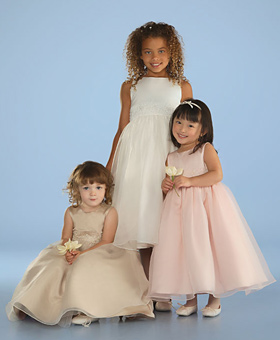
Interestingly, the one area where Sully noticed interracial groups, including Asians, was in pictures of flower girls:

She said there were actually quite a few Asian girls in these photos. Presumably this is a safe place to show interracial mixing; it implies a childhood innocence where everybody gets along and is less likely to alienate adults who might be more uncomfortable with images of an interracial couple getting married.


W7VMG6TW33MX