race/ethnicity: Whites/Europeans

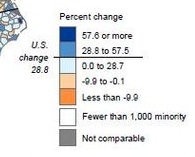
The U.S. Census Bureau has started releasing data from the 2010 Census. This map shows the change in the racial/ethnic minority (i.e., anything other than non-Hispanic White) population over the last decade:
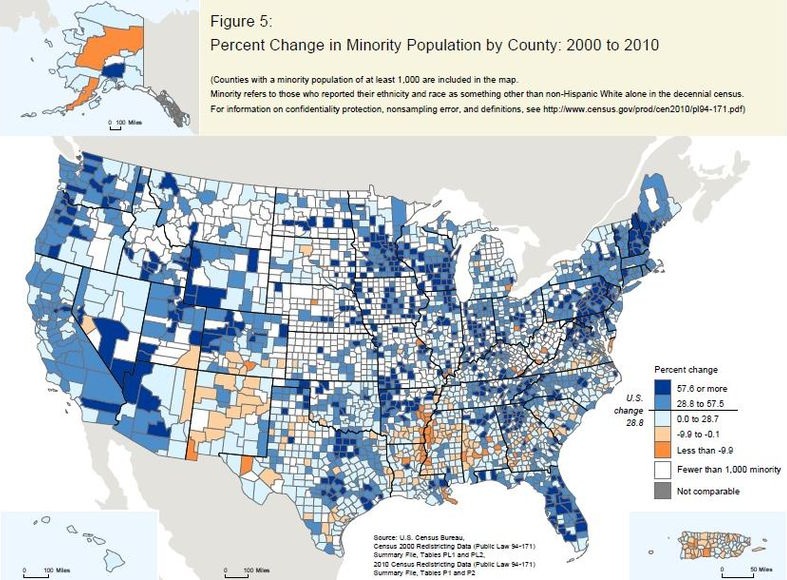
Legend:
They released a report, An Overview: Race and Hispanic Origin in the 2010 Census (available here), which includes data on those who reported more than one race. Among those who reported more than one race, the vast majority listed two. Here are the most commonly reported combinations:
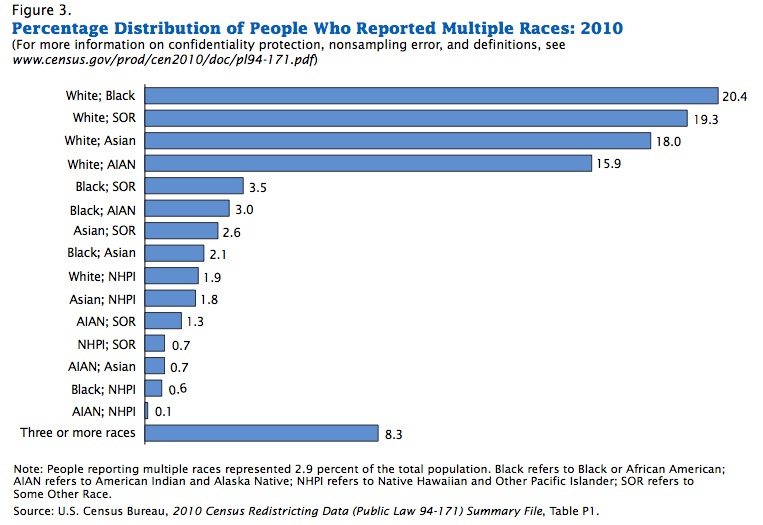
AIAN = American Indian/Alaska Native, NHPI = Native Hawaiian/Pacific Islander, and SOR = some other race.

Laura E. pointed out that New Geography posted some maps based on 2010 Census data. Here’s the Hispanic population as a percent of the total population, by county (notice that the legend need to be multiplied by 100 to get the percent):

The African American population (alone or in combination with another race, and again, multiply by 100):

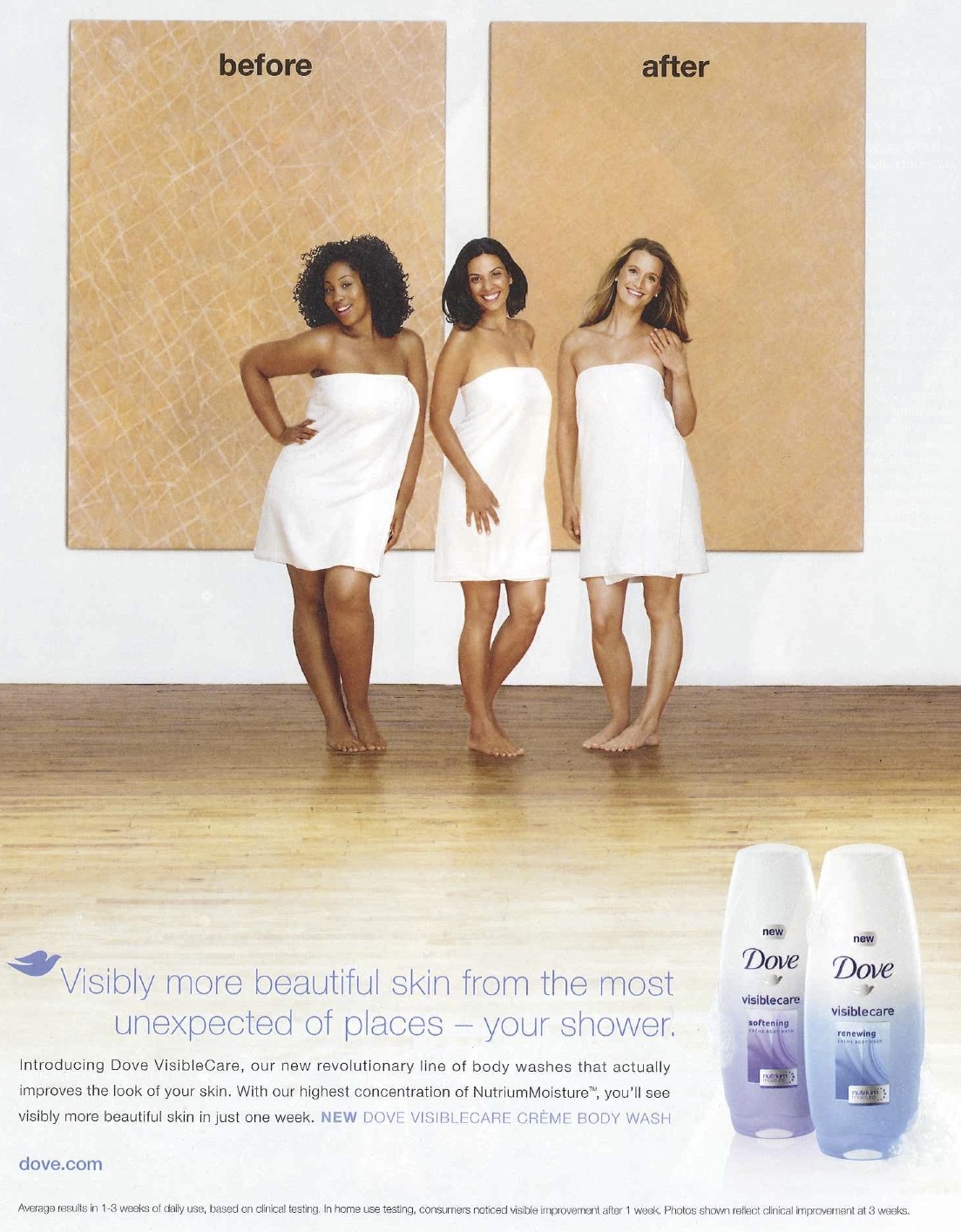
 

Amy H. sent in a Dove ad from O magazine. The ad clearly means to say that women get “visibly more beautiful skin” because their body wash moisturizes dry skin. However, the placement of the women in front of the “before” and “after” text may unfortunately, based on a quick glance, inadvertently convey a different message:

I continue to be puzzled that multinational corporations with resources for large-scale marketing campaigns so often stumble in awkward ways when trying to include a range of racial/ethnic groups in their materials. This seems to occur by not sufficiently taking into account existing or historical cultural representations that may provide a background for the interpretation of images or phrases in the advertising. In this case, the arrangement of the models combined with the text above and below them unfortunately intersects with a cultural history in which White skin was seen as inherently “more beautiful” than non-White skin (not to mention thinner bodies as more beautiful than larger ones).

It would be possible to make this same ad, using these same models and basic idea, in a way that avoided any potential misinterpretation — all it would take, I think, would be to take the before-and-after pics and make them small off-set images on the side, so “before” and “after” couldn’t be read as referring to the women’s bodies. Given that advertising materials are often highly scrutinized, Photoshopped, market tested, and focus grouped, I can’t quite figure out how potentially problematic racial/ethnic connotations aren’t caught before such ads are released.

UPDATE: In my analysis, I gave Dove the benefit of the doubt in assuming this was a non-intentional aspect of the ad, largely because even in the “best case scenario” where this is entirely unintended, it is problematic. However, several readers suggest that we shouldn’t too quickly assume that instances such as these are accidental.

Gwen Sharp is an associate professor of sociology at Nevada State College. You can follow her on Twitter at @gwensharpnv.

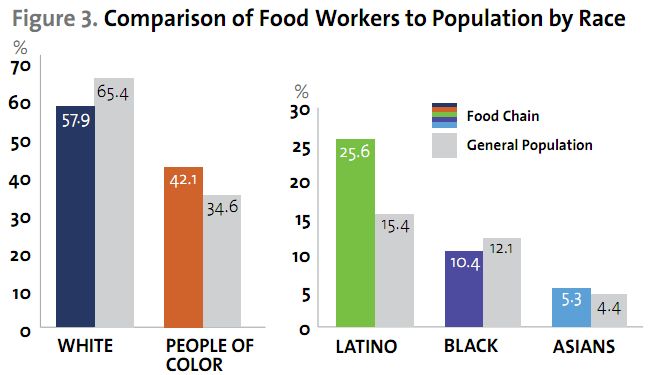
Via Colorlines I discovered an Applied Research Center report titled The Color of Food.  The report found that Blacks, Latinos, and Asians were overrepresented in food service work:

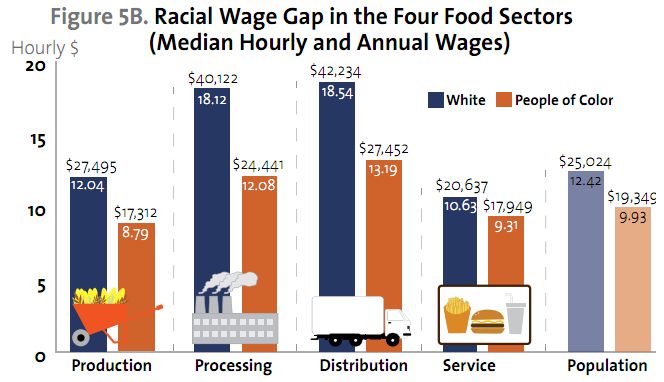
The report also discovered a wage gap between White workers and non-White workers at every level of food production:

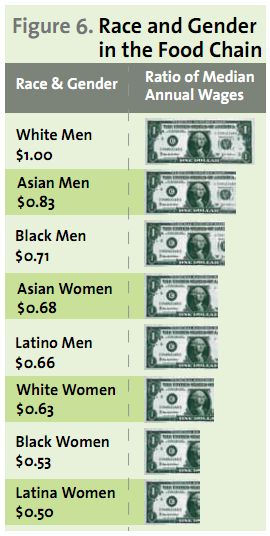
Race intersected with gender, such that women earned less than men of their same race for each group studied:

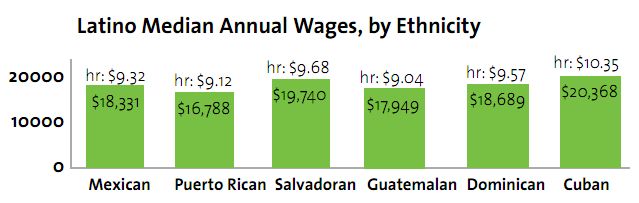
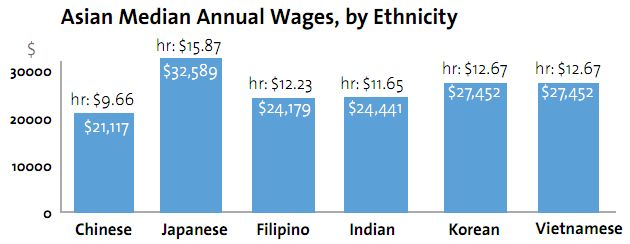
The authors go on to break down the data further by each part of the commodity food chain — production, processing, distribution and service — and by racial group.  For example, they show that the average wage of Latinos and Asians differs by ethnic background (always a good reminder that racial categories obscure variability):

Lots more at The Color of Food.

Lisa Wade, PhD is an Associate Professor at Tulane University. She is the author of American Hookup, a book about college sexual culture; a textbook about gender; and a forthcoming introductory text: Terrible Magnificent Sociology. You can follow her on Twitter and Instagram.

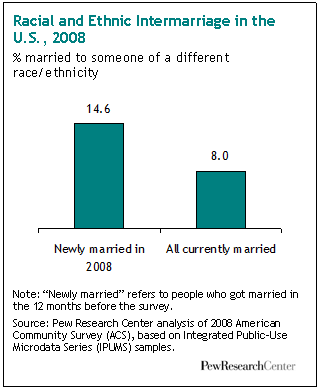
New-ish data from the Pew Research Center suggests that inter-racial and -ethnic marriages are on the rise due to cohort changes.  First, the report shows that people who were newly married in 2008 were more likely to be married to someone of a different racial or ethnic group:

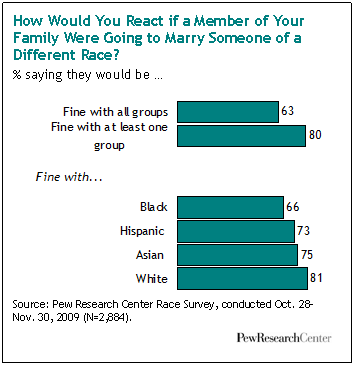
This trend is likely facilitated by greater acceptance of intermarriage.  According to the report, in 1987 less than half of Americans said it was okay for White and Black people to date each other, by 2009 that number had risen to 83%.  Among 18- to 32-year-olds, 93% approve.

Among Pew’s respondents, 63% said that they approved of inter-racial and -ethnic marriages without reservation and another 17% said that they approved of at least one type of intermarriage, but not others.  Still, overall acceptance of intermarriage still aligns with the familiar racial hierarchy in that Americans are more comfortable with outmarriages to Whites, than to Asians, Hispanics, and especially Blacks.

Acceptance of inter-racial and -ethnic marriage is on the rise, then, in part because younger people are more accepting of it than older people.  Acceptance, however, still reflects a color-based racial hierarchy.

Lisa Wade, PhD is an Associate Professor at Tulane University. She is the author of American Hookup, a book about college sexual culture; a textbook about gender; and a forthcoming introductory text: Terrible Magnificent Sociology. You can follow her on Twitter and Instagram.

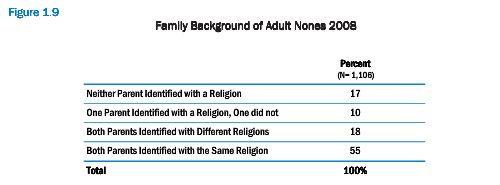
Data from the American Religious Identification Survey (collected in 2008) reveals some interesting things about the population of Americans that do not identify with organized religions: atheists, agnostics, and the “spiritual but not religious.”  Most of the non-religious grew up with religious parents.  Only 17% report that neither of their parents identified with a religion:

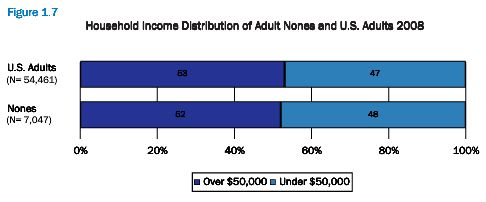
Being non-religious does not correlate with income or education:

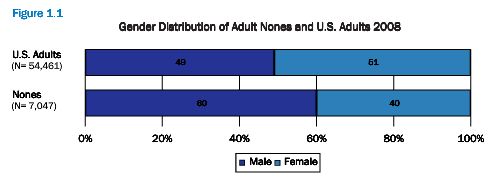
Instead, it’s strongest correlation is with gender.  Women are more likely than men to believe in God, more likely to convert to a faith if raised as a non-believer, and less likely to leave a faith they are raised in.

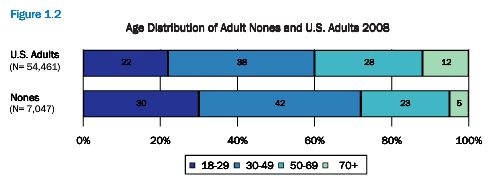
Younger people are also more likely to be non-religious:

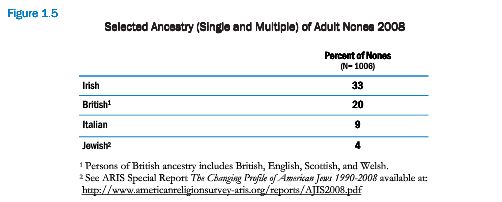
Americans with Irish ancestry make up a significant percentage of the non-religious. They account for about 12% of Americans, but about 1/3rd of all non-religious:

More details at American Nones.

Lisa Wade, PhD is an Associate Professor at Tulane University. She is the author of American Hookup, a book about college sexual culture; a textbook about gender; and a forthcoming introductory text: Terrible Magnificent Sociology. You can follow her on Twitter and Instagram.

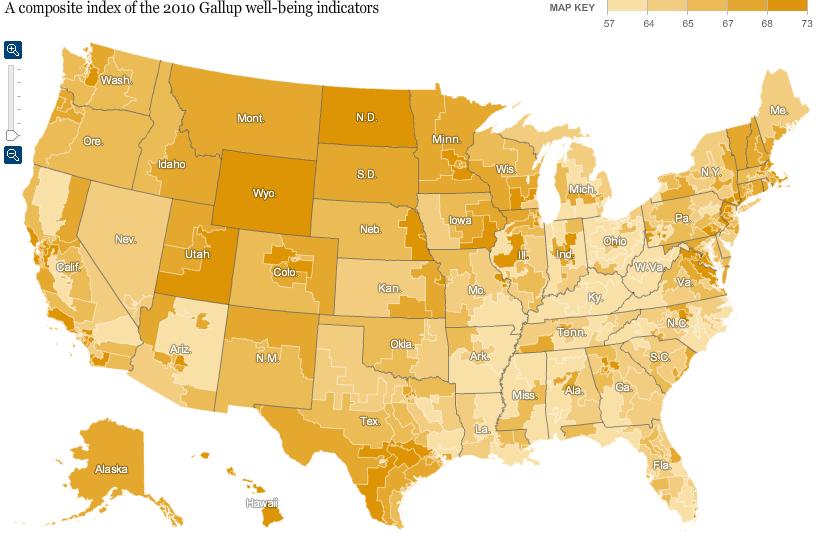
Kristina K. sent in a link to an interactive map at the New York Times that shows the results of Gallup’s 2010 polls of well-being. [UPDATE: Reader Danielle pointed out I forgot to provide a link to the map. Sorry! You can find it here.] Gallup surveys 1,000 people per day about a variety of indicators of well-being, including questions about physical, mental, and emotional health, various health-related behaviors, ability to access health care, access to adequate food and housing, and perceptions of their communities. Here are the overall composite scores, by congressional district (a higher score is better):


The general geographic pattern indicates a swath of relatively low well-being curving from Louisiana up through Michigan, while those in the upper Great Plains and the inter-mountain West are doing better than average.

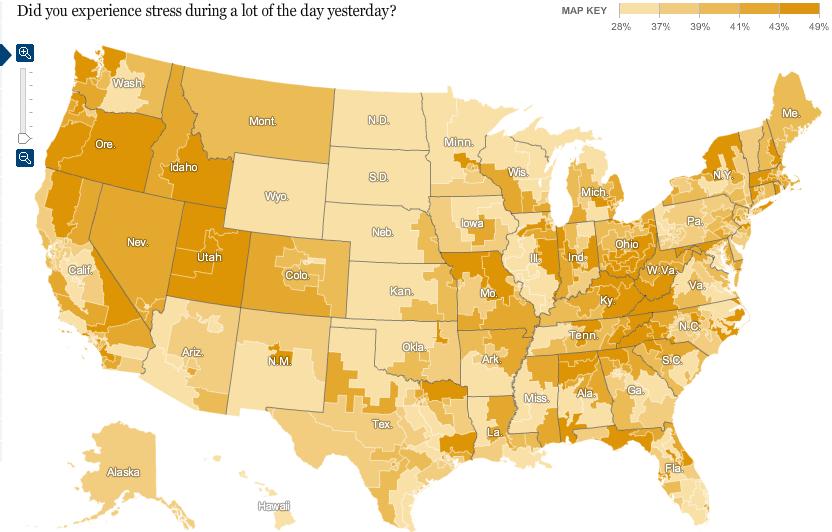
Percent reporting experiencing a lot of stress:

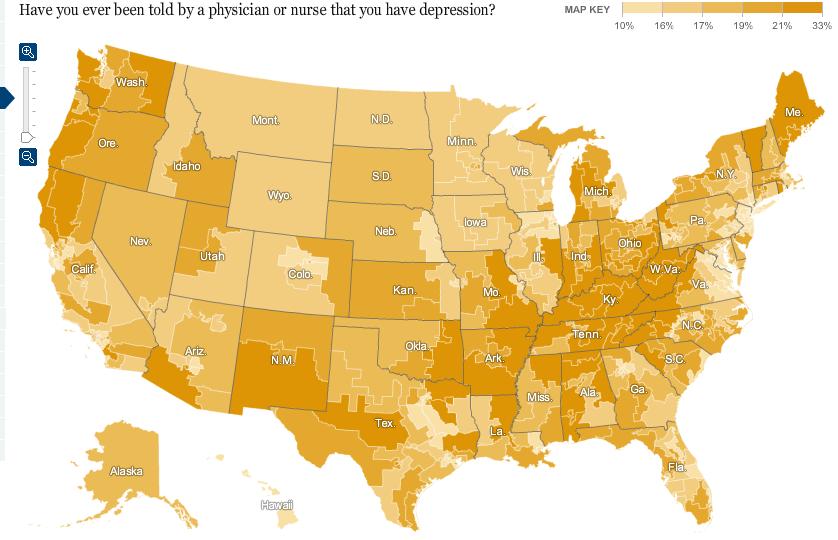
Percent who have ever been told they have depression:

Of course, this may reflect differences in rates of depression, but it could also reflect differences in medical professionals’ likelihood of identifying a set of symptoms as depression and bringing it up with a patient. For example, we see significant differences by state in the frequency of Caesarean sections among pregnant women.

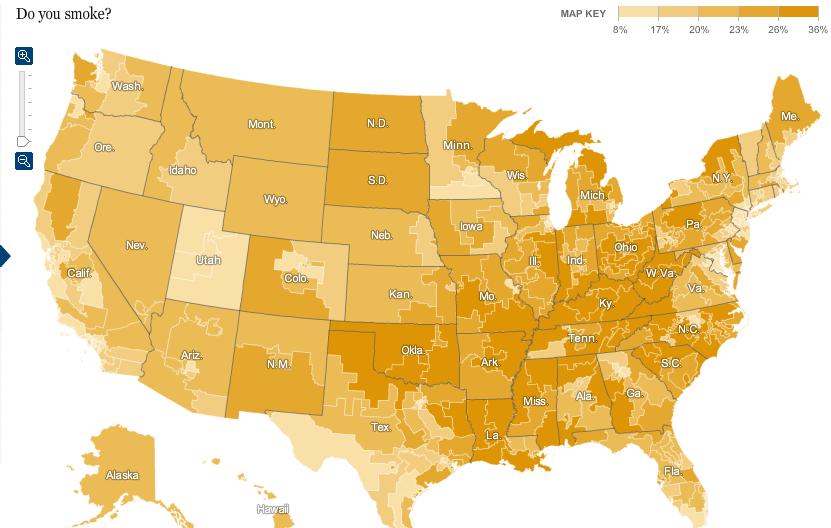
Percent of people who smoke:

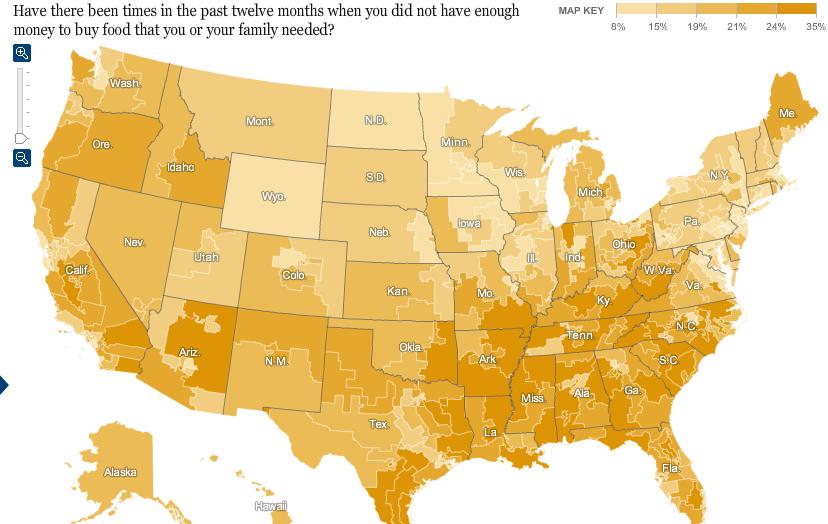
Percent reporting an inability to buy sufficient food:

The Gallup page on well-being presents more data. Here is a map of 2009 overall well-being that is a bit easier to read since it’s presented by state rather than congressional district:

Hawaii had the highest overall score, at 70.2; West Virginia had the lowest, 60.5. If you go to their site and click on a state, you can get a breakdown of scores in each area (emotional well-being, physical health, healthy behaviors, and so on).

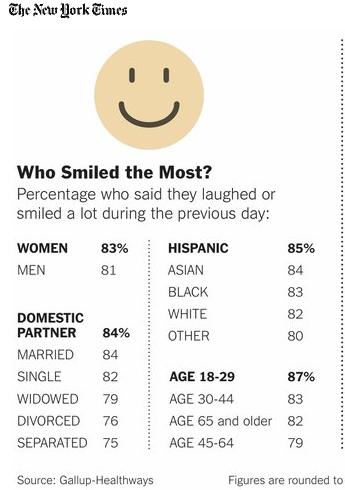
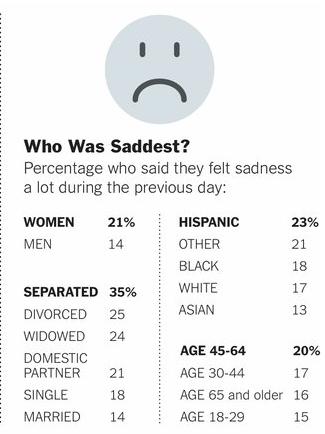
Finally, the NYT provides some demographic information on who was most likely to have said they spent a lot of the previous day laughing or smiling vs. being sad:

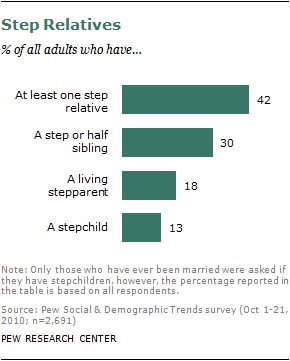
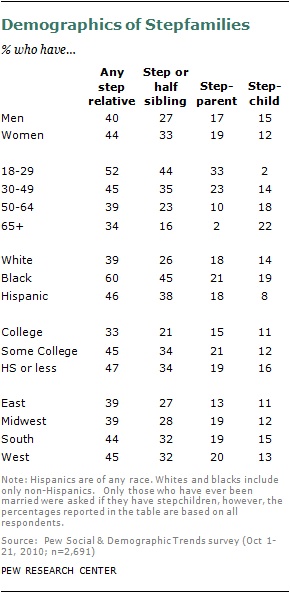
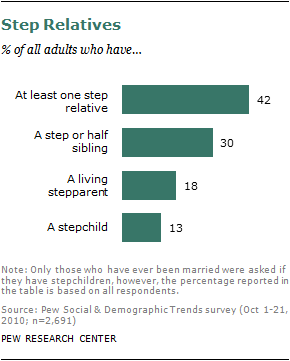
The Pew Research Center recently released data on stepfamilies in the U.S. Of the 2,691 respondents, over 40% had at least one step relative in the immediate family:

Note that they include both step- and half-siblings. For readers who might not be familiar with that language, a step-sibling is related to you only through marriage; you don’t share a biological parent. A half-sibling shares one parent with you, but not both. I can see the point of including both categories if you’re interested in seeing the degree to which American family life varies from the culturally-accepted “ideal” nuclear family, but I would think putting both in a single category might hide meaningful differences (such as for the question about obligation, below).

The chances of having a step-relative in the immediate family vary quite a bit based on demographics, reflecting differences in marriage, divorce, and non-marital childbearing rates:

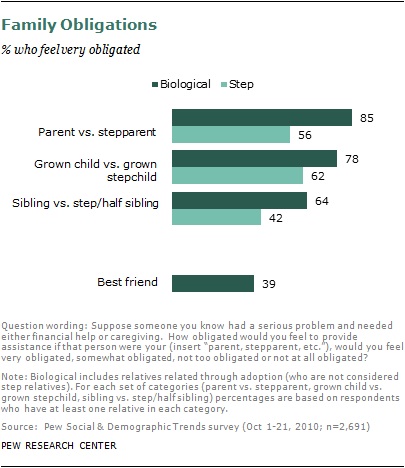
The vast majority (70%) of people with step-relatives said they were very satisfied with their family lives, undermining some of the cultural stereotypes of stepfamilies as inherently filled with conflict. However, the survey also asked participants if they would feel “obligated” to help a family member who was facing serious problems and needed either financial help or caregiving. The results show more feelings of obligation to biological family members than to step-relatives:

I presume perceptions of obligation vary widely based on how old a person was when their parent married their stepparent, the quality of the relationship, and perhaps even whether the stepparent has biological children. The data would seem to have important implications for our ability to draw on family networks for resources. Who is responsible for caring for elderly parents, for instance? Only their biological children? Should someone feel obligated to help a person who they’re related to only because of a parent’s marital choice? Unclear cultural norms about obligations to step-relatives bring up a number of complex issues that many Americans will be forced to grapple with in the future.

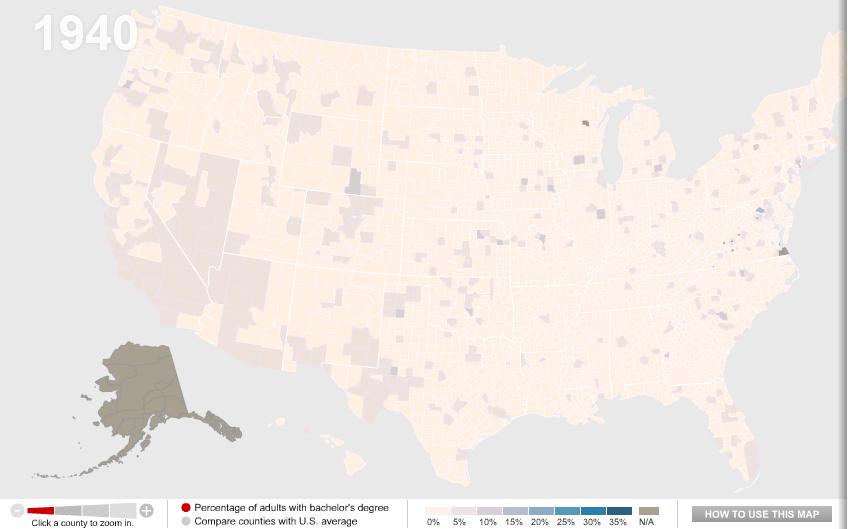
One of my colleagues, Kate Hahn, sent me a link to an interactive map at The Chronicle of Higher Education website that presents data on the proportion of U.S. adults with a bachelor’s degree over time. In 1940, in the vast majority of counties no more than 10% of the population had graduated from college (the national average was 4.6%):

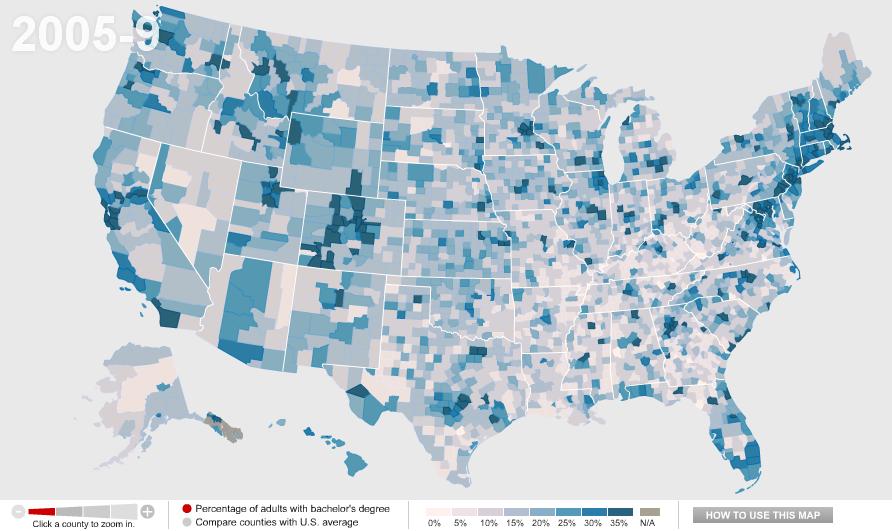
Now the national average is 27.5%:

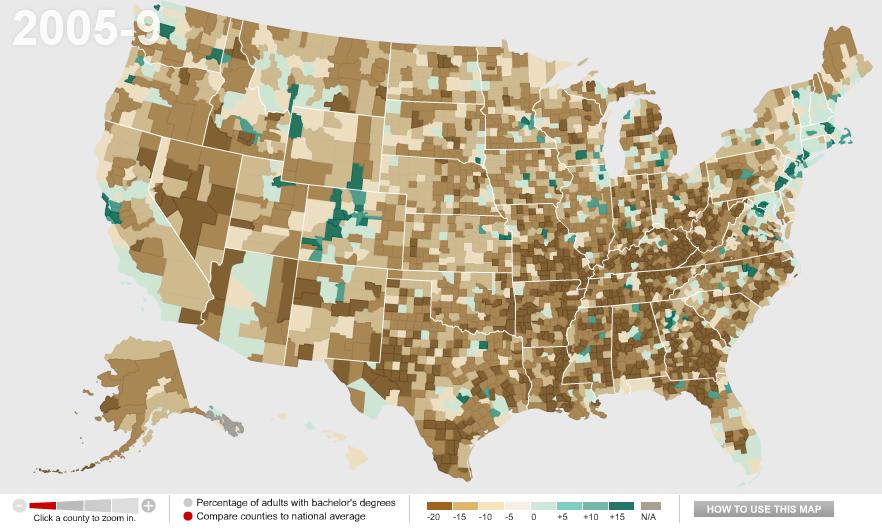
You can also compare counties to the national average. Green counties are above the national average, brown ones are below and, not surprisingly, we see clear regional variations in rates of college education, with Colorado and the Northeast doing particularly well and the South and Appalachian regions lagging:

Wealthy counties (those with a median income of $60,000+) in general have higher than average rates of bachelor’s degrees, with the exception of a few counties in the Mountain West, Alaska, and a few scattered areas:

We see the opposite with poor counties (median income under $30,000):

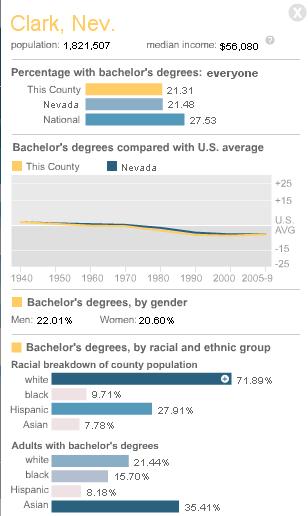
You can break down any of the comparisons by sex or race/ethnicity, and/or look only at  counties with 20% or more Hispanic or Black residents.  You can also select a particular county for more detailed information. For instance, here’s the info on Clark County, Nevada, where I live:

By comparing the maps over time, you can easily track a number of changes: the increase in college degrees overall, of course, but also changes in education such as the dramatic gains women have made in earning college degrees in the past few decades — the gender gap in college degrees was over 7 percentage points in 1980 but only about 1.5 points today.