nation: United States

Amie G. sent along a five minute documentary in which a series of artists and entrepreneurs talk about why the Day of the Dead has become so popular in parts of the United States.

While they don’t discuss issues of cultural appropriation (like at Halloween), they have some interesting things to say about why it is so appealing to a broad audience. A professor of Art History, Ray Hernández Durán, for example, traces it to the growing Latino demographic, the way media has changed, and a history of the U.S. being open to cultural influence.

—————————

Lisa Wade is a professor of sociology at Occidental College. You can follow her on Twitter and Facebook.
Cross-posted at Caroline Heldman’s Blog.

Last Thursday, Republican Representative and Tea Party favorite, Joe Walsh (R-Ill), told reporters that when it comes to abortion, “there’s no such exception as life of the mother” because of “advances in science and technology.” This astounding claim was news to the medical community.

Walsh joins the ranks of some other prominent Republican men who don’t understand basic lady parts science: Representative Todd Akin (R-MO), who claimed that pregnancy from “legitimate rape” is “really rare” because “the female body has ways to shut the whole thing down,” and conservative comedian Rush Limbaugh, who doesn’t understand the basics of birth control pills. (He thinks you take a pill every time you have sex!)

These remarks would be humorous if it weren’t for the fact that these men are part of a broader effort by the extreme wing of the Republican Party to take aim at women’s reproductive health.

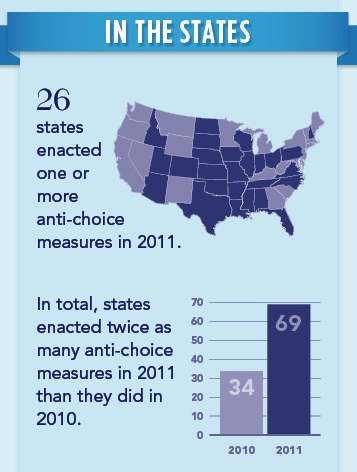
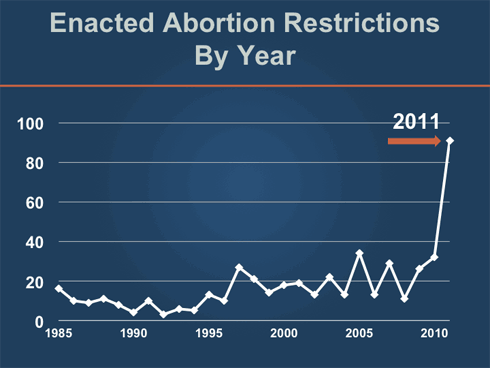
At the state level, Republican lawmakers enacted a record number of anti-abortion measures in 2011, four times as many as the previous year. A study from the Guttmacher Institute shows that legislators in 45 state capitals introduced 944 provisions to limit women’s reproductive health and rights in the first three months of 2012. These states are proposing/passing abortion ultrasound requirements, gestational limits, health insurance exemptions for contraception coverage, and stringent limitations on medical abortions.

In the past two years, 19 states have introduced bills modeled on a Nebraska law that bans abortion 20 weeks after fertilization. The Oklahoma State Senate redefined “person” as starting at conception, while the Mississippi House approved a bill requiring women who want an abortion to undergo an examination to determine if there is a fetal heartbeat. Texas and Virginia require women to undergo an ultrasound prior to receiving an abortion, and many other states have similar proposals underway. Texas recently cut reproductive services for 130,000 poor women.  As this chart from NARAL indicates, twice as many states passed anti-choice laws in 2011 than in 2010.


At the federal level, in 2010, the newly elected House Republican majority was quick to propose major cuts to reproductive health services. They made several attempts to eliminate funding for Planned Parenthood, the largest family planning provider in the U.S. that has been around for a century. They also tried to gut Title X, a program that funds family planning and preventive breast and cervical cancer screenings. Both proposals were stopped by Senate Democrats. Ironically, on the same day that House Republicans tried to eliminate Title X funding, Representative Dan Burton (R-IN) proposed contraceptive funding for wild horses (something that we desperately need, actually).

Congressional Republicans also proposed an amendment to the health care bill that allows federally funded hospitals to turn away women in need of an abortion to save their lives. This is by far the most brazen attack on the “mother’s health” exception to restrictions on abortions. In May of 2012, Republicans proposed a veto on sex-selective abortions that failed to pass the House, despite broad Republican support for the bill. And in early 2012, Republicans in Congress held hearings on whether the new health care law should include contraception coverage. These hearings included virtually no female experts, so House Democrats held more inclusive hearings that (gasp) included women. Limbaugh assailed one hearing participant, Georgetown student Sandra Fluke, calling her a “slut” and a “prostitute.”

Prominent conservatives, including Republican Party leadership, have roundly dismissed the assertion that the party is engaged in a War on Women, but the recent flurry of legislation curbing reproductive freedoms tells a different story. Given baffling comments from the likes of Walsh, Akin, and Limbaugh, the generals in this War on Women obviously need to include lady parts science as part of basic training.

 ——————
Caroline Heldman is a professor of sociology at Occidental College.  You can follow her at her blog and on Twitter and Facebook.
Cross-posted at Montclair SocioBlog.

Back in June, Mitt Romney said:

I want to make sure that we keep America a place of opportunity, where everyone… get[s] as much education as they can afford

After all, Mitt got as much education as he (his parents, really) could afford, so he thought it best if everyone had that same opportunity.

Opportunity – How much is that in American money?

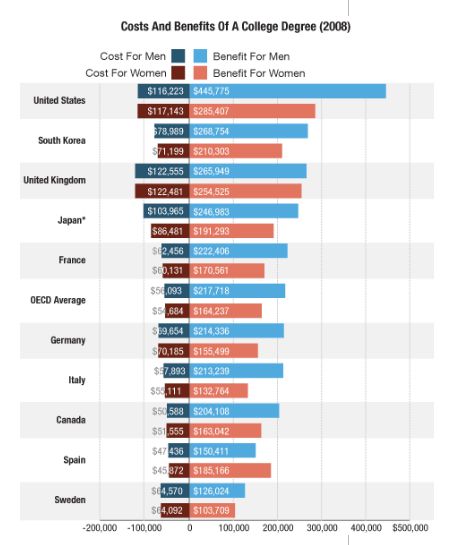
Yesterday, Planet Money  posted this graph showing the costs and benefits of a college education in several countries.

The title of the post summarizes the interpretation of the college-educated folks at Planet Money:

“College Costs More In America, But The Payoff Is Bigger”

But what if you look at the data from the other side?  Here’s the half-empty-glass title:

“College in the US Costs a Lot, and If You Can’t Afford It, You’re Really Screwed”

…or words to that effect.

What the chart seems to show is inequality — specifically, the inequality between the college educated and everyone else.  In advanced economies, like the those of the countries in the chart, education is important. But some of those countries, like the Scandinavian countries, have reduced the income sacrificed by non-college people relative to the college educated. Other countries favor a more unequal distribution of income.

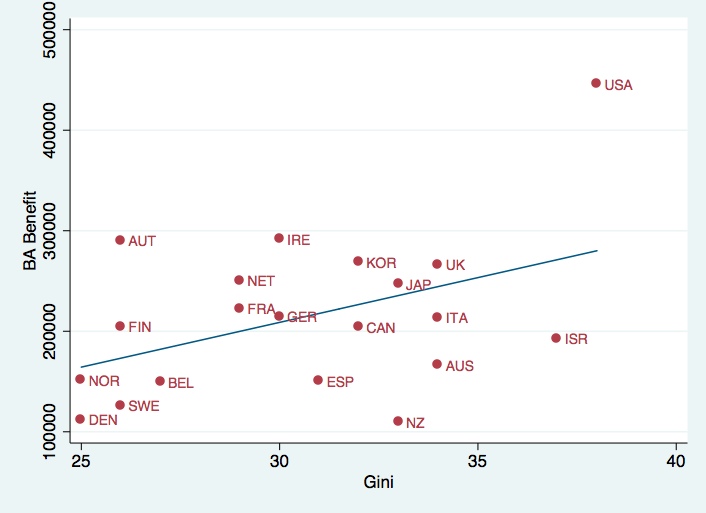
To look a little closer, I looked at the relationship between the payoff of a BA degree for men and a country’s Gini coefficient, a measure of inequality.  I used the ten countries in the Planet Money chart and added another ten OECD countries.

The correlation is 0.44.  The US is the clear outlier.  In the land of opportunity, if you’re a male, either you pay the considerable price of going to college, or you pay the price for not going to college.

With this inequality come the kinds of social consequences that Charles Murray elaborates in his latest book about non-educated Whites — disability, divorce, demoralization, death.

—————————

Jay Livingston is the chair of the Sociology Department at Montclair State University.  You can follow him at Montclair SocioBlog or on Twitter.

Cross-posted at Caroline Heldman’s Blog.

On Monday, Mother Jones released a video recorded in May of presidential candidate Mitt Romney speaking at a $50,000-a-plate fundraiser in the Boca Raton home of “private equity party boy” and “sexy party” host, Marc Leder. A hidden camera caught controversial remarks about IsraelIran, and a joke about being more electable if his parents had been born in Mexico, but the topic of this post is Romney’s use of the 47% Meme.

The 47% Meme is the idea that half of Americans take from rather than contribute to tax coffers. It sometimes surfaces in the form of the “takers vs. makers” frame. I have encountered this “argument” for years on Fox News, so it is surprising to see it gaining national attention now. Romney did a superb job articulating the 47% Meme in response to a question of how he might win in November:

There are 47 percent of the people who will vote for the president no matter what. All right, there are 47 percent who are with him, who are dependent upon government, who believe that they are victims, who believe the government has a responsibility to care for them, who believe that they are entitled to health care, to food, to housing, to you-name-it. That that’s an entitlement. And the government should give it to them.

Many myths start with a kernel of truth. The 47% Meme is loosely based on the statistic that 47% of Americans pay no income tax (down to 46% in 2011). This meme is wildly dishonest since people pay a host of other federal, state, and local taxes. It’s about as honest as saying a person doesn’t eat vegetables because she only eats carrots, celery, bell peppers, cucumbers, and cabbage, but not broccoli.

So who is paying taxes, and what taxes are they paying?


Federal Income Tax

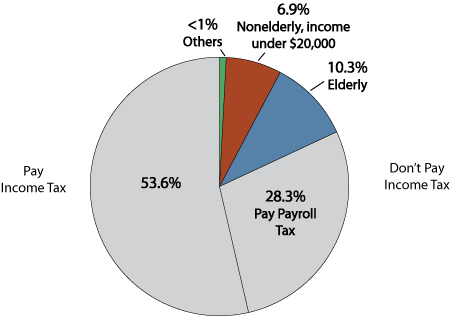
The Tax Policy Center finds that two main groups comprise the 46% who do not pay federal income tax: (1) The poor whose subsistence-level income is not taxable, and (2) those who receive tax expenditures. This chart shows that the lion’s share of tax expenditures goes to senior citizens, children, and the working poor, with the notable exception of 7,000 millionaires who paid no income tax in 2011.


Other Federal Taxes

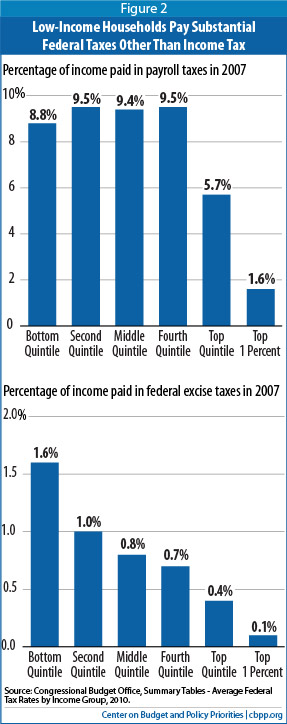
But enough about income tax since this narrow focus only serves to further the misleading 47% Meme. The chart below shows a more accurate picture of who pays federal taxes. If we don’t count retirees, only 8% of Americans pay no income or payroll taxes.

Americans also pay federal excise tax on gas, liquor, cigarettes, airline tickets, and a long list of other products, so virtually every American pays federal taxes in some form. And contrary to the 47% Meme, poor and middle-class Americans actually pay a greater percentage of their income in federal payroll and excise taxes than wealthier Americans.

State and Local Taxes

When it comes to state and local taxes, the Institute on Taxation and Economic Policy finds that the poor pay more in state and local taxes in every state except Vermont. As the chart below indicates, state and local taxes are regressive, meaning that those who can least afford to pay, pay more.

Romney has apologized for the inelegance of his statements, but stands by their substance, despite ample data debunking the dependency (above) and entitlement bases for the 47% Meme. I don’t believe that Romney believes that half of the people in the U.S. are pathetically entitled “victims.” He is a smart person, and this is a ludicrous line of reasoning. But what does it say about our bitterly partisan nation that heaping unmitigated scorn on the poor brings in big bucks from the base?

Cross-posted at Montclair SocioBlog.

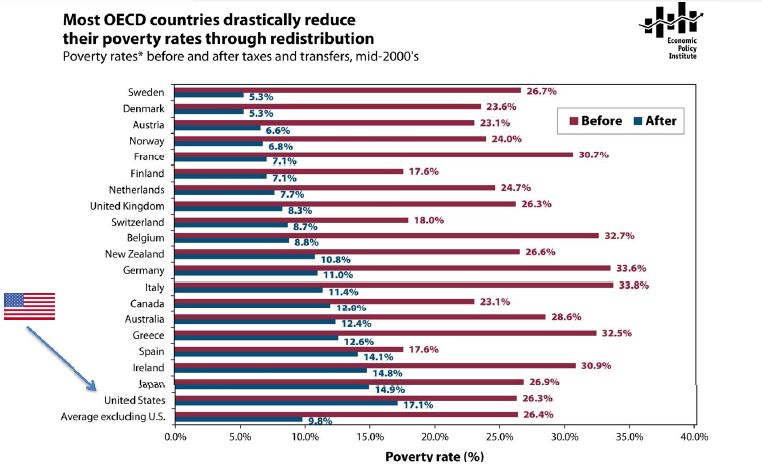
The poverty rate in the US in the mid-2000s was about 17%.  In Sweden, the poverty rate was 5.3%; in Germany, 11%.   That was the rate after adding in government transfers.  In Germany, the poverty rate before those transfers was 33.6%, ten points higher than that in the US.  Sweden’s pre-transfer poverty rate was about the same as ours.

Jared Bernstein has this chart showing pre-transfer and post-transfer rates for the OECD countries (click to enlarge):

Three  points:

1.  Governments have the power to reduce poverty, and reduce it a lot.  European governments do far more towards this goal than does the US government.

2.  It’s unlikely that America’s poor people are twice as lazy or unskilled or dissolute as their European counterparts.  Individual factors may explain differences between individuals, but these explanations have little relevance for the problem of overall poverty.  The focus on individual qualities also has little use as a basis for policy.  European countries have fewer people living in poverty, but not because those countries exhort the poor to lead more virtuous lives and punish them for their improvident ways.  European countries have lower poverty rates because the governments provide money and services to those who need them.

3.  The amount of welfare governments provide does not appear to have a dampening effect on the overall economy.

Cross-posted at Montclair SocioBlog.

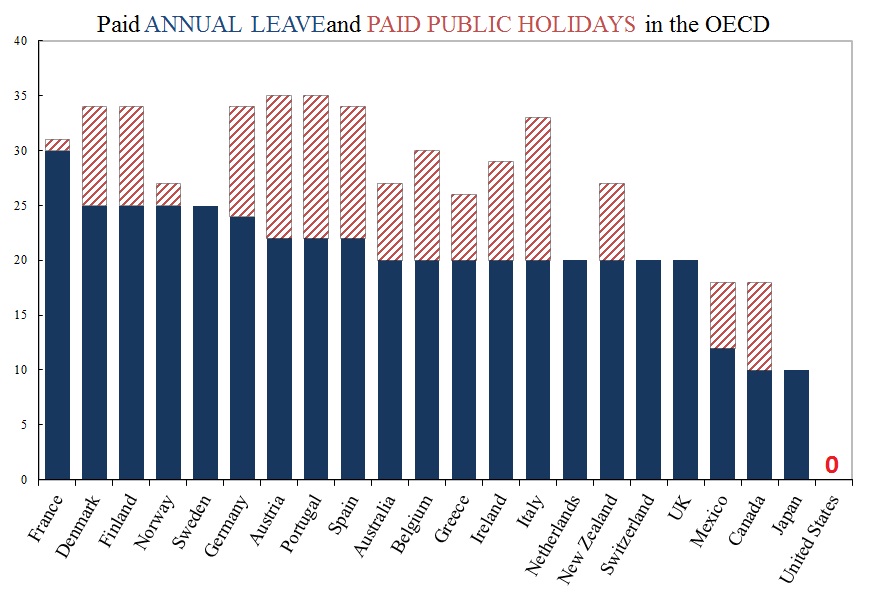
As I speculated years ago (here and here), it may be hard for Americans to imagine a world where the law guarantees them at least 20 paid vacation days per year.  But such a world exists.  It’s called Europe.*

Americans are the lucky ones.  As Mitt Romney has warned us “European-style benefits” would   “poison the very spirit of America.”  Niall Ferguson, who weighs in frequently on history and economics, contrasts America’s “Protestant work ethic” with what you find in Europe – an “atheist sloth ethic.”

The graph is a bit misleading. It shows only what the law requires of employers.  Americans do get vacations.  But here in America, how much vacation you get, or whether you get any at all, and whether it’s paid – that all depends on what you can negotiate with your employer.

Since American vacations depend on what the boss will grant, some people get more paid vacation, some get less, and some get none.  So it might be useful to ask which sectors of our economy are beehives of the work ethic and which are sloughs of sloth.  (Ferguson’s employer, for example, Harvard University, probably gives him three months off in the summer, plus a week or two or more in the winter between semesters, plus spring break, and maybe a few other days.  I wonder how he would react if Harvard did away with these sloth-inducing policies.)

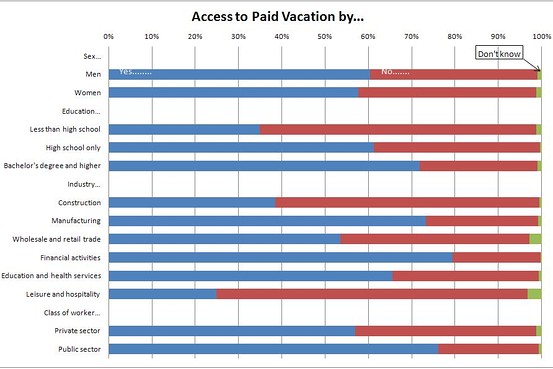
The Wall Street Journal recently (here) published a graph of BLS data on access to paid vacations; they break it up by industry near the bottom.

Those people who are cleaning your hotel room and serving your meals while you’re on vacation — only about one in four can get any paid vacation days.  And at the other end, which economic sector is most indulgent of sloth among its workforce?  Wall Street.  Four out of five there get paid vacation.

How much paid vacation do we get?  That depends on sector, but it also depends on length of service.  As the Journal says,

Europeans also get more time off: usually a bare minimum of four weeks off a year. Most Americans have to stay in a job for 20 years to get that much, according to BLS data.

—————————

* The graph is from five years ago, but I doubt things have changed much. The US still has no federal or state laws requiring any paid vacation days.

Most people assume that the various benefits we collectively describe as “welfare” go to people who aren’t working.  The truth is, however, that some people with full-time jobs still find themselves below the poverty line.  The U.S. federal minimum wage is $7.25 an hour.  A full-time employee who doesn’t miss a single day of work for a year earns $290 a week; that’s 15,080 a year.  According to how the government measures poverty, that’s enough to support a single adult.  For a single adult with a child, however, it’s officially below the poverty line. It’s $4,000 below the poverty line for a family of three.  When a person has a full-time job, but still lives in poverty, they are what sociologists call the “working poor.”

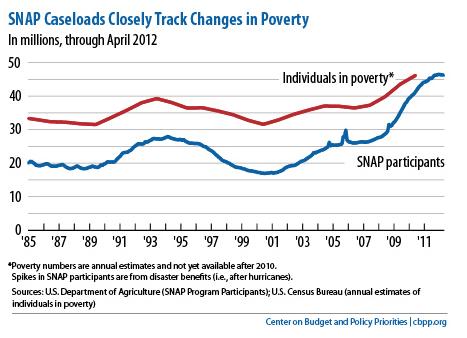
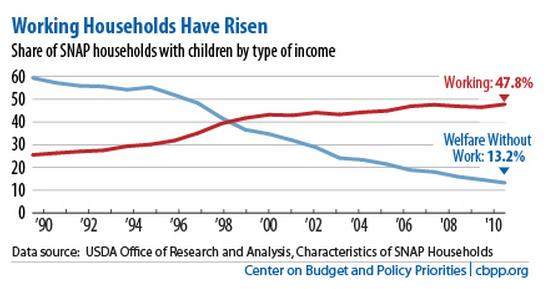
Some welfare benefits, then, go to people who do work.  The  Supplemental Nutrition Assistance Program, better known as food stamps, is an example.  Working parents have always comprised a large percentage of people receiving food stamps.  Today the number of working families who rely on food stamps is higher than it’s been in over 20 years (source).  These numbers reflect the impact of the recession generally, but also the extra-burden placed on already struggling families.  The first chart shows the rise of poor families, the second shows the increase in the working poor using food stamps.

This kind of data inspires me to ask if this is what a functional economy looks like.  We have policies — e.g., the federal minimum wage and somewhat laissez faire free market policies — that create a situation in which working full time doesn’t allow a single parent to support even one child.  When we hear criticisms of people who receive benefits, then, we should be careful to remember that their economic crisis is not a straightforwardly personal characteristic, one that can be explained by a poor work ethic or disorderly personality. There are structural reasons that people end up in need.  We have three choices: let them suffer and perhaps die, help them, or change our society.

Lisa Wade, PhD is an Associate Professor at Tulane University. She is the author of American Hookup, a book about college sexual culture; a textbook about gender; and a forthcoming introductory text: Terrible Magnificent Sociology. You can follow her on Twitter and Instagram.

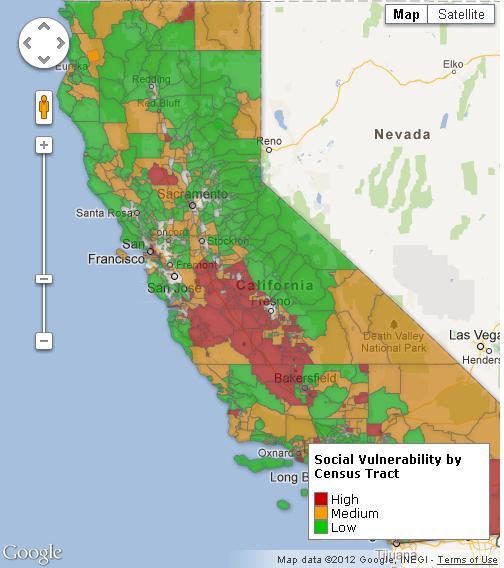
Scholars are busy attempting to predict the effects of climate change, including how it might harm people in some parts of the globe more than others.  A recent report by The Pacific Institute, sent in by Aneesa D., does a more fine-grained analysis, showing which Californians will be the most harmed by climate change.

They use a variety of measures for each Census tract to make a Vulnerability Index, including natural factors (like tree cover), demographic factors (like age), and economic factors (like income).  At the interactive map, you can see the details for each Census tract.  Their compiled index looks like this:

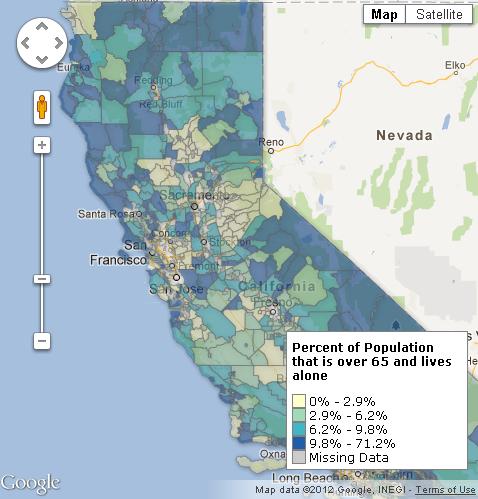
You can also see the Vulnerability Index for each measure individually.  Here is the data for the percent of people over age 65 who live alone, a variable we know increases the risk of death from heat wave.

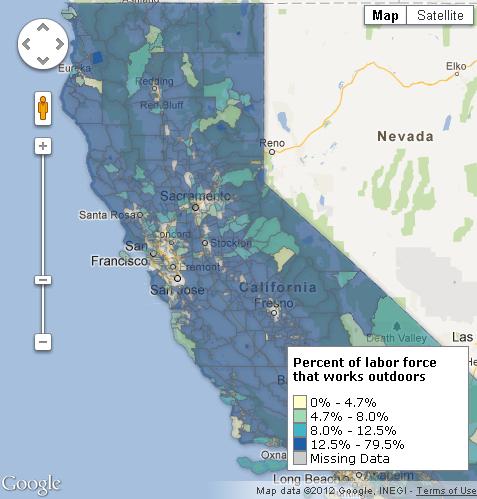
And here’s the data for the percent of workers who labor outside:

There’s lots more data at the site, but what’s interesting here is that, even in incredibly wealthy parts of the world, climate change is going to have uneven effects.  When it does, the most vulnerable people in the more vulnerable parts of the state are going to migrate to the other parts.  Most Californians don’t imagine that their cities will be home to refugees, but this is exactly what will happen as parts of California become increasingly difficult to live in.

Lisa Wade, PhD is an Associate Professor at Tulane University. She is the author of American Hookup, a book about college sexual culture; a textbook about gender; and a forthcoming introductory text: Terrible Magnificent Sociology. You can follow her on Twitter and Instagram.