nation: United States

In capitalism, owners of the “means of production” (things like land, factories, technologies, and natural resources, or the money to buy these things) employ labor to do the work of actually producing things.  If the system is working correctly, the value of the labor that goes into making something is worth less than the value of the thing.  This way the capitalist can sell the thing, pay the worker, and skim some profit off the top.

But how much profit?  In a less exploitative system, the worker is paid close to what his work is worth (after accounting for the expenses of maintaining the means of production). In a more exploitative system, the capitalist takes a larger chunk of the enhanced value for himself and gives less to the worker.

What kind of system do we have in the U.S.?  Let’s take a look at some data.

Over at Reports from the Economic Front, Martin Hart-Landsberg posted this graph. It shows that  workers have become increasingly productive since 1948 (i.e., they have created more and more surplus value).  Employers largely shared the increase in profitability with their workers… until the mid-1970s.  Since then, wages have remained stagnant even as worker productivity has continued to rise.  “In other words,” Hart-Landsberg writes, “the owners of the means of production have basically stopped sharing gains in output with their workers.”
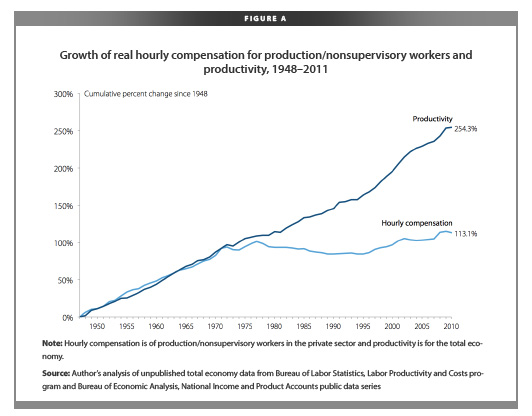
You wonder why the middle class is shrinking?  This is one reason.

Lisa Wade, PhD is an Associate Professor at Tulane University. She is the author of American Hookup, a book about college sexual culture; a textbook about gender; and a forthcoming introductory text: Terrible Magnificent Sociology. You can follow her on Twitter and Instagram.

Cross-posted at Montclair SocioBlog.

Air pollution is what economists call an “externality.”  It is not an intrinsic part of the economic bargaining between producers and consumers.  The usual market forces — buyers and sellers pursuing their own individual interests — won’t help.  The market may bring us more goods at lower prices, for example, but it can harm the air that everyone, in or out of that market, has to breathe. To create or protect a public good, the free market has to be a little less free.  That’s where government steps in.  Or not.

Case in point: My son and his girlfriend arrived in Beijing ten days ago.  The got-here-safely e-mail ended with this:

…was blown away by the pollution! I know people talk about it all the time, but it really is crazy.

And it is.  Here’s a photo I grabbed from the Internet:

Flickr creative commons by nasus89.

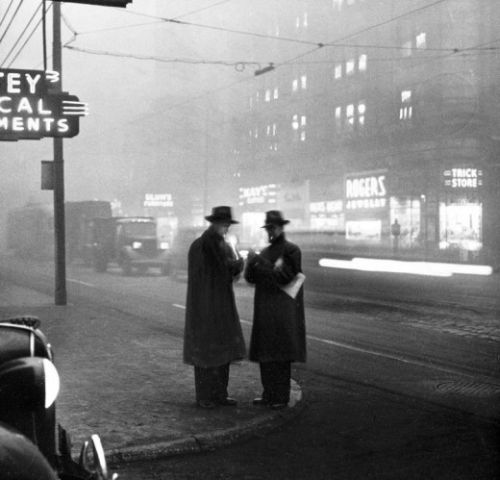
At about the same time, I came upon a this link to photos of my home town Pittsburgh in 1940.  Here are two of them:
Today in downtown Pittsburgh, the streetcars and overhead trolleys are gone.  So are the fedoras.  And so is the smoke.

The air became cleaner in the years following the end of the War.  It didn’t become clean all by itself, and it didn’t become clean because of free-market forces.  It got clean because of government — legislation and regulation, including an individual mandate.

The smoke was caused by the burning of coal, and while the steel mills accounted for some of the smoke, much of the it came from coal-burning furnaces in Pittsburghers’ houses.  If the city was to have cleaner air, the government would have to force people change the way they heated their homes.  And that is exactly what the law did. To create a public good — clean air — the law required individuals to purchase something — either non-polluting fuel (oil, gas, or smokeless coal) or smokeless equipment.*

Initially, not everyone favored smoke control, but as Pittsburgh became cleaner and lost its “Smoky City” label, approval of the regulations increased, and there was a fairly rapid transition to gas heating.  By the 1950s, nobody longed for the unregulated air of 1940.  Smoke control was a great success.**  Of course, it may have helped that Pittsburgh did not have a major opposition party railing against this government takeover of home heating or claiming that smoke control was a jobs-killing assault on freedom.

————————

* Enforcement focused not on individuals but distributors.  Truckers were forbidden from delivering the wrong kind of coal.

** For a fuller account of smoke control in Pittsburgh, see Joel A. Tarr and Bill C. Lamperes, Changing Fuel Use Behavior and Energy Transitions: The Pittsburgh Smoke Control Movement, 1940-1950: A Case Study in Historical Analogy. Journal of Social History , Vol. 14, No. 4, Special Issue on Applied History (Summer, 1981), pp. 561-588.

Jay Livingston is the chair of the Sociology Department at Montclair State University. You can follow him at Montclair SocioBlog or on Twitter.

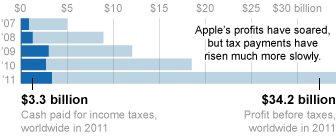
Apple’s profits more than quintupled in the last five years, but their tax burden has risen much more slowly.  Last year, just 9.8% of their profits went to taxes.   “By comparison,” writes economist Marty Hart-Landsberg, “Wal-Mart was downright patriotic — paying a tax rate of 24 percent.”

How does the company do it?  Hart-Landsberg summarizes the New York Times: “The answer is tax loopholes and a number of subsidiaries in low tax places like Ireland, the Netherlands, Luxembourg and the British Virgin Islands. ”  More details at Reports from the Economic Front.

Lisa Wade, PhD is an Associate Professor at Tulane University. She is the author of American Hookup, a book about college sexual culture; a textbook about gender; and a forthcoming introductory text: Terrible Magnificent Sociology. You can follow her on Twitter and Instagram.

Cross-posted at Montclair SocioBlog.

In recent Democratic primaries in Appalachian states, Obama lost 40% of the vote.  The anti-Obama Democrats voted for candidates like “uncommitted” (Kentucky), an unknown lawyer (Arkansas), and a man who is incarcerated in Texas (West Virginia).

Could it be that there’s racism at work in Appalachia?  Or is the anti-Obama vote based entirely on opposition to his policies?

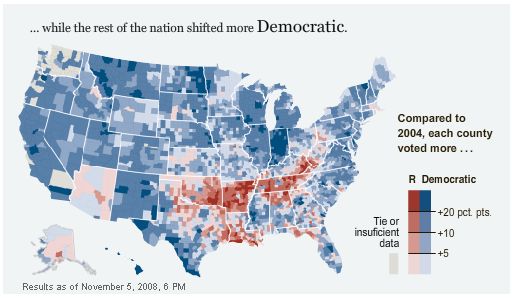
The 2008 Presidential election — Obama v. McCain — offers some hints.  For those with short memories, the Bush legacy — an unpopular war and an economic catastrophe — may have hurt the GOP.  In that election, the country went Democratic.  The Democrats did better than they had in 2004, the Republicans worse.  But not everywhere.  The Times provides this map:

Still, it’s possible that those voters in Appalachia preferred the policies of candidate Kerry to those of candidate Obama.  As Chris Cilizza says in in a Washington Post blog (here), the idea that race had anything to do with this shift is…

…almost entirely unprovable because it relies on assuming knowledge about voter motivations that — without being a mindreader — no one can know.

Cilizza quotes Cornell Belcher, the head of a polling firm with the Monkish name Brilliant Corners:

One man’s racial differences is another man’s cultural differences.

Right.  The folks in Appalachia preferred John Kerry’s culture.

I’m generally cautious about attributing mental characteristics to people based on a single bit of behavior.  But David Weigel, in Slate, goes back to the 2008 Democratic primaries – Obama versus Hillary Clinton.  A CNN exit poll asked voters if race was an important factor in their vote. In West Virginia and Kentucky, about 20% of the voters in the Democratic primary said yes.  Were those admittedly race-conscious voters more anti-Obama than other Democrats?

As Weigel points out, this was before Obama took office, before voters really knew what policies he would propose.  Besides, there wasn’t all that much difference in his policies and those of Hillary Clinton.

Cilizza is right that we can’t read voters’ minds.  But to argue that there was no racial motivation, you have to discount what the voters said and what they did.

Cross-posted at Montclair SocioBlog.

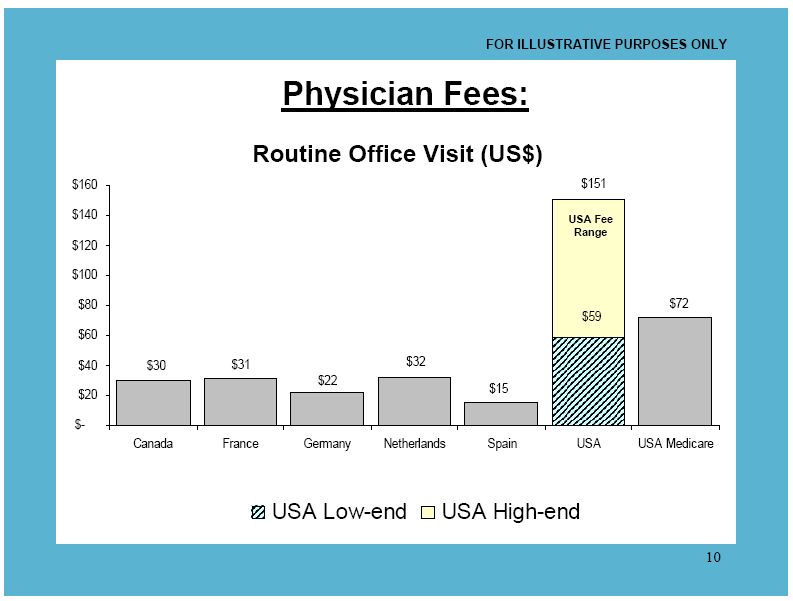
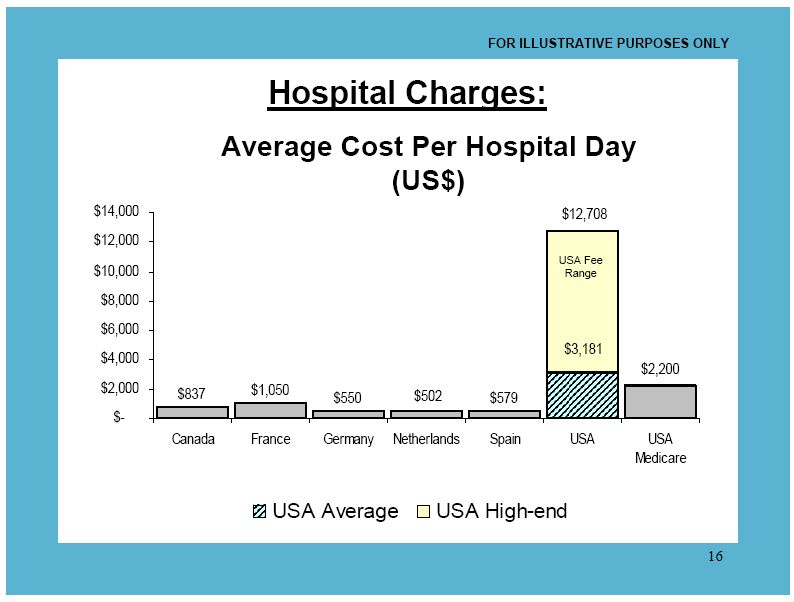
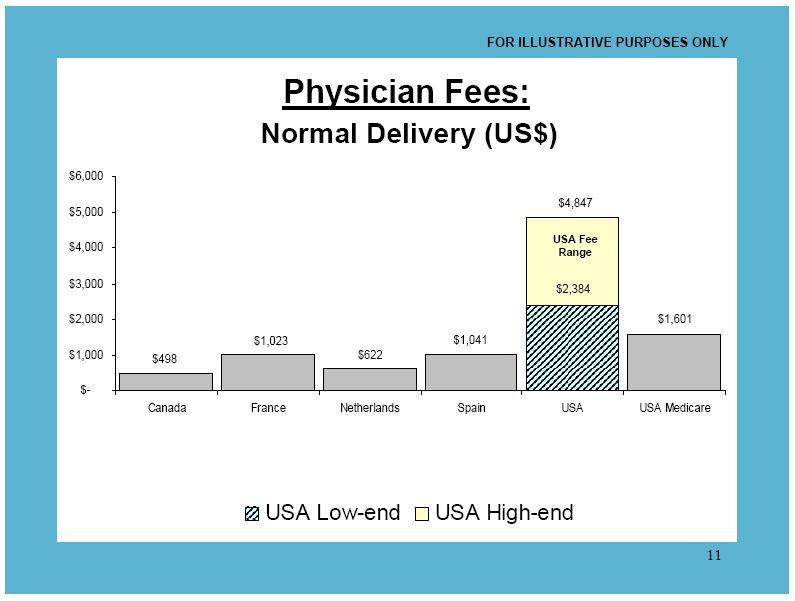
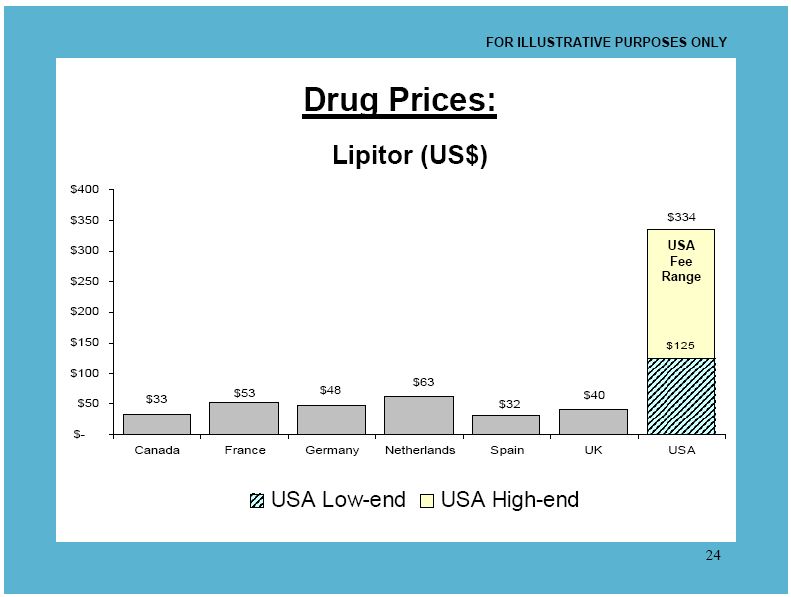
In case you wondered about what we in the U.S. pay for health care compared with those unfree unfortunates who suffer under various forms of socialized medicine, here are some graphs from 2009 showing the advantages of what is sometimes called “the best health care system in the world.”

The graphs are from the International Federation of Health Plans. I’ve selected only four — to show the relative costs* of

  • an office visit
  • a day in the hospital
  • a common procedure (childbirth without complications)
  • a widely used drug (Lipitor)

You can download all the charts here, but be warned: it gets boring. We’re number one in every chart, at least in this one category of how much we shell out.

Since we have the best health care in the world, this must mean that you get what you pay for. Our Lipitor must be four to ten times as good as the Lipitor that Canadians take.

Hat tip: Ezra Klein.

———————–

*These amounts are what providers are paid by governments or other insurers, not what the patient pays, which in many Eurpean countries is essentially nothing. See the footnotes for the tables in the original document. Or look at the comments on this at Boing Boing, a discussion which is remarkably civil (do they monitor comments?).

Here’s a neat story that reminds us that beneath “mainstream” culture are rich, unique, and sometimes whimsical sub-cultures:

In 1946 a clown aficionado named Stan Bult began collecting the faces of clowns painted onto blown out chicken eggs.  It became a U.K. tradition and, because it is considered a great breach of etiquette to steal another clown’s face, the eggs served as  a sort of “registry.”  The tradition crossed the pond in 1979 when Leon “Buttons” McBryde began a collection in the U.S.   Linda, McBryde’s wife, paints the eggs herself (they use goose) and they’ve now collected over 700 unique clown faces.

Check out this example from the British collection.

Clown Eggs via Learn Something Every Day.

Lisa Wade, PhD is an Associate Professor at Tulane University. She is the author of American Hookup, a book about college sexual culture; a textbook about gender; and a forthcoming introductory text: Terrible Magnificent Sociology. You can follow her on Twitter and Instagram.
The presence of vintage cars on Cuban roads is one of the  most iconic consequences of the 50-year-old U.S. trade embargo on the communist country.  Cubans, however, have had to preserve many other types of items that Americans routinely replace, while making do with the gradual deterioration that comes with age.

Offering another peek into this life, Ellen Silverman has been photographing Cuban kitchens.  NPR describes how they capture, among other things, the “grand, but crumbling” architecture,” mismatched kitchenware, and vintage appliances:

See the photographs of Cuban kitchens and more at her webpage.

Lisa Wade, PhD is an Associate Professor at Tulane University. She is the author of American Hookup, a book about college sexual culture; a textbook about gender; and a forthcoming introductory text: Terrible Magnificent Sociology. You can follow her on Twitter and Instagram.
Cross-posted at OrgTheory.

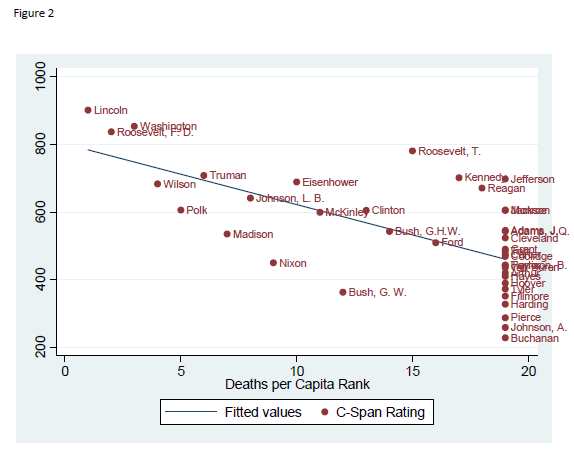
David Henderson and Zachary Gouchenour have a paper on the topic of presidential ratings. The finding is simple. American war casualties, as a fraction of the population, positively correlate with how historians rate U.S. presidents. More death = better presidents. The regression model includes some controls, like economic growth. Here’s the chart:

This is consistent with sociological research on state building, which has traditionally linked wars, bureaucratic growth, and tax collection. See, for example, Charles Tilly’s classic work “Warmaking and Statemaking as Organized Crime.”  My one criticism of the paper is that there is no measure in the regression that controls for “big legislation” (i.e., New Deal). Historians like law passing and it might account for some variation. I have a hunch that is how variation on the right hand side of the figure would be explained.

Henderson and Gouchenour then spin out the policy implication. Greatness rankings by historians may prompt presidents to start more wars. The historians may have more blood on their hands than we care to admit.

Adverts: From Black Power/Grad Skool Rulz

—————————

Fabio Rojas is an Associate Professor of Sociology at Indiana University. He is the author of two books: From Black Power to Black Studies: How a Radical Social Movement Became an Academic Discipline and Grad Skool Rulz: Everything You Need to Know about Academia from Admissions to Tenure.  Rojas’ academic research addresses political sociology, organizational analysis, and computer simulations.