Search results for embed

Shamus K. posted this clip from the show QI, in which Stephen Fry provides a  3 1/2 minute primer on the truly stunning statistics about U.S. imprisonment rates:

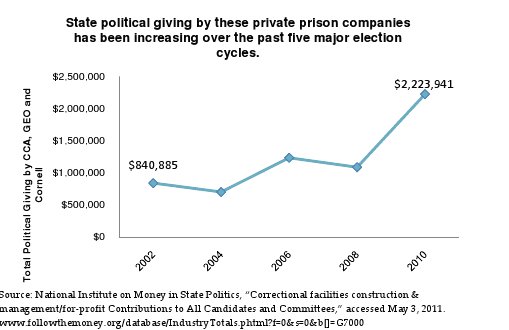
Relatedly, Tara B. provided a link to data posted at Think Progress about the growth in lobbying by private prison operators, who receive contracts to house prisoners; their political contributions nearly tripled between 2002 and 2010:
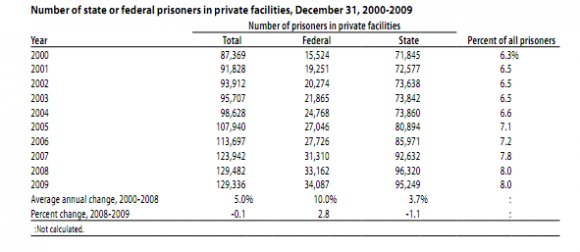
Private prisons are still a minor, but growing, segment of the U.S. prison system. As of 2009, they housed 8% of all federal and state prisoners:
For more on private prisons and their lobbying efforts, see our earlier post on the role of Corrections Corporation of America in passage of the Arizona anti-immigration law.

Dmitriy T.M. and Laura McD. sent in this awesome one-minute clip of 1950s commercials in which men insult their wives’ coffee. There’s something just stunning in the nature of the relationships portrayed. The men seem so entitled to their wives’ service, and so disdainful of her genuine efforts to please him. It’s sad.

Lisa Wade, PhD is an Associate Professor at Tulane University. She is the author of American Hookup, a book about college sexual culture; a textbook about gender; and a forthcoming introductory text: Terrible Magnificent Sociology. You can follow her on Twitter and Instagram.

A couple of years ago I posted a segment from Sesame Street featuring Jesse Jackson leading kids in a chant of “I am somebody,” including the lines “I may be poor” and “I maybe on welfare.” I wrote about the changes in public discourse about welfare since the 1970s, and how surprising the segment seems now.

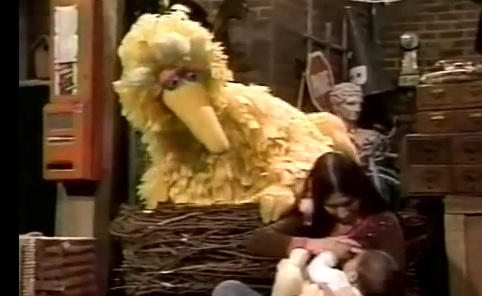
Aliyah C. sent in two more Sesame Street videos that illustrate changing norms, particularly regarding what we think it’s acceptable to expose children to. In both cases, a woman is breastfeeding her child in public (in the first case, openly; in the second, covered by a blanket) and explains to an onlooker that the baby is drinking milk from her breast:

Despite the fact that breastfeeding is widely hailed now as the ideal method of feeding babies, Aliyah said it was hard for her to imagine the topic being treated so casually on a children’s show now, or a woman using the word “breast” on Sesame Street without the show facing a lot of outrage.

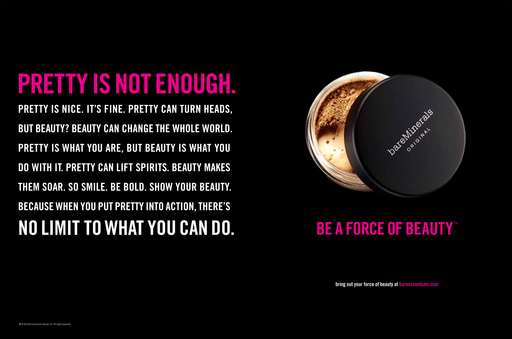
Bare Escentuals, a cosmetics company specializing in mineral makeup, has a new ad campaign that hinges upon how it found “the world’s most beautiful women…without ever seeing their faces.” Models and actresses showed up at the casting call and filled out questionnaires about themselves, which were given to Bare Escentuals. The company then cast the campaign solely on the basis of the questionnaires, choosing models not for their looks but for their “inner beauty,” posting a series of videos about the women on their website:

The campaign uses its selection process as a touchstone for all its taglines, pitting “pretty” against “beauty”: “Pretty can turn heads…beauty can change the whole world.” The commercials and print ads showcase the selected models in their daily lives: We see Lauren, a volunteer firefighter, hoisting a water hose from the ladder truck; we learn that Keri enjoys skateboarding and learned Farsi to communicate with her in-laws. This is meant to let us see the model meeting the company’s definition of beautiful by being themselves.

On its face this seems a logical, even praise-worthy, response to the constant barrage of unrealistic messages hurled at women every day about what appearance they should aspire to. But in so doing, the campaign commodifies women’s inner lives in addition to their beauty. Viewers are asked to reward the company for putting the models’ personalities on display; we’re expected to judge the models, albeit positively, for going above and beyond the model call of duty — she’s a volunteer firefigher! she has a sword collection! she blogs! By parading the inner (and formerly private) lives of the models for profit, the company appears to be showing us “real” women instead of the professional beauties that they are.

The customer takeaway is supposed to be that Bare Escentuals, more than other companies, recognizes that beauty comes from within. But the net effect is that we are shown how “being oneself” is now subject to standards of beauty. The same labor that has always gone into looking attractive — the labor that models have professionalized and monetized (smiling, appearing natural in front of the camera, speaking the company line) — is now applied to “being yourself,” which has been turned into a field of commodified emotional labor.

———-

Autumn Whitefield-Madrano writes at The Beheld, a blog exploring the role of beauty and personal appearance in our lives through essays, cultural analysis, long-form interviews, and more.

If you would like to write a post for Sociological Images, please see our Guidelines for Guest Bloggers.

Recently, Elizabeth Warren — Harvard Law professor and Massachusetts Senate candidate — was filmed discussing arguments that efforts to raise taxes on extremely high income earners is “class warfare,” an increasingly common refrain. She responds to this line of argument by questioning the individualist narrative of wealth — that is, that people who are rich did it all on their own, and thus owe nothing to society. As she points out, taxpayer-funded infrastructure and services — from highways to law enforcement to widely-available education — are essential elements of such financial success stories. But current discourse about wealth and taxes obscures the social nature of wealth creation, portraying taxation as unfair taking rather than a fair return on the public’s investment:

Transcript after the jump.

more...

Lately we’ve seen a number of instances in which men are portrayed as babies.  We saw it in a Jack in the Box commercial featuring men being pushed around in a stroller, in the recent advertising for the movie Life as We Know It, and now Australian Ikea has opened Manland, a “day care” for men, a place where women can drop off their husbands while they shop. Thanks to Andri, a brand new student of mine, and readers YetAnotherGirl, Laura E., and LM for sending it in.

The idea that men are like babies is pretty damn obnoxious and should be offensive on the face of it (see especially the Jack in the Box commercial). But this is more insidiously problematic even than that.  It tells women that they can’t expect men to be grown ups.  And if men can’t be grown ups, they we certainly can’t expect them to do their share of the dishes or the hard work of raising families or, for that matter, be a true and equal emotional partner.

We see a similar pattern of insulting men in a way that undermines women  in the new “mediocre man” genre.  As I’ve written elsewhere, the mediocre man (think Judd Apatow movies and Hard Lemonade commercials):

…is a self-deprecating character who undermines idealized masculinity by being likeable despite being decidedly non-ideal…  The viewers are meant to identify with the mediocre men, who revel in each others’ company, happy to be dudes free from the clutches of the women in their lives, even if they aren’t sleeping with supermodels.  The mediocre man may be kind of a loser, indeed, but he can thank God he’s a man.

In both the man-as-child and the mediocre man tropes, then, the portrayals manage to simultaneously mock guys and support patriarchy. Pretty amazing.

Lisa Wade, PhD is an Associate Professor at Tulane University. She is the author of American Hookup, a book about college sexual culture; a textbook about gender; and a forthcoming introductory text: Terrible Magnificent Sociology. You can follow her on Twitter and Instagram.

In a previous post I discussed data showing the growing income inequality in the U.S.: the middle class is shrinking, the poor are getting poorer, and the rich are getting richer. It turns out that corporations understand what is happening and they are responding.  In brief, they are letting go of the middle class as a market and restructuring their offerings to appeal to the top and bottom of the income distribution.

Below the jump (warning, it automatically starts playing with sound) is an enlightening five minute discussion of this new business strategy on Daily Ticker video:

more...

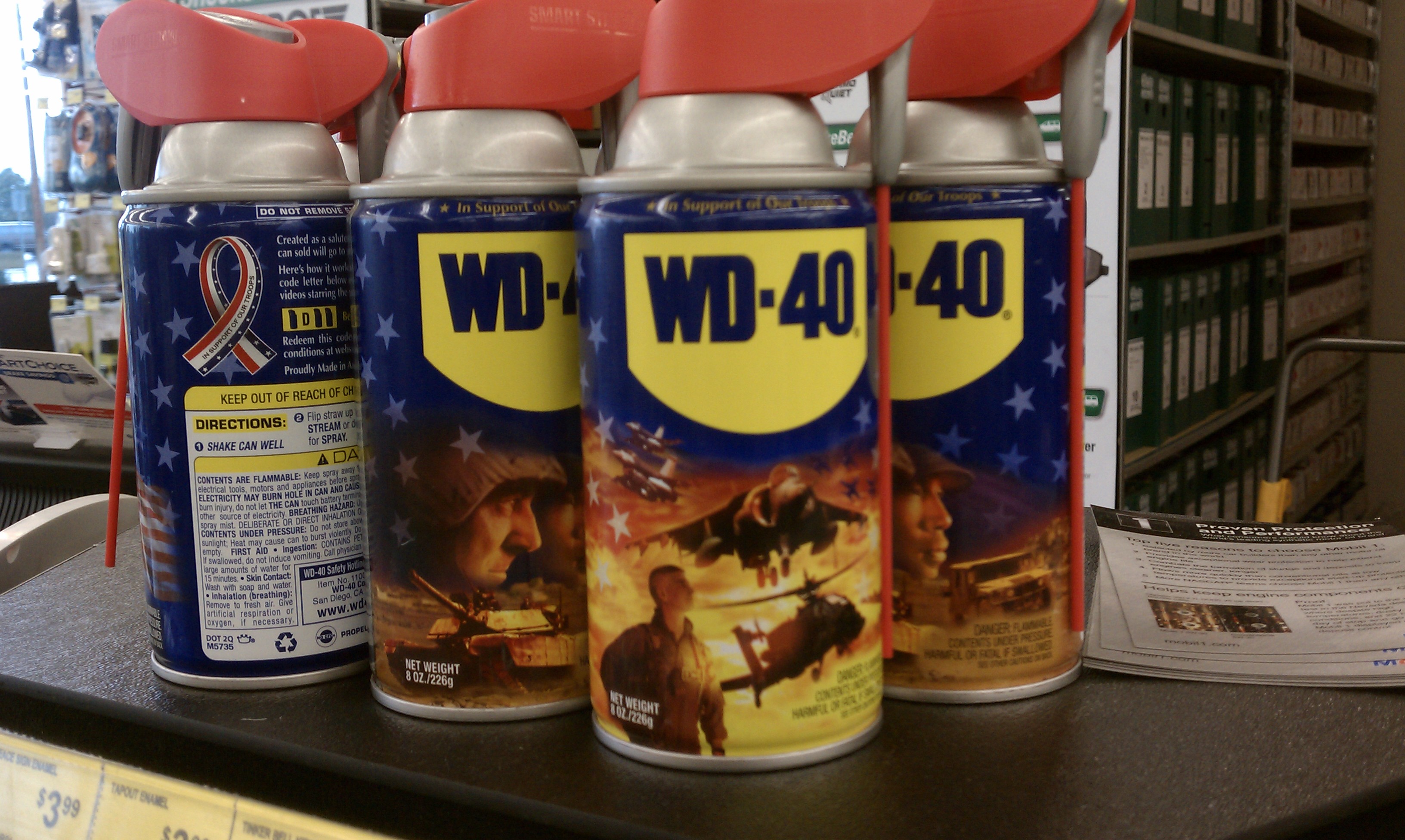
Recently, Raz sent in this image of cans of WD-40, part of their Collectible Military Series, for sale at an auto parts store:

The types of war-related advertising we see can give us insights about how average Americans are connected to, and affected by, different wars. During many U.S. wars, contributing to the war effort was the duty of every citizen; this is particularly apparent with World War II. The draft, the deployment of some 16 million Americans, and public calls to purchase war bonds and ration food meant that war was nearly everyone’s concern. In contrast, the current War on Terrorism mostly only impacts those connected directly to it—military families. There are no widespread calls to ration, buy war bonds, or otherwise support the war effort through employment, growing vegetables, saving scrap metal, or other changes to our daily lives. My own research shows that members of military families feel the war is ignored and forgotten by most Americans. They feel isolated in their daily anxieties and their efforts to support their loved ones.

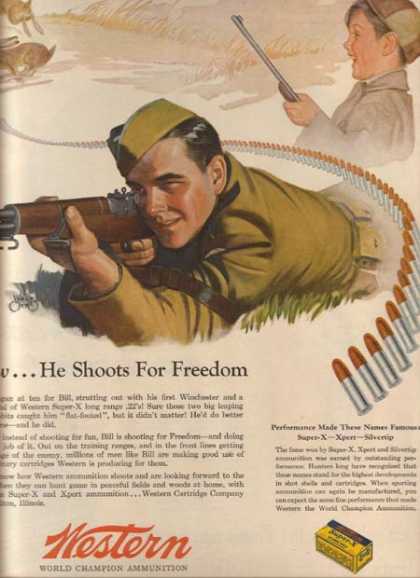
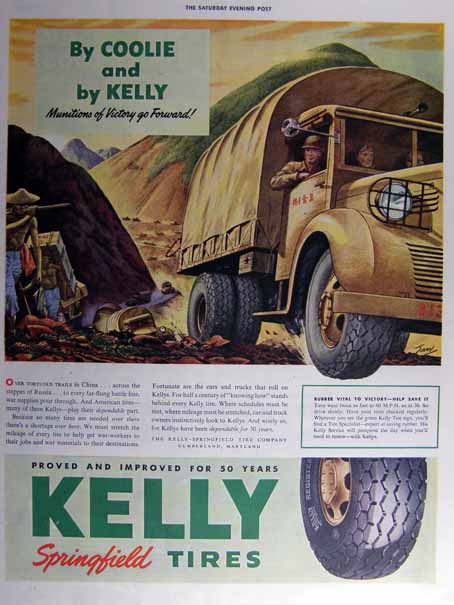
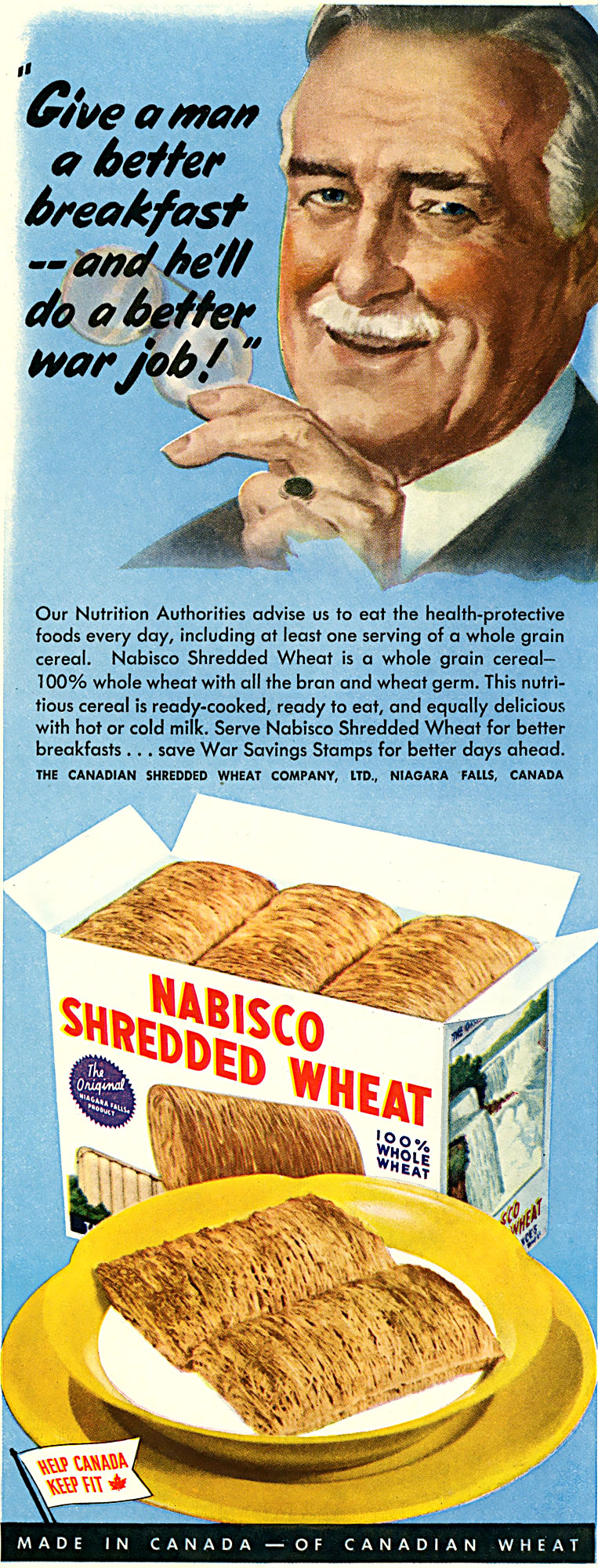
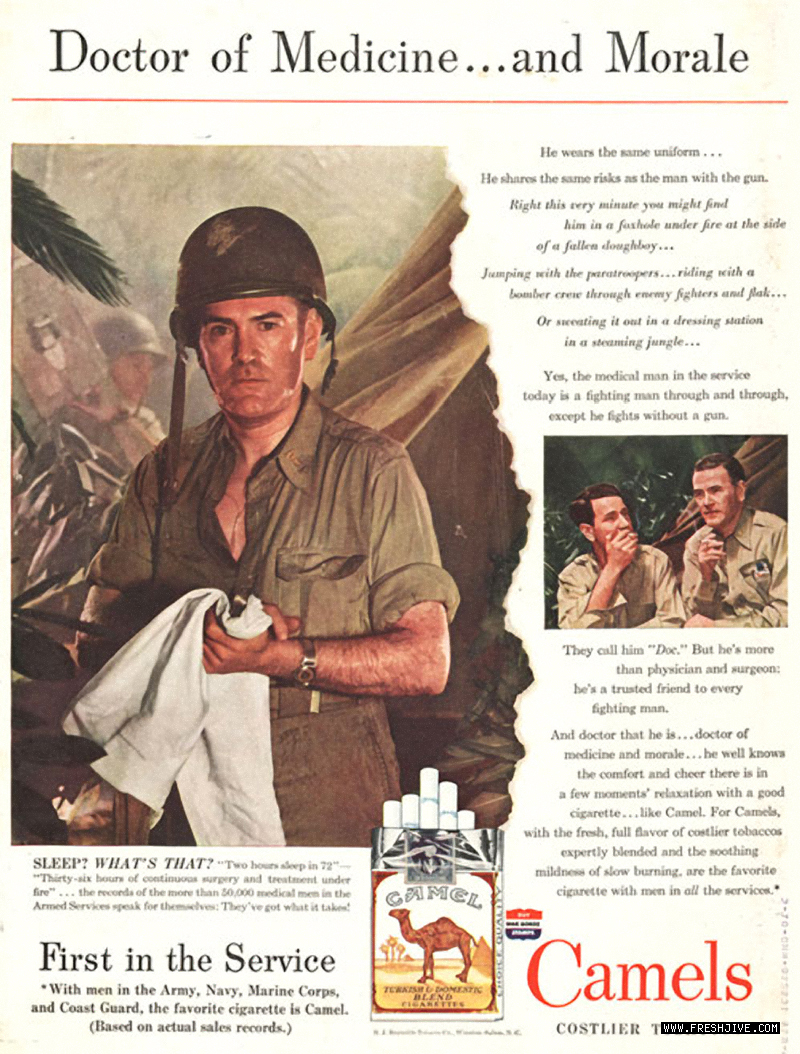
Products like the WD-40 Collectible Military Series were more common during WWII than they are now. During WWII advertising used the war cause and feelings of patriotism to sell a wide range of products that, ads argued, would help the U.S. win. Some were clearly connected to the war effort:

With others, the connection was much less obvious or direct:

Both Shlitz and Camel donated to the war effort. Similarly, with their “Drop and Give Me 40” campaign, WD-40 is donating part of their profits to charities that support service members and their families:

For each can purchased from March 2011 through May 2011, WD-40 Company donated 10 cents to three charities that help active-duty military, wounded warriors, retired veterans and their families. On Memorial Day, WD-40 Company presented $100,000 checks to each of the following military charities: Armed Services YMCA, Wounded Warrior Project, and the Veterans Medical Research Foundation.

Although military-themed products (aside from “support the troops” t-shirts, stickers and pins that are widely available) are not as common as they were during WWII, some companies have come out with patriotic advertising.

Goodyear has “support the troops” tires, sold and marketed at NASCAR races:

An Anheuser-Busch commercial shows ordinary Americans stopping their everyday lives to thank the troops. There is no mention of the company until the very end, and nothing at all about beer:

American Airlines has a similar advertisement depicting various Americans being supportive the troops before and during their flight:

The messages in these recent ads are markedly different than the WWII messages of everyone taking part and working toward victory, reflecting changing relationships between war efforts and the average citizen. No reminder of the war was necessary in the 1940s—war was a part of everyday Americans’ lives. Current ads, like the WD-40 series, often serve less as a call to specific action than as a reminder that the war exists, as a reminder to thank the troops and support service members. It’s a different type of message for a different type of war, one that only involves a small fraction of Americans and is often largely invisible to everyone else.