Search results for embed

For the last week of December, we’re re-posting some of our favorite posts from 2011.

————————

In this hilarious two minute video, twin toddlers practice having a conversation. They don’t really know words, but they know HOW to do it. They’ve figured out how to sound sure of themselves, how to sound inquisitive, how to gesticulate, how to aim their efforts at a second person, and how to take turns. They’ve learned, in other words, the rules of talking to another person, even before they’ve learned how to talk. A fun example of socialization.

For more really great examples of children learning to act like grown ups, see our posts on the baby worshipper, the baby preacher, the baby rapper, and the baby Beyonce. Via Blame it on the Voices.

Lisa Wade, PhD is an Associate Professor at Tulane University. She is the author of American Hookup, a book about college sexual culture; a textbook about gender; and a forthcoming introductory text: Terrible Magnificent Sociology. You can follow her on Twitter and Instagram.

For the last week of December, we’re re-posting some of our favorite posts from 2011.

————————

Hennessey has previously treated us to his recipe for being a successful artist. In this 3-and-a-half minute video, he helps us understand what art is. Tongue-in-cheek, be forewarned, and with plenty of language that is NSFW:

Thanks to Duff McDuffee for introducing me, and now us, to The Pharaoh Hennessey.

Lisa Wade, PhD is an Associate Professor at Tulane University. She is the author of American Hookup, a book about college sexual culture; a textbook about gender; and a forthcoming introductory text: Terrible Magnificent Sociology. You can follow her on Twitter and Instagram.

For the last week of December, we’re re-posting some of our favorite posts from 2011.

————————

In Sway: The Irresistible Pull of Irrational Behavior, Ori and Rom Brafman discuss a contestant on Qui Veut Gagner des Millions?, the French version of Who Wants to Be a Millionaire?, who asks the audience for help with the question, “Which of these revolves around the Earth?” His options are the sun, the moon, Venus, and Mars. While it might be surprising that he doesn’t know, more shocking is the result of the audience poll — 56% say the sun:

How can we explain this? The easiest answer, and the video’s title, is that French people appear to be stupid, or were never informed about the Copernican Revolution. But the Brafmans have an explanation based on different cultural attitudes toward reality shows and, ultimately, ideas about fairness.

The general outlines of Who Wants to Be a Millionaire? are the same regardless of country. But distinct cultural patterns have emerged in how audiences act when asked for help. In the U.S., contestants can count on the audience’s goodwill; regardless of the question asked, audiences appear to do their best to help contestants out and the Brafmans report that data shows the audience is right over 90% of the time. I must admit it had never occurred to me that audiences would do anything other than try to be helpful. Though I don’t watch game shows now, as a kid I regularly watched The Price Is Right, among others, with my family, and we always inherently rooted for the contestant, cringing if they seemed to make a bad choice and rejoicing if they won big. We truly wanted these complete strangers to win.

But not all national audiences are so cooperative. When the show was introduced in Russia, contestants quickly learned to be wary of asking the audience for help because Russian audiences frequently mislead them, intentionally giving the wrong answer. It doesn’t seem to have anything to do with the players or the questions they ask for help on.

In France, audiences seem to fall in the middle. They don’t regularly attempt to trick players, as Russian (and according to my googling, Ukrainian) audiences do. But unlike U.S. audiences, they don’t seem willing to help under any circumstances, either. They appear to intentionally give the wrong answer if the contestant asks for help on a question the audience perceives as too easy. If they think the player ought to know the answer they give the wrong response, apparently thinking the contestant deserves to lose if they’re so stupid. In the video you can hear audience laughter when Henri decides to go with the results of the audience poll.

Ori and Rom Brafman suggest this relates to notions of fairness, which have been shown to vary widely by culture. They say that in the U.S., we think it’s fair for people to win large sums of money even if they seem dumb, while in France, there is more concern about whether the individual deserves to win. They consulted historians of Russian society who suggest audience behavior there results from a general mistrust of those who gain sudden wealth. However, they provide no data to directly connect the audience members’ intentional wrong answers to cultural perceptions of fairness more broadly, so I’m somewhat hesitant about this theoretical leap. If you’re an enterprising grad student looking for a dissertation topic, perhaps you can take this project on and get back to me with your results.

But I think this topic is also interesting for the way it highlights the intersection of globalization and local cultures. Who Wants to Be a Millionaire?, like other reality shows such as the various varieties of Idol, are international franchises (Millionaire is owned by Sony), designed to be easily transferable to and implemented in many countries with the same basic blueprint — simply add local talent and you’ve got a successful TV show. But as the variation in Millionaire shows, differences inevitably creep in as a global product or process is used or interpreted on the local level, sometimes in superficial ways but other times to a degree that significantly alters the original product.

Thanks to Kelly V. for the tip about the book!


For the last week of December, we’re re-posting some of our favorite posts from 2011.

————————

In this 26-minute talk, philosopher Gerald Allan Cohen offers a wonderfully eloquent critique of capitalism. His critique revolves around common defenses. He suggests that even the existence of people who have earned their riches legitimately and through their own wit and work do not justify a system of private property. He contests the idea that we are all better off under capitalism compared to other economic systems, suggesting that capitalism retards the human potential of workers nefariously and by design. And he disagrees with the claim that economic inequality is inevitable. Economic inequality, he contends, will someday be seen as an injustice. Capitalism was an important stage, he concludes, and one that we need to outgrow.

I recommend that everyone take a listen, though I’ll admit it starts off kind of goofy:

Part I:

Part II:

Thanks to Chris Bertam at Crooked Timber for putting these videos up.

Lisa Wade, PhD is an Associate Professor at Tulane University. She is the author of American Hookup, a book about college sexual culture; a textbook about gender; and a forthcoming introductory text: Terrible Magnificent Sociology. You can follow her on Twitter and Instagram.

Time for another round-up of gendered kids’ items!

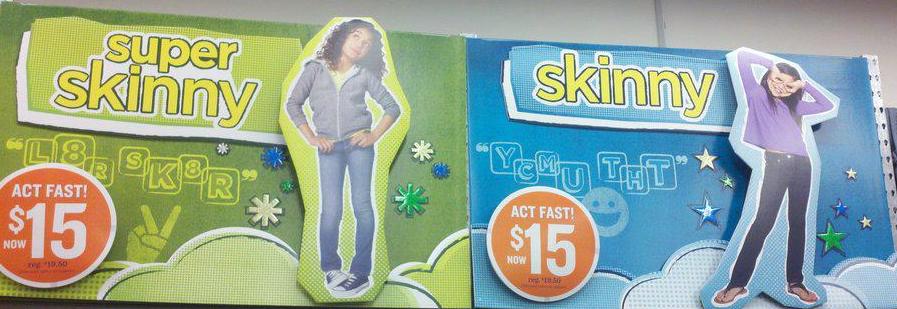
Will L. noticed something interesting recently at Old Navy. The boys’ section offered two styles of jeans, Skinny and Regular:

But when he looked at the corresponding section in the girls’ clothing, he found not Skinny and Regular, but Skinny and…Super Skinny:

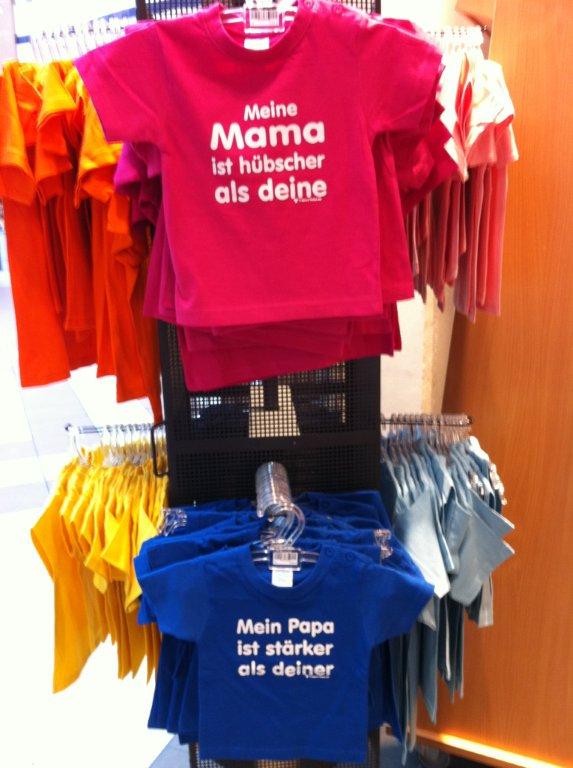
Caro Reusch sent us an example of kids;’ t-shirts with messages about what we value for men and women. She saw the following at a mall in Berlin:

The blue one says “My daddy is stronger than yours,” while the pink announces, “My mommy is prettier than yours.”

Similarly, Lindsey B. saw two themed bibs for sale at Target. The blue bib is a doctor and the pink one is a ballerina:

Shantal Marshall, a postdoc student at UCLA with a Ph.D. in social psych and blogger at Smartie Pops, noticed that Crayola has a new product out, the Crayola Story Studio.  It lets you upload a photo of yourself, have it turned into a cartoon, and then it’s inserted into one of 3 themed templates: Disney Princess, Spiderman, or Cars. You can then print off various versions of coloring books based on those templates. The commercial for the Spiderman version shows a boy excitedly becoming a superhero:

For the Disney Princess version, we see a girl excited to become a princess, then dancing in the background with her very own Prince Charming:

As Shantal said, it’s a bit dispiriting that Crayola’s slogan for these items is “give everything imaginable,” but the pre-existing templates, and their marketing, don’t seem to include an imaginable alternative to the “boys = superheroes” and “girls = princesses” division we see so often in kids’ toys.

Madelyn C. saw a store in Warsaw, Poland, that just goes ahead and makes the gendered division of the toy industry explicit:

Finally, Jessica M. sent in a link to a GOOD post by Christopher Mims about the Toy Industry Association’s 2011 Toy of the Year Awards. There are general categories of toys, such as educational, innovative, and action, but of course also girl and boy categories (also, I personally can’t think of “boy toy of the year” without thinking of Madonna’s outfit in her “Like a Virgin” performance at the first MTV Video Music Awards, but maybe the ’80s are sufficiently behind us that the phrase resonates differently for most people). Anyway, Mims discusses the gendered messages in the commercials for the nominees in the two categories. Among other things, the categorization is rather confusing. Hexbugs are nominated in the boy category, even though commercials for them show girls as well:

Also, Mims points out that the boys’ category “includes a strong undercurrent of Beyond Thunderdome via WWE.” Exhibit A: The commercial for Beyblade Metal Masters, “performance tops” to be used in “strategic battles”:

Playing with tops has gotten super hardcore, I guess. Probably they should look into a sponsorship from an energy drink.

L. Edmondson sent in a commercial for Littlewoods, a catalog-based company in the U.K. Like much advertising around this time of year, it reminds us that holidays are women’s work.  It is your mother who is responsible for buying gifts, but also for making holidays magical.  So you know who to blame if you’re left unsatisfied.

Lisa Wade, PhD is an Associate Professor at Tulane University. She is the author of American Hookup, a book about college sexual culture; a textbook about gender; and a forthcoming introductory text: Terrible Magnificent Sociology. You can follow her on Twitter and Instagram.

In the video below, borrowed from Geoffrey Arnold’s blog on heightism, people on the street in New York are asked to evaluate the likely occupational and class status of two men: one short, one tall.  The results are striking (if also edited and non-random, but still):

See also Arnold’s guest posts introducing the concept of heightism as a gendered prejudice and discussing heightism (and other icky stuff) at Hooters.

Lisa Wade, PhD is an Associate Professor at Tulane University. She is the author of American Hookup, a book about college sexual culture; a textbook about gender; and a forthcoming introductory text: Terrible Magnificent Sociology. You can follow her on Twitter and Instagram.

Late Night TV host Jimmy Kimmel encouraged his viewers to film their children getting early Christmas presents that they would surely hate.  The result is a collection of children acting badly: bursting into tears, saying they hate their parents, lecturing them on proper gift giving protocol, etc.  It’s funny and also a great illustration of the gift-giving rules that Theodore Caplow meticulously lists in his article, Rule Enforcement Without Visible Means: Christmas Gift Giving in Middletown (pdf) (btw: this is the very first article I assign in Soc101).

(UPDATE: I was quoted briefly on this phenomenon in a New York Times story on the prank.)

In a number of cases, the gift is considered bad because the recipient is a boy and the gift is for a girl.  One boy, for example, gets a Hello Kitty gift, another gets a pop star-themed coloring book.  The boys’ reaction at being presented with a girls’ gift reveals their internalization of androcentrism, the idea that masculinity is superior to femininity.   They express both disgust and, in some cases I think, fear at being poisoned by contact — especially such personal contact as “I got this for you” — with girlness.

More posts on androcentrism: “woman” as an insult, being a girl is degradingmaking it manly: how to sell a car, good god don’t let men have long hairdon’t forget to hug like a dudesaving men from their (feminine) selvesmen must eschew femininitynot impressed with Buzz Lightyear commercialdinosaurs can’t be for girls, and sissy men are so uncool.

Lisa Wade, PhD is an Associate Professor at Tulane University. She is the author of American Hookup, a book about college sexual culture; a textbook about gender; and a forthcoming introductory text: Terrible Magnificent Sociology. You can follow her on Twitter and Instagram.