Search results for embed

Yesterday I posted about the extraordinary number of people in Louisiana prisons.  The rise in imprisonment mirrors the U.S. growth that began with the so-called war on drugs, but was also triggered by a crisis in the early 1990s, after two decades of growth.  A federal court ordered Louisiana to reduce overcrowding in prisons, which had risen to an inhumane level.  They  had to either let criminals out or build more prisons.  They did the latter.

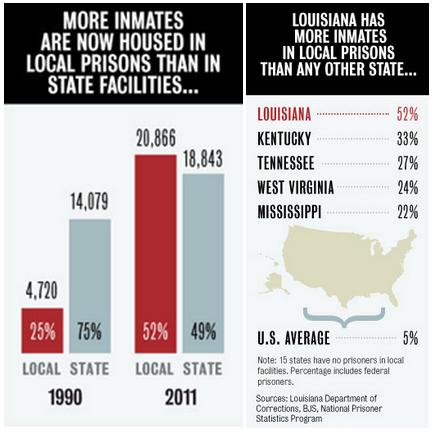
Instead of building more state-funded prisons, though, for-profit prisons were built by sheriffs and residents of local parishes.  Today there are more inmates housed in local, for-profit prisons than in state prisons (left) and Louisiana has more inmates in private prisons than any other state in the U.S. (right):
Why should we care if so many prisoners are housed in private, for-profit institutions?

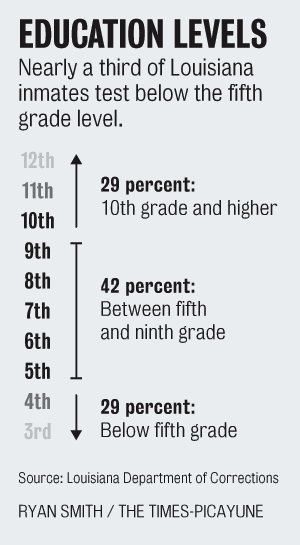
The conditions in these prisons are worse than those in state prisons, especially when it comes to quality of life (like the opportunity to develop hobbies or practice their religion) and rehabilitative services (like high school equivalency classes and job training). These are desperately needed services; the average Louisiana prisoner has a 7th grade education and nearly a 3rd read below a 5th grade level:
State facilities simply spend more money, while for-profit prisons skim as much off the top as possible.  Writes reporter Cindy Chang:

An inmate at the Angola state penitentiary costs $63.15 a day, compared with the $24.39 sheriff’s per diem. State facilities house the sickest and oldest, but [Department of Corrections] Secretary Jimmy LeBlanc admits part of the differential is the lack of educational offerings.

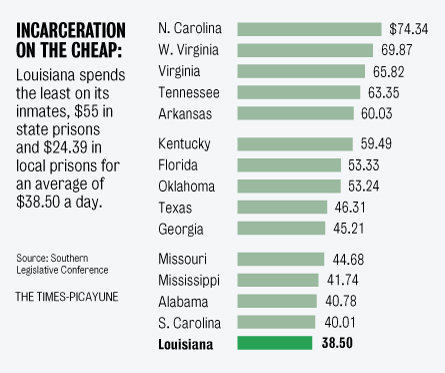
In fact, Louisiana spends less on its prisoners (in state and private facilities combined) than any other state in the U.S.:
Law enforcement officials and parish residents may not like what’s happened in Louisiana, but many feel trapped.  For-profit prisons are sustaining local communities: they fund police departments and employ residents. Often they are the only local jobs with decent wages and benefits. Those residents support the local economies and keep small towns alive.

In this short video, an employee talks about the occupational opportunity the prison provides:

Many Louisianans, then, see the harsh sentences and high imprisonment as a price worth paying.  Says Sheriff Charles McDonald: “I know it sounds crazy and impersonal… but we’re stuck with this jail. We can’t walk away. We’ve got investors, employees.”

Lisa Wade, PhD is an Associate Professor at Tulane University. She is the author of American Hookup, a book about college sexual culture; a textbook about gender; and a forthcoming introductory text: Terrible Magnificent Sociology. You can follow her on Twitter and Instagram.

The prisoner’s dilemma is a concept used to help explain situations in which individual actors may pursue their own self-interest even in situations where they would all be better off if they cooperated and acted for the good of the group. In this short video posted at Scientific American, Michael Moyer explains the prisoner’s dilemma puzzle and how it helps explain situations such as the global nuclear arms race:

See also: Game Theory and the Prisoner’s Dilemma.

This is the second of two posts about cruel practices in horse industries. The first was about horse racing.

Yesterday we covered the abuse of horses in horse racing; in this post we discuss a recent video released by the Humane Society. The video highlights an instance of a larger issue, which is how arbitrary human tastes can create incentives for cruelty.

The concern revolves around the Tennessee Walking Horse (TWH), a breed developed in the U.S. in the late 1800s and bred to have smooth gaits, including their distinctive “running walk,”  that are unusual in most breeds. Over time, a more exaggerated version became popular among show judges and spectators at TWH shows; called the “big lick,” it requires horses to shift their weight to their back legs and pick their front legs high off the ground. Fans enjoyed the flashy, unusual movements and horses that performed the gait began taking home more prizes. This created a powerful incentive to get horses to exhibit the unnaturally exaggerated gait.

How do you get this gait? It’s possible to get some horses to do so through careful training. But to speed up the process, or for horses that aren’t learning, trainers developed a range of techniques. These first two are still allowed, under varying circumstances, during training and in the show ring:

  • Using padding and weighted shoes to change how the horse stands and moves its feet (akin to how high heels shift a person’s weight and stance).
  • Placing chains around the tops of their hooves to encourage them to pick their feet up more highly than they would otherwise (presumably they’re irritating).
However, some trainers use prohibited versions of these two items, using pads and chains that were not within the allowable height and weight.
The next three techniques are illegal, but many insiders argue that they are still common.  I warn you now: much of this post from this point on will be very upsetting for many readers.
  • Place screws or nails in different parts of their front hooves or soles to cause discomfort.  While horses’ hooves are hard, the soles are quite sensitive.  The screws or nails make it painful for the horse to put its front legs down, so it shifts its weight back, helping to attain the gait.
  • Intentionally cut the horse’s front hooves so short that the sensitive sole hits the ground directly, which is extremely painful (think of what happens if your fingernail gets cut or broken off too short).
  • Coating a horse’s hooves and lower legs with caustic substances, then wrapping them in plastic wrap, for as long as several days, until they’re very sore — a process called, aptly, “soring.” This causes the horse to shift weight to its back legs in an effort to reduce the pain from the front feet. This is often used in conjunction with chains, which irritate and rub up against the raw skin.

Many inspectors argue that these practices, once widely accepted in the industry, are still common today. Recently the Humane Society released undercover footage of training practices at Whitter Stables, a facility in Collierville, TN that has been the center of a federal investigation. It is a very distressing video that includes many of the practices listed above, as well as horses being whipped when they have difficulty standing:

In 1970, Congress passed the Horse Protection Act, which outlawed the exhibition of sored horses. So trainers have developed techniques to hide them; they paint horses’ hooves and legs to cover evidence of soring or use boots to cover tacks embedded in their hooves.

They also beat them so that they learn not to show any sign of pain when inspected before a show.  They do this by simulating an inspection and then punishing the horse if it shows any signs of distress (e.g., punching or hitting them in the face or administering an electric shock).  Eventually horses learn that if they flinch, they get hurt twice; hiding signs of pain prevents the infliction of more suffering.

Trainers may also use a fast-acting but short-term numbing agent to reduce the pain just long enough to pass inspections. Other trainers and owners simply leave a show if word gets out that USDA inspectors were present.

The Tennessee Walking Horse Breeders’ and Exhibitors’ Association argues that these practices are not widespread. However, in 2006 the last class in the World Grand Champion competition at the Tennessee Walking Horse Celebration (the TWH show equivalent of the Kentucky Derby, in terms of importance) was canceled because of the 10 entered horses, 5 did not pass the inspection and another was removed by the owner without being inspected. In 2009, the USDA issued over 400 violations at the Celebration.

A USDA report states the organization only had the resources to send their own veterinarians to 6% of official TWH shows in 2007; the other 94% were inspected by individuals hired, trained, and licensed by organizations sponsoring shows, a system the USDA found to be plagued by conflicts of interest. The report also noted that hostility toward USDA inspectors is so high that they routinely bring police or armed security with them to shows.

Jackie McConnell, the trainer in the video, has been indicted on federal charges. But without sustained attention and commitment to punishing violators, the problem will continue due to the pressure to produce horses that satisfy the tastes that have become entrenched in the industry. As one industry insider explained to Horse Illustrated magazine in 2004,

As long as the big lick wins at shows, the trainer must produce it to stay in business….The day a trainer stops producing big lick horses is the day all the horses in his or her barn are removed and taken to another trainer.  The pressure is enormous.

—————————

Gwen Sharp and Lisa Wade are professors of sociology. You can follow Gwen on Twitter and Lisa on Twitter and Facebook.

Gwen Sharp is an associate professor of sociology at Nevada State College. You can follow her on Twitter at @gwensharpnv.

In this talk, statistician Hans Rosling looks at whether, globally, religion impacts national fertility rates. His conclusion? Nah, not really. He also points out that while fertility rates are certainly correlated with national income levels, it’s no longer true that a nation must be wealthy before experiencing significant reductions in fertility rates. While all of the nations with fertility rates of 6 or more children per woman are, indeed, quite poor, many similarly poor countries have fertility levels similar to that in much wealthier nations — an average of about 2 children per woman.

A crazy character named Andrew Hales, a student at Utah Valley University, has put up a series of You Tube videos in which he — knowingly or not — does a classic Sociology 101 experiment called “norm breaching”: break a simple social rule and see how people react to you.  I’ll put my favorite first, but they’re all worth a chuckle:

Holding the door open for people that are (too) far away:

Walk (too) close to people and get in their way:

Staring at people:

Some of his transgressions are more out there than others, but these experiments show how uncomfortable others can be made by even mild norm breaking.

Lisa Wade, PhD is an Associate Professor at Tulane University. She is the author of American Hookup, a book about college sexual culture; a textbook about gender; and a forthcoming introductory text: Terrible Magnificent Sociology. You can follow her on Twitter and Instagram.
Network effect is a concept from economics that explains situations in which something becomes more valuable as more people use it. The classic example is the telephone; as more people and businesses adopted telephones, they became more useful (you could call a larger number of people you might wish to contact). More usage increased the value of the product, both for existing users and potential users. Social media work much the same way — an issue Google has faced as they try to pull enough users into Google+ to make it competitive with Facebook.

Over the weekend Matthew Hurst posted a video at Data Mining that illustrates the network effect…with dancers using an open area at the Sasquatch music festival. The video starts out a little slow; one guy starts dancing in the field, and a second guy joins him. For about a minute, it’s just the two of them. At 0:54, a third dancer appears. Through all of this, the surrounding crowd mostly ignores them, showing no inclination to participate. But at 1:12, a couple more people arrive, following immediately by more, and suddenly we’ve reached a tipping point: that open area is now a highly desirable spot to dance. People start running in from all directions, and many who had been ignoring the dancers suddenly jump up and join. It’s a great illustration of instances in which use drives more and more use:

Many of you may have seen a video featuring Reverend William Barber speaking out against North Carolina’s Amendment One, which banned same-sex marriages (and which was approved by voters on Tuesday). The video is heartfelt and passionate, and is also a great example of the importance of how we frame issues in social movements.

Reverend Barber argues that media coverage of the amendment has asked the wrong questions. Whether same-sex couples should be allowed to get married isn’t the core issue here, he says; what’s really at stake is whether the majority should get to vote on which rights will be guaranteed to those in the minority, a decision he sees as a dangerous standard in a nation that has used it previously to exclude racial/ethnic minorities, women, and the poor from the full benefits and protections of citizenship. This reframes the amendment from an issue about same-sex marriages to a broader question about rights, equal protection, and the dangers of codifying inequality into our governing documents:

In this three-minute clip, sociologist Shelley Correll discusses her research on the “motherhood penalty.”  The phrase refers to the finding that being a mom specifically, not just being female or being a parent, leads to lower income. Scholars have begun to realize just how significant this is. As Correll explains, the pay gap between women with and without children is larger than that between women and men:

For more, see the full text of Correll’s paper titled “Getting a Job: Is There a Motherhood Penalty.”

Lisa Wade, PhD is an Associate Professor at Tulane University. She is the author of American Hookup, a book about college sexual culture; a textbook about gender; and a forthcoming introductory text: Terrible Magnificent Sociology. You can follow her on Twitter and Instagram.