Search results for embed

Kevin L. let me know about Independent Woman, a PBS documentary in which a number of TV actresses discuss how their roles reflect the pressures, expectations, and opportunities women face, from the happy housewives of the 1950s to a variety of current shows. I don’t always agree with their interpretations, but if you love pop culture, as I do, it’s worth a watch:

Watch The Independent Woman on PBS. See more from America in Primetime.

Referring to the controversy over Pluto’s demotion, in this quick video C.G.P. Grey does a fun job of explaining why the icy rock is no longer a planet.  He closes with a discussion of why properly categorizing objects in space with words like “planets” may always elude us.  It’s a great example of social construction.

Via Blame it on the Voices.  For lots more examples, see our Pinterest pages on the social construction of everything and the social construction of race.

Lisa Wade, PhD is an Associate Professor at Tulane University. She is the author of American Hookup, a book about college sexual culture; a textbook about gender; and a forthcoming introductory text: Terrible Magnificent Sociology. You can follow her on Twitter and Instagram.

Merinda B. sent in an interesting example of the use of gendered discourses in airline marketing. Last fall British Airways released “To Fly. To Serve,” a commercial touting the bravery and adventurousness of BA pilots. These pilots, who heroically pushed into the frontiers of air travel and now ensure the safety and comfort of their travelers, are presented as exclusively male:

Transcript:
Those first young men, the pioneers, the aviators. Building superhighways in an unknown sky. Leaving wives and children in their snug homes with just a kiss and a promise to return. Roaring into the clouds to battle wind and stars. Their safety system built of brain and heart. They landed where there were no lights. Transforming strange names from tall tales into pictures on postcards home. And those next young men, travelling further, faster, higher then any in history, are the ones that followed them. Who skimmed the edge of space, the edge of heaven, the edge of dreams. And we follow them up there, to live by an unbreakable promise. The same four words stitched into every uniform of every Captain that takes their command: To fly. To serve.
As Merinda pointed out, while the British Airways of 1920 presumably had all-male pilots, that’s certainly no longer true in 2011. BA hired its first female pilot in 1987; indeed, she flew the first flight to land at Heathrow airport’s recently-added Terminal 5 in 2008. As of 2008, BA had about 175 female pilots on staff. Yet the ad reserves the heroic pilot role only for men. Women appear in the role of worried wife, waiting at home while her brave husband is off to do “battle” (similar to imagery of wives waiting on the homefront while soldiers go off to war) or as passengers, safe in the hands of their trusty male pilots; even in the modern scenes, this romanticized pilot-as-soldier role is imagined as male-only.

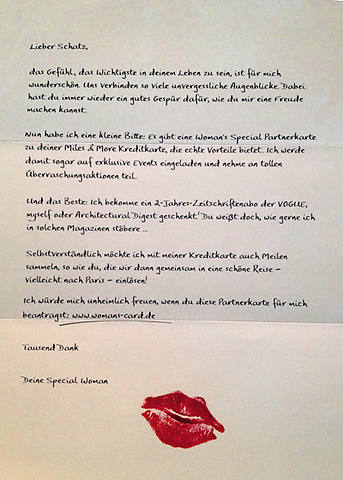
In another example of gendered marketing, German airline Lufthansa recently mailed ads to male customers, encouraging them to sign up for a new credit card. Nothing particularly out of the ordinary there, but the ad campaign, sent to us by Katrin, drew a lot of attention — and criticism — because the credit card in question wasn’t for the men themselves, but for their female partners. The Women’s Special card was offered as an add-on to male frequent fliers who have a Lufthansa Miles-and-More account:

Written as a letter from a woman to her male partner, many felt the ad reinforced stereotypes of female dependence and consumerism. Katrin provided a translation:

Dear Honey,
The feeling that I am the most important thing in your life is wonderful for me. We are bound together by so many unforgettable moments. During which you again and again had a great feel for how to make me happy. Now I have a small plea: There is a Woman’s Special partner card to your Miles & More credit card which offers real benefits. With it I will even be invited to exclusive events and will take part in great surprise activities. And the best part: I’ll get a 2-year-subscription to VOGUE magazine, Myself  or to the Architectural Digest as a gift. You know how much I like browsing these kind of magazines… Of course I also want to collect miles with my credit card, just like you, which we can then redeem for a nice trip together- maybe to Paris! It would make me very happy if you could apply for this partner card for me: www.womans-card.de
Thousand times thank you,
 Your Special Woman
Part of the criticism sprang from the explicitly gendered program; the card, after all, isn’t called the Partner’s Special, or Spouse’s Special, but specifically the Woman’s Special. As The Local, a German English-language news site, reported, one German businesswoman, Anke Domscheit-Berg, Tweeted, “Will I be getting a letter from my sweetheart asking if he can have a partner credit card to go shopping with?” Presumably not — there is no equivalently-named (or even gender-neutral) option targeting the male partners of account holders.

In May of this year the baseball team at Our Lady of Sorrows, a high school charter in Arizona, was scheduled to play a championship game against Mesa Preparatory Academy.  Claiming a religious tenet forbidding co-ed sports, they forfeited the final game of the season.  Mesa’s second baseman, you see, was a 15-year-old named Paige Sultzbach.

This was not an isolated incident.  In 2011 a high school threatened to forfeit a junior varsity football game unless a girl on the opposing team, Mina Johnson, sat out.  Johnson, a five-foot-two-inch 172-pound linebacker on the opposing team, had “gain[ed] a reputation in the league as a standout junior varsity player”; she sacked a six-foot quarterback in her very first game. Nevertheless, not wanting to be the cause of a lost opportunity for her team to play, Johnson sat out.  The opposing team still lost to hers 60 to zero, but apparently that was less humiliating than losing to a girl.

In my sociology of gender textbook I discuss the practice of segregating sports by gender.  Both those on the political left and political right tend to think this is a good idea.  Conservatives tend to think that women are more fragile than men, while liberals want women to have the same opportunities.

Ensuring that men never compete alongside or with women, however, also ensures that the belief that men would always win goes unchallenged.  In other words, because we already assume that men would win any competition with women, it is men, not women, who have the most to lose from de-segregating sports.  If women lose, the status quo — believing women are physically inferior to men — simply remains in place.  But if men lose, the assumption of male superiority is undermined.

Women’s participation in non-team sports, of course, potentially challenges these assumptions in a different way.  While some of these sports try to write rules that ensure that women never measure up to men (e.g., body building has a cap on how muscular women can be), others lay these comparisons bare, which brings us to Sarah Robles.  Robles, a weightlifter, out-lifted all Americans of both sexes at last year’s world championships.  “On her best day,” writes Buzzfeed, “she can lift more than 568 pounds — that’s roughly five IKEA couches, 65 gallons of milk, or one large adult male lion.” Here she is lifting 278 pounds.

The Buzzfeed article focuses on how a main source of revenue — corporate sponsorship — is likely out of reach for Robles.  Companies don’t like to support athletes who challenge our beliefs about men and women.  And Robles certainly does.  She’s proof that women can compete with men, at their own games even, and win.

Thanks to Kari for the tip!

Lisa Wade, PhD is an Associate Professor at Tulane University. She is the author of American Hookup, a book about college sexual culture; a textbook about gender; and a forthcoming introductory text: Terrible Magnificent Sociology. You can follow her on Twitter and Instagram.

My post on the centrality of whiteness in fashion photos — whether magazine photos, catalogs, or ads — inspired several readers to send in other examples related to this trend.

YetAnotherGirl and Julian S. sent in a link to a Jezebel post about the new J.Crew catalog, which presents the two models in J.Crew clothing amid a group of local children, who are used to help signal the exoticism of the location:

Marianne sent in a couple of ads for Naf Naf, a French fashion brand, that show a slight variation, utilizing ethnic/cultural differences within Europe. They show a “luminous, lightning-blond caucasian woman and the dark, anonymous and yet welcoming bohemians,” seemingly meant to evoke popular imagery of the Romani.

And finally, H. pointed out Louis Vuitton’s “Journey” commercial, which she actually saw at an indie movie theater. It provides an interesting counterpoint, as groups other than Caucasians can be included as central characters in the narrative, as long as they are privileged LV consumers, with others presented in the more peripheral setting-the-tone role. As H. explains,

In this ad they include the story line of the (presumably African?) black man who is dressed in an elegant Western-style linen suit, but who is barefoot and rubbing the dust off of an old family photo. An interesting racial counterpoint — and one which suggests a metanarrative which is not only about race but also quite pointedly about class.

Take a look:


Gwen Sharp is an associate professor of sociology at Nevada State College. You can follow her on Twitter at @gwensharpnv.

We’ve posted a number of examples that make it clear just how re-touched the images of people we see in magazines and ads are. Of course, everything else in those images is photoshopped too, leading to those “hmmm, this doesn’t look quite  like it does on the box” moments.

McDonald’s Canada released a video showing a photoshoot for a hamburger. It reveals the techniques that are used to get that luscious, huge, fresh look that so tempts us in food ads. I think it’s great to add to the examples of retouching people to spark discussion on our relationship to the manipulated images around us and the effects of different types of retouched images.

Thanks to Dmitriy T.C. for the tip!

A while back, in a post about Kim Kardashian’s fame, Lisa summarized the concept of a patriarchal bargain as “a decision to accept gender rules that disadvantage women in exchange for whatever power one can wrest from the system. It is an individual strategy designed to manipulate the system to one’s best advantage, but one that leaves the system itself intact.”

Christine B. sent in an excellent example of an individual-level attempt at empowerment with the confines of gender inequality. The video, part of the Howcast series of how-to videos, explains to women how to get men to buy them drinks at a bar:

In case you didn’t feel like watching the video, I can sum it up for you:

  • Dress sexy, but not slutty, or you’re asking for it. How do you know if you’ve crossed the line? Well, if any men act inappropriately toward you, you must have shown too much boob. Better luck next time!
  • Instead of planning a fun night out with your female friends, select only one — the bubbliest one, obviously — and go find a male-dominated environment.
  • Buy yourself one drink right off the bat, so it looks like you’re an independent-minded woman who isn’t trying to get free shit in return for being pretty. I mean, you are doing that, but you don’t want to make it obvious. Men might be turned off if the gendered exchange were made explicit.
  • Assume all men are stupid.
  • Don’t ever stop to question a system that tells women that trading on our appearance, faking interest in people, excluding friends from social outings because they might be annoying to random men you’ve never met, and being manipulative are all totally empowering and socially-acceptable ways to behave as long as ladies get a fairly low-cost item for free in return for our efforts.

Transcript after the jump.

more...

Raised by a racist father, Johnny Lee Clary joined the Klan in 1963 at the age of 14. By 30, he had risen through the ranks and was named the Imperial Wizard, the leader of the entire organization.  He was an outspoken advocate of white supremacy and violence against non-whites, even appearing on the Oprah Winfrey show.

In this four-minute video, he discusses his association with Reverend Wade Watts, a Black civil rights activist and member of the NAACP.  Watts expressed kindness and love towards Clary, even in the face of escalating violence (Clary ultimately set fire to his church).  Deeply affected by Watts, Clary would eventually recant his association with the KKK and join Watts in the fight against racism.

Lisa Wade, PhD is an Associate Professor at Tulane University. She is the author of American Hookup, a book about college sexual culture; a textbook about gender; and a forthcoming introductory text: Terrible Magnificent Sociology. You can follow her on Twitter and Instagram.