Search results for embed

First the marketing team for an energy drink out of Poland, called “Black,” hired a Black person, Mike Tyson, to personify its product.  Then, they surround him with White, female models and have the convicted rapist call himself a “beast” that can’t control himself.  Tag lines include “that’s the power of Black” and “Black power.”

So we have, in one ad campaign, the fetishization of Black men, the White supremacist portrayal of White women as the ultimate female, their objectification (see #3, he actually hands one out in the second ad), the trivialization of his crime (he can’t control himself, LOL right!?), the use of animalistic language to refer to Black people, and the appropriation of the Black Power movement.  Anyone see anything else?  Does it matter that this comes out of Poland and not the U.S.?

Thanks to Tom Megginson at Work That Matters for the heads up.

Lisa Wade, PhD is an Associate Professor at Tulane University. She is the author of American Hookup, a book about college sexual culture; a textbook about gender; and a forthcoming introductory text: Terrible Magnificent Sociology. You can follow her on Twitter and Instagram.
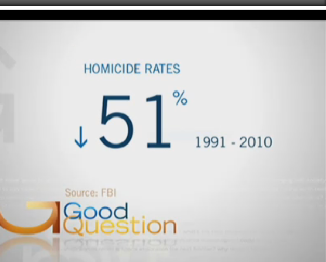
In the wake of the Aurora theater shooting and the shooting of a Sikh temple in Wisconsin, Minneapolis CBS affiliate WCCO asked, “Are we more violent than ever before?” They interviewed The Society Pages’ own Chris Uggen about historical changes in crime. Given the way local news often covers crime and violence, this is a surprisingly nuanced segment:

Often, the most socio-economically disadvantaged individuals of a group are used as a wide brush to paint a picture of an entire minority race or ethnicity.  Common examples include stereotyping all Black men as members of the inner-city underclass or as uneducated, unemployed, urban criminals, or all African-American women as “welfare queens.”  In the current cultural and political discourse, Hispanics are often prejudicially construed  as murderous drug-smugglers or as destitute immigrants who illegally cross the border to “drop babies” and exploit U.S. social programs.  As Eduardo Bonilla-Silva has argued, these prejudices then disadvantage minorities of all social classes who are stereotyped and experience discrimination regardless of their individual socio-economic status or accomplishments.

However, focusing on the marginal members during the social construction of an entire racial group does not usually occur with Whites.  The existence of poor Whites is often ignored as Caucasians are stereotyped as upper-class—which usually entails assumptions that they are hardworking, highly-moral, successful exemplars of American individualism, as Kirby Moss explains in The Color of Class.  “The Whitest People,” a skit from Carlos Mencia (a controversial comedian who built his career drawing upon his Hispanic background to explore race in America), illustrates the connections between whiteness and heightened class status (sorry about the ad):

Mencia’s construction of whiteness critiques the excesses and frivolousness of the upper-middle class lifestyle often conflated with whiteness.  While Mencia pokes fun at this lifestyle, outside comedy these same stereotypes mean Caucasians are usually viewed positively as many presume the upper class can only be reached through hard work and strong morals.  Whereas minorities are often presumed poor and thus viewed with suspicion, whites are often prejudged favorably.  For instance, Mencia himself mentions that because people are viewed through prejudicial lenses, when whites drink alcohol they are thought “sophisticated” but when Blacks drink they are accused of being “drunks.”  These differential prejudgments based on race are the basis of white privilege that replicates and reinforces both class, and racial stratification.

The open expression of Latino stereotypes and slurs in this video also highlights why Mencia’s comedy is controversial.  Detractors claim he engages in a process symbolic interactionists call trading power for patronage (see Schwalbe et al. 2000)This process occurs when an individual embodies a marginal identity in order to receive personal benefits that come at the expense of the larger group.  For example, while Mencia’s comedy career benefits from the self-deprecating humor in this video about low wage employment, family violence, and food insecurity his jokes might also reinforce negative stereotypes about Hispanics.

However, Carlos Mencia’s supporters describe the open confrontation of race and racial disadvantage in his comedy as contesting stigma (Goffman) by celebrating a minority group’s ability to persevere despite their marginalization.  To this group, Mencia’s frequent use of ethnic slurs to describe himself and other Latinos is an example of re-appropriation (Galinsky et al.), reclaiming a pejorative label in a way that redefines the meaning of racist slights and infuses the word with positive and empowering meanings.

—————

Jason Eastman is an Assistant Professor of Sociology at Coastal Carolina University who researches how culture and identity influence social inequalities.

Earlier this week I wrote a post asking Is the Sky Blue?, discussing the way that culture influences our perception of color.  In the comments thread Will Robertson linked to a fascinating 8-minute BBC Horizon clip.  The video features an expert explaining how language changes how children process color in the brain.

We also travel to Namibia to visit with the Himba tribe.  They have different color categories than we do in the West, making them “color blind” to certain distinctions we easily parse out, but revealing ways in which we, too, can be color blind.

Lisa Wade, PhD is an Associate Professor at Tulane University. She is the author of American Hookup, a book about college sexual culture; a textbook about gender; and a forthcoming introductory text: Terrible Magnificent Sociology. You can follow her on Twitter and Instagram.
Thanks to Leticia, Caely, Anjan G., Liz, Bradley K., and Kelsey P. for their patience.  Our SocImages email inbox is a hot mess, and sometimes things fall through the cracks.  This is certainly true for the short video below, one of the responses to the “Shit Girls Say” clip that inspired a round of copycats last December.  We decided to post about it belatedly because it remains a great example of something called a microaggression.

Microaggressions are “brief and commonplace daily verbal, behavioral, or environmental indignities, whether intentional or unintentional, that communicate hostile, derogatory, or negative… slights and insults” (source).  These are often subtle.  So the recipient feels badly, but it can be difficult to explain exactly why, especially to someone who isn’t sympathetic to issues of bias.  The Microaggressions Project has hundreds, maybe thousands, of examples.

In this video, Franchesca Leigh poses as a “White girl” and says many of the things that she and other “Black girls” hear routinely.  To Leigh, these are microaggressions.  They variously trivialize and show insensitivity towards race and racism, remind the listener that she is considered different and strange, homogenize and stereotype Black people, and more…

Lisa Wade, PhD is an Associate Professor at Tulane University. She is the author of American Hookup, a book about college sexual culture; a textbook about gender; and a forthcoming introductory text: Terrible Magnificent Sociology. You can follow her on Twitter and Instagram.
In the wake of the shootings in a Colorado theater last week, Sean D. sent in a BBC video clip commenting on media coverage of mass murders.  It criticizes the typical response, which usually involves intense coverage dissecting every piece of the story, focusing closely on the killer and his motivations.  This can go on for days.

The narrator argues that this is exploitative — the media is using gruesome events to drive ratings (often for days at a time) — and it feeds into the public’s tendency towards voyeurism.  He also includes an interview with a forensic psychiatrist, Dr. Park Dietz, who specializes in such cases; he says that this type of coverage is the exact opposite of what the media should do… if it is interested in saving lives.  The attention, especially to the criminal himself, encourages other “anti-heros” to contemplate and execute mass murders themselves.

Lisa Wade, PhD is an Associate Professor at Tulane University. She is the author of American Hookup, a book about college sexual culture; a textbook about gender; and a forthcoming introductory text: Terrible Magnificent Sociology. You can follow her on Twitter and Instagram.

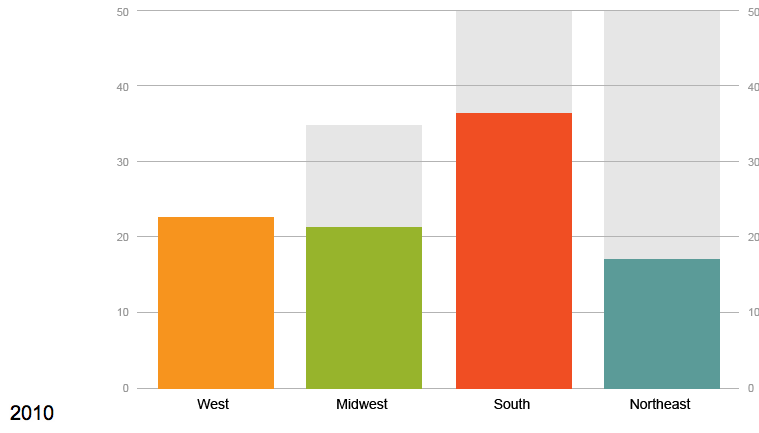
The U.S. Census Bureau recently posted some visualizations of data related to urbanization and the distribution of the U.S. population. One shows changes in the regional distribution of the population from 1790 to 2010. I can’t embed it, but I took a couple of screencaps, but it’s much more striking to watch it and see when various trends (say, the surge of population in the Midwest in the late 1800s) first appear, so I’d go check it out at the Census site.

In 1850, the South and Northeast had about equal portions of the population, and the West was just barely in the picture (I presume the 1850 Census data excludes Native Americans living in the West; if anyone is certain, let us know in the comments):

By 2010, we see a smaller percent of the population living in the Northeast, which has been overtaken by the West (though the Northeast is also the smallest of the four geographic areas, so it’s still overall more densely settled than the West):

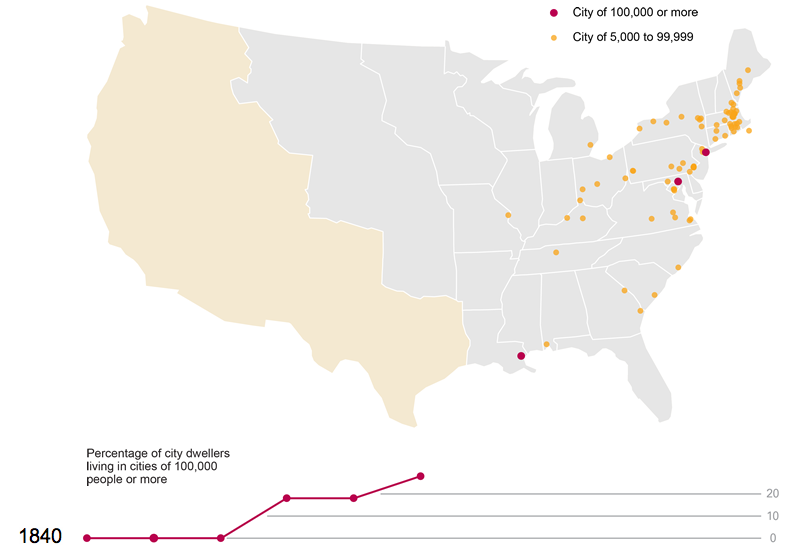
There’s also an animated graph showing urbanization in the U.S. between 1790 and 1890. Here’s 1840:

And fifty years later:

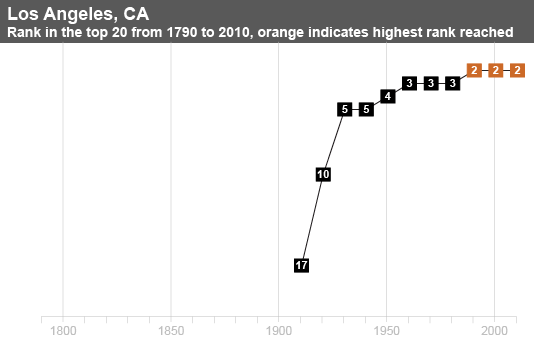
Finally, there’s a map showing all cities that have ever been in the top 20 largest cities in the U.S. since 1790. If you click on a city name, you can see

Los Angeles:

And for Dmitriy T.C., here’s New Orleans:

The Census site lets you click through for the data each visualization is based on, so there’s lots to dig through if you’re really excited about this type of thing, as I am.

Wired describes the new documentary, The Mechanical Bride, as a “moving, weirdly human exploration of artificial companionship.”  Directed by Allison de Fren, explores the range of mechanical brides, from robots to Real Dolls (NSFW), and the “technosexuals who love them.” I can’t wait to see it.

Trailer:

Bonus clip:

The Mechanical Bride will be screened at the Fantasia International Film Festival in Montreal (July 19-August 7).

Lisa Wade, PhD is an Associate Professor at Tulane University. She is the author of American Hookup, a book about college sexual culture; a textbook about gender; and a forthcoming introductory text: Terrible Magnificent Sociology. You can follow her on Twitter and Instagram.