Search results for embed

In honor of yesterday’s game, we’re re-posting two of our favorite football-related posts. This one and one about how much of a three-hour televised NFL games actually involves the game itself.

MontClair SocioBlog’s Jay Livingston posted the wickedly creative football play embedded below.  The play, pulled off by Driscoll Middle School’s football team (Corpus Christi, TX), is a wonderful example of the importance of a shared understanding of context.  Watch the clip:

Understanding the context of interaction heavily influences what you say and do and how you interpret others’ speech and actions. The behavior that you exhibit on a first date, for example, is very different than the behavior you exhibit in your professor’s office hours, or at Thanksgiving, or at a sports bar with your buddies. The situation shapes whether or not you can get away with bragging, farting, or being withdrawn, drunk, or loquacious.  And it shapes what we expect from others too.  In other words, we often think we know who we are, but who we are actually changes quite dramatically from situation to situation.

In this case, the offense did something entirely unexpected given the understanding of the context.  He isn’t supposed to just get up and walk through the defensive line.  And, so, when he did, the defense took several seconds to figure out what to do.  It’d be like your Grandma getting drunk at Thanksgiving (maybe) or your partner farting on the first date; such behaviors are confounding because it involves deviating from the script determined by the situation.  In Livingston’s words:

In this middle-school football play, the quarterback and center do something unusual for someone in those roles. They don’t violate the official rulebook, but their behavior is outside the norms of the game everyone knows. What’s going on? The defense looks around to the others for their cue as to what to do. They see the offensive line motionless in their stances, and they see their own teammates too looking uncertain rather than trying to make a tackle. So nobody defines the play as having started. But it has. Only when the quarterback, having walked past eight definitionless players, starts running do they arrive at an accurate definition, and by then, it’s too late. Touchdown.

See also our post about virtuoso violinist Joshua Bell in the subway.

Lisa Wade, PhD is an Associate Professor at Tulane University. She is the author of American Hookup, a book about college sexual culture; a textbook about gender; and a forthcoming introductory text: Terrible Magnificent Sociology. You can follow her on Twitter and Instagram.
In honor of yesterday’s game, we’re re-posting two of our favorite football-related posts. This one and one about a young team that confused its opponent by deviating from the football script without breaking the rules.

In “Televised Sport and the (Anti)Sociological Imagination,” Dan C. Hilliard discusses the rigid segmentation of televised sports programs, a schedule that in some cases requires “television timeouts”–that is, timeouts in the game due primarily to the need to break up the broadcast for commercials. Televised sports programs and advertising have become increasingly intertwined, such that they’re often nearly indistinguishable, what with the frequent mention of sponsors’ products by sports commentators.

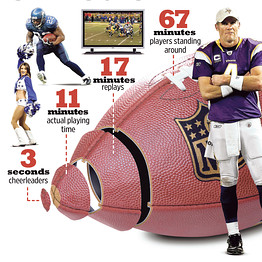
In this video from the Wall Street Journal, a journalist talks about the results of a study he completed in which he timed every element of a large number of televised football (as in American football, not soccer) games. The results? In a typical 3-hour broadcast, barely over 10 minutes shows action on the field. What makes up the rest? Well, advertising, of course, but even aside from that, most of the game coverage is made up of replays, players standing around or huddling before plays, shots of coaches or the crowd, and about 3 seconds of cheerleaders:

A breakdown of game coverage:

Here’s a breakdown of the amount of time spent on each element for a bunch of specific games.

Of course, in some cases these breaks in the action are an integral part of the game. But as things such as television timeouts show, games may also be intentionally slowed down to be sure the game fills the allotted time slot… and provides plenty of time for all the advertising they sold during it.

Gwen Sharp is an associate professor of sociology at Nevada State College. You can follow her on Twitter at @gwensharpnv.

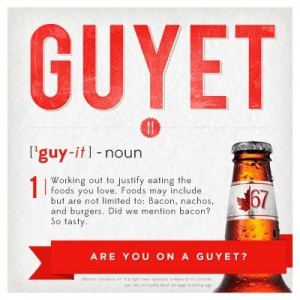
The Ethical Adman’s Tom Meggison sent along a new ad campaign by Molson.  The campaign coins the word “guyet,” a supposedly masculine alternative to “diet.”

If dieting is working out in order to be thin, then guyeting is “working out to justify eating the foods you love… Bacon, nachos, and burgers.”

There’s a very simple thing going on here: things associated with women are NOT-FOR-MEN, so anything that rings feminine must be covered in bacon, dipped in beer batter, and fried masculinized. See, for lots of examples, our Pinterest page on the phenomenon with almost 100 examples.

Importantly, this isn’t just about maintaining a strong distinction between men and women, it’s about maintaining gender inequality.  We disparage and demean femininity, which is why men want to avoid it.  Listen to the tone of voice that the narrator uses when saying the word “diet” at 21 seconds:

Dieting is stupid ’cause girls and everything associated with girls is stupid.  Guyeting is awesome ’cause guys are awesome.

The reverse doesn’t apply. Women who do things men like to do — drink whiskey, play sports, become surgeons, have dogs, etc — somehow rise in our esteem.  Men’s worth, in contrast, is harmed by their association with femininity.  This is a layer of gender inequality above and beyond sexism, the privileging of men over women; it’s androcentrism, the privileging of the masculine over the feminine.  Since women are required to do femininity, it means being required to do trivial, demeaned, and disparaged things.  Meanwhile, men have to come up with stupid excuses for participating in basic healthy activities like going for a jog.

More posts on androcentrism: “woman” as an insultbeing a girl is degradingmaking it manly: how to sell a car, good god don’t let men have long hairdon’t forget to hug like a dudesaving men from their (feminine) selvesmen must eschew femininitynot impressed with Buzz Lightyear commercialdinosaurs can’t be for girls, and sissy men are so uncool.

UPDATE: Comments closed.

Lisa Wade, PhD is an Associate Professor at Tulane University. She is the author of American Hookup, a book about college sexual culture; a textbook about gender; and a forthcoming introductory text: Terrible Magnificent Sociology. You can follow her on Twitter and Instagram.
Cross-posted at PolicyMic.At the end of my sociology of gender class, I suggest that the fact that feminists are associated with negative stereotypes — ugly, bitter, man-haters, for example — is not a reflection of who feminists really are, but a sign that the anti-feminists have power over how we think about the movement.  The very idea of a feminist, in other words, is politicized… and the opposition might be winning.

A clip forwarded by Dmitriy T.C. is a great example.  In the 1.38 minute Fox News clip below, two pundits discuss a North Carolina teacher, Leah Gayle, who was accused of having sex with her 15-year-old student.  One of the show’s hosts suggests that feminism is to blame for Gayle’s actions. She says:

There’s something about feminism that lets them know, I can do everything a man does. I can even go after that young boy. I deserve it… It’s turning women into sexualized freaks.

This clip reveals a discursive act.  She is defining who feminists are and what they believe.  And this idea is being broadcast across the airwaves.

This happens all day every day.  Some of the messages are friendly to feminists, and some are not.  These messages compete in our collective imagination.  Most have little to do with what feminists (who are a diverse group anyway) actually believe and many are outrageous lies and distortions, like this one.

So, next time you hear someone describing a feminist, know that what you’re hearing is almost never a strict definition of the movement. Instead, it’s a battle cry, with one side competing with the other to shape what we think of people who care about women’s equality with men.

Lisa Wade, PhD is an Associate Professor at Tulane University. She is the author of American Hookup, a book about college sexual culture; a textbook about gender; and a forthcoming introductory text: Terrible Magnificent Sociology. You can follow her on Twitter and Instagram.

My brilliant colleague, Adrianne Wadewitz, was featured on Wikipedia last month. In this two-minute video, she talks about how she’s incorporated writing for Wikipedia into her classes and why it’s such a powerful teaching tool.

Lisa Wade, PhD is an Associate Professor at Tulane University. She is the author of American Hookup, a book about college sexual culture; a textbook about gender; and a forthcoming introductory text: Terrible Magnificent Sociology. You can follow her on Twitter and Instagram.

Cross-posted at Racialicious.
Sociologist Jooyoung Lee is writing what sounds like a truly fascinating book. Titled Blowing Up: Rap Dreams in LA, it follows a series of young Black men who are trying to make it as rappers.  “Together,” Lee writes, “their stories show how rapping — and Hip Hop culture more generally — transform the social worlds of urban poor black youths.”

The video below gives us a taste of his findings.  In it, he’s asked why he thinks rappers are “so maligned in our culture.”  He explains that it’s because people often “take violent and misogynistic lyrics” literally.  Doing so, however, is to misunderstand “how the creative process works.”  He goes on to explain how one of the men he studied was pressured by a music label to cultivate an image that conformed to stereotypes of young, urban Black men.

Lisa Wade, PhD is an Associate Professor at Tulane University. She is the author of American Hookup, a book about college sexual culture; a textbook about gender; and a forthcoming introductory text: Terrible Magnificent Sociology. You can follow her on Twitter and Instagram.

Cross-posted at Montclair SocioBlog.

“Silver Linings Playbook,” the new David O. Russell movie, starts off by making the audience uncomfortable.  We want to like Pat (Bradley Cooper).  We root for him to overcome the internal demons that landed him in a mental hospital for eight months.  We do like him.  But he keeps doing things we don’t like.  He is socially insensitive and often offensive, utterly absorbed in his own deluded ideas and obsessions, and although we know that these emanate from his psychiatric condition, it’s impossible to separate the personal from the psychiatric.  He is his mental illness, and it’s often not pretty. We’re actually glad to see the cop who shows up to enforce the restraining order.  (Usually in American films, when a uniformed cop restrains the hero, the moral question is so clear the cop might as well be wearing a Nazi uniform.)

At some point, the film takes a turn away from the complicated and difficult.  It calls on a smooth, familiar recipe and gives us comfort food — sweet chocolate pudding, spoonful after spoonful.  It’s made from good chocolate, but it’s predictable  pudding nonetheless.

It all leads up to a climactic scene that we all know from countless other movies.  In this case, it’s a ballroom dancing competition:

The movie plays on one long-standing idea in American movies and TV: all moral questions, all questions of character, can be settled in a contest. Typically, the story sets out some difficulties for the hero — conflicts with the society, conflicts with some other person or organization, conflicts within himself. It all leads up to some climactic  contest.  Usually the hero wins, occasionally he loses. But the outcome doesn’t matter so much as the nobility of the fight, for win or lose, the hero has fought, and that seems to resolve all issues.   Rocky is the obvious example…

That’s from six years ago in one of the first posts on this blog.  (I’ve edited it lightly.)  That post was about the first episode of Friday Night Lights.   But it could have been about “Silver Linings Playbook” — “Rocky” meets “Dancing With the Stars.”

For a nearly complete plot summary, watch the trailer.

The contest seems to melt all problems no matter how complicated, no matter how seemingly unrelated to the competition itself – problems between a man and a woman, a son and father, friend and friend.

“Silver Linings Playbook” hits all three of those plus husband and wife, brother and brother, and maybe some others.  Other seemingly insoluble problems – from Pat’s obsession with his estranged wife to the side effects of medications – vanish.  And in case the pudding wasn’t already sweet enough, there’s an added Hollywood-ending bonus involving a large bet on the Cowboys-Eagles game, an outcome so predictable I’m not even putting in a spoiler warning.

And they all live happily ever after.

These themes are not inherent in movie contests.  In British films of the sixties – “The Loneliness of the Long Distance Runner” or “This Sporting Life” for example – athletic contests bring a heightened consciousness of the class system.  But in American movies, regardless of the setting – the boxing ring, the pool hall, the poker game, the karate dojo, the dance floor, etc. – competition works its magic and allows the heroes to overcome all personal and interpersonal problems.

—————————

Jay Livingston is the chair of the Sociology Department at Montclair State University.  You can follow him at Montclair SocioBlog or on Twitter.

In her classic article, Teddy Bear Patriarchy, Donna Haraway examined the arrangement of the taxidermied animals in the American Museum of Natural History mammal hall in the first half of the 1900s.  She observed that the dioramas consistently featured nuclear families with strong fathers alert for dangers and nurturing mothers attending to their children.

This was a lie, of course. As we well know, the nuclear family is the exception, not the rule among mammals.  Instead of science, it was our own beliefs about men, women, and gender roles that informed the curators of the exhibits… and left viewers with a sense that these arrangements were more natural and universal than they are.

I’m an animal lover and have a broad appreciation for science, so I particularly enjoy exposing this type of projection.  Bee Movie was a particularly egregious case and we’ve written posts on nature documentaries that do this (on hyenas and flatworms).  The latest case is a Geico commercial.  See if you can catch it:

So, if you know anything about lions, you know that it’s unlikely that “Karl” is doing the hunting.  Among lions, it is the females who specialize in hunting (and they usually do so in groups, for what it’s worth).

See, no manes:

The commercial certainly coincides nicely with what many of us believe to be true about the natural role of human men, but it doesn’t reflect the reality of lion life at all.

Perhaps the people at Geico thought that a female huntress would confuse or distract the reader from their joke.  Or perhaps everyone involved in the project didn’t know this fact about lions; their gender ideology would have masked their ignorance, such that it never occurred to them to look it up.  Either way, contemporary ideas about gender shaped this “diorama” and it potentially reinforces similar beliefs among viewers.

Lisa Wade, PhD is an Associate Professor at Tulane University. She is the author of American Hookup, a book about college sexual culture; a textbook about gender; and a forthcoming introductory text: Terrible Magnificent Sociology. You can follow her on Twitter and Instagram.