Search results for embed

For the last week of December, we’re re-posting some of our favorite posts from 2012. Cross-posted at The Huffington Post.

All that rot they teach to children about the little raindrop fairies with their buckets washing down the window panes must go.  We need less sentimentality and more spanking.

Or so said Granville Stanley Hall, founder of child psychology, in 1899.  Hall was one of many child experts of the 1800s who believed that children needed little emotional connection with their parents.

Luther Emmett Holt, who pioneered the science of pediatrics, wrote a child rearing advice book in which he called infant screaming “the baby’s exercise.”   “Babies under six months old should never be played with,” he wrote, “and the less of it at any time the better for the infant.”

Holt and Granville’s contemporary, John B. Watson, wrote a child advice book that sold into the second half of the 1900s.  In a chapter titled “Too Much Mother Love,” he wrote:

Never hug and kiss them, never let them sit in your lap. If you must, kiss them once on the forehead when they say goodnight. Shake hands with them in the morning.

When you are tempted to pet your child remember that mother love is a dangerous instrument. An instrument which may inflict a never-healing wound, a wound which may make infancy unhappy, adolescence a nightmare, an instrument which may wreck your adult son or daughter’s vocational future and their chances for marital happiness.

With these quotes in mind, it seems less surprising that we put adolescents to work in factories and coal mines.

In any case, it was in this context — one in which loving one’s child was viewed suspiciously, at best, and nurturing care both psychologically and physically dangerous — that psychologist Harry Harlow did some of his most famous experiments.  In the 1960s, using Rhesus monkeys, he set about to prove that babies needed more than just food, water, and shelter.  They needed comfort and even love.  While this may seem stunningly obvious today, Harlow was up against widespread beliefs in psychology.

This video shows one of the more basic experiments (warning, these videos can be hard to watch):

The need for these experiments reveals just how dramatically conventional wisdom can change.  The psychologists of the time needed experimental proof that physical contact between a baby and its parent mattered.   Harlow’s experiments were part of a revolution in thinking about child development.  It’s quite fascinating to realize that such a revolution was ever needed.

Special thanks to Shayna Asher-Shapiro for finding Holt, Hall, and Watson for me.

Lisa Wade, PhD is an Associate Professor at Tulane University. She is the author of American Hookup, a book about college sexual culture; a textbook about gender; and a forthcoming introductory text: Terrible Magnificent Sociology. You can follow her on Twitter and Instagram.
For the last week of December, we’re re-posting some of our favorite posts from 2012.

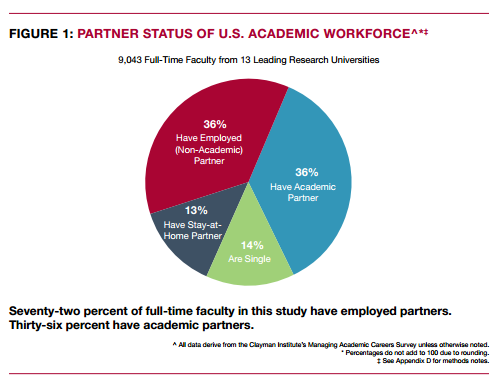
In an effort to map the shape of the dual career challenge, the Clayman Institute for Research on Gender at Stanford University did a survey of 30,000 faculty at 13 universities. The study was headed by Londa Schiebinger, Andrea Henderson, and Shannon Gilmartin.

When academics use the phrase “dual career,” they’re referring to the tendency of academics to marry other academics, making the job hunt fraught with trouble.  Most institutions are not keen to hire someone’s partner just because they exist.  Meanwhile, the academic job market is tough; it’s difficult to get just one job, let alone two within a reasonable commute of one another.

So, what did the researchers find?

More than a third of professors are partnered with another professor:

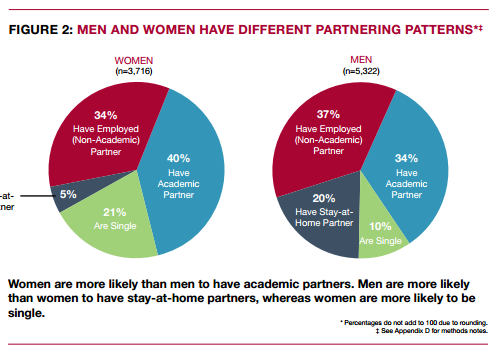
When we break this data down by gender, we see some interesting trends.  Female professors are somewhat more likely to be married to an academic partner (40% of women versus 34% of men), they are twice as likely to be single (21% are single versus 10% of men; racial minority women are even more likely), and they are only 1/4th as likely to have a stay-at-home partner:

On the one hand, since women are more likely to have an academic partner, the problem of finding a job for a pair of academics hits women harder.  On the other hand, the fact that they are more often single makes choosing a job simpler for a larger proportion of women than men.  (On anther note, if you’ve ever wondered why fewer female than male academics have children, there are several answers in the pie charts above.)

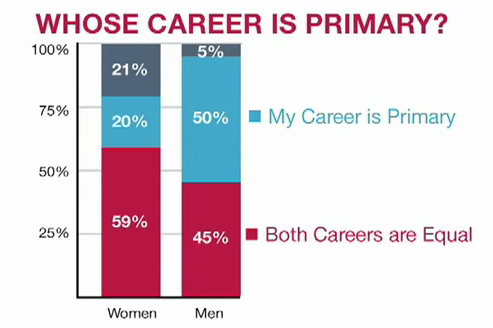
For women who are partnered with another academic, the data is starker than the 6 point difference above would suggest.  The researchers asked members of dual-career academic couples, whose job comes first?  Half of men said that theirs did, compared to only 20% of women.  When it comes to balancing competing career demands, then, women may be more willing to compromise than men.

There is a lot more detailed information on academic couples and what institutions think of them in the report. Or, listen to Londa Schiebinger and the other researchers describe their findings:

Lisa Wade, PhD is an Associate Professor at Tulane University. She is the author of American Hookup, a book about college sexual culture; a textbook about gender; and a forthcoming introductory text: Terrible Magnificent Sociology. You can follow her on Twitter and Instagram.
For the last week of December, we’re re-posting some of our favorite posts from 2012.

Pierre Bourdieu was an amazingly influential thinker who, among other things, theorized a concept called “the habitus.”  The term refers to our often unconscious bodily knowledges and habits.  According to Bourdieu, our habits reflect where and how we grow up.  The kid of a rancher, in other words, will have a very different habitus than the kid of a New York finance elite.

I thought of the habitus when I saw this quick video of people in New York, exiting a subway platform, tripping — one after the other — on the same step. Brooklyn Filmmaker Dean Peterson, who recorded this for us, remarks that the step in question is just a fraction of an inch taller than all the others. But that’s all it takes.

What is striking is how perfectly calibrated are bodies are. Most stair heights (correct me if I’m wrong) are standardized and, when we grow up in this environment, our habitus becomes tuned to that standard.  We come to learn exactly how high to lift our foot to be able to climb each step, and we learn to lift it no higher.  Our habitus allows us, then, to climb stairs throughout each day with minimal effort and without having to individually gauge each step, but it also makes us easy to “trip up.”

Thanks to Thomas G. for the tip!

Via BoingBoing.  For another stunning example of habitus, see the baby worshipper and babies learn to have a conversation.

Lisa Wade, PhD is an Associate Professor at Tulane University. She is the author of American Hookup, a book about college sexual culture; a textbook about gender; and a forthcoming introductory text: Terrible Magnificent Sociology. You can follow her on Twitter and Instagram.
This is one of our favorite Christmas-themed posts from the archive.  We hope you don’t mind the re-post!

Stressing remarkable differences between the two, Rachel and Lucy sent in the music videos for the original Mariah Carey version of “All I Want for Christmas is You” (1994) and the re-make (2011).  They suggested that the comparison reveals two trends: the rising emphasis placed on consumption and the new hyper-sexualization.  I figured, “yeah, I’ll bet they’re onto something there.”  And boy were they.

The first video involves Mariah mostly bounding around in the snow in a snow suit. Often acting pretty darn goofy, with dogs and Santa.

She spends part of the video inside with kids, a Christmas tree, presents, and more animals.  She’s usually wearing a sweater.

She spends less than (I’m guessing) 10 seconds of the video in a sexy Mrs. Claus outfit and, when she’s wearing it, it looks like she’s got long johns on her legs.

The new video, featuring Justin Bieber, is wildly different. Instead of a snowy field or an intimate home, the video takes place in a shopping mall.  It centrally features a Nintendo product.

Likewise, instead of bounding around in the snow like a goof, she spends the entire video up against a wall in super high heels and the sexy Mrs. Claus outfit (except this one doesn’t have sleeves or a midriff).

At one point she runs her hand down her body, touching her breast and moving down to her crotch; at another she just leans against the wall with her back to us and swings her butt back and forth.

So there’s one data point, for what it’s worth, but in line with emerging research on and plenty of anecdotal evidence of the “pornification” of American culture.

“All I Want for Christmas is You” (1994):

“All I Want for Christmas is You” (2011):

Lisa Wade, PhD is an Associate Professor at Tulane University. She is the author of American Hookup, a book about college sexual culture; a textbook about gender; and a forthcoming introductory text: Terrible Magnificent Sociology. You can follow her on Twitter and Instagram.

We’ve posted before about how women are held disproportionately responsible for making holidays happen.  In our imaginations, and all-too-often in real life, the majority of the cleaning, the decorating, the cooking, the gift buying, and the card sending is done by women.

Last year Jeremiah J. sent in a twist on this theme: a CBS report on the First Ladies’ intimate involvement in the decorating of the White House for the holidays. Accordingly to the guest, they are the “commander of chief of Christmas, and they all really care.” Embedding is disabled (watch the video here).

The segment is also a really great example of how women get associated with trivial things. In addition to that stunning line, “commander of chief of Christmas,” the guest explains: “they all have their signature style… it’s really a lot of fun.” Fun, yes, but not by any means important. At the end of the video, the guest is asked if she wrote the book on First Lady involvement with decorating because she wanted ideas for how to decorate her own home. A good sport, the woman replies yes.

This year the White House highlighted Michelle Obama’s role in managing the decorating of the 54 Christmas trees that currently dot the residence.  The story specifies that Ms. Obama had help — 85 volunteers — but also that they were there to help her, specifically, with her job: “…none of this would be possible if not for the volunteers… and Mrs. Obama thanked them in her remarks this afternoon.”

See also: 12 Mums Make the Workload Light, Christmas is Women’s Work, and Holding Women Responsible for the Holidays.

Lisa Wade, PhD is an Associate Professor at Tulane University. She is the author of American Hookup, a book about college sexual culture; a textbook about gender; and a forthcoming introductory text: Terrible Magnificent Sociology. You can follow her on Twitter and Instagram.

A couple of months back I posted a video that illustrated the way that our expectations shape our perceptions. In it, Jimmy Kimmel gave people an iPhone 4 but told them it was an iPhone 5. Believing they were holding a neat new Apple product, they identify a range of features that make it clearly superior — often holding it up to their identical iPhone 4s and perceiving significant differences between the two.

Following up on this theme, Kimmel followed up by asking people on the street to try two cups of coffee and tell him which one had the new $7-per-cup premium coffee from Starbucks and which had a cheap brand. Except both cups of coffee were actually full of the same, non-premium, non-Starbucks coffee. Nonetheless, a number of testers immediately identify striking differences in taste between the two options, providing specific differences in quality that they think distinguish the coffees. It’s a fun illustration of a basic aspect of human cognition — that what we expect to see or experience affects how we interpret the sensory information we encounter:

Thanks to Dmitriy T.C. for the tip!

Gwen Sharp is an associate professor of sociology at Nevada State College. You can follow her on Twitter at @gwensharpnv.

Cross-posted at Montclair SocioBlog.

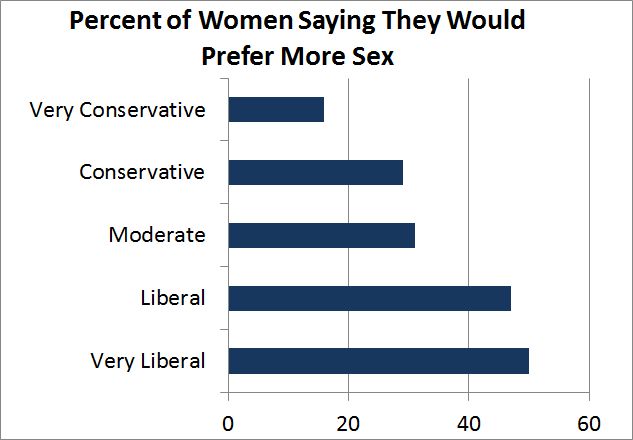
Liberal women want more sex.

Controversial sociologist Mark Regnerus has been fooling around with the New Family Structures Survey.  Back in June, Regnerus used the NFSS data to conclude that gay parents are bad for children.  Now, he runs the regressions and finds that liberalism leaves women sexually dissatisfied.

Question:“Are you content with the amount of sex you’re having?”

The possible answers:

  • Yes
  • No, I’d prefer more
  • No, I’d prefer less

The differences were clear.

Those liberal women, they try and they try and they try; they can’t get no… satisfaction. Hey, hey, hey — that’s what they say.

The differences held even with controls for how much sex the woman had had recently.  Nor did adding other possible explanatory variables dampen the effect:

[T]he measure of political liberalism remains significantly associated with the odds of wanting more sex even after controlling for the frequency of actual intercourse over the past two weeks, their age, marital status, education level, whether they’ve masturbated recently, their anxiety level, sexual orientation, race/ethnicity, depressive symptoms, and porn use.

Regnerus says he was puzzled and asked an economist friend for her explanation.  She, like Regnerus, is a serious Christian, and saw it as a matter of seeking “transcendence.”  Liberal women want to have more sex because they feel the lack of sufficient transcendence in life and seek it in sex.  Conservative women find transcendence in the seemingly mundane — “sanctifying daily life” — so they do not need sex for transcendence.  Or as Regnerus puts it, “Basically, liberal women substitute sex for religion.”

To test this idea, Regnerus controlled for religious attendance.  When he did,  “political liberalism finally went silent as a predictor.”  Churchgoing liberals were no more insatiable than were their sexually content conservative co-worshipers.

So here’s the scenario.  All women want transcendence.  Since liberal women are not religious, they seek transcendence in sex and don’t find it.  They’re dissatisfied, but they cling to the idea that sex will bring them transcendence if only they have more of it.   So they keep looking for transcendence in all the wrong places.  Conservative women seek transcendence in religion and in everyday activities.  And that works.

Conclusion: Religion is deeply satisfying; sex, not so much.

This explanation, with its attribution of psychological-spiritual longing, makes some huge assumptions about what’s going on inside women’s heads.

I can offer a contrasting sociological explanation for Regnerus’ findings.  It looks not to deep inner longings for transcendence but to social norms, beliefs, and values.  It rests on the assumption that people’s desires are shaped by external forces, especially the culture of the social world they live in.  In some groups, sex for women is good, so it’s OK for them to want more sex.  In other social worlds, sex for women has a lower place on the scale of values.  It is less of a “focal concern.”

These differences make for differences in who is content with what — a liberal, East Coast man and a WASP woman from the Midwest, for example:

Can we really say that the difference here is about spiritual transcendence?

In some social worlds, a woman can never be too thin or too rich.  In those worlds, women diet and exercise in a way we might find obsessive.  But that’s what their culture rewards.  Some cultures hold that sex is a good thing — certainly more pleasurable than dieting and exercising — therefore,  more is better.  In some social worlds, that’s the way some people feel about money.  Are these desires really about transcendence, or they about cultural values?

Oh, and on the sexual discontent matter, there are two other possibilities that may not to have occurred to Regnerus: (1) maybe conservative men are better lovers; they satisfy their conservative bedmates in ways liberals can only dream of.   Or (2) conservative men are so bad at sex that when you ask their partners if they want more, the answer is, “No thanks.”

—————————

Jay Livingston is the chair of the Sociology Department at Montclair State University.  You can follow him at Montclair SocioBlog or on Twitter.

Jay Livingston is the chair of the Sociology Department at Montclair State University. You can follow him at Montclair SocioBlog or on Twitter.

Today we have an important public service announcement for you from Radi-Aid: Africa for Norway. The campaign has released a song and accompanying music video, imploring Africans to donate radiators to help Norwegians survive the difficult conditions in their country:

The real point of the video, of course, is to point out some of the problems with the images of Africa that are often presented in humanitarian fundraising drives by using a “We Are the World”-style song to turn the tables. The video’s creators argue that the constant depiction of Africa as a place of violence and misery is both counter-productive and generally obscures the actual cause of many of the problems, presenting the West as benevolent saviors while ignoring any role they might have in actually creating the conditions the fundraising campaigns are meant to address.

From the Radi-Aid website:

The pictures we usually see in fundraisers are of poor African children. Hunger and poverty is ugly, and it calls for action. But while these images can engage people in the short term, we are concerned that many people simply give up because it seems like nothing is getting better. Africa should not just be something that people either give to, or give up on…We need to change the simplistic explanations of problems in Africa. We need to educate ourselves on the complex issues and get more focus on how western countries have a negative impact on Africa’s development. If we want to address the problems the world is facing we need to do it based on knowledge and respect.

Erik Evans, one of the people behind the video, spoke to NPR about the video and the intent. You can listen to the segment here.

Thanks to Erin A., Amy H., Katrin, and Autumn S. for sending it in!

Also see this video in which four African men awesomely poke a little fun at stereotypes of African men in U.S. pop culture, Chimamanda Adichie on the “single story of Africa,” and how not to write about Africa.

Gwen Sharp is an associate professor of sociology at Nevada State College. You can follow her on Twitter at @gwensharpnv.