Search results for embed

Earlier this month, voters in Maryland, Maine, Minnesota, and Washington faced ballot measures on same-sex marriage. The measures in Maryland and Washington sought to repeal same-sex marriage rights passed by their legislatures, while Minnesotans voted on whether to ban same-sex marriage in the state constitution — and rejected the change. These three unsuccessful measures were part of a long history of anti-gay ballot measures dating back to 1974, which I document in my book, Gay Rights at the Ballot Box. Meanwhile, in Maine voters legalized same-sex marriage at the ballot.

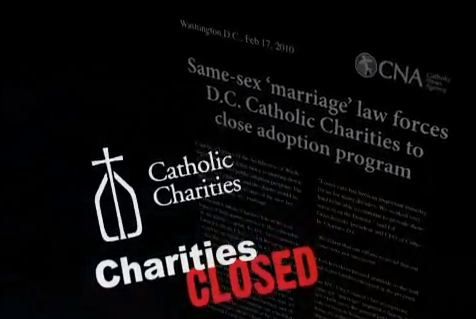
In all four states, the campaigns to ban same-sex marriage developed political ads that suggest that same-sex marriage is a threat to individual religious freedom. One ad about a Gallaudet diversity officer whose job was temporarily suspended due to her support for a referendum on same-sex marriage was initially aired in Maryland before being pulled for copyright restrictions by Gallaudet University. This and similar ads warned voters that individuals who do not support same-sex marriage will be fined, imprisoned, or ostracized for their religious beliefs:

[youtube]http://www.youtube.com/watch?v=YqO9_I2akOQ&feature=share&list=ULYqO9_I2akOQ[/youtube]

These ads draw from a documentary series called Speechless: Silencing the Christians, created by the Reverend Donald Wildmon, founder and president of the American Family Association, a national organization that has worked for decades to restrict same-sex marriage and other rights for LGBT individuals. The 13-episode series was produced in 2008 and published as a book in 2009:

This discourse of religious freedom relies on civil rights language rather than morality. It focuses on the ability of individuals to live lives of faith in the world and make decisions in all aspects of their lives in accordance with their religious beliefs.

This understanding of religious freedom has more in common with arguments about civil rights than ones about religious morality. Rather than arguing about a particular moral perspective (e.g., the immorality of homosexuality), religious freedom rests on an argument that all individuals should have the freedom to make decisions based on their religion and should not be obstructed in their daily lives in doing so. The ads present Christians as embattled victims of intolerance for their religious views.

The political ads also use many of the zero-sum arguments about civil rights that have been documented by scholars since the 1960s, with gains for one group seen as a loss for another group. For example,  a gain for African Americans through desegregation was constructed by some white citizens as an equally dramatic loss for themselves.

Thus, these political ads, which seem to emerge out of the individual politics of each ballot measure, are connected to a larger argument about same-sex marriage and a long history of arguments about civil rights.

————————

Amy L. Stone is an associate professor of sociology at Trinity University in San Antonio, Texas.

Sociologists Arlie Hochschild and Anne Machung used “the second shift” to refer to the responsibilities of childcare and housework borne disproportionately by women, in addition to their paid labor.

A student in Will LaSuer’s class at the University of Akron noticed that a 5-Hour Energy ad explicitly references this idea of a second shift for women. A harried mom with an armful of groceries enters a home full of yelling kids. She talks about getting home from her first job to start her second job, and how worn out this can make her:

Of course, the ad doesn’t actually critique this arrangement or the organization of household duties. The second shift is taken for granted, an unavoidable burden. Consumption provides the answer: buy a product that gives you more energy so you can tackle that second job when you get home. Problem solved!

Gwen Sharp is an associate professor of sociology at Nevada State College. You can follow her on Twitter at @gwensharpnv.

Over at the Ms. blog, Rachel Kassenbrock posted an adorable video of two Capuchin monkeys given unequal rewards for the same task. The monkey who gets the lesser reward displays her displeasure, in no uncertain terms.

The research, described by primatologist Frans de Waal, has been reproduced in chimps, dogs, and birds. It reveals an inherent sense of fairness, suggesting that social justice may not be a silly fantasy, but quite natural indeed.

Lisa Wade, PhD is an Associate Professor at Tulane University. She is the author of American Hookup, a book about college sexual culture; a textbook about gender; and a forthcoming introductory text: Terrible Magnificent Sociology. You can follow her on Twitter and Instagram.

In the five minute video below, U.C. Santa Barbara sociologist Richard Appelbaum discusses the global changes that are driving our uncertain economic future.  While economists have rightly focused on many proximate factors, he says, sociologists have emphasized “changing nature of the economy in the world today.”  He offers a quick history of economic transformations throughout human history and then focuses on the ongoing changes that we call “globalization.”  This includes lightning speed communication and extremely fast movement of goods from one part of the world to another.

Globalization, he goes on, has caused a migration of work out of wealthy and into poor countries.  Meanwhile, businesses that have no national boundaries are increasingly independent. Not beholden to any given country, it has become more difficult to regulate industries in ways that benefit any given state and its citizens.

Appelbaum finishes with a quick discussion of what all this means for young people who are educating themselves today with the hopes of a bright future tomorrow.

Video by Norton Sociology.

Lisa Wade, PhD is an Associate Professor at Tulane University. She is the author of American Hookup, a book about college sexual culture; a textbook about gender; and a forthcoming introductory text: Terrible Magnificent Sociology. You can follow her on Twitter and Instagram.

In a fun five minutes, Mike Rugnetta manages to invoke John Stewart Mill and Judith Butler, plus discuss how “bronies” — male fans of My Little Pony: Friendship is Magic — challenge rigid rules of masculinity.

Thanks to Griff for sending the link!

Lisa Wade, PhD is an Associate Professor at Tulane University. She is the author of American Hookup, a book about college sexual culture; a textbook about gender; and a forthcoming introductory text: Terrible Magnificent Sociology. You can follow her on Twitter and Instagram.

Wanna get clear on the relationship between sex, gender identity, sexual and romantic orientation, sexual behavior, and gender role?  Watch this video by the Vlog Brothers, sent in by Jeffrey B.:

UPDATE: Comments closed.

Lisa Wade, PhD is an Associate Professor at Tulane University. She is the author of American Hookup, a book about college sexual culture; a textbook about gender; and a forthcoming introductory text: Terrible Magnificent Sociology. You can follow her on Twitter and Instagram.

Fish farming, the raising of fish in captivity, is often seen as a more sustainable way to feed the increasingly global hunger for seafood.  At least, the story goes, it doesn’t contribute to the over-fishing of our oceans.

Right?

The answer turns out to be: not necessarily.  Carnivorous species of farmed fish still need to be fed, so there is  an entire secondary industry: fishing for fish food.  Just about anything that can be caught will do; the mix of sea animals is simply ground up and made into pellets.  So, the fisherman typically catch absolutely everything that they can, sterilizing a small piece of the ocean.  They don’t distinguish between large and small fish (the large they can sell as human food, the small they sell as fish food) or adults and juveniles. By taking the larger fish, they’re taking out populations before they have a chance to reproduce.  You can see how this is a system with a devastating expiration date.

This 9-minute clip from Grinding Nemo covers the environmental impact of this practice, as well as the inhumane working conditions of some of the men hired to work in this industry:

Via Sociology in Focus.

Lisa Wade, PhD is an Associate Professor at Tulane University. She is the author of American Hookup, a book about college sexual culture; a textbook about gender; and a forthcoming introductory text: Terrible Magnificent Sociology. You can follow her on Twitter and Instagram.

In this 6 1/2 minute video, CGP Gray explains how the mathematics of a one person/one vote system inevitably leads to a two-party system that pleases almost no one.

Also from CGP Gray:

Lisa Wade, PhD is an Associate Professor at Tulane University. She is the author of American Hookup, a book about college sexual culture; a textbook about gender; and a forthcoming introductory text: Terrible Magnificent Sociology. You can follow her on Twitter and Instagram.