Search results for embed

Cross-posted at Montclair SocioBlog.

At the GOP convention in August, Mitt Romney’s cavalier dismissal of global warming got the intended laughs.  Today, it seems less funny and the Democrats are capitalizing on the turn of events:

Here’s the transcript:

President Obama promised to begin to slow the rise of the
oceans and to heal the planet.  My promise is to help you and your family.

In two short sentences, Romney gives us the broader context for the denial of global warming:  the denial of society itself.  He echoes Margaret Thatcher’s famous dictum

There is no such thing as society. There are individual men and women, and there are families.

This doesn’t mean that there are no groups beyond the family.  But those larger groups are valid only because individuals, consciously and voluntarily, chose to create them.  This way of thinking about the relation between individuals and groups has long been an underlying principle of American thought.  Claude Fischer, in Made in America calls it “voluntarism” – the idea that the only legitimate groups are the ones that people voluntarily form or join.*  The individual has a strong obligation to those groups and their members, but he has little or no obligation towards groups and people he did not choose.

That is a moral position.  It tells us what is morally O.K., and what is not.  If I did not choose to join a group, I make no claims on others, and it is wrong for others – whether as individuals or as an organized group, even a government – to make any claim upon me.

That moral position also shapes the conservative view of reality, particularly about our connectedness to other people and to the environment.  Ideas about what is right determine ideas about what is true.  The conservative rejects non-voluntary connections as illegitimate, but he also denies that they exist.  If what I do affects someone else, that person has some claim upon me; but unless I voluntarily enter into that relationship,  that claim is morally wrong.  So in order to remain free of that claim, I must believe that what I do does not affect others, at least not in any harmful way.

It’s easy to maintain that belief when the thing being affected is not an individual or family but a large and vague entity like “society” or “the environment.”  If I willingly join with many other people, then I will see how our small individual acts – one vote, one small donation, one act of charity, etc. – add up to a large effect. That effect is what we intended.  But if we separately, individually, drive a lot in our SUVs, use mega-amounts of electricity, and so on, we deny that these acts can add up to any unintended effect on the planet.

As Fischer says, voluntarism is characteristically American.  So is the denial of global warming.  At a recent Romney rally (video here), when a protester yelled out the question, “What about climate?” Romney stands there, grinning but silent, and the crowd starts chanting, “USA, USA.”  The message is clear: we don’t talk about climate change; we’re Americans.

Jay Livingston is the chair of the Sociology Department at Montclair State University.  You can follow him at Montclair SocioBlog or on Twitter.  Two more posts on voluntarism are here and here.

I have just what you were wishing for: an overview of the electoral college. Yooooor welcome.

Also from CGP Gray:

Lisa Wade, PhD is an Associate Professor at Tulane University. She is the author of American Hookup, a book about college sexual culture; a textbook about gender; and a forthcoming introductory text: Terrible Magnificent Sociology. You can follow her on Twitter and Instagram.

Amie G. sent along a five minute documentary in which a series of artists and entrepreneurs talk about why the Day of the Dead has become so popular in parts of the United States.

While they don’t discuss issues of cultural appropriation (like at Halloween), they have some interesting things to say about why it is so appealing to a broad audience. A professor of Art History, Ray Hernández Durán, for example, traces it to the growing Latino demographic, the way media has changed, and a history of the U.S. being open to cultural influence.

—————————

Lisa Wade is a professor of sociology at Occidental College. You can follow her on Twitter and Facebook.

In this five-minute interview, Sociologist Joel Best debunks the idea that people are poisoning Halloween candy and talks about how his research in the area prompted his career studying the social construction of social problems:

Lisa Wade, PhD is an Associate Professor at Tulane University. She is the author of American Hookup, a book about college sexual culture; a textbook about gender; and a forthcoming introductory text: Terrible Magnificent Sociology. You can follow her on Twitter and Instagram.

Cross-posted at Caroline Heldman’s Blog.

During a debate this past Tuesday, Indiana Republican senate nominee, Richard Mourdock, made the case against the rape exception for abortions: “I’ve struggled with it myself for a long time, but I came to realize that life is that gift from God, and even when life begins in that horrible situation of rape, that it is something that God intended to happen.”

So according to Mourdock, God intends for rape to happen, and the outcome of rape is a gift from God.

What puzzles me is how Mourdock’s rape enthusiast comments fit with Missouri Republican senate candidate Todd Akin’s recent comments that “legitimate rape” (read“forcible rape”) rarely leads to pregnancy because, ”If it’s a legitimate rape, the female body has ways to try to shut that whole thing down.”

Mourdock and Akin’s beliefs, when considered together, produce a bizarre philosophy. I would like to know: Why would God create female bodies that reject God’s “gifts”? And if women don’t get pregnant from “forcible rape,” does that mean that God doesn’t intend ”forcible rapes”? Put another way, does God only intend certain types of rape, you know, the ones that come with “the gift”?

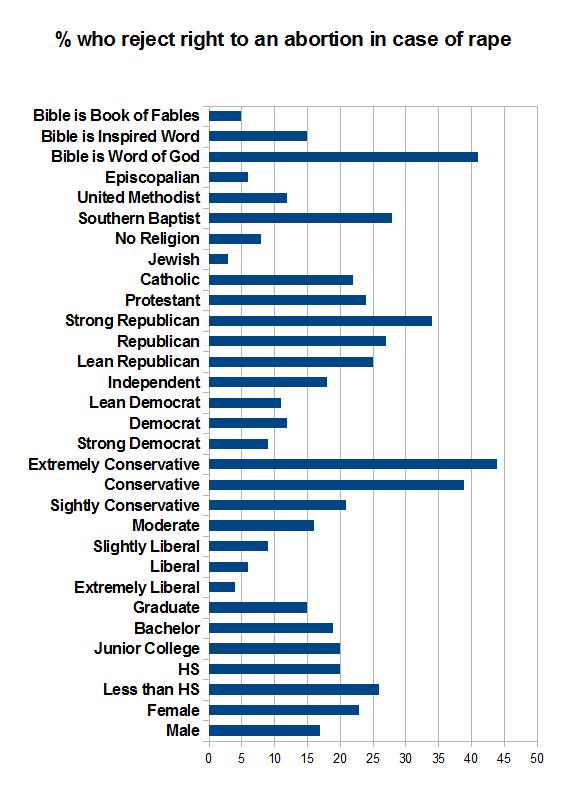
One-in-five Americans agree with Mourdock and Akin’s abortion stance. Razib Khan’sanalysis of the General Social Survey shows that 20% of Americans think abortion should be illegal in cases of rape. Republicans with lower levels of education who identify as extremely conservative and believe the Bible is the word of God are more likely than other Americans to hold this belief.

For Mourdock, Akin, and more than 50 million other Americans, God truly does work in mysterious ways.

Caroline Heldman is a professor of politics at Occidental College. You can follow her at her blog and on Twitter and Facebook.

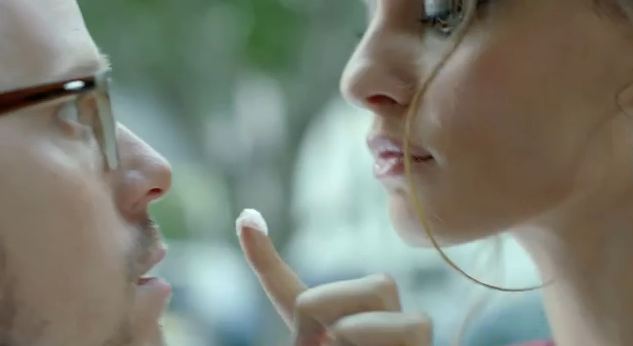
Emilia J. sent in a Fiat ad that illustrates the conflation of women with products. In the commercial, a man sees an attractive woman bending over on the street. She yells at him for staring at her, but the encounter quickly becomes sexualized, with ejaculation imagery as a bonus:

https://thesocietypages.org/socimages/2012/10/24/objectifying-women-sexualizing-cars/

As Emilia points out, the woman is “portrayed as a foreign beauty…exotic and coveted.” An Italian car literally becomes a sexualized, sexually aggressive Italian woman, available for “our own advancement in our ethnosexual adventures.”

We see this depiction of women as things to be consumed, or things as sexy women, often. For other examples, see our posts on sexualizing food, women as the product, an “up-skirt” soap dispenser, products shaped like women’s bodies, women as useful accessories, and lots of stuff shaped like boobs.

Gwen Sharp is an associate professor of sociology at Nevada State College. You can follow her on Twitter at @gwensharpnv.

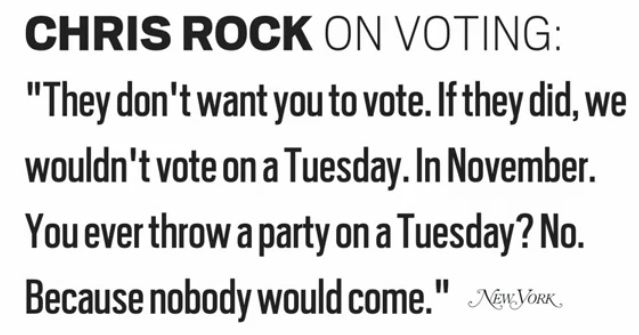
We’re in the home stretch of the presidential election here in the U.S. Many of us now live in states that allow early voting or mail-in absentee voting, but Tuesday, November 6th, is officially Election Day.

But why Tuesday? It doesn’t seem like the most obvious or convenient day to go to the polls; Saturday might seem like a better candidate.

In this short talk, Jacob Soboroff explains the history of why we vote on Tuesdays: in 1845, Congress passed a law setting an official voting day, and didn’t want people to have to travel on Sundays or miss Wednesday market days and so on and so forth, and eventually they settled on Tuesday as the best day to accommodate the travel times required to get places in horse-drawn buggies so people could vote with the minimum disruption to their lives.

And so we still vote on Tuesdays more than a century and a half later, even though, as Selena Simmons-Duffin of NPR pointed out in a story this morning, a lot of critics argue that it reduces voter turnout due to the difficulty of getting off of work to go vote in states that don’t allow any type of early voting.

Gwen Sharp is an associate professor of sociology at Nevada State College. You can follow her on Twitter at @gwensharpnv.

Dolores R. and Kelly S. alerted us to Ellen Degeneres’ ridiculing of the new Bic product, “Bic for Her” (yes, a real product, if you hadn’t heard).   Gentle but straight up, it’s worth four minutes of your time:

Lisa Wade, PhD is an Associate Professor at Tulane University. She is the author of American Hookup, a book about college sexual culture; a textbook about gender; and a forthcoming introductory text: Terrible Magnificent Sociology. You can follow her on Twitter and Instagram.