Search results for embed

Vogues photo-shoot titled “Storm Troopers: Celebrating Hurricane Sandy First Responders” features various images of models with workers of different organizations who combated the damage of Hurricane Sandy. Vogue praises the attributes of these workers in the caption: “when Hurricane Sandy hit, the city’s bravest and brightest punched back.”

Although the title and caption suggest that the photos are meant celebrate the hard work of the men and women who responded to the hurricane, they also serve as a foil against which the models stand out. In other words, this photo spread is at least as concerned with celebrating a look and lifestyle associated with money and beauty, as it is with celebrating the working class.  This is obvious for at least two reasons.

First – the weaker argument — the majority of the workers are dressed in baggy, loosely fitting uniforms; they are not wearing the make-up or striking the poses so cherished by magazines like Vogue.  The models, in literal contrast, embody high fashion.  Their expressionless faces and leisurely poses are the province of the elite.

The next image is particularly striking in this regard.  The glamorous model not only contrasts with the gritty workers, she is elevated above them; the eye is drawn to her ephemeral presence, not to the men and women below.  Their presence serves to make her allure all the more impressive.So, the class contrast elevates the models, figuratively and sometimes literally in these images.  We see race contrast used to do the same thing when Black men and women are used as props in fashion shoots as well as East Indian and Asian people.

Second – the stronger argument – if Vogue wanted to celebrate the men and women in working class occupations that helped after Hurricane Sandy, they could have left the models out altogether.  As it is, the implication is that the workers aren’t valuable in themselves, they’re only valuable as a setting for high fashion.

The photo shoot, then, instead of honoring the workers, affirms the class hierarchy in which they are embedded.  The photographs fall in line with the magazine’s message – a celebration of an elite lifestyle – one that is well out of the reach of blue collar men and women.

Eliza Connors is a first year student at Occidental College.  She hopes to pursue a degree in sociology.  

Cross-posted at PolicyMic.

1Let me ask you a question: Do you have a good friend of the opposite sex?

Odds are you do. In fact, the odds are overwhelming.

When I first began teaching, 25 or so years ago, I asked my students how many of them had a good friend of the opposite sex. About 10% said they did. The rest were from what I called the When Harry Met Sally generation. You’ll remember the scene, early in the film, when Harry asserts that women and men can’t be friends because “sex always gets in the way.”  Sally is sure he’s wrong. They fight about it. Then, thinking she has the clincher for her position, she says, confidently, “So that means that you can be friends with them if you’re not attracted to them!”

“Ah,” says Harry, “you pretty much want to nail them too.”

Young people today have utterly and completely repudiated this idea. These days, when I ask my students, I’ve had to revise the question: “Is there anyone here who does not have a friend of the opposite sex?” A few hands perhaps, in the more than 400 students in the class.

But let’s think, for a moment, about the “politics” of friendship. With whom do you make friends? With your peers. Not your supervisor or boss. Not your subordinate. Your equal.  More than romance, and surely more than workplace relationships, friendships are the relationships with the least amount of inequality.

This changes how we can engage men in the efforts to end sexual assault, because there are three elements to sexual assault that can be discussed and disentangled.

First is m en’s sense of entitlement to women’s bodies, to sex. This sense of entitlement dissolves in the face of an encounter with your friends. After all, entitlement is premised on inequality. The more equal women are, the less entitlement men may feel. (Entitlement is not to be confused with resentment; equality often breeds resentment in the privileged group. The privileged rarely support equality because they fear they have something to lose.) Entitlement leads men to think that they can do whatever they want.

Second, the Bro Code tells those guys that they’re right – that they can get away with it because their bros won’t challenge or confront them. The bonds of brotherhood demand men’s silent complicity with predatory and potentially assaultive behavior. One never rats out the brotherhood. But if we see our female friends as our equals, then we might be more likely to act ethically to intervene and resist being a passive bystander. (And, of course, we rescue our male friends from doing something that could land him in jail for a very long time.)

Men’s silence is what perpetuates the culture of sexual assault; many of the excellent programs that work to engage men suggest that men start making some noise. We know the women, or know people who know them. This is personal.

Finally, we’re better than that – and we know it.

Sexual assault is often seen as an abstraction, a “bad” thing that happens to other people: Bad people do bad things to people who weren’t careful, were drunk or compromised. But, as I said, it’s personal. And besides, this framing puts all the responsibility on women to monitor their activities, alcohol consumption, and environments; if they don’t, whose fault is it?

This sets the bar far too low to men. It assumes that unless women monitor and police everything they do, drink, say, wear etc., we men are wild, out of control animals and we cannot be held responsible for our actions.

Surely we can do better than this. Surely we can be the good and decent and ethical men we say we are. Surely we can promise, publicly and loudly, the pledge of the White Ribbon Campaign (the world’s largest effort to engage men to end men’s violence against women): I pledge never to commit, condone, or remain silent about violence against women and girls.

Our friends – both women and men – deserve and expect no less of us.

Michael Kimmel is a professor of sociology at the State University of New York at Stonybrook.  He has written or edited over twenty volumes, including Manhood in America: A Cultural History and Guyland: The Perilous World Where Boys Become Men.  You can visit his website here.

Last week someone sent me a link to an article about Brad Paisley’s new song, “Accidental Racist,” which features LL Cool J. Given that you’re a Soc Images reader, chances are good you’ve heard about this song. I don’t remember what I was expecting when I saw the title of the song, but man. I really was not prepared for that experience. There’s no official video available on YouTube at the moment, but someone made a video of the song with the lyrics:

In Racism without Racists: Color-Blind Racism and the Persistence of Racial Inequality in the United States, Eduardo Bonilla-Silva discusses the rhetorical strategies that Whites often use to minimize the existence of racial inequality today. As being openly racist has become increasingly stigmatized in the U.S., a version of “color-blind” racism has emerged.

One argument that underpins color-blind racism is the framing of racial oppression and injustice as elements of the past that, while regrettable, can’t be remedied now. Moreover, it’s history; since African Americans aren’t enslaved or legally segregated today, we need to move on from here and treat everyone as equals, with no special considerations for anyone. As one of Bonilla-Silva’s interviewees explained, “…what happened in the past is horrible and it should never happen again, but I also think that to move forward you have to let go of the past…And it should really start equaling out…” (p. 78).

Along with this is often an attempt to equate the discrimination faced by some groups of European immigrants (Italians, the Irish, Jews, etc.) to the experience of African Americans, as this interviewee did: “…they were slaves back in the past and yet, how often do you hear about the people who were whites that were slaves…Boy, we should get reparations, the Irish should get reparations from the English…” (p. 79). From this perspective, African Americans are just one of many groups that had it bad; the impacts of a legally institutionalized racist system that denied African Americans full citizenship or access to opportunities is ignored. This storyline of “we all had it bad” equalizes various experiences of racial and ethnic inequality.

And this is the problem with Paisley’s song (well, it’s one of the problems, but let’s focus). Take these lyrics (found here):

And it ain’t like you and me can re-write history
Our generation didn’t start this nation
We’re still pickin’ up the pieces, walkin’ on eggshells, fightin’ over yesterday
And caught between southern pride and southern blame

And we’re still paying for the mistakes
That a bunch of folks made long before we came

And these contributions from LL Cool J:

If you don’t judge my gold chains…I’ll forget the iron chains

The past is the past, you feel me…Let bygones be bygones

While Paisley may mean well, his song presents racial inequality or conflict as the result of long-past history, “mistakes…made long before we came,” something we need to just get past so we can appreciate each other. And it equates wildly divergent issues, presenting everyone has having a fair, legitimate complaint. Slavery (“iron chains”) and adopting an aesthetic style (“gold chains”) that some Whites might not like are, apparently, equivalent issues. Ending racism is just a matter of everybody deciding to be nicer. If Whites can get over not liking what some African Americans wear, well then hey, African Americans will get over a history of institutionalized racial oppression and the impacts it still has today.

In the world of color-blind racism, this is a fair, plausible compromise.

You might also enjoy SNL’s take.

Gwen Sharp is an associate professor of sociology at Nevada State College. You can follow her on Twitter at @gwensharpnv.

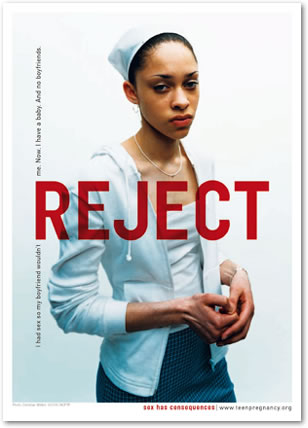
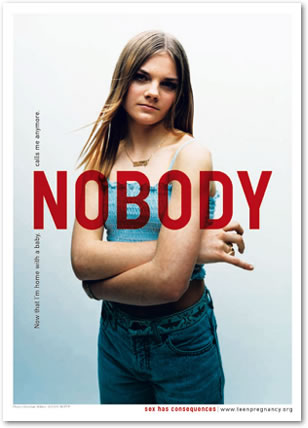
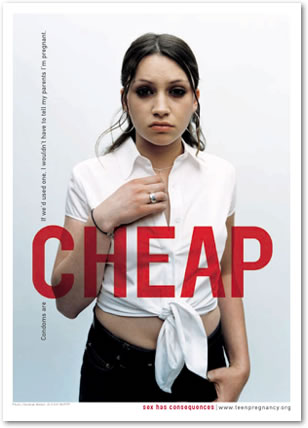
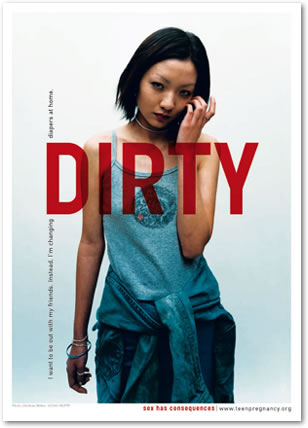
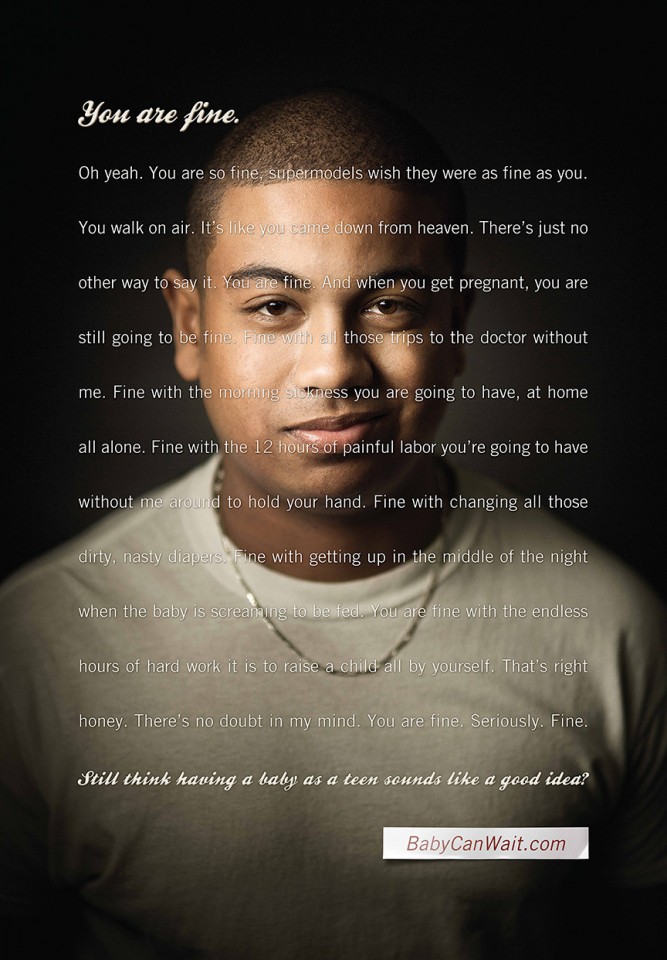
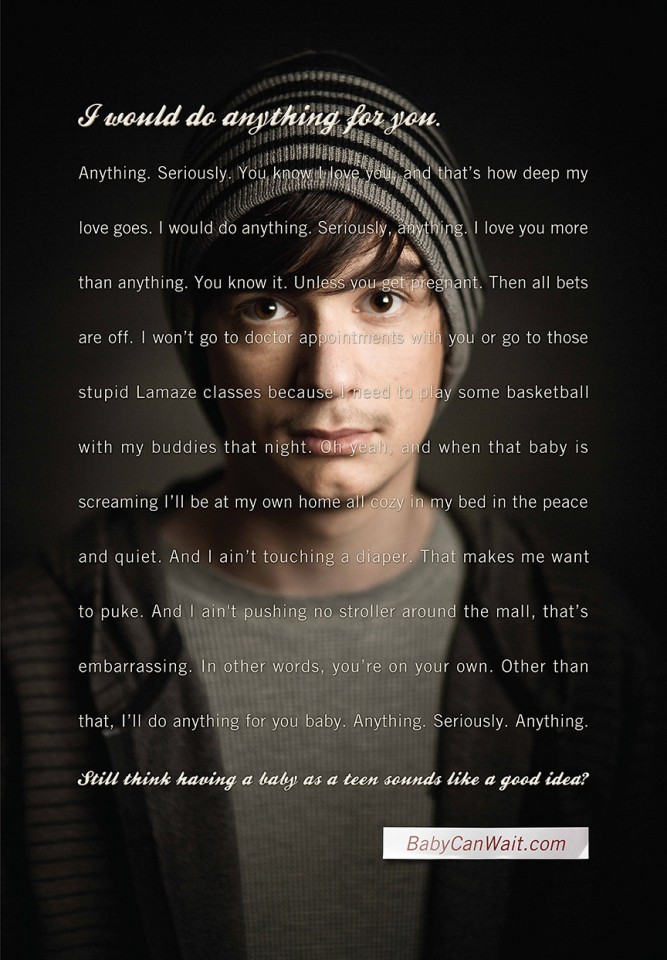
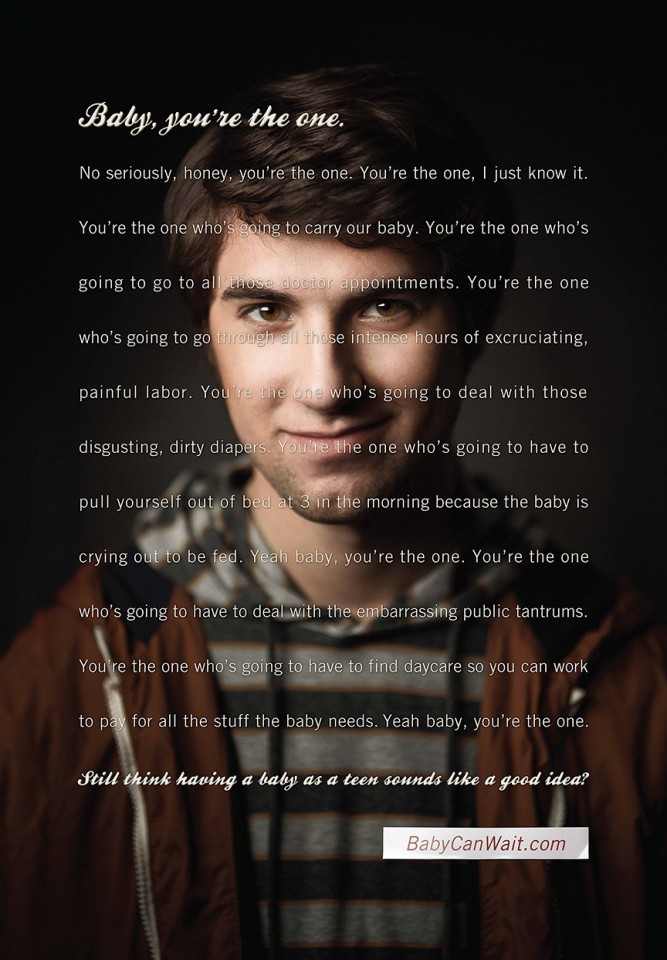
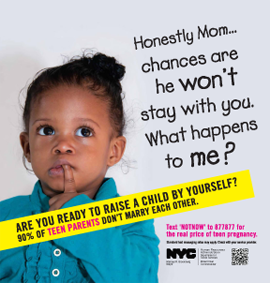
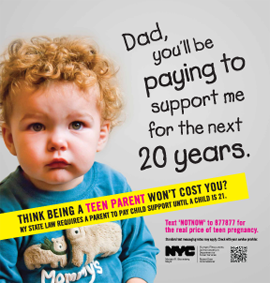
I first posted these posters on SocImages in 2008. They are designed to scare teenagers into taking precautions against pregnancy by demonizing teenagers who get (someone) pregnant. The way in which teens are portrayed in these images — labeled cheap, dirty, rejects, pricks, and nobodys — suggests that the organization, the National Campaign to Prevent Teen Pregnancy, doesn’t care about teenagers, only in controlling their behavior.

This is the sentence that runs along the left vertical with the word “reject” extracted in bold: “I had sex so my boyfriend wouldn’t REJECT me. Now, I have a baby. And no boyfriends.”

“Now that I’m home with a baby, NOBODY calls me anymore.”

“All it took was one PRICK to get my girlfriend pregnant. At least that’s what her friends say.”

“Condoms are CHEAP. If we’d used one, I wouldn’t have to tell my parents I’m pregnant.”

“I want to be out with my friends. Instead, I’m changing DIRTY diapers at home.”

In response to ads like these, sociologist Gretchen Sisson has started a tumblr of examples of anti-teen pregnancy PSAs that use fear, shame, and threats as motivators, sent to me by @annajobin.  Here’s the one I found most stunning; I think it goes something like don’t-drink-and-party-or-you’ll-get-raped-and-pregnant-and-your-life-will-be-horrible-and-oh-your-child-will-become-a-rapist-too:

Here are a set of ads that try to convince women not have (unprotected) sex with their male peers by suggesting that the men showing interest in them are bad guys who will inevitably abandon them:

1 2 3And here are a set that use simple threats to get across their message:

1 2 3About her tumblr, Sisson writes:

Public service announcements that claim to be about “preventing teen pregnancy” are more frequently about shaming and stigmatizing young parents. This is not a way to encourage young people to take control of their reproductive lives, and it’s certainly not a way to support young families.

Nor is it a way to support teenagers who are negotiating complicated interpersonal terrain and making difficult decisions.  These ads are about getting teenagers to do what we want, not helping them figure out what’s best for them.  They caricature the actual lives of teenagers and make early parenthood into a comical boogeyman.  Moreover, they send a clear message to the teenagers that do get pregnant: “you’re a slut/idiot and your life is over.”  This is not good for young parents and it sets them up to fail.

Lisa Wade, PhD is an Associate Professor at Tulane University. She is the author of American Hookup, a book about college sexual culture; a textbook about gender; and a forthcoming introductory text: Terrible Magnificent Sociology. You can follow her on Twitter and Instagram.

Screen Shot 2013-04-10 at 10.55.52 PM

Back in 2010 we featured a post about a segment from the “What Would You Do?” series from abc News that illustrated the way that race plays a role in who is labeled as deviant and who is given the benefit of the doubt.

The producers had teens vandalize a car in public to see what onlookers would do. To see if race played a role, they tried it with a group of White boys and then with a group of African American boys. Only one 911 call was made on the White boys, but 10 calls were made on the African American teens. Moreover, while the White teens were vandalizing the car, 911 received a call to report the African American boys simply for being asleep in a car, which the caller took as a possible sign they were planning to engage in criminal activity.

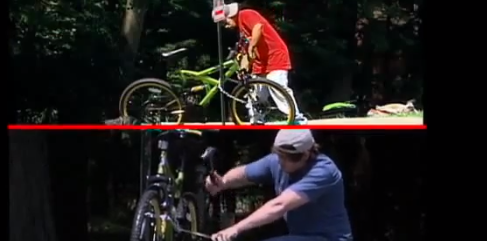
We see this same pattern in another “What Would You Do?” segment. This time, a young White man and a young African American man try to remove a lock from a bike as the cameras capture the reactions of onlookers.

The onlooker interviewed toward the end says race played no role in his reaction. But the extremely different reactions to the two teens indicate differences in who is perceived as likely to be engaged in criminal activity, and whose criminal activity we may think deserves being reported to the police, rather than given a disapproving tsk-tsk as we walk on by.

Gwen Sharp is an associate professor of sociology at Nevada State College. You can follow her on Twitter at @gwensharpnv.

Cross-posted at Osocio.

We’ve been covering the saga of Russian protest punk group Pussy Riot for over a year now. The feminist collective performed guerrilla musical protests around Russia against Vladimir Putin. One in particular, in a church, ended with members Nadezhda Tolokonnikova and Maria Alyokhina sentenced to two years imprisonment for “hooliganism motivated by religious hatred”. The human rights implications of this sentence attracted much worldwide attention, with Amnesty International and celebrities like Sting, Yoko Ono and Madonna speaking out for the women.

But something else happened. The “Free Pussy Riot” movement, with its iconic knitted balaclavas and provocative language, became a popular meme. The cause célèbre was even appropriated by the fashion industry.

Which is what makes this video by Blush lingerie an intriguing conundrum. While it legitimately promotes the freepussyriot.org fundraising site to help the women, it is also promoting a product using a woman’s sexuality as the bait:

On the first anniversary of the Pussy Riot concert in the Cathedral of Christ the Savior, the Berlin based Lingerie label blush supports the free pussy riot movement with a sexy protest march through icy Moscow (-15° C). Support Freepussyriot.org!

This is no Femen action, in which women’s bodies become weapons of protest. It is a commercial for sexy underwear that pays for its appropriation of a radical feminist cause by directing people to that cause.

Is this irony?

Tom Megginson is a Creative Director at Acart Communications, a Canadian Social Issues Marketing agency. He is a specialist in social marketing, cause marketing, and corporate social responsibility. You can follow Tom at workthatmatters.blogspot.com.

Re-posted in honor of Roger Ebert’s passing. Cross-posted at BlogHer.

University of Minnesota doctoral candidate Chris Miller sent in a fascinating episode of Siskel and Ebert, a long-lasting TV show devoted to reviewing movies.  What is amazing about this episode is the frankness with which the movie critics — Gene Siskel and Roger Ebert — articulate a feminist analysis of a group of slasher movies.

The year? 1980.

First they describe the typical movie:

A woman or young girl is shown alone and isolated and defenseless… a crazy killer springs out of the shadows and attacks her and frequently the killer sadistically threatens the victims before he strikes.

They pull no punches in talking about the problem with the films:

These films hate women.

They go on to suggest that the films are a backlash against the women’s movement:

I’m convinced it has to do with the growth of the woman’s movement in America in the last decade. I think that these films are some sort of primordial response by some very sick people… of men saying “get back in your place, women.”

One thing that most of the victims have in common is that they do act independently… They are liberated women who act on their own. When a woman makes a decision for herself, you can almost bet she will pay with her life.

They note, too, that the violence is sexualized:

The nudity is always gratuitous. It is put in to titillate the audience and women who dress this way or merely uncover their bodies are somehow asking for trouble and somehow deserve the trouble they get. That’s a sick idea.

And they’re not just being anti-horror movie.  They conclude:

[There are] good old fashioned horror films… [but] there is a difference between good and scary movies and movies that systematically demean half the human race.

It’s refreshing to hear a straightforward unapologetic feminist analysis outside of a feminist space.  Their analysis, however, isn’t as sophisticated as it could be.

In doing research for a podcast about sex and violence against women in horror films (Sounds Familiar), I came across the keen analysis of Carol Clover, who wrote a book called Men, Women, and Chainsaws.

Clover admitted that most horror films of the time sexualized violence against women — meditating on the torture and terrorizing of beautiful female victims — but she also pointed out that the person who ultimately vanquished the murderer was almost always also female. She called this person the “final girl.”

The final girl was different than the rest of the women in the film: she was less sexually active, more androgynous, and smarter.  You could pick her out, Clover argued, from the very beginning of the movie.  She was always the first to notice that something frightening might be going on.

Boys and men watching horror films, then (and that is the main audience for this genre), were encouraged to “get off” on the murder of women, but they were also encouraged to identify with a female heroine in the end.  How many other genres routinely ask men to identify with a female character?  Almost none.

In this sense, Clover argues, horror films don’t “hate women.”   Instead, they hate a particular kind of woman. They reproduce a Madonna/whore dichotomy in which the whores are dispatched with pleasure, but the Madonna rises to save us all in the end.

Lisa Wade is a professor of sociology at Occidental College. You can follow her on Twitter and Facebook.

Siskel and Ebert full episode:

———————–

Full transcript after the jump:

more...

American companies that once looked to places like Mexico and China for cheap labor are bringing those jobs back to the U.S.  Why? Because prison labor is much, much cheaper.  Paid between 93¢ and $4.73 per day, and collecting no benefits, prisoners are a cheap labor source for about 100 companies (source).

What does this have to do with you?

If you have insurance, invest, use utilities, have a bank, drive a car, send a child to school, go to a dentist, call service centers, fly on planes, take prescription drugs, or use paper, you might be benefiting from prison labor.

If you’ve bought products by or from Starbucks, Nintendo, Victoria’s Secret, JC Penney, Sears, Wal-Mart, K-Mart, Eddie Bauer, Wendy’s, Proctor & Gamble, Johnson & Johnson, Fruit of the Loom, Motorola, Caterpiller, Sara Lee, Quaker Oats, Mary Kay, or Microsoft, you are part of this system.

When prisoners are in state and federal prisons, the U.S. taxpayer is subsidizing low wages and corporate profits, since they are paying for prisoners’ room, board, and health care.  When prisoners are in private prisons, prison labor is a way to make more money off of the human beings caught in the corrections industry.  In other words, prison labor is an efficient way for corporations to continue to increase their profits without sharing those gains with their employees.

For an extensive list of the companies contracting prison labor, click here.  You might also find interesting the video clips, embedded in this news story, of promotional videos by prison corporations that attempt to sell the idea of prison labor to companies:

Lisa Wade, PhD is an Associate Professor at Tulane University. She is the author of American Hookup, a book about college sexual culture; a textbook about gender; and a forthcoming introductory text: Terrible Magnificent Sociology. You can follow her on Twitter and Instagram.