Search results for embed

Despite the cellphone video of two police officers killing Kajieme Powell, there is some dispute as to what happened (see this account in The Atlantic). Was Powell threatening them; did he hold the knife high; was he only three or four feet away? 

The video is all over the Internet, including the link above. I’m not going to include it here.  The officers get out of the car, immediately draw their guns, and walk towards Powell. Is this the best way to deal with a disturbed or possibly deranged individual – to confront him and then shoot him several times if he does something that might be threatening?

Watch the video, then watch London police confronting a truly deranged and dangerous man in 2011.  In St. Louis, Powell had a steak knife and it’s not clear whether he raised it or swung it at all.  The man in London has a machete and is swinging it about.


Unfortunately, the London video does not show us how the incident got started. By the time the recording begins, at least ten officers were already on the scene. They do not have guns. They have shields and truncheons. The London police tactic used more officers, and the incident took more time. But nobody died.  According to The Economist:

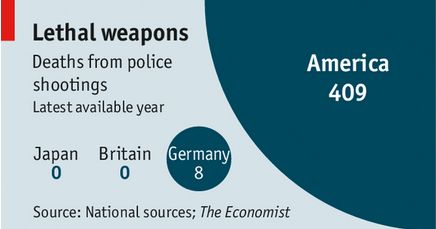
The police in and around Ferguson have shot and killed twice as many people in the past two weeks (Mr Brown plus one other) as the police in Japan, a nation of 127m, have shot and killed in the past six years. Nationwide, America’s police kill roughly one person a day.

The article includes this graphic:
1 (2)

I’m sure that the Powell killing will elicit not just sympathy for the St. Louis police but in some quarters high praise – something to the effect that what they did was a good deed and that the victims got what they deserved. But righteous slaughter is slaughter nevertheless. A life has been taken.<

You would think that other recent videos of righteous slaughter elsewhere in the world would get us to reconsider this response to killing. But instead, these seem only to strengthen tribal Us/Them ways of thinking. If one of Us who kills one of Them, then the killing must have been necessary and even virtuous.

Originally posted at Montclair SocioBlog.

Jay Livingston is the chair of the Sociology Department at Montclair State University. You can follow him at Montclair SocioBlog or on Twitter.


Ten women marched in defiance of the stigma against women smoking cigarettes as part of the New York Easter Day Parade in 1929.  The interesting thing was, however, it was all a sham. The tobacco industry had set the whole thing up with the help of public relations mastermind, Edward Bernays.  American Tobacco Company President George Hill  knew cigarette sales would skyrocket if more U.S. women smoked, a behavior reserved for men in the 1920s that had closed off the female market.

Within one year of Bernay’s stint, women were smoking.

Today, similarly, Japanese fast-food has found a way to bypass the cultural stigmas that impede their profits. One food chain noticed many women would not buy their biggest-sized burgers.  The culprit was ochobo, a Japanese custom that prevents women from opening their mouth widely in public.  Small mouths are considered beautiful and opening them widely is considered “ugly” and “rude.”  The restaurant concluded that it would get into the business of “freeing women from the spell of ‘ochobo.’”

1

The burger chain invented a wrapper that would allow women to open their mouths larger, but not be seen: the liberation wrapper. It is a profitable tactic touted as a cultural solution.

2

You can watch them introduce the wrapper in this short video:

The liberation wrapper was welcomed in Japanese media and social networks, spreading its popularity.  Similarly, Bernay’s public relation’s stint in 1929 garnered much of its success from the media hype that ensued then.

The approach has produced results. Sales of the Japanese chain’s biggest burgers jumped 213% after the wrappers were made because they allowed the burgers to become “socially available” to women.

Of course, the irony is that the burger chain’s “solution” isn’t actually liberating women.  By hiding the deviation behind a paper mask, it is actually reinforcing Ochobo. After all, the social reality remains — it is not acceptable for Japanese women to display an open mouth in public.

Michael Lozano is a graduate of CSULB’s Sociology Honors program and frequent contributor to NewAmericaMedia.org and VoiceWaves.org, a hyper-local news site based in Long Beach, CA.

Conspicuous consumption refers to the practice of ostentatiously displaying of high status objects.  Think very expensive purses and watches.  In the last few decades, as concern for the environment has become increasingly en vogue, it has become a marker of status to care for the earth.  Accordingly, people now engage in conspicuous conservation, the ostentatious display of objects that mark a person as eco-friendly.

Driving a Prius and putting solar panels on visible roof lines, even if they aren’t the sunniest, are two well-documented examples.  Those “litter removal sponsored by” signs on freeways are an example we’ve featured, as are these shoes that make it appear that the wearer helped clean up the oil spill in the gulf, even though they didn’t.

Well, welcome to the opposite: conspicuous pollution.

Elizabeth Kulze, writing at Vocativ, explains:

In small towns across America, manly men are customizing their jacked-up diesel trucks to intentionally emit giant plumes of toxic smoke every time they rev their engines. They call it “rollin’ coal”…

It’s a thing. Google it!

1a

This is not just a handful of guys.  Kulze links to “an entire subculture” on Facebook, Tumblr, and Instagram. “It’s just fun,” one coal roller says. “Just driving and blowing smoke and having a good time.”

It isn’t just fun, though. It’s a way for these men — mostly white, working class, rural men — to send an intrusive and nasty message to people they don’t like. That includes Prius drivers, cops, women, tailgaters, and people in vulnerable positions.

[youtube]https://www.youtube.com/watch?v=_gcb84qn3mU[/youtube]

[youtube]https://www.youtube.com/watch?v=rYPMbLO4pAY[/youtube]

Kulze reports that it costs anywhere between $1,000 and $5,000 to modify a pickup to do this, which is why the phenomenon resonates with conspicuous consumption and conservation.  It’s an expensive and public way to claim an identity that the owner wants to project.

Lisa Wade, PhD is an Associate Professor at Tulane University. She is the author of American Hookup, a book about college sexual culture; a textbook about gender; and a forthcoming introductory text: Terrible Magnificent Sociology. You can follow her on Twitter and Instagram.

A blast from the past.  Fred and Barney let their wives do all the work, pull out a pack of Winston’s:

Originally posted in 2008.

Lisa Wade, PhD is an Associate Professor at Tulane University. She is the author of American Hookup, a book about college sexual culture; a textbook about gender; and a forthcoming introductory text: Terrible Magnificent Sociology. You can follow her on Twitter and Instagram.

If you stop and think about it, alcohol is just the worst. Almost every one who drinks has experienced the pain of a mean morning hangover (at least once). Also, the experience of being drunk… why is that enjoyable? When drunk you slur your words, it’s hard to think straight, you’re liable to say or do something that will offend the people around you, and you can’t legally drive a car. Why does any of that sound like a good way to spend a Friday night?

To a sociologist, the reason people drink alcohol is that they have been socially taught to. That is, we like alcohol because we’ve been taught to overlook the negative side effects or we have redefined them as positive. If that’s confusing, don’t worry. Let’s talk about another drug people abuse (marijuana) and how the sociologist Howard Becker argues we socially construct getting high and being a stoner.

Becoming a Marijuana User

In 1953 Becker set out to answer what appears to be a simple question: how does a person become a marijuana user. After interviewing fifty marijuana users Becker (1953: 235) concluded that:

An individual will be able to use marihuana for pleasure only when he (1) learns to smoke it in a way that will produce real effects; (2) learns to recognize the effects and connect them with drug use; and (3) learns to enjoy the sensations he perceives. This proposition based on an analysis of fifty interviews with marihuana users, calls into question theories which ascribe behavior to antecedent predispositions and suggests the utility of explaining behavior in terms of the emergence of motives and dispositions in the course of experience.

The first point should be pretty obvious. You can’t get high if you don’t inhale when you smoke marijuana (like President Bill Clinton). So the first step to becoming a pot smoker is learning to properly smoke pot. Most often this takes place when an experienced smoker socializes (i.e. trains) a novice smoker in the mechanics of the task.

Becker’s second point might be harder to understand. Drugs inherently alter your physiology… that’s what makes them drugs. Being in a chemcially alterted state can be disorienting. But don’t believe me, watch this:

David, the little boy in the movie, had not been socialized to how anesthesia works. Similarly, when you ingest any drug you have to be taught to recognize the effects. So for marijuana maybe that would include heightened senses, food cravings, and possibly a sense of anxiety or paranoia. When you haven’t been socialized it’s easy to go into a panic or ignore the effects altogether.

For instance, around 2007 a police officer in Dearborn Heights Michigan stole marijuana from a drug arrest, baked it into brownies, and then consumed the brownies to get high for what he said was his very first time. He then called 911 because he thought he was dying. Becker would likely say that if he had been socialized and knew what effects he should expect, the police officer wouldn’t have likely freaked out and incriminated himself.

After you’ve learned to inhale properly, learned to recognize how the substance will alter you, then the last step to becoming a marijuana user is to redefine potentially negative experiences as positive. As we talked about above, smoking marijuana can lead to anxiety, paranoia, insatiable food cravings, hyper sensitivity, confusion, etc.

To see an example of this, we need look no further than the comment section under the video I just showed you.  What WeBeChillin420’s comment does is reframe a panic attack into a desirable thing. S/he seems to be nostalgic for his or her first time consuming freak out quantities of marijuana.

Becker and the scholars he inspired to research marijuana communities further point out that it’s common among smokers to say that “coughing gets you higher.” Actually, coughing after smoking is your body’s way of telling you that you inhaled something it didn’t like. It’s your body literally gasping for air. It seems just as likely that marijuana users could think of coughing as a bad thing or as a sign they inhaled too much. Instead smokers socially construct coughing as a positive and desirable thing.

All Drugs Are Socially Constructed

While Becker focused on marijuana, we can extend his ideas to every type of drug. For instance let’s look at caffeine. Coffee and Red Bull are said to be “acquired tastes.” Doesn’t this mean that you have to learn to like them? You have to learn to like to feel a slight jitteriness? What you can take from Becker’s research is that how we think about drugs, how we react to any drug or medicine we ingest, and how we feel about others who’ve used drugs are all social constructs.

Nathan Palmer, MA is a visiting lecturer at Georgia Southern University. He is a passionate educator, the founder of Sociology Source, and the editor of Sociology in Focus, where this post originally appeared.

In the lasts 15 years, student debt has grown by over 1,000% and the debt held by public colleges and universities has tripled.  Where is the money going?

The scholars behind a new report, Borrowing Against the Future: The Hidden Costs of Financing U.S. Higher Education, argue that profit is the culprit.  They write:

Scholars have offered several explanations for these high costs including faculty salaries, administrative bloat, and the amenities arms race. These explanations, however, all miss a crucial piece of the puzzle.

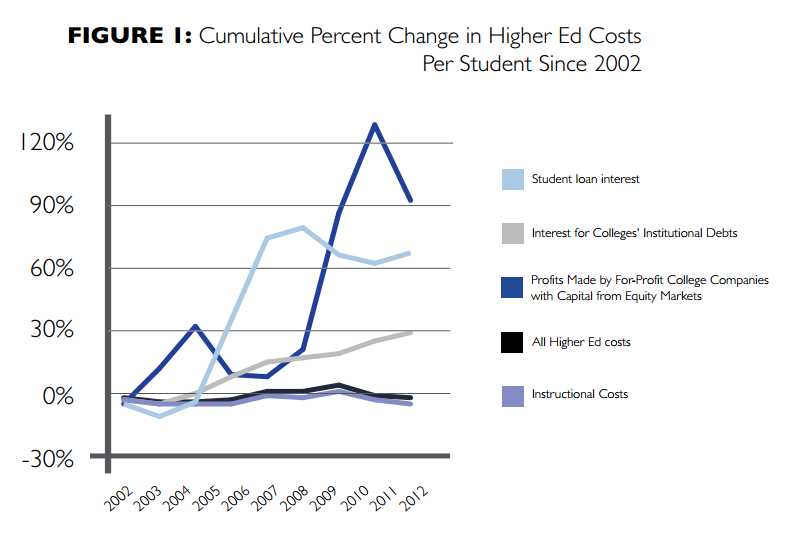
Sociologist Charlie Eaton and his colleagues crunched the numbers and found that spending on actual education has stagnated, while financial speculators have been taking an increasing amount of money off of the top.

Higher education fills the pockets of investors in three ways:

  • Interest on student loans, paid by students and parents.
  • Interest paid by colleges who take out loans to fund projects — everything from new academic buildings to luxury dorms and stadiums — ultimately repaid with tuition hikes and higher taxes.
  • And profit from for-profit colleges (with “dismal graduation rates, by the way).

Take a look at this figure breaking down the sources of the rise in the cost of higher education.  Interest on debt — taken on by both students and the colleges they attend — has risen.  Meanwhile, direct profits from for-profit colleges have skyrocketed.

3

Overall, Eaton and his colleagues found that Americans are spending $440 billion dollars a year on higher education and that 10% of that goes into the pockets of investors who are skimming profit off of all forms of higher education.

Want more?  Read their report or watch their summary:

Cross-posted at Pacific Standard.

Lisa Wade, PhD is an Associate Professor at Tulane University. She is the author of American Hookup, a book about college sexual culture; a textbook about gender; and a forthcoming introductory text: Terrible Magnificent Sociology. You can follow her on Twitter and Instagram.

While there has been significant attention to recruiting women into STEM fields, what about the converse – recruiting men to female-dominated fields?  My recent article in Gender & Society analyzes the recruitment strategies of key health care players, examining themes of masculinity in text, speech, and images.

Some recruitment items, like this early poster from the Virginia Partnership for Nursing, asked viewers “Are you man enough to be a nurse?” Aspects of hegemonic masculinity — characteristics associated with being the culturally defined “ideal man” — are common themes in the poster, including sports, military service, risk-taking, and an emotionally-reserved demeanor:

1 (3)

Since the “Are You Man Enough?” campaign in the early 2000’s, nurse leaders have tried to make recruitment messages less ostensibly gendered. In discussing the American Assembly for Men in Nursing’s (AAMN) new campaign, Don Anderson notes:

Nursing recruitment efforts needed to evolve from asking men if they were masculine enough to be a nurse to something less gender specific

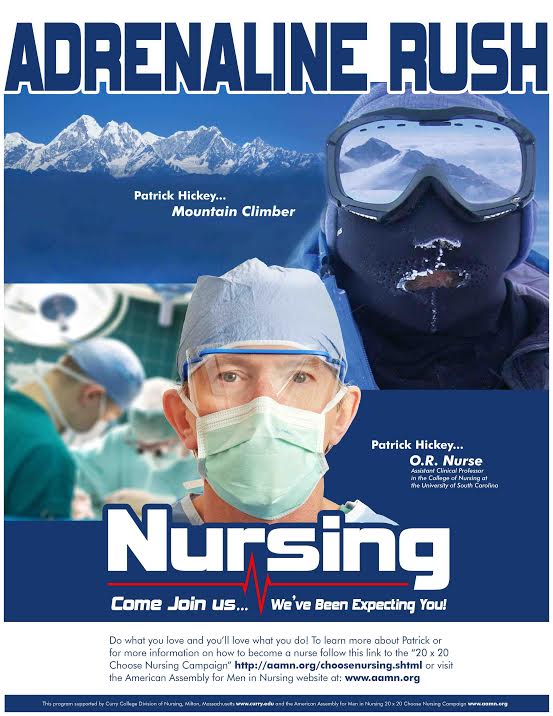
Despite the effort to “de-genderify” nursing (Anderson’s word), masculinity is still front and center. Though the slogan is different, materials continue to emphasize culturally idealized forms of masculinity. One of the AAMN’s newest posters, “Adrenaline Rush,” avoids the “man enough” rhetoric, but maintains the theme of a stoic, emotionally-detached masculinity through visual cues.  Most of the nurse’s face is covered – limiting emotional expression—while risk-taking is emphasized.

1 (2) - Copy

But not all recruitment materials employ a macho form of masculinity. Johnson & Johnson’s 30-second clip “Name Game” portrays a caring and emotionally competent nurse:

Key health care players, including an international organization (Johnson & Johnson), urban hospital systems, nursing programs, and organizations like the American Assembly for Men in Nursing (AAMN) have devoted resources to recruiting men into nursing. Analyzing their recruitment strategies reveals as much about contemporary tensions within masculinity as it does about the profession’s push for gender diversity.

Check out more of the recruitment materials and a more in-depth analysis in the article, “Recruiting Men, Constructing Manhood: How Health Care Organizations Mobilize Masculinities as Nursing Recruitment Strategy.”  For a free copy, contact me at cottingham@unc.edu.

Marci Cottingham is a postdoctoral fellow in the department of Social Medicine at the University of North Carolina – Chapel Hill. She received her Ph.D. in sociology from the University of Akron. Her research spans issues of gender, emotion, health, and healthcare. For more on her work, visit her site.

Cross-posted at Pacific Standard.

A few days ago, Juliano Pinto kicked off the World Cup with a first kick.  It was a media stunt designed to make us verklempt.  Pinto is a paraplegic who wore a mind-controlled robotic exoskeleton to make his move.

We were to be awed by the technology, too, of course, which is being developed by the Walk Again Project, a scientific consortium.  Says the leading scientist on the project, “With enough political will and investment, we could make wheelchairs obsolete.”

Red Nicholson isn’t having it.

Ask any wheelchair user, particularly one who’s been in the game a while, and they’ll tell you that they’re far too busy living their life to sit there worrying about whether or not they’ll ever walk. We just get on and do.

From his point of view, the exoskeleton is for people who aren’t in wheelchairs.  Getting “non-walkers to walk again,” he says, is about making everyone else happy.  As for him, he says, he’s fine:

My wheelchair is a very capable tool and to be honest, the last thing I want is to be strapped to a District 9-esque robot and become a puppet in some corporation’s half-baked execution of an obsession…

In the meantime, he says, everyone’s concern with getting him to walk again suggests that he, and everyone else who uses a wheelchair, is living a pitiable life.  “These stories,” he says, “are unwittingly invalidating a unique way of life for millions of people around the globe who are really happy with their wheelchairs.”   So, he goes on record: “This is not my dream.”

William Peace, an anthropologist who also uses a wheelchair, goes further, arguing that the exoskeleton is harmful to people who are newly paralyzed.  The scientists developing the exoskeleton are “sell[ing] the dream of walking to newly paralyzed people who cannot imagine life as a wheelchair user.”  This is bad, he says, because it encourages people to reject their new body instead of accept it.   He writes: “the exoskeleton is symbolically and practically destructive to a newly paralyzed person.”

Instead of focusing on the one thing people using wheelchairs can’t do, Peace argues, we should focus on all the things they do everyday:

Work, make a decent living, and be autonomous. Own a home even. Have a family. Get married. In short, be ordinary. Walking is simply not required for all this nor should it be glorified.

Nicholson concurs: “My life as a wheelchair-user is a very good one.”

So hey, able-bodied media: quit making me feel like wheelchairs are a shitty, sub-par option. Stop beating your exoskeleton drum. And most of all, let go of your obsession with walking, because it’s totally overrated.

Cross-posted at Pacific Standard.

Lisa Wade, PhD is an Associate Professor at Tulane University. She is the author of American Hookup, a book about college sexual culture; a textbook about gender; and a forthcoming introductory text: Terrible Magnificent Sociology. You can follow her on Twitter and Instagram.