
Search results for embed

Flashback Friday.

Below is a remarkable commercial in which a white woman is told that if she buys Pampers, the company will donate vaccines to children in other countries.   Thanks to Kenjus W. for the submission.

It is an example of “activism by purchase,” which we have discussed at length on this blog. Apparently Pampers will only help keep babies alive if you buy their product.  How nice of them.

It’s also a fascinating example of the way in which white Westerners are seen as rescuing the rest of the world. This white mother with her white baby represent the West (erasing the diversity of people who live there). And she and her baby are counterposed to all the other mothers and their babies representing different racial groups (which are assumed to be coherent categories, even continents).

In the narrative of this commercial, all women are bonded by virtue of being natural nurturers of babies (and I could take issue with that, too), but the white Western woman is the ultra-mother. They may be sisters, but there are big and little sisters in this narrative. The babies run to her as if drawn to her ultra-motherhood and she treats them all, just for a moment, as if they were her very own.

Pampers wants you to think, of course, that when you buy a pack of Pampers, you are “helping” Other mothers and can save those Other babies.

This is just another manfestation of an old colonial belief, the white man’s burden, or the belief that white men had to take care of the rest of the world’s people because they were incapable of taking care of themselves.

Great find, Kenjus!

This post originally appeared in 2008.

Lisa Wade, PhD is an Associate Professor at Tulane University. She is the author of American Hookup, a book about college sexual culture; a textbook about gender; and a forthcoming introductory text: Terrible Magnificent Sociology. You can follow her on Twitter and Instagram.
Usually, you want to match up with someone at about your level, or a little higher.  The trouble is that many people overestimate their own level.  Maybe that’s especially true of men.

One summer many years ago at the tennis courts, a guy I didn’t know  came over and asked me if I’d like to play. I hadn’t arranged a game with anyone, but I didn’t want to wind up playing some patzer.

“Are you any good?” I asked. He paused.

“Well, I’m not Jimmy Connors,” he said (I told this was many years ago), “but neither are you.”

In chess and other games, serious players have ratings. Give a roomful of possible partners, they can sort through the ratings and find a match with someone at roughly the same level.  It’s called assortative mating, though that term usually refers to the other kind of mating, not chess.  It’s the basis of the conflict in this poignant scene from “Louie.”

Vanessa is not a ten, neither is Louie.  According to principles of assortative mating, the tens will wind up with other tens, the nines with nines, and so on down the attractiveness scale. One problem in the “Louie” scene is that Louie seems to have an inflated view of his own attractiveness.  He’s aiming higher than Vanessa.  That’s typical.  So is the importance that Louie, the man, places on physical attractiveness. This excerpt begins with Louie telling Vanessa that she’s a really beautiful . . . . He can’t bring himself to say “girl”; he’s probably going to say “person.” But he’s obviously not saying what he thinks.

Or as Dan Ariely and colleagues concluded from their study of HotOrNot members:

[Men] were significantly more influenced by the consensus physical attractiveness of their potential dates than females were. [Men also] were less affected by how attractive they themselves were . . .  In making date choices, males are less influenced by their own rated attractiveness than females are.

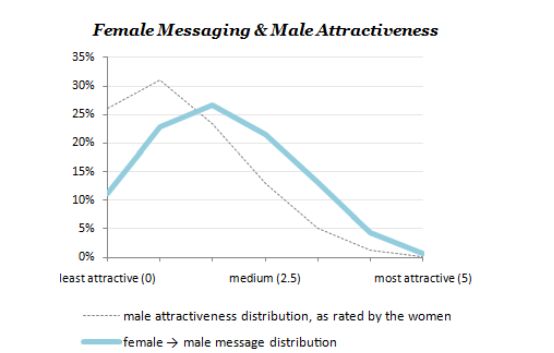
Another dating site, OK Cupid, found a similar pattern when they looked at data about who gets messages.  They asked their customers to rate profile photos of the opposite sex on a scale of 0 to 5. They then tracked the number of messages for people at each level of attractiveness.  The graph below shows what women thought and what they did – that is, how attractive they found men, and who they sent messages to.

1 (2) - Copy

Men who were rated 0 or 1 got fewer messages than their proportion in the population.  That figures. But even men who were only moderately attractive got more than their share. Generally, the fewer men at a level of attractiveness, the fewer total messages women sent. The 4s, for example, constituted only 2% of the population, and they got only 4% of all the messages.  The Vanessas on OK Cupid are not sending a lot of inquiries to guys who look like George Clooney.

But look at the men.

1 (2)

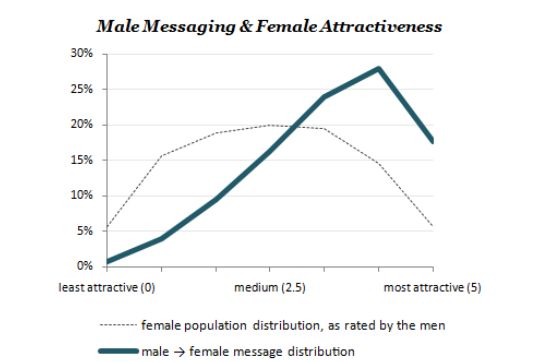
Men are more generous in their estimates of beauty than are women. But they also ignore the Vanessas of the world (or at least the world of OK Cupid) and flock after the more attractive women.  Only 15% of the women were rated as a 4, but they received about 26% of the messages.  Women rated 5 received messages triple their proportion in the population.

What about those with so-so looks?  Women rated as 2s received only about 10% of the messages sent by men. But men at that same level received 25% of the messages women sent.  The women seem more realistic.

Vanessa too has no illusions about her own attractiveness. She refers to herself as “a fat girl,” and when Louie, trying to be kind, says, “You’re not fat,” she says: “You know what the meanest thing is you can say to a fat girl? [pause] ‘You’re not fat.’” But it’s only when she challenges Louie’s view of his own attractiveness that their relationship starts to change.

Y’know if you were standing over there looking at us, you know what you’d see?

What?

That we totally match. We’re actually a great couple together.

She doesn’t explain what she means by “totally match.” It could be their interests or ideas or personalities, but the imaginary stranger looking at them from over there couldn’t know about any of that. What that generalized other could see is that they are at roughly the same place on the assortative mating attractiveness scale.

Cross-posted at Pacific Standard.

Jay Livingston is the chair of the Sociology Department at Montclair State University. You can follow him at Montclair SocioBlog or on Twitter.

I am so pleased to have stumbled across a short excerpt from a talk by Alan Watts, forwarded by a Twitter follower.  Watts makes a truly profound argument about what money really is.  I’ll summarize it here and you can watch the full three-and-a-half minute video below if you like.

Watts notes that we like to talk about “laws of nature,” or “observed regularities” in the world.  In order to observe these regularities, he points out, we have to invent something regular against which to compare nature. Clocks and rulers are these kinds of things.

All this is fine but, all too often, the clocks and the rulers come to seem more real than the nature that is being measured.  For example, he says, we might think that the sun is rising because it’s 6AM when, of course, the sun will rise independently of our measures.  It’s as if our clocks rule the universe instead of vice versa.

He uses these observations to make a comment about wealth and poverty. Money, he reminds us, isn’t real. It’s an invented measure.  A dollar is no different than a minute or an inch.  It is used to measure prosperity, but it doesn’t create prosperity any more than 6AM makes the sun rise or a ruler gives things inches.

When there is a crisis — an economic depression or a natural disaster, for example — we may want to fix it, but end up asking ourselves “Where’s the money going to come from?”  This is exactly the same mistake that we make, Watts argues, when we think that the sun rises because it’s 6AM.  He says:

They think money makes prosperity. It’s the other way around, it’s physical prosperity which has money as a way of measuring it.  But people think money has to come from somewhere… and it doesn’t. Money is something we have to invent, like inches.

So, you remember the Great Depression when there was a slump?  And what did we have a slump of?  Money.  There was no less wealth, no less energy, no less raw materials than there were before. But it’s like you came to work on building a house one day and they said, “Sorry, you can’t build this house today, no inches.”

“What do you mean no inches?”

“Just inches!  We don’t mean that… we’ve got inches of lumber, yes, we’ve got inches of metal, we’ve even got tape measures, but there’s a slump in inches as such.”

And people are that crazy!

This is backward thinking, he says.  It is allowing money to rule things when, in reality, it’s just a measure.

I encourage you to watch:

Lisa Wade, PhD is an Associate Professor at Tulane University. She is the author of American Hookup, a book about college sexual culture; a textbook about gender; and a forthcoming introductory text: Terrible Magnificent Sociology. You can follow her on Twitter and Instagram.
“For many of us, quicksand was once a real fear,” write the producers at Radio Lab:

It held a vise-grip on our imaginations, from childish sandbox games to grown-up anxieties about venturing into unknown lands. But these days, quicksand can’t even scare an 8-year-old.

Interviewing a class of fourth graders, writer Dan Engber discovered that most understood the concept, but didn’t find it particularly worrisome.  “I usually don’t think about it,” said one.  They were more afraid of things like aliens, zombies, ghosts, and dinosaurs.  But they understood that it was something that people used to be afraid of: “My dad told me that when he was little his friends always said ‘look out that could be quicksand!'”

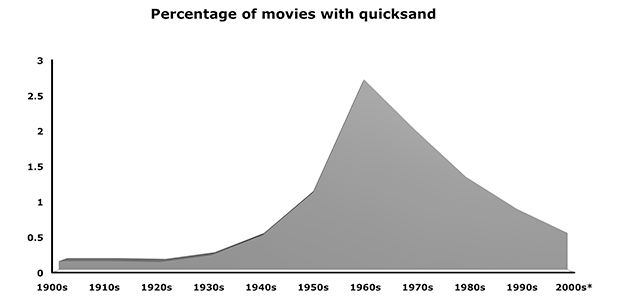
Engber became fascinated with what happened to quicksand.  He found a source of data — compiled by, of all things, quicksand sexual fetishists — that included every movie scene that involved quicksand from the 1900s to the 2000s.  Comparing this number to the total number of movies produced allowed him to show that quicksand had a lifecourse.  It rose in the ’40s, skyrocketed in the ’60s, and then fell out of favor.

1.jpg

Why?

Engber found a pattern in the data.  In quicksand’s early years, the movie scenes featured quicksand as a very serious threat.  But, after quicksand peaked, it became a  joke.  In the ’80s, quicksand even made it into My Little Pony and Perfect Strangers.  Later, in discussions about plot lines for Lost, the idea of quicksand was dismissed as ridiculous.

I guess it’s fair to say that quicksand “jumped the shark.”

In sociology, we call this the social construction of social problems: the fact that our fears don’t perfectly correlate with the hazards we face.  In this case, media is implicated. What is it making us fear today?

Lisa Wade, PhD is an Associate Professor at Tulane University. She is the author of American Hookup, a book about college sexual culture; a textbook about gender; and a forthcoming introductory text: Terrible Magnificent Sociology. You can follow her on Twitter and Instagram.
Flashback Friday.

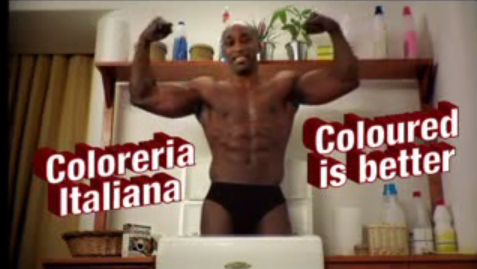
Behold, one of my favorite things on SocImages.  This pair of Italian commercials are for a do-it-yourself fabric dye.  First, commercial #1 (no Italian needed):

Message: “Coloured is better” or black men are physically and sexually superior to white men.

Screenshot (45)

BUT WAIT!  Wait till you see the twist in commercial #2!

When the man tries to use the dye to transform his wife, it becomes clear that the dye only works one way.  Clearly, it is designed for women to produce the (heteronormative, racialized) object of desire that they supposedly want.  Message: Coloreria is “What women want” or the laundry room is for ladies.

Originally posted April 2008, thanks to  Elizabeth A. and Feministing.  Also in women-are-responsible-for-cooking-and-cleaning: women love to cleanhomes of the futurewhat’s for dinner, honey?liberation through quick meals, and my husband’s an ass.

Lisa Wade, PhD is an Associate Professor at Tulane University. She is the author of American Hookup, a book about college sexual culture; a textbook about gender; and a forthcoming introductory text: Terrible Magnificent Sociology. You can follow her on Twitter and Instagram.
Devoted SocImages readers know that I will make any excuse to put up a video involving animals.  I’m going to do it right now.

The video is a dolphin petting a cat. In the first part of the video, you’ll see the dolphin come out of the water and try to put his chin on the top of the cat’s head.  In the second part of the video, you’ll see how the dolphin learned to do that. The cat very clearly wants to rub the top of his head, specifically, on the dolphin and the dolphin is paying attention and learning.

This isn’t just adorable interspecies communication, it’s proto-culture.  It’s the transmission of an idea. I don’t know if all the dolphins in this video pet the cat this way, or if it’s just one dolphin, but I can certainly imagine one dolphin teaching the next, just as the cat taught the first dolphin.

Or, to put it more simply, humans aren’t special because we’re humans, were special because we’re animals.

Lisa Wade, PhD is an Associate Professor at Tulane University. She is the author of American Hookup, a book about college sexual culture; a textbook about gender; and a forthcoming introductory text: Terrible Magnificent Sociology. You can follow her on Twitter and Instagram.

13A few times on SocImages we’ve been tickled to highlight instances of very young children performing adult behavior.  In each (adorable) case, they were great examples of how children learn how to a culturally intelligible adult and particular kinds of ones at that.

Our favorites include the baby worshipper, baby preacher, baby Beyonce, baby rapper, and babies learn how to have a conversation. Seriously. Click on every single one of those links. You won’t be disappointed.

This one is of a little girl in a Baptist church in Bishkek, Kyrgyzstan mimicking a choir conductor.  It’s fantastic.

I’m sure you’ll have your own favorite thing about it, but mine is her intensity. Maybe it’s an indication of just how seriously she takes learning.  At one time, and in a different way in the modern world, learning to copy adults was a matter of life or death. This must be part of what it means to be a human child even today.

But it may also be part of the mimicry.  Conducting tends to be a pretty serious business. Maybe she’s just performing seriousness as part of the game, like her heartfelt facial expressions.

Either way, it’s a pretty impressive performance and a wonderful example of children’s active involvement in their own socialization.

Lisa Wade, PhD is an Associate Professor at Tulane University. She is the author of American Hookup, a book about college sexual culture; a textbook about gender; and a forthcoming introductory text: Terrible Magnificent Sociology. You can follow her on Twitter and Instagram.

12In just 6 1/2 minutes, CGP Gray offers a humorous and info-packed account of Daylight Savings.  He tackles the historical rationale, the role of the equator, the contemporary debate, and the wildly wacky situations it causes today, including health problems and loss of productivity.  It’s all even wackier than you probably already imagine. Enjoy:

Also from CGP Gray:

Lisa Wade, PhD is an Associate Professor at Tulane University. She is the author of American Hookup, a book about college sexual culture; a textbook about gender; and a forthcoming introductory text: Terrible Magnificent Sociology. You can follow her on Twitter and Instagram.