Search results for embed

Yesterday I wrote about how the money spent on adult Halloween revelry now rivals, or even exceeds, that spent on kids. This may seem like a surprising shift, but it turns out it’s the focus on children that’s new. Halloween as the kid holiday we know it in the U.S. today was really invented in the 1950s.

This, and more fun facts about the history of Halloween, in this two-minute History Channel summary:

Lisa Wade, PhD is an Associate Professor at Tulane University. She is the author of American Hookup, a book about college sexual culture; a textbook about gender; and a forthcoming introductory text: Terrible Magnificent Sociology. You can follow her on Twitter and Instagram.

The United Nations’ #HeForShe campaign had a fantastic launch, with Emma Watson’s impassioned speech deservedly going viral. She stood up and described how everyday sexism continues to discourage girls and women from being strong, physical, and outspoken. And she defended the “feminist” label as a simple demand for sexual equality. But most importantly, she called for solidarity between men and women in achieving it.

And then this video came out:

On the surface, it looks like a group of men from all walks of life answering Ms. Watson’s call. But delve deeper, and it becomes problematic. For me, anyway.

I’m a man, and I consider myself a feminist. But when I think about working towards an end to sexism, the last thing I would do is get a group of men to discuss the issue isolated from women. And yet that’s what this video seems to be trying to do.

It feels like a male encounter group, but obviously highly scripted. The different men describe their commitment to #HeForShe in terms of protective paternalistic stereotypes (“I can’t let my daughters, or my wife, suffer because I didn’t do MY job”) and entitlement (“If we don’t change it, it’s never gonna change.”)

I realize that men have to be part of the solution, but this video feels like it is saying that men ARE the solution. As if a bunch of bros getting together to share their feelings are going to solve sexism, with no reference to how sisters have been doing it for themselves for over 200 years. They don’t need a heroic male takeover of the women’s movement that helps us all feel proud of ourselves because we are “#NotAllMen.” They need real understanding and support.

Am I being too harsh? Maybe. But when the one man says, “Understand that it’s not only speaking out FOR women, but WITH women” to a sausage fest, the irony speaks volumes to me.

I think #HeForShe is a great idea, “a solidarity movement for gender equality that brings together one half of humanity in support of the other of humanity, for the entirety of humanity.”

So why can’t we do it together? Are men considered to be so sexist already that we need to find a “manly” way to be feminist?

Here’s an idea: Talk to women about the issue. But more importantly, listen to them about what they experience. There is far more work for us to do together.

Tom Megginson is a Creative Director at Acart Communications, a Canadian Social Issues Marketing agency. He is a specialist in social marketing, cause marketing, and corporate social responsibility. You can follow Tom at Osocio, where this post originally appeared, and The Ethical Adman Work That Matters.

Today is Love Your Body Day and is this is our favorite body positive post of the year, re-posted in celebration. 

Rachel Wiley delivers a provocative poem about her experience as a “fat girl” loved by a skinny boy.  My favorite part:

My college theater professor once told me
that despite my talent,
I would never be cast as a romantic lead.
We put on shows that involve flying children and singing animals
but apparently no one
has enough willing suspension of disbelief
to buy anyone loving a fat girl.

Watch the whole thing (transcript here):

If you liked, we also recommend Kara Kamos’ confession that she’s ugly, but can’t think of a good reason to care.  Hat tip to Polly’s Pocket.

Lisa Wade, PhD is an Associate Professor at Tulane University. She is the author of American Hookup, a book about college sexual culture; a textbook about gender; and a forthcoming introductory text: Terrible Magnificent Sociology. You can follow her on Twitter and Instagram.
Flashback Friday.

Laura A. sent in a video in which African American men ask people in Fuzhou, China, what race they believe people in some photos are:

It’s a good example of the social construction of race. Notice how several people in the photos who would be considered Black in the U.S. don’t seem Black to the Chinese people looking at them, because they don’t have the features that they assume Black people have (such as big lips). Since they don’t have those features…they can’t be Black. We also see here that racial differences that would be easily identified in one culture (such as the U.S.) aren’t necessarily recognized in the same way in another. If race were a fixed, biological characteristic, we’d expect more consistency in how it’s defined, how many races people are divided into, and so on.

At about 3:45 you can see the African American men compare their skin color to some Chinese teens (?), who initially define themselves as “yellow people.” But after comparing their skin color, the Black men tell them they’re Black too. I wouldn’t say that the teens seem to be taking the news with great excitement.

Of course, it’s also interesting that the filmmakers refer to the people in the pictures as “really” Black, and tell the Chinese people who are guessing whether they are right or wrong in guessing their race, which implies there actually is a specific race that they belong to. They’re correct in saying that’s the race most people in the U.S. would place those individuals in, but since race is socially constructed, you can’t really say any way of categorizing people by race is “right” or “wrong.”

Originally posted in 2009.

Gwen Sharp is an associate professor of sociology at Nevada State College. You can follow her on Twitter at @gwensharpnv.

I don’t yet have a copy of Matt Richtel’s new book, A Deadly Wandering: A Tale of Tragedy and Redemption in the Age of Attention. Based on his Pulitzer-prize winning reporting for the New York Times, however, I’m afraid it’s unlikely to do justice to the complexity of the relationship between mobile phones and motor vehicle accidents. Worse, I fear it distracts attention from the most important cause of traffic fatalities: driving.

A bad sign

The other day Richtel tweeted a link to this old news article that claims texting causes more fatal accidents for teens than alcohol. The article says some researcher estimates “more than 3,000 annual teen deaths from texting,” but there is no reference to a study or any source for the data used to make the estimate. As I previously noted, that’s not plausible.

In fact, only 2,823 teens teens died in motor vehicle accidents in 2012 (only 2,228 of whom were vehicle occupants). So, I get 7.7 teens per day dying in motor vehicle accidents, regardless of the cause. I’m no Pulitzer-prize winning New York Times journalist, but I reckon that makes this giant factoid on Richtel’s website wrong, which doesn’t bode well for the book:

1 (2)

In fact, I suspect the 11-per-day meme comes from Mother Jones (or someone they got it from) doing the math wrong on that Newsdaynumber of 3,000 per year and calling it “nearly a dozen” (3,000 is 8.2 per day). And if you Google around looking for this 11-per day statistic, you find sites like textinganddrivingsafety.com, which, like Richtel does in his website video, attributes the statistic to the “Institute for Highway Safety.” I think they mean the Insurance Institute for Highway Safety, which is the source I used for the 2,823 number above. (The fact that he gets the name wrong suggests he got the statistic second-hand.) IIHS has an extensive page of facts on distracted driving, which doesn’t have any fact like this (they actually express skepticism about inflated claims of cellphone effects).

After I contacted him to complain about that 11-teens-per-day statistic, Richtel pointed out that the page I linked to is run by his publisher, not him, and that he had asked them to “deal with that stat.” I now see that the page includes a footnote that says, “Statistic taken from the Insurance Institute for Highway Safety’s Fatality Facts.” I don’t think that’s true, however, since the “Fatality Facts” page for teenagers still shows 2,228 teens (passengers and drivers) killed in 2012. Richtel added in his email to me:

As I’ve written in previous writings, the cell phone industry also takes your position that fatality rates have fallen. It’s a fair question. Many safety advocates point to air bags, anti-lock brakes and wider roads — billions spent on safety — driving down accident rates (although accidents per miles driven is more complex). These advocates say that accidents would’ve fallen far faster without mobile phones and texting. And they point out that rates have fallen far faster in other countries (deaths per 100,000 drivers) that have tougher laws. In fact, the U.S. rates, they say, have fallen less far than most other countries. Thank you for your thoughtful commentary on this. I think it’s a worthy issue for conversation.

I appreciate his response. Now I’ll read the book before complaining about him any more.

The shocking truth

I generally oppose scare-mongering manipulations of data that take advantage of common ignorance. The people selling mobile-phone panic don’t dwell on the fact that the roads are getting safer and safer, and just let you go on assuming they’re getting more and more dangerous. I reviewed all that here, showing the increase in mobile phone subscriptions relative to the decline in traffic accidents, injuries, and deaths.

That doesn’t mean texting and driving isn’t dangerous. I’m sure it is. Cell phone bans may be a good idea, although the evidence that they save lives is mixed. But the overall situation is surely more complicated than TEXTING-WHILE-DRIVING EPIDEMIC suggests. The whole story doesn’t seem right — how can phones be so dangerous, and growing more and more pervasive, while accidents and injuries fall? At the very least, a powerful part of the explanation is being left out. (I wonder if phones displace other distractions, like eating and putting on makeup; or if some people drive more cautiously while they’re using their phones, to compensate for their distraction; or if distracted phone users were simply the worst drivers already.)

Beyond the general complaint about misleading people and abusing our ignorance, however, the texting scare distracts us (I know, it’s ironic) from the giant problem staring us in the face: our addiction to private vehicles itself costs thousands of lives a year (not including the environmental effects).

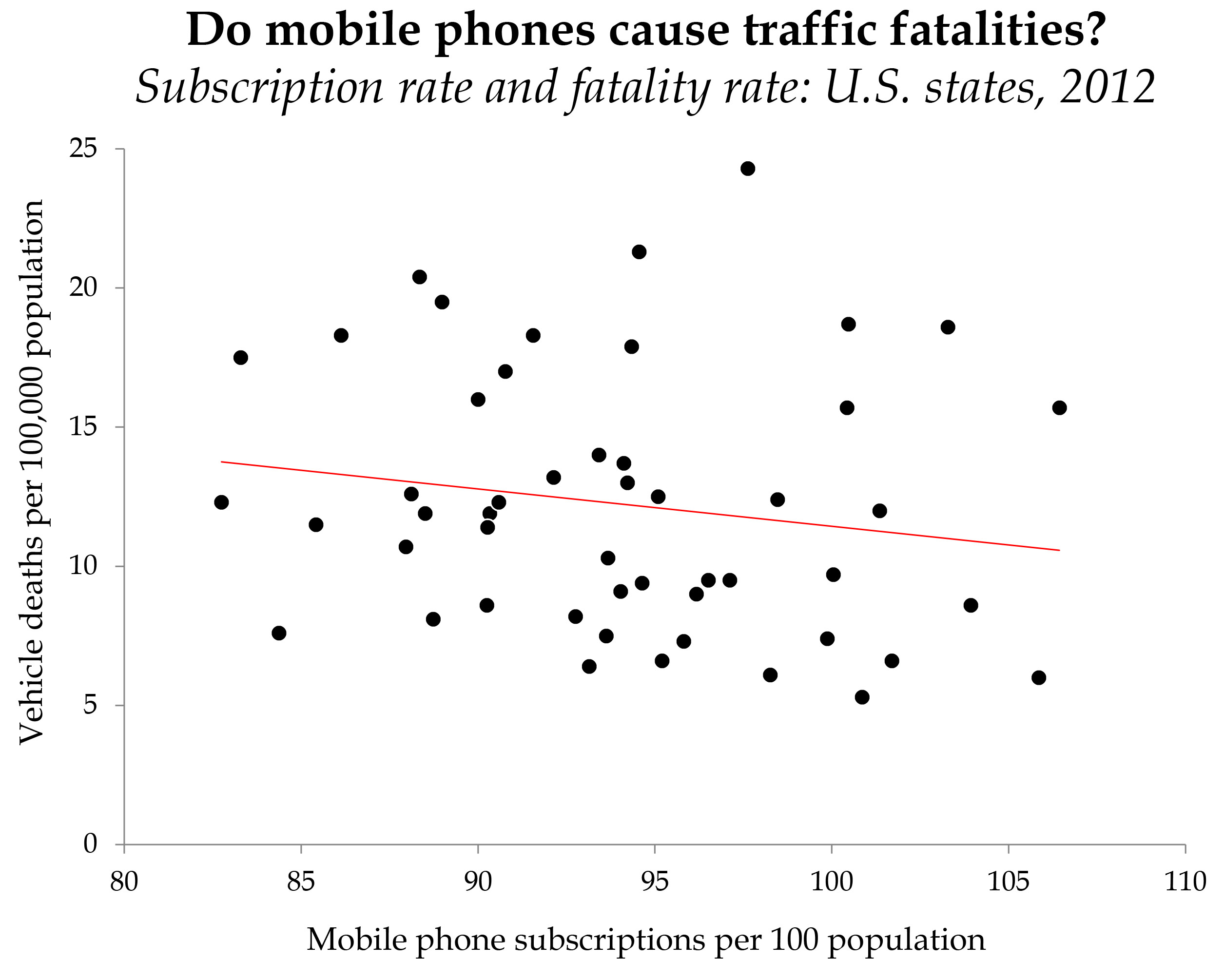
To illustrate this, I went through all the trouble of getting data on mobile phone subscriptions by state, to compare with state traffic fatality rates, only to find this: nothing:

cellphones traffic deaths with NEJM.xlsx

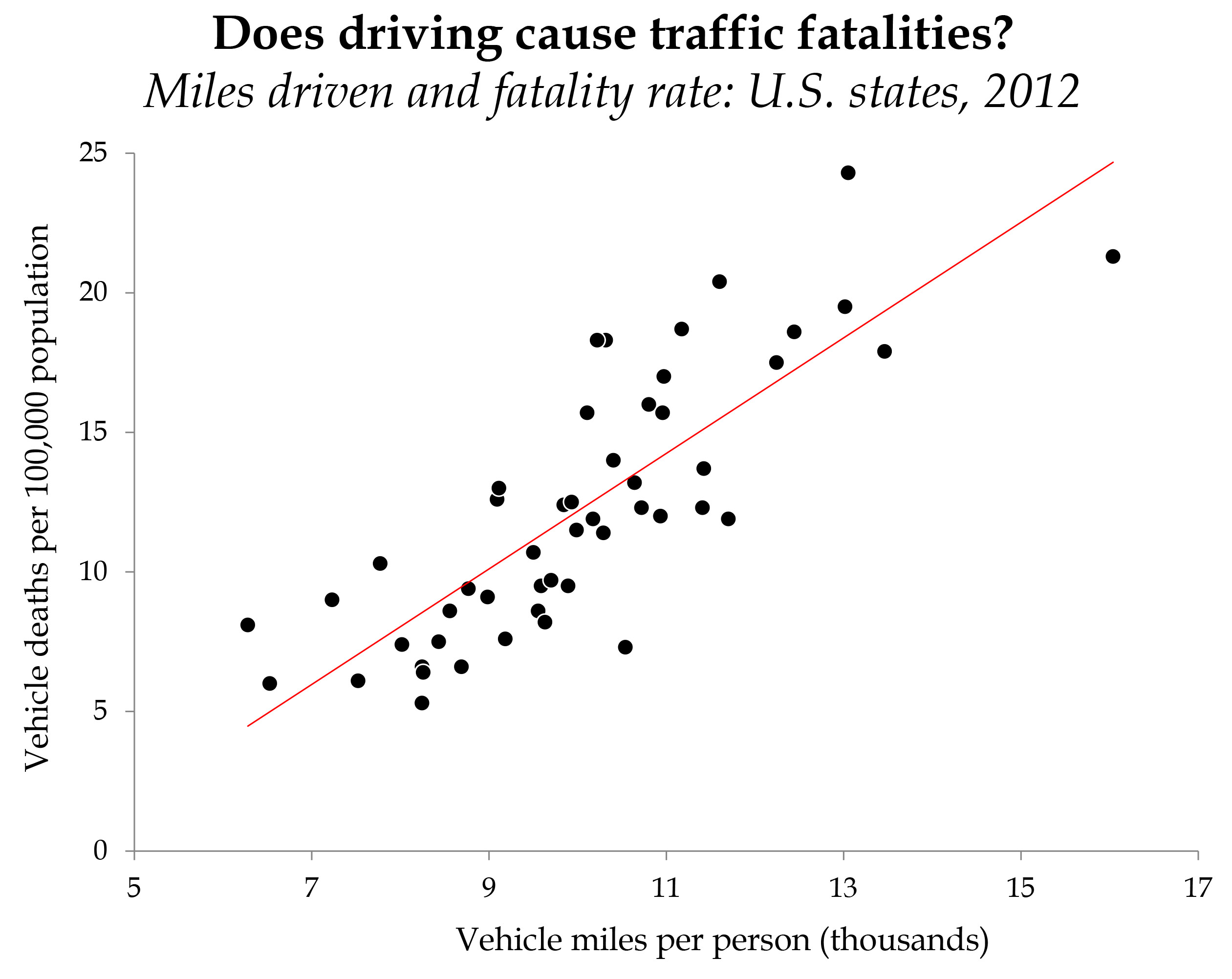
What does predict deaths? Driving. This isn’t a joke. Sometimes the obvious answer is obvious because it’s the answer:

cellphones traffic deaths with NEJM.xlsx

If you’re interested, I also put both of these variables in a regression, along with age and sex composition of the states, and the percentage of employed people who drive to work. Only the miles and drive-to-work rates were correlated with vehicle deaths. Mobile phone subscriptions had no effect at all.

Also, pickups?

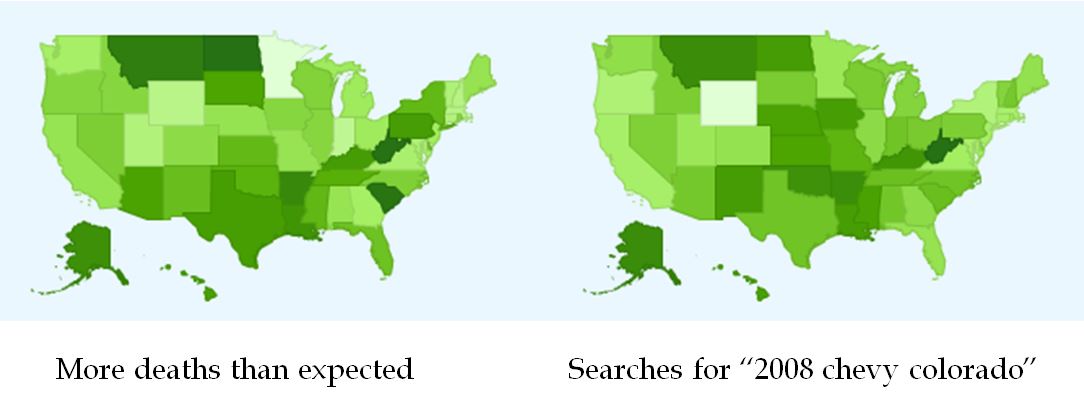
Failing to find a demographic predictor that accounts for any of the variation after that explained by miles driven, I tried one more thing. I calculated each state’s deviation from the line predicted by miles driven (for example Alaska, where they only drive 6.3 thousand miles per person, is predicted to have 4.5 deaths per 100,000 but they actually have 8.1, putting that state 3.6 points above the line). Taking those numbers and pouring them into the Google correlate tool, I asked what people in those states with higher-than-expected death rates are searching for. And the leading answer is large, American pickup trucks. Among the 100 searches most correlated with this variable, 10 were about Chevy, Dodge, or Ford pickup trucks, like “2008 chevy colorado” (r = .68), shown here:

1 (4) - Copy

I could think of several reasons why places where people are into pickup trucks have more than their predicted share of fatal accidents.

So, to sum up: texting while driving is dangerous and getting more common as driving is getting safer, but driving still kills thousands of Americans every year, making it the umbrella social problem under which texting may be one contributing factor.

I used this analogy before, and the parallel isn’t perfect, but the texting panic reminds me of the 1970s “Crying Indian” ad I used to see when I was watching Saturday morning cartoons. The ad famously pivoted from industrial pollution to littering in the climactic final seconds:

Conclusion: Keep your eye on the ball.

Philip N. Cohen is a professor of sociology at the University of Maryland, College Park, and writes the blog Family Inequality. You can follow him on Twitter or Facebook.

One of the better things about social media is that if you manage to curate social feeds with just the right balance of entertaining spirits and brilliant intellects, it delivers unto you amazing content you would have otherwise missed.

I woke up one of these days — Sunday? Monday? I’m dissertating — to find dozens of messages from social media comrades about John Oliver’s take-down of for-profit colleges. You can watch it here:

It’s very satisfying.

It is particularly satisfying if you’ve experienced what education professor Kevin Kinser rightly points out is the oddly sporadic nature of public interest in a 100 year old institutional practice of selling education for profit. Oliver is one of the best in the entertainment-as-news genre. He reaches people that mainstream media does not. He makes difficult issues palatable for general, concerned audiences.

And if you think about debt, precarity, credentialism, and financial cronyism, like I do, it is gratifying to see someone like Oliver take on an issue most people could care less about until someone they care about borrows $50,000 for a veterinary assistant’s degree. Then they’re emailing you like the roof is on fire.

I do have a greater hope, though, than that something I study benefit from the spotlight of people like Oliver.

I wish we could talk about impoverished educations without ignoring impoverished conditions.

Here’s the thing, for-profit colleges have manipulated a system primed for manipulation. No doubt about that. But eliminating for-profit colleges does not eliminate the conditions that cause people to seek them out.

By and large, none of the people I have interviewed, observed or worked with is an idiot without agency. They have sometimes been lied to and led astray; occasionally they are bamboozled by sparkly advertising and aggressive sales tactics. They do sign documents they do not completely understand and they trust authority that has little incentive to counsel as opposed to sell. All of that is true.

But most students picked up the phone to “call today; start tomorrow” because they have been unemployed, underemployed, marginalized, and otherwise made vulnerable by socio-economic conditions.

So, by all means, crib Oliver’s letter. It’s a doozy.

But maybe keep in mind that moving inequality around isn’t exactly the same as addressing inequality.

Tressie McMillan Cottom is a PhD candidate in the Sociology Department at Emory University in Atlanta, GA.  Her doctoral research is a comparative study of the expansion of for-profit colleges.  You can follow her on twitter and at her blog, where this post originally appeared.

Forgive me, because this is probably better left to Cyborgology, but something amazing is happening here. In the video below, nesting swallows become trapped in a building when they add doors. The birds soon learn, though, that they can get the doors to automatically open by triggering the motion sensors. This is a story, obviously, of how smart birds are, but here’s what struck me: we often think about human technology as for humans. In this case, however, birds adapted the technology for their own very similar needs (to get in and out).

If the workers had installed an older human technology — plain old doors — the birds would have been out of luck because they don’t have thumbs and the strength to manipulate an environment built for humans. But motion activated doors make both thumbs and strength irrelevant, so now birds are our functional equals.

This is fascinating, yeah? Our technology has advanced to the point where we’re potentially undermining our own evolutionary advantages. I’m not putting a moral judgment on it. I think morality is firmly on the side of non-fitness based decisions (eh em, social Darwinism). If one wants to theorize the relationship between animals, technology, and what it means to be human, however, this looks like gold to me.

Okay Cyborgology, your turn.

Thanks to Reuben S. for the tip! Cross-posted at Pacific Standard.

Lisa Wade, PhD is an Associate Professor at Tulane University. She is the author of American Hookup, a book about college sexual culture; a textbook about gender; and a forthcoming introductory text: Terrible Magnificent Sociology. You can follow her on Twitter and Instagram.
In the clip below, James Baldwin powerfully explains why he, as a black man, has no reason to assume that white people care about him and his people.

Responding to Dick Cavett, he says, “I don’t know what most white people in this country feel, but I can only conclude what they feel from the state of their institutions.”

He goes on to present a devastating list of ways in which American institutions are segregated and biased.  He concludes:

Now, this is the evidence. You want me to make an act of faith — risking myself, my wife, my woman, my sister, my children — on some idealization which you assure me exists in America, which I have never seen.

It was 1968, four years after the Civil Rights Act.  This year marks its 50th anniversary. How much have things changed?

Hat tip to Tim Wise. Cross-posted at Pacific Standard.

Lisa Wade, PhD is an Associate Professor at Tulane University. She is the author of American Hookup, a book about college sexual culture; a textbook about gender; and a forthcoming introductory text: Terrible Magnificent Sociology. You can follow her on Twitter and Instagram.