Search results for embed

In the 5min speech below, Malcolm X makes an argument in favor of violence when violence is called for.

Excerpts:

We are peaceful people, we are loving people. We love everybody who loves us. But we don’t love anybody who doesn’t love us. We’re nonviolent with people who are nonviolent with us. But we are not nonviolent with anyone who is violent with us.

Whatever kind of action program can be devised to get us the thing that are ours by right, then I’m for that action no matter what the action is.

I don’t think when a man is being criminally treated, that some criminal has the right to tell that man what tactics to use to get the criminal off his back. When a criminal starts misusing me, I’m going to use whatever necessary to get that criminal off my back.

And the injustice that has been inflicted on Negros in this country by Uncle Sam is criminal…

Watch:
From the great documentary, Black Power Mix Tape, Angela Davis puts violence in perspective. She’s being interviewed about the tactics of the Black Panthers. The interviewer asks: “How do you get there? Do you get there by confrontation, violence?” She responds:

Oh, is that the question you were asking?

She smiles to herself.

Because of the way this society’s organized, because of the violence that exists on the surface everywhere. You have to expect that there are going to be such explosions. You have to expect things like that as reactions. If you… if a black person lives in the black community all your life and walks out on the street everyday seeing white policemen surrounding you…

I grew up in Birmingham, Alabama. Some very good friends of mine were killed by bombs, bombs that were planted by racists. I remember from the time I was very small, I remember the sounds of bombs exploding across the street, our house shaking. I remember my father having to have guns at his disposal at all times because of the fact that at any moment someone… we might expect to be attacked.

The… man who was at that time in complete control of the city government… would often get on the radio and make statements like: “Niggers have moved into a white neighborhood. We better expect some bloodshed tonight.” And, sure enough, there would be bloodshed.

In fact, when the bombing occurred one of the mothers of one of the young girls called my mother and said, “Can you take me down to the church to pick up Carol. We heard about the bombing and I don’t have my car.” And they went down and what did they find? They found limbs and heads strewn all over the place.

And then after that, in my neighborhood all of the men organized themselves into an armed patrol. They had to take their guns and patrol our community every night because they did not want that to happen again.

I mean, that’s why when someone asks me about violence, I just…. I just find it incredible. Because what it means is that the person asking that question has no idea what black people have gone through… what black people have experienced in this country since the time the first black person was kidnapped from the shores of Africa.

She’s no longer smiling.

The interchange begins at 1min 40sec:

There was violence and unrest following the news that Darren Wilson would not be indicted. Some argued that this was proof that the people involved were bad people. Jay Smooth responds with a question: “How much do you think people can take?”

Here is a partial transcript of his 5min discussion, embedded below:

Riots are things that human beings do because human beings have limits.

We don’t all have the same limits. For some of us, our human limit is when our favorite team loses a game. For some of us, it’s when our favorite team wins a game.

The people of Ferguson had a different limit than that. For the people of Ferguson, a lifetime of neglect and defacto segregation and incompetence and mistreatment by every level of government was not their limit.

When that malign neglect set the stage for one of their children to be shot down and left in the street like a piece of trash… that was not their limit.

For the people of Ferguson, spending one hundred days almost entirely peacefully protesting for some measure of justice for that child  and having their desire for justice treated like a joke by every local authority… was not their limit.

And then after those 100 days, when the so-called prosecutor waited till the dead of night to twist that knife one last time. When he came out and confirmed once and for all that Michael Brown’s life didn’t matter…

Only then did the people of Ferguson reach their limit.

So when you look at what happened Monday night, the question you should be asking is how did these human beings last that long before they reached their human limit? How do black people in America retain such a deep well of humanity that they can be pushed so far again and again without reaching their human limit?

Riots? Violence? Unrest?

That is what happens when you treat human beings that way.

Watch to the whole thing:

A four minute introduction to Marxism, featuring Super Mario Bros., by Wisecrack:

Lisa Wade, PhD is an Associate Professor at Tulane University. She is the author of American Hookup, a book about college sexual culture; a textbook about gender; and a forthcoming introductory text: Terrible Magnificent Sociology. You can follow her on Twitter and Instagram.

In her provocative book, The Technology of Orgasm, Rachel Maines discusses a classic medical treatment for the historical diagnosis of “hysteria”: orgasm administered by a physician.

Maines explains that manual stimulation of the clitoris was, for some time, a matter-of-fact part of medical treatment and a routine source of revenue for doctors. By the 19th century, people understood that it was an orgasm, but they argued that it was “nothing sexual.” It couldn’t “be anything sexual,” Maines explains, “because there’s no penetration and, so, no sex.”

So, what ended this practice? Maines argues that it was the appearance of the vibrator in early pornographic movies in the 1920s.  At which point, she says, doctors “drop it like a hot rock.” Meanwhile, vibrators become household appliances, allowing women to treat their “hysteria” at home. It wasn’t dropped from diagnostic manuals until 1957.

Listen to it straight from Maines in the following 7 minutes from Big Think:

Bonus: Freud was bad at this treatment, so he had to come up with some other cause of hysteria. After all, she says, “this was the guy who didn’t know what women wanted.” No surprise there, she jokes.

Cross-posted at Pacific Standard.

Lisa Wade, PhD is an Associate Professor at Tulane University. She is the author of American Hookup, a book about college sexual culture; a textbook about gender; and a forthcoming introductory text: Terrible Magnificent Sociology. You can follow her on Twitter and Instagram.

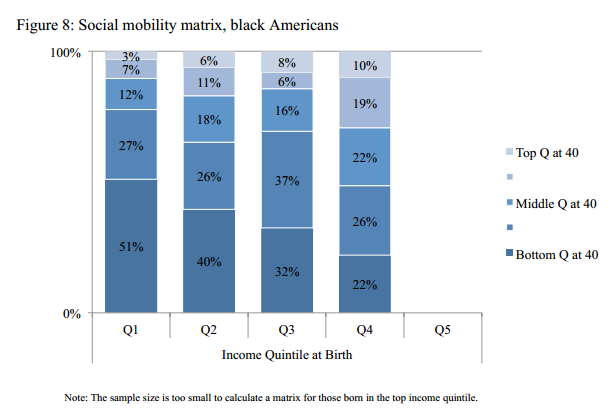
Social mobility refers to likelihood that a person born in one social class will end up in another as an adult. A new study by Richard Reeves and Isabel Sawhill for the Brookings Institute offered a devastating picture of the possibilities for black youth. To summarize: most black children see downward mobility and are poorer as adults than they were as children.

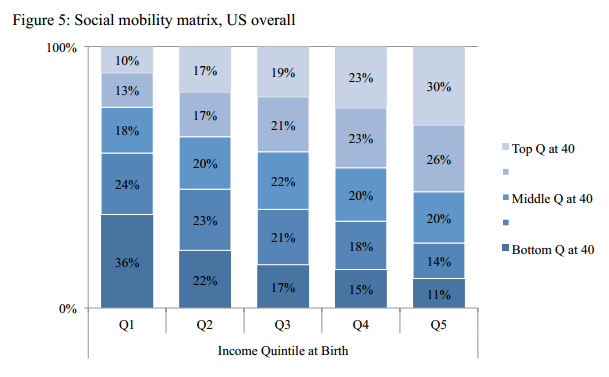
4More than half of black children born into the poorest 1/5th of households will remain there as adults. That’s only true for 36% of similarly-situated Americans overall. Poor black children, then, are less likely than Americans in general to be able to escape poverty.

Black children born into the middle class — literally the middle 5th of Americans as measured by household income — overwhelmingly see downward mobility. 16% will remain somewhere in the middle, 14% will be richer than their parents, and a whopping 69% will end up less economically stable. In comparison, only 38% of Americans, overall, born into the middle 5th see a decline in their status as adults.

As you may have noticed from the hole in the far right of the chart, the researchers didn’t have enough cases to even estimate outcomes for blacks born rich.

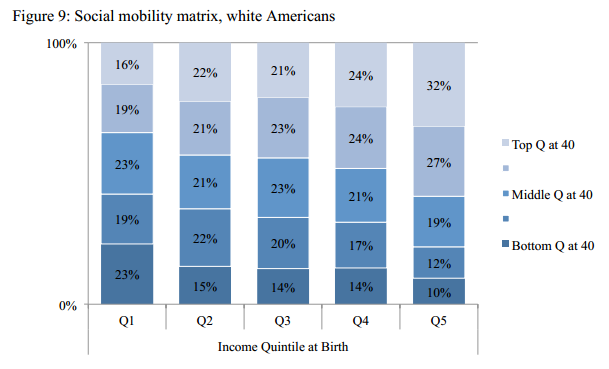
Below is the data for whites (first) and all Americans (second) for comparison:

32Here’s the first author, Richard Reeves, explaining social mobility, using Legos of course:

H/t Joe Feagin. Cross-posted at Pacific Standard.

Lisa Wade, PhD is an Associate Professor at Tulane University. She is the author of American Hookup, a book about college sexual culture; a textbook about gender; and a forthcoming introductory text: Terrible Magnificent Sociology. You can follow her on Twitter and Instagram.

Way back in 1996, sociologist Sharon Hays coined the phrase “the ideology of intensive motherhood.” She intended to draw attention to a new norm for mothering that involved, among other things, making children the center of one’s life and subordinating your own needs and wants to theirs.

I can’t help but think of Hays and her beleaguered mothers every time I see this commercial:

“When we’re having this much fun,” the voiceover says, “why quit?”

And I think, “No, seriously, quit it.”

But the mother in the ad doesn’t tell the kid to quit it. She beams. And then she gives the younger child his own glass of chocolate milk and claps as he learns how to blow bubbles in it.

Bounty glamorizes the clean-up work the mother has to do after her child blows his chocolate milk all over the kitchen table and floor. As if letting a child make an unnecessary mess is the most unselfish sign of love. It’s an excellent example of the ideology of intensive motherhood: everyone knows that this is going to be additional work for the mother, but the kids are having a good time and that’s what’s important.

Cross-posted at Pacific Standard.

Lisa Wade, PhD is an Associate Professor at Tulane University. She is the author of American Hookup, a book about college sexual culture; a textbook about gender; and a forthcoming introductory text: Terrible Magnificent Sociology. You can follow her on Twitter and Instagram.

Last week we saw a range of responses break out in reaction to this video: “F-Bombs for Feminism: Potty-Mouted Princesses Use Bad Word for Good Cause.”

Some commenters fell immediately into the “cursing = bad” camp and are offended by the language, but for those not turned off, the other initial reaction seems to be glee.  There’s an “I can’t believe they’re saying that!” kind of catharsis that accompanies watching little girls drop f-bombs all over the place and show some righteous rage over the injustices they are bound to face due to gender inequity.  What seems less present in the general reaction, and concerns me the most, is how these girls — and these causes — are fundamentally being leveraged by a T-shirt company.

For years I’ve written about what I call “fauxpowerment” — the “rah-rah, you go girl,” feel-good phrases and gestures that are meant to pump girls up with confidence or a newly varnished sense of self-esteem (often enough through a makeover) but, in fact, undermine any real confidence building as these messages reinforce that girls’ looks are paramount or that a quick, pink band-aid slapped over a deep wound makes everything better.  For those in the Girls’ Studies community or who work at well-developed programs designed just for girls, these attempts are not only insultingly facile, they are understood to be downright harmful and counterproductive. Worst of all is seeing corporations leverage girls for commercial purposes, a tradition, maddeningly, that seems ongoing.  That’s the category in which I would put the “Potty-Mouthed Princesses” advertisement — what it fundamentally is.

FCKH8, the company behind the ad, initially responded positively to my queries about their intentions, what charities they are donating proceeds of each sale to, and if the girls in the video were tightly scripted or had any input into the video, but I have not heard back again.  I hope to update this post if I do.  On their home page they cite their mission as being a “for-profit T-shirt company with an activist heart and a passionate social change mission: arming thousands of people with pro-LGBT equality, anti-racism and anti-sexism T-shirts that act as ‘mini-billboards’ for change.”

Their T-shirt slogans are meant to be provocative, and in some cases, it seems, also plagiarized, as the Feminist Majority Foundation has had an ongoing “This is What A Feminist Looks Like” campaign since 2003, with President Obama in the shirt on their 2009 cover.  More recently, FCKH8 came under fire for allegedly exploiting the events in Ferguson to sell their antiracism gear.

A quick look on the FCKH8 website reveals they barely sell T-shirts in children’s sizes.  So, why use child-models in what is essentially an ad? The answer seems painfully obvious.  Anxiety about girls is pervasive in American society, if manifested through various channels.  The value of seeing girls, in princess costumes no less, letting loose about the gendered inequities they face, never mind parade across the screen asking which one of them will inevitably be raped in her lifetime, is designed to shock.  FCKH8 is tapping into a cultural zeitgeist by putting girls in princess costumes and then breaking with stereotype by having them swear up a storm and shout out their fury, complete with very adult-like, fed-up gestures and the waved middle finger.

The reaction FCKH8 has carefully cultivated is the drama that results from presenting such high contrasts — furious princesses calling out the system in which they are entrapped, flipping off the patriarchy, and angrily speaking out.  The power of seeing this dramatized speaks to how coded and closed these systems are — “little girls” under most circumstances would hardly be allowed to swear with such abandon, if they even wanted to.

Is there something cathartic about hearing these injustices called out and denounced with anger? There is.  For those furious about gender inequality it can be gratifying hearing these issues called out — when the adult women in the ad step forward. This isn’t how most girls under 10 would speak and the girls used, albeit likely paid models or actresses taking on a role, are props.  While many commenters reported that their (usually teenage) daughters expressed delight at seeing girls let loose with things they cannot say — again a moment that reveals how girls are stifled — there is hardly any empowerment when the girls didn’t write these scripts themselves and are, fundamentally, co-opted into a purportedly radical company’s for-profit campaign through their “walking billboards” which work to questionable effect.

I‘ve always loved Peggy Orenstein’s coined phrase “empowertainment” — a moment when companies use a generic sense of “sisterhood” or a cheery pro-girl message to essentially sell products. The criticism of this practice is (necessarily) ongoing and FCKH8, a company that I’m certain will defend its practices as radical and empowering, is doing exactly this.  In Andi Zeisler’s excellent round-up of the history of “femapowerment” or, as she coins it, “empowertising,” she calls out the companies that, beyond girls, are co-opting feminism — or their brand of it — to essentially sell products.

Criticism of the company has been swift, and wide, but the click-bait appeal of this video will probably outnumber its detractors.  A few years back the video “Riley on Marketing” went viral as the outraged Riley decried the limitations imposed upon her by gendered marketing.  There was nary an f-bomb in the mix.  This was a real girl, speaking out unscripted about the injustices she knows.  The authenticity in her voice and in her message garnered almost 5 million YouTube views and carries far more power than FCKH8′s gimmicky, egregious act.

Elline Lipkin is a scholar, poet, and nonfiction writer. She is the author of two books: The Errant Thread and Girls’ Studies. This post originally appeared at Girl w/ Pen.