Search results for embed

In this excellent 6 minute video, CJ Pascoe discusses some of the findings of her widely acclaimed book, Dude, You’re a Fag.  She points out that, while being called “fag” and other terms for people with same sex desires are the most common and most cutting of insults between boys in school, they rarely mean to actually suggest that the target is gay.  Instead, the terms are used to suggest that boys are failing at masculinity.

This, she points out, is not “unique to childhood.”  For this reason, calling it bullying it is probably a distraction from the fact that this doesn’t just happen among kids.  She includes, as an example, a bomb destined for Afghanistan with the phrase “highjack this, fags” written on it by American soldiers.

Kids, then, aren’t in a particularly nasty stage.  They’re “repeating, affirming, investing in all of these norms and expectations that we as adults are handing down.”  If we used more adult language, Pascoe argues, we might do a better job of thinking how we’re teaching boys how to be this way.

A great watch:

Lisa Wade, PhD is an Associate Professor at Tulane University. She is the author of American Hookup, a book about college sexual culture; a textbook about gender; and a forthcoming introductory text: Terrible Magnificent Sociology. You can follow her on Twitter and Instagram.

Anita Sarkeesian is back with a new installment in her feminist analysis of video games. This one is a 25 minute discussion of the Ms. Male Character Trope, the phenomenon in which video games spice up their characters by including a female modeled off of the original male character.  It’s a good example of the way in which males are centered, while females, if included at all, are seen as a non-normative kind of human, animal, or thing.

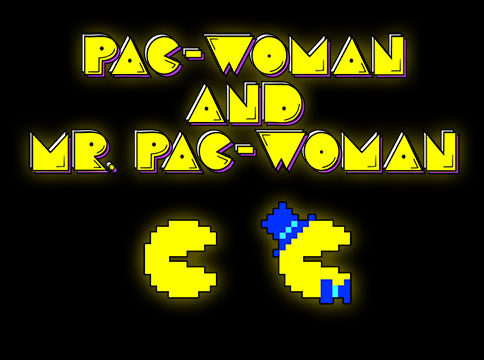
She starts with the classic example of Pac-Man and Mrs. Pac-Man, observing that only Mrs. is marked with symbols of femininity; Pac-Man, who’s not even called Mr. Pac-Man, has no markers at all.  This is typical.  This is how maleness is made simultaneously invisible and front-and-center, while femaleness is othered.  Like this:

Pacman and Mrs Pacman

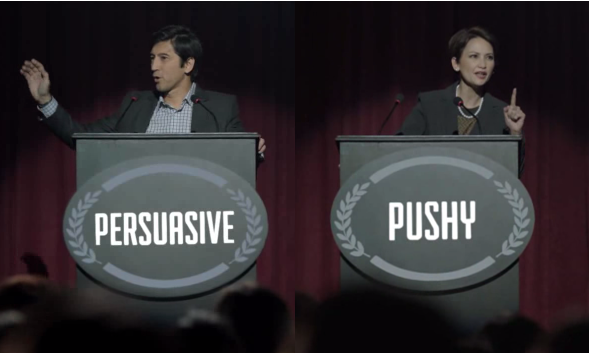
A fan sent her an example of what a reverse world would look like, where women were the default and men were marked and othered.  Awesome:

2

Here’s the whole video:

Lisa Wade, PhD is an Associate Professor at Tulane University. She is the author of American Hookup, a book about college sexual culture; a textbook about gender; and a forthcoming introductory text: Terrible Magnificent Sociology. You can follow her on Twitter and Instagram.
SureYou absolutely must find three minutes to watch Aamer Rahman defend the idea of reverse racism. Yes, he says, of course reverse racism is possible: “All I would need is a time machine…”  The rest is glorious.

Lisa Wade, PhD is an Associate Professor at Tulane University. She is the author of American Hookup, a book about college sexual culture; a textbook about gender; and a forthcoming introductory text: Terrible Magnificent Sociology. You can follow her on Twitter and Instagram.

Posted last year, but I love it, so here it is again!

In this fun four minute history of Santa Claus, CGP Gray explains how the character evolved, the role of Coca Cola, his conquest of the globe (i.e., Santa’s cultural imperialism), and the ongoing debates about where, exactly, he lives.

Also from CGP Gray:

Via Blame It On The Voices.

Lisa Wade, PhD is an Associate Professor at Tulane University. She is the author of American Hookup, a book about college sexual culture; a textbook about gender; and a forthcoming introductory text: Terrible Magnificent Sociology. You can follow her on Twitter and Instagram.

In this 4 1/2 minute video, Harvard business professor Michael Norton describes a study testing people’s willingness to talk about race.  He made volunteers play a simple game.  One picked a face from a field of 12 and the other asked yes/no questions in order to guess who they had in mind.  Among the field of faces, six were white and six were black.

Screenshot_4

Even though asking if a person was black or white would eliminate half of the contenders, 43% of people did not mention race.  If the other volunteer was African American, they were even less likely to mention it.  In that scenario, 79% didn’t ask if the face they had in mind was white or black.

They reproduced the experiment with children and found that, while little kids would ask about race, by nine or ten, they’d stopped.  The little kids often beat the older kids at the game, given that race was a pretty good way to eliminate faces.

Interestingly, the people who didn’t mention race were probably trying to appear not racist, but their decision had the opposite effect.  The partners of people who didn’t mention race rated them as more racist than the partners of people who did.  Bringing up race was, in fact, a way to signal comfort with racial difference.

For the whole story, here’s the video:

Lisa Wade, PhD is an Associate Professor at Tulane University. She is the author of American Hookup, a book about college sexual culture; a textbook about gender; and a forthcoming introductory text: Terrible Magnificent Sociology. You can follow her on Twitter and Instagram.

This 1 minute commercial for Pantene, running in the Philippines, is getting a lot of praise.  It does a powerful job of pointing out the way that women are disadvantaged in corporate contexts.  The men and women in the ad are portrayed similarly, but the women are judged for the behavior while the men are praised.

32

1Pretty neat.

But then the end.  Oh Pantene.  The answer to this systemic double bind that damns women if they do and damns them if they don’t is, apparently, to “be strong and shine.”

1

I suppose we shouldn’t expect much more from a shampoo ad, but I lament the ending anyway.  It resonates with a wider cultural trend in which feminist empowerment has been conflated with individual gain within a patriarchal system, not a collective effort to end patriarchy once and for all.

This is the lesson of Sheryl Sandberg’s Lean In: the system’s all set up to fuck you over, she acknowledges, but then she whispers: I will try to help you get to the top anyway.  No matter if you have to step all over lots of other women on the way.  That’s not feminism, that’s self-interest.  And it’s certainly not progressive change.

Thanks to @yassmin_a at Redefining the Narrative, Keely W., and Jacob R. for the link!  Cross-posted at the Huffington Post.

Lisa Wade, PhD is an Associate Professor at Tulane University. She is the author of American Hookup, a book about college sexual culture; a textbook about gender; and a forthcoming introductory text: Terrible Magnificent Sociology. You can follow her on Twitter and Instagram.

1Sociologists observe that cultures are centered around some people and  not others such that members of some groups just seem like people and others are perceived as deviations from that presumed norm.

Names are part of how we divide the world into the normals and the deviants.  Illustrating this, the sketch comedy duo Key and Peele are super creative in this 3 minute skit.  They reverse the white-teacher-goes-into-the-inner-city trope and put a non-white teacher into a suburban school.  As he calls roll, the skit center HIS reality instead of that of the white, middle class kids.  He pronounces their names like stereotypically black names, confusing the heck out of the kids, and never considering the possibility that the names he’s familiar with isn’t how all names really are.

It’s not a safe skit — it potentially reinforces the conflation of non-white and urban and the stereotypes of inner city students and the names low-income black parents give their kids — but it does a great job of playing with what life might be like if we shifted the center of the world.

Lisa Wade, PhD is an Associate Professor at Tulane University. She is the author of American Hookup, a book about college sexual culture; a textbook about gender; and a forthcoming introductory text: Terrible Magnificent Sociology. You can follow her on Twitter and Instagram.
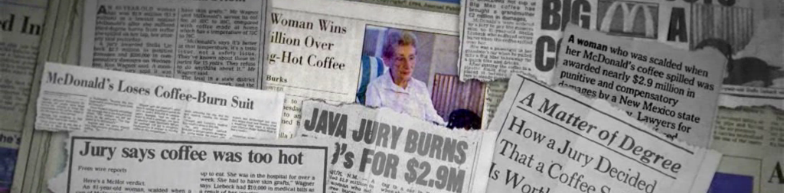
Screenshot_1The joke about the woman who sued McDonald’s after spilling hot coffee in her lap has become a cultural lightening rod, mocked in sitcoms and used to argue in favor of reforming the law that guides civil lawsuits.  In fact, the coffee was served 30 degrees higher than coffee made at home. When it spilled between 79-year-old  Stella Liebeck’s legs and pooled in her seat, she went into shock.  She was burned over 16% of her body, 6% of the burns were 3rd degree.  She spent a week in the hospital and had to have skin grafts.  When she asked McDonald’s to pay her hospital bills, they refused.  Later it came out that the restaurant had gotten many complaints about the temperature of their coffee.

This New York Times video reviews the case, described as the “most widely misunderstood story in America.”  From a sociological perspective, it’s a great example of how stories can bounce around in the media echo chamber, constrained by the need for sound bites, and become a cultural touchstone.

Lisa Wade, PhD is an Associate Professor at Tulane University. She is the author of American Hookup, a book about college sexual culture; a textbook about gender; and a forthcoming introductory text: Terrible Magnificent Sociology. You can follow her on Twitter and Instagram.