
Search results for embed

Well done, Joy Regullano, well done:

Lisa Wade, PhD is an Associate Professor at Tulane University. She is the author of American Hookup, a book about college sexual culture; a textbook about gender; and a forthcoming introductory text: Terrible Magnificent Sociology. You can follow her on Twitter and Instagram.
Flashback Friday.

Dating site OKCupid did an analysis of 500,000 inquiry messages to determine what keywords correlate most strongly with getting a reply.  It has some great lessons about dating and some counter-stereotypical news about what heterosexual women want from men.

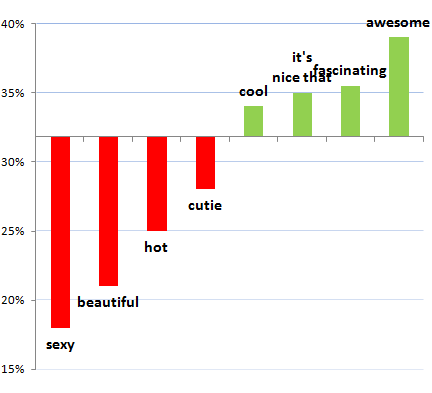
This first graph shows that mentioning someone’s level of attractiveness decreased the likelihood of getting a response (for both men and women), though men were more likely to mention looks.  But general compliments about one’s profile increased the likelihood of getting a response (the middle line is the average number of responses, the green bars signify an increase in the number of responses, and the red bars a decrease):

compliments-chart

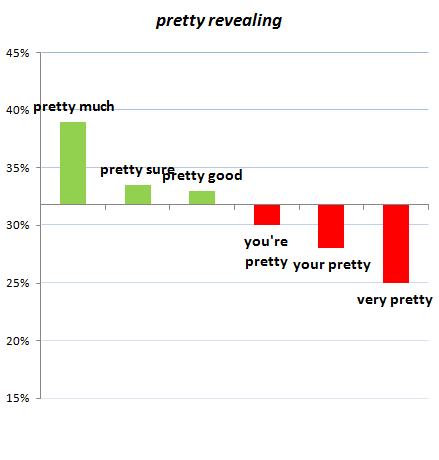
A good lesson in operationalization: “pretty” is used in two ways in our culture, so when they made sure to differentiate between pretty (meaning “sort of”) and pretty (meaning “attractive”), you can see clearly the way that commenting on looks decreases the recipients’ interest:
pretty-chart

So, in contrast to stereotypes, many women cannot be flattered into a date (though the figure above includes men and women, I’m assuming most people being called “pretty” are female).

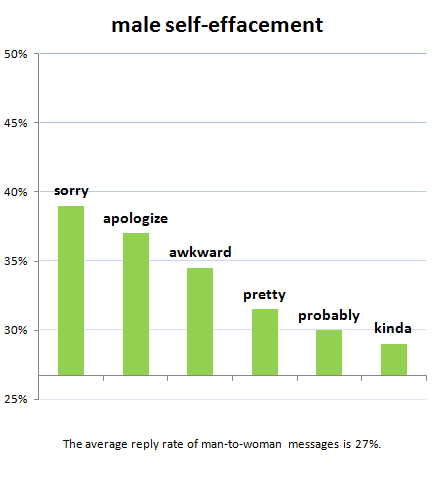
Further, the site found that when men sent messages, female recipients preferred humility to bold self-confidence.  The words below all increased the chances of a woman responding to a man’s inquiry:
efface-chart

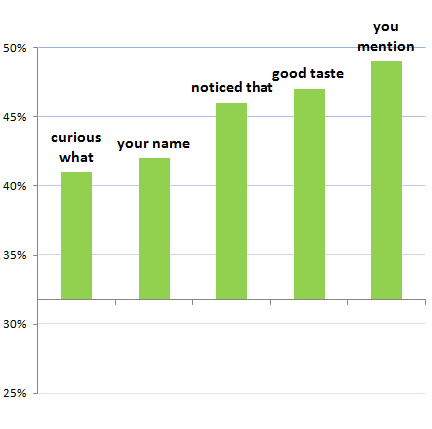
Instead of bravado and flattery, women appear to actually like men who take an interest in them.  They respond positively to phrases that indicate that a guy actually read their profile and is interested in the content of their person:
engage-chart

The lesson: Treat a woman (on the OK Cupid dating site) like a human being and she will respond positively.

And to answer the question, “What do women want?”  As my dear friend David Landsberg would say: “Everything!

This post originally appeared in 2009.

Lisa Wade, PhD is an Associate Professor at Tulane University. She is the author of American Hookup, a book about college sexual culture; a textbook about gender; and a forthcoming introductory text: Terrible Magnificent Sociology. You can follow her on Twitter and Instagram.
“First, let me say that I’m tired of all of this talk about ‘snubs,'” said an anonymous member of the Academy of Motion Picture Arts and Sciences. And continued:

And as far as the accusations about the Academy being racist? Yes, most members are white males, but they are not the cast of Deliverance — they had to get into the Academy to begin with, so they’re not cretinous, snaggletoothed hillbillies.

In the video below, Jay Smooth takes on the idea that only “hillbillies” are racist and asks about the idea of the “good person” and what it actually takes to be one.

Lisa Wade, PhD is an Associate Professor at Tulane University. She is the author of American Hookup, a book about college sexual culture; a textbook about gender; and a forthcoming introductory text: Terrible Magnificent Sociology. You can follow her on Twitter and Instagram.
The United States imprisons more people than any other country. This is true whether you measure by percentage of the population or by sheer, raw numbers. If the phrase mass incarceration applies anywhere, it applies in the good ol’ U. S. of A.

It wasn’t always this way. Rates of incarceration began rising as a result of President Reagan’s “war on drugs” in the ’80s (marijuana, for example), whereby the number of people imprisoned for non-violent crimes began climbing at an alarming rate. Today, about one-in-31 adults are in prison. his is a human rights crisis for the people that are incarcerated, but its impact also echoes through the job sector, communities, families, and the hearts of children. One-in-28 school-age children — 2.7 million — have a parent in prison.

2 (1)

In a new book, Children of the Prison Boom, sociologists Christopher Wildeman and Sara Wakefield describe the impact of parental imprisonment on children: an increase in poverty, homelessness, depression, anxiety, learning disorders, behavioral problems, and interpersonal aggression. Some argue that taking parents who have committed a crime out of the family might be good for children, but the data is in. It’s not.

Parental incarceration is now included in research on Adverse Childhood Experiences and it’s particular contours include shame and stigma alongside the trauma. It has become such a large problem that Sesame Street is incorporating in their Little Children, Big Challenges series and has a webpage devoted to the issue. Try not to cry as a cast member sings “you’re not alone” and children talk about what it feels like to have a parent in prison:

Wildeman and Wakefield, alongside another sociologist who researches the issue, Kristin Turney, are interviewed for a story about the problem at The Nation. They argue that even if we start to remedy mass incarceration — something we’re not doing — we will still have to deal with the consequences. They are, Wildeman and Wakefield say, “a lost generation now coming of age.”

The subtitle of their book, Mass Incarceration and the Future of Inequality, points to how that lost generation might exacerbate the already deep race and class differences in America. At The Nation, Katy Reckdahl writes:

One in four black children born in 1990 saw their father head off to prison before they turned 14… For white children of the same age, the risk is one in thirty. For black children whose fathers didn’t finish high school, the odds are even greater: more than 50 percent have dads who were locked up by the time they turned 14…

Even well-educated black families are disproportionately affected by the incarceration boom. Wakefield and Wildeman found that black children with college-educated fathers are twice as likely to see them incarcerated as the children of white high-school dropouts.

After the Emancipation Proclamation, Jim Crow hung like a weight around the shoulders of the parents of black and brown children. After Jim Crow, the GI Bill and residential redlining strangled their chances to build wealth that they could pass down. The mass incarceration boom is just another in a long history of state policies that target black and brown people — and their children — severely inhibiting their life chances.

Hat tip Citings and Sightings. Cross-posted at Pacific Standard.

Lisa Wade, PhD is an Associate Professor at Tulane University. She is the author of American Hookup, a book about college sexual culture; a textbook about gender; and a forthcoming introductory text: Terrible Magnificent Sociology. You can follow her on Twitter and Instagram.
If you are worried about the abuse and exploitation of non-human animals, you can become a vegetarian or a vegan. But if you worry about the abuse and exploitation of humans, there is no morally upright consumer choice you can make, short of growing 100% of your food yourself.

This is the main message of journalist Eric Schlosser in this 4min video produced by BigThink. In it, he summarizes the extent of the exploitation of poor people, mostly immigrants, in the restaurant industry, the meatpacking industry, and the production of fresh fruits and vegetables in the U.S.

Especially for the people who pick our produce, he insists, the working conditions “are more reminiscent of the mid-nineteenth century than they are with the twenty-first century.” It is “literally slavery.”

Watch here:

Lisa Wade, PhD is an Associate Professor at Tulane University. She is the author of American Hookup, a book about college sexual culture; a textbook about gender; and a forthcoming introductory text: Terrible Magnificent Sociology. You can follow her on Twitter and Instagram.

Flashback Friday.

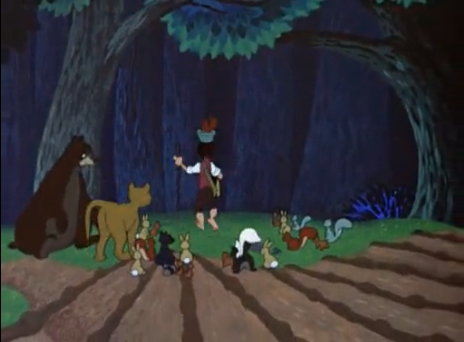
If you’re like me, you probably grew up hearing a charming story about John Chapman, aka Johnny Appleseed, in which he planted apples across America so that no one would ever go hungry again. The image, overall, is of an eccentric but kindly man who went around planting apples so pioneers could have fresh, healthy fruit to eat. Here’s the 1948 version of the story from Disney, if you have 15 minutes:


Johnny Appleseed-1948 by Kanker76

In his book The Botany of Desire, Michael Pollan discusses Johnny Appleseed. He really did exist, and he did travel around the frontier planting apples from apple seeds and later selling the apples to pioneers (and apparently giving lots of trees away, too). He was, by all accounts, extremely eccentric, wearing sackcloth as a tunic for clothing, going barefoot much of the time, and so on. He was a vegetarian, though I don’t know if chipmunks and other animals pranced around in the woods with him.

3

But there’s a little detail the Disney movie and all the kids’ books about Johnny Appleseed got wrong. His apples weren’t for eating. They were for liquor.

Apples don’t grow “true” from seeds — that is, if you plant a Granny Smith apple seed, the tree that grows will not produce Granny Smith apples (the vast majority of the time, anyway). The only way to be sure what kind of apples a tree will produce is to graft limbs onto it from another apple tree that has the kind of apples you want. Most trees that grow from seeds produce smallish apples that are bitter and very much unlike the glowing waxed fruit we’ve come to associate with health and a good diet. People would not want to eat those apples. But what they could do with them is turn them into apple cider, alcoholic apple cider.

For much of American history, alcoholic beverages were widely consumed by both adults and children. Before clean water was necessarily available, it was safer to drink alcohol, particularly in cities.

So how did we go from apples as source of liquor to apples as healthy fresh fruit? According to The Straight Dope,

We stopped drinking apples and started eating them in the early 1900s. The Women’s Christian Temperance Union publicized the evils of alcohol, the movement towards Prohibition was gaining momentum, and the apple industry saw the need to re-position the apple… We can thank prohibition for shifting the image of the apple to the healthy, wholesome, American-as-apple-pie fruit that it is today.

Anyway, it’s sort of a funny instance of both the way we sanitize history and of re-branding. Most of us, raised on images of Laura Ingalls Wilder, can’t imagine early pioneers drinking alcohol all day and happily giving it to their children, or that there might be legitimate reasons for doing so (protecting your kids from getting dysentery from polluted water, for instance). And apples have become such an icon of health that the idea of campaigns against them as sources of liquor is unimaginable.

Originally posted in 2009.

Gwen Sharp is an associate professor of sociology at Nevada State College. You can follow her on Twitter at @gwensharpnv.

This is the question that The1Janitor answers in his vlog below, offering some interesting perspective on cultural appropriation.

When white people ask him whether they should wear dreadlocks — a question he says he gets a lot — he explains that he gets the impression that they think that dreadlocks are a part of black culture. Here’s his response to that:

As far as I know, dreadlocks are mostly associated with the Rastafarian movement from Jamaica. And, as far as I know, that’s not a racial movement. And beyond that locks are worn in other places like Africa and the Middle East and Asian for many different reasons, sometimes spiritual or religious reasons.

Now I am not African or Jamaican or Rastafarian or even remotely spiritual or religious at all. Yet no one has ever accused me of cultural appropriation for having dreadlocks.

He makes a good point.

Culture is, itself, a political and politicized thing and it’s subject to social construction. Whether something counts as cultural — as opposed to, say, rational or biological or universal — is something that people figure out together in interaction, not always consciously. Dreadlocks aren’t African American, they’re lots of things to lots of people. But they also are African American, because Americans do tend to associate them with African Americans. This isn’t reality, though, it’s socially constructed reality.

Moreover, cultures are always changing, often in response to interaction with other cultures. So, to say that a thing like dreadlocks, even if they were African American in origin, could never be borrowed by another cultural group is both overly rigid and inevitably false.

His conclusion: “You’re allowed to like stuff, but you do have to take history into account,” including stuff like power and inequality.

I don’t necessary agree with all of his examples, but I like how he pushes us to think more carefully about cultural appropriation by putting the idea of culture front and center.

Here’s The1Janitor (I apologize if you encounter an ad):

Hat tip to @antoniojc75!

Lisa Wade, PhD is an Associate Professor at Tulane University. She is the author of American Hookup, a book about college sexual culture; a textbook about gender; and a forthcoming introductory text: Terrible Magnificent Sociology. You can follow her on Twitter and Instagram.
In this Farm Bureau Insurance ad, a father and son paint a room pink and commiserate about how their lives will be ruined by the arrival of a baby girl.

1. Essentialize gender. A girl is coming? That means playing with dolls and having tea parties. Girls are girls. Us, we’re boys, so automatically we…

2. …belittle femininity. The stuff girls do is boring and trivial. Only girls would want to do those things. Girls are such a drag!

In short, all girls are girly and girly stuff is dumb.

I didn’t find it, but I’ll give them the benefit of the doubt; maybe they made the opposite commercial, too. One in which a mom and her daughter cringe over the idea of having to put up with booger-flinging and farting at the table.

But that would be equally bad. We don’t know a child’s personality just by anticipating the stuff between their legs. And it’s not true that male and female humans are so different as to enjoy entirely non-overlapping sets of things.

In daily life, we recognize each other for the complex and varied people that we are. Think about it. Practically the only place we see stereotypes this retrograde are on TV and in the movies. We’re not “opposite sexes,” but we’re surrounded by the idea that we are.

Thanks to @DustinStoltz anyway!

Lisa Wade, PhD is an Associate Professor at Tulane University. She is the author of American Hookup, a book about college sexual culture; a textbook about gender; and a forthcoming introductory text: Terrible Magnificent Sociology. You can follow her on Twitter and Instagram.