Search results for embed

In the 6-minute video below, Stanford sociologist Aliya Saperstein discusses her research showing that the perception of other peoples’ race is shaped by what we know about them. She uses data collected through a series of in-person interviews in which interviewers sit down with respondents several times over many years, learn about what’s happened and, among other things, make a judgment call as to their race. You may be surprised how often racial designations. In one of her samples, 20% of respondents were inconsistently identified, meaning that they were given different racial classifications by different interviewers at least once.

Saperstein found that a person judged as white in an early interview was more likely to be marked as black in a later interview if they experienced a life event that is stereotypically associated with blackness, like imprisonment or unemployment.

She and some colleagues also did an experiment, asking subjects to indicate whether people with black, white, and ambiguous faces dressed in a suit or a blue work shirt were white or black. Tracing their mouse paths, it was clear that the same face in a suit was more easily categorized as white than the one in a work shirt.

5

Race is a social construction, not just in the sense that we made it up, but in that it’s flexible and dependent on status as well as phenotype.

She finishes with the observation that, while phenotype definitely impacts a person’s life chances, we also need to be aware that differences in education, income, and imprisonment reflect not only bias against phenotype, but the fact that success begets whiteness. And vice versa.

Watch the whole thing here:

[youtube]https://www.youtube.com/watch?v=jiwieME2tis[/youtube]

The Colbert Report also referenced Saperstein’s work:

Lisa Wade, PhD is an Associate Professor at Tulane University. She is the author of American Hookup, a book about college sexual culture; a textbook about gender; and a forthcoming introductory text: Terrible Magnificent Sociology. You can follow her on Twitter and Instagram.

In this 15min TED talk, the eminent masculinities scholar Michael Kimmel argues that feminism is in everyone’s best interest. After discussing the robust research on the benefits of gender equality, he concludes:

Gender equality is in the interest of countries, of companies, and of men, and their children and their partners… [It is] is not a zero sum game, it’s not a win-lose, it is a win-win for everyone.

Watch!

Flashback Friday.

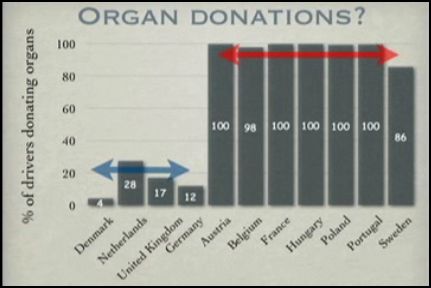
In the talk embedded below, psychologist and behavioral economist Dan Ariely asks the question: How many of our decisions are based on our own preferences and how many of them are based on how our options are constructed? His first example regards willingness to donate organs. The figure below shows that some countries in Europe are very generous with their organs and other countries not so much.

Capture1

A cultural explanation, Ariely argues, doesn’t make any sense because very similar cultures are on opposite sides: consider Sweden vs. Denmark, Germany vs. Austria, and the Netherlands vs. Belgium.

What makes the difference then? It’s the wording of the question. In the generous countries the question is worded so as to require one to check the box if one does NOT want to donate:

Capture3

In the less generous countries, it’s the opposite. The question is worded so as to require one to check the box if one does want to donate:

Capture2
Lesson: The way the option is presented to us heavily influences the likelihood that we will or will not do something as important as donating our organs.

For more, and more great examples, watch the whole video:

Originally posted in 2010.

Lisa Wade, PhD is an Associate Professor at Tulane University. She is the author of American Hookup, a book about college sexual culture; a textbook about gender; and a forthcoming introductory text: Terrible Magnificent Sociology. You can follow her on Twitter and Instagram.
In this 6 minute video, Col. Ty Seidule, head of the department of history at the U.S. Military Academy at West Point, takes on the claim that the Civil War was about something other than slavery. He begins:

Was the American Civil War fought because of slavery. More than 150 years later, this remains a controversial question. Why? Because many people don’t want to believe that the citizens of the southern states were willing to fight and die to preserve a morally repugnant institution. “There has to be another reason,” we are told. Well, there isn’t.

He goes on to use strong logic and documentation — speeches, secession documents, the Emancipation Proclamation, and more — to make a convincing case that the Civil War was about “slavery and just slavery.”  He finishes:

Slavery is the great shame of America’s history. No one denies that. But it’s to America’s everlasting credit that it fought the most devastating war in its history in order to abolish slavery. As a soldier, I am proud that the United States army — my army — defeated the confederates. In its finest hour, soldiers wearing this blue uniform, almost 200,000 of them former slaves themselves, destroyed chattel slavery; freed four million men, women, and children from human bondage; and saved the United States of America.

Wow.

Watch it all:

Lisa Wade, PhD is an Associate Professor at Tulane University. She is the author of American Hookup, a book about college sexual culture; a textbook about gender; and a forthcoming introductory text: Terrible Magnificent Sociology. You can follow her on Twitter and Instagram.

In a previous post, I wrote about a University of Illinois football coach forcing injured players to go out on the field even at the risk of turning those injuries into lifelong debilitating and career-ending injuries. The coach and the athletic director both stayed on script and insisted that they put the health and well-being of the scholar athletes “above all else.” Right.

My point was that blaming individuals was a distraction and that the view of players as “disposable bodies” (as one player tweeted) was part of a system rather than the moral failings of individuals.

But systems don’t make for good stories. It’s so much easier to think in terms of individuals and morality, not organizations and outcomes. We want good guys and bad guys, crime and punishment. That’s true in the legal system. Convicting individuals who commit their crimes as individuals or in small groups is fairly easy. Convicting corporations or individuals acting as part of a corporation is very difficult.

That preference for stories is especially strong in movies. In that earlier post, I said that the U of Illinois case had some parallels with the NFL and its reaction to the problem of concussions. I didn’t realize that Sony pictures had made a movie about that very topic (title – “Concussion”), scheduled for release in a few months.

Hacked e-mails show that Sony, fearful of lawsuits from the NFL, wanted to shift the emphasis from the organization to the individual.

Sony executives; the director, Peter Landesman; and representatives of Mr. Smith discussed how to avoid antagonizing the N.F.L. by altering the script and marketing the film more as a whistle-blower story, rather than a condemnation of football or the league…

Hannah Minghella, a top [Sony] executive, suggested that “rather than portray the N.F.L. as one corrupt organization can we identify the individuals within the N.F.L. who were guilty of denying/covering up the truth.” [source: New York Times]

I don’t know what the movie will be like, but the trailer clearly puts the focus on one man – Dr. Bennet Omalu, played by Will Smith. He’s the good guy.

Will the film show as clearly how the campaign to obscure and deny the truth about concussions was a necessary and almost inevitable part of the NFL? Or will it give us a few bad guys – greedy, ruthless, scheming NFL bigwigs – and the corollary that if only those positions had been staffed by good guys, none of this would have happened?

The NFL, when asked to comment on the movie, went to the same playbook of cliches that the Illinois coach and athletic director used.

We are encouraged by the ongoing focus on the critical issue of player health and safety. We have no higher priority.

Originally posted at Montclair SocioBlog. Cross-posted at Pacific Standard.

Jay Livingston is the chair of the Sociology Department at Montclair State University. You can follow him at Montclair SocioBlog or on Twitter.

Embed from Getty Images
When tourists returned to New Orleans after Hurricane Katrina, there was a new site to see: disaster.  Suddenly — in addition to going on a Ghost Tour, visiting the Backstreet Cultural Museum, and lunching at Dooky Chase’s — one could see the devastation heaped upon the Lower Ninth Ward.  Buses full of strangers with cameras were rumbling through the neighborhood as it tried to get back on its feet.

Reader Kiara C. sent along a photograph of a homemade sign propped up in the Lower Ninth, shaming visitors for what sociologists call “disaster tourism,” a practice that is criticized for objectifying the suffering of others. It read:

TOURIST
Shame On You
Driving BY without stopping
Paying to see my pain
1,600+ DIED HERE

Imagine having lost loved ones and seen your house nearly destroyed. After a year out of town, you’re in your nastiest clothes, mucking sludge out of your house, fearful that the money will run out before you can get the house — the house your grandmother bought and passed down to you through your mother — put back together.

Imagine that — as you push a wheelbarrow out into the sunlight, blink as you adjust to the brightness, and push your hair off your forehead, leaving a smudge of toxic mud — a bus full of cameras flash at you, taking photographs of your trauma, effort, and fear. And then they take that photo back to their cozy, dry home and show it to their friends, who ooh and aah about how cool it was that they got to see the aftermath of the flood.

The person who made this sign… this is what they may have been feeling.

Originally posted in 2011. 

Lisa Wade is a professor of sociology at Occidental College. She writes about New Orleans here. You can follow her on Twitter and Facebook.

Trigger warning for racist language and discussions of racial violence.

After the storm had passed, while New Orleans was still in a state of crisis, residents of a predominantly white neighborhood that had escaped flooding, Algiers Point, took it upon themselves to violently patrol their streets.

“It was great!” says one man interviewed below. “It was like pheasant season in South Dakota. If it moved, you shot it!” According to one witness testimony, they were looking for “anything coming up this street darker than a paper bag…” At least 11 black men were shot.

Here is a short interview with two of the men of Algiers Point, from the documentary Welcome to New Orleans:

This next video, sent in by reader Martha O., includes some of the footage above, but focuses much more on the experiences of several African American men who lived in the neighborhood and were shot or threatened by their White neighbors.

The men talk about the panic and terror they felt during these incidents. Toward the end, Donnell Herrington watches footage of the White residents bragging about their exploits. It’s brutal to watch this man listening to the militia members talk about shooting African Americans casually and with obvious enthusiasm and pride.

The video is part of an in-depth story about the Algiers Point shootings featured in The Nation in 2008. And as Martha explained, it’s a harrowing example of how swiftly organized violent racism can emerge when external constraints are even briefly weakened.

Originally posted in 2012. Watch the full documentary here.

Gwen Sharp is an associate professor of sociology at Nevada State College. You can follow her on Twitter at @gwensharpnv.

In this two minute clip, comedian Kate Berlant casually makes the case that women should steal cosmetics because, to paraphrase Berlant, no one should have to constantly pay for their own domination. Enjoy!

Thanks Letta!

Lisa Wade, PhD is an Associate Professor at Tulane University. She is the author of American Hookup, a book about college sexual culture; a textbook about gender; and a forthcoming introductory text: Terrible Magnificent Sociology. You can follow her on Twitter and Instagram.