Search results for embed

Flashback Friday.

In the contemporary U.S., individuals choose who to marry based on personal preference, but there is a specific script by which those choices become a wedding day. Not everyone follows the script, but everyone knows it: the man decides to ask the woman to marry him, he buys a ring, he arranges a “special” event, he proposes, and she agrees. Many of us grow up dreaming of a day like this.

But this isn’t the only possible way to decide to marry. A reverse script might involve female choice. We can imagine a world in which, instead of hoping to be chosen, women decide to propose and men can only marry if they get asked. Another alternative script might involve no proposal at all, one in which two people discuss marriage and come to a decision together without the pop question and uncertain answer.

Of course, many couples essentially decide to marry through months or years of discussion, but these couples frequently act out the script anyway because, well, it’s so romantic and wonderful.

Or is it?

Andre M. sent in a clip of John Preator, a finalist on a previous season of American Idol. In the clip, he proposes to his girlfriend Erica on Main Street at a Disneyland Resort. The clip exaggerates the patriarchal underpinnings of both marriage and the marriage proposal. It may or may not be real, but it doesn’t really matter for our purposes.

Here it is:

First, Andre says, the spectacle is a shining testament to our commitment to the idea of marriage as an ideal state. Everyone loves marriage! As Andre writes:

A whole rainbow of characters come out of the shadows to push her towards yes, from the smiling Asian janitor, to the African American guy knighted by our hero and his plastic phallus, to the disabled woman who wishes to trade her fate with the bride-to-be.

We are supposed to think: “How wonderful! How sweet! How perfect!” What is made invisible is the fact that, in addition to a potential site of wedded bliss, marriage is the site of the reproduction of patriarchal privilege (especially through women’s disproportionate responsibility for housework and childcare) and heterosexist (still excluding same sex couples). But the audience knows that they are supposed to feel elated for the couple and privileged to witness their special moment (whether they feel these things or not).

Second, the public nature of the proposal put a lot of pressure on her to say “yes.” The audience is asked to participate in urging her to agree to marry him (“come on folks, how about a little encouragement?!”). And the performers, as well as the performance itself, create conditions that look a lot like coercion. Could she have said “no” if she wanted to? As if breaking his heart wouldn’t have been deterrent enough, saying “no” would have disappointed the onlookers and ruined the performance. He put so much work into scripting the proposal and it was very clear what her line was. How many women, with less pressure, have nonetheless felt it difficult or impossible to say “no”?

Okay, so let’s assume that Erica did want to marry John and that they will live happily ever after. And let’s also assume that most marriage proposals in the U.S. do not come with this degree of pressure. The clip is still a nice reminder of (1) just how taken-for-granted marriage is as an ideal state (can you imagine her saying, “I love you more than life itself and I want to be with you forever, but marriage, no thanks!”) and (2) the way that the proposal script puts men in the position of getting to choose and women in the position of having to agree or go off script.

Originally posted in 2010.

Lisa Wade, PhD is an Associate Professor at Tulane University. She is the author of American Hookup, a book about college sexual culture; a textbook about gender; and a forthcoming introductory text: Terrible Magnificent Sociology. You can follow her on Twitter and Instagram.

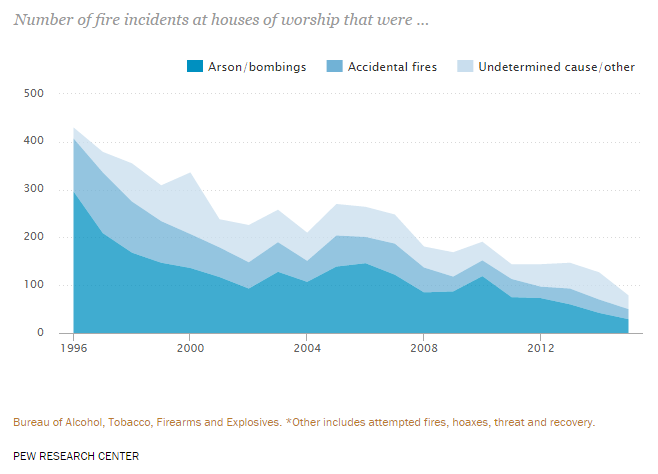
According to data presented by Pew Research Center, 51% of the last 20 years of fires at houses of worship were ruled “intentional.” In contrast, 10% of non-residential fires and 5% of residential fires are believed to be arson.

Overall, all types of fire incidents at churches and other houses of worship have been declining, but the proportion that are ruled intentional has been stable. In 1996, a House Judiciary Committee report found that arson attacks disproportionately targeted black churches in the South.

This is your image of the week:5

Play with the interactive data here.

Lisa Wade, PhD is an Associate Professor at Tulane University. She is the author of American Hookup, a book about college sexual culture; a textbook about gender; and a forthcoming introductory text: Terrible Magnificent Sociology. You can follow her on Twitter and Instagram.

I saw “Trainwreck” last night. The 7:00 p.m. showing at the 68th Street AMC was full. Maybe people had come just to get out of the apartment and yet avoid the beastly heat, but they enjoyed the movie.  Sometimes the laughter lasted long enough to cover up the next joke.

The “Trainwreck” story is standard rom-com: Amy Schumer plays a young woman who rejects the idea of commitment and love. Circumstances put her together with a man she seems to have nothing in common with. You can guess the rest.

But this is Amy Schumer’s movie, so there’s an important twist – the conventional sex roles are reversed. It’s the man who is sweet and naive and who wants a real relationship; the woman has a lot of sex with a lot of different guys, drinks a lot, smokes weed, and resists love until at the end, she decides to become the woman he wants her to be.

Here is the R-rated version of the trailer:

What interested me was not the movie itself, but the reaction in some conservative quarters. For Armond White at the National Review, the movie triggered something like what Jonathan Haidt calls “disgust” – a reaction to the violation of strong taboos that surround things like food, sex, blood and other bodily matters, and death. These taboos are often arbitrary, not rational. Pork is an “abomination,” for example, because… well, because it is, and because pigs are “unclean.”

“Trainwreck” has no pork, but it does have what some find unclean.

Schumer’s tampon jokes and gay jokes, female versions of locker-room humor, literally drag pop culture to the toilet. A girl-talk scene set in adjoining restroom stalls — one revealing dropped panties, the other panty-less (obviously Amy) — is just Apatow using women to show off his indecency.

As a comedian and now as a filmmaker, Schumer talks about women-things: body functions and body parts. These jokes seem to elicit two different kinds of laughter. Back when researchers studying small group interaction were trying to code and categorize behavior, laughter posed a problem (see this earlier post). It could be coded as “Shows Tension,” but it might also be “Shows Tension Release.”

With Amy Schumer jokes, the male laughter is mostly a nervous, full of tension about a taboo subject. But the female laughter seems much less inhibited – tension release, maybe even a relief, as if to say, “Someone is finally talking publicly and frankly about things we could only whisper about,” since most of the time they have had to pretend to share the male taboo.

Indecency indeed. But something is indecent only to members of groups that deem it indecent. Some groups are not at all disgusted by pork.  And for some audiences, tampon jokes and toilet-stall conversations about Johnny Depp movies are not indecent; they’re just funny. What audiences might those be? Women.

Take the tampon joke that the National Reviewer finds indecent. It would seem obvious that used tampons look different depending on where you are in your period – less bloody on the final day, more so a few days earlier. But at the mere mention of this fact in “Trainwreck,” hilarity ensues, especially among women in the audience.

The thing about taboos – ideas about what is indecent or disgusting – is that entire social structures get built around them. To violate the taboo is to threaten the entire edifice. Powerful taboos on women-things often go with male domination. So for the National Review, the “Trainwreck”reversal of rom-com gender roles makes the movie dangerous and subversive.

Here are some excerpts from the review just to give the flavor of this Purity-and-Danger-like conflating of taboo, female sexuality, and social/political threat to the established order (emphasis mine):

Schumer turns female sexual prerogative into shamelessness

the degradation of sex — and women

uses sex to promote feminist permissiveness.

She enjoys a sexual license

Amy brazenly practices the same sexual habits as men

Lacking
. . . old-fashioned sense of shame,

It’s merely brazen, like Lena Dunham’s HBO series, Girls (also about a promiscuous female writer

Schumer’s film can be seen to distort human relations into smut.

This is not just disrespectful, it confirms Schumer’s project of cultural takeover,

she aims to acquire cultural power

Schumer disguises a noxious cultural agenda as personal fiat. She’s a comedy demagogue who okays modern misbehavior yet blatantly revels in PC notions about feminism, abortion, and other hot-button topics

Wow.

I should add that not all conservative publications felt so threatened. Joe Morganstern at the Wall Street Journal gave the movie a warm review. Breitbart saw the movie’s essential conservatism (“The anti-slut message is a healthy one”) and praised Schumer as a comic actor.  Still, the National Review piece seems emblematic of something broader in the cultural conservative camp: a taboo-like reaction to female sexuality.

Originally posted at Montclair SocioBlog.

Jay Livingston is the chair of the Sociology Department at Montclair State University. You can follow him at Montclair SocioBlog or on Twitter.

Organizers of Free Pride Glasgow, a Scottish gay pride parade, have “banned” drag queens from the event, citing concerns that men dressing up like women is offensive to trans women. The LGBTQ community is afire about this, citing the long tradition of drag performances in gay communities and the role drag queens have played in the Gay Liberation movement. “hello, ever heard of THE STONEWALL RIOTS?!!!” tweeted one of the stars of RuPaul’s Drag Race.

The organizers of Free Pride Glasgow are standing their ground, stating that they will only allow trans women to perform in drag. A facebook comment suggested, and rightly so, that this could get really problematic really fast in practice, asking: “How are you going to moderate who is a trans and who is a cis drag act?”

Well, that’s a can of worms.

I don’t know how this conversation is going to play out and, to be honest, I’m nervous to jump in. But I gotta say that I, for one, really hope we keep talking about this. I don’t think it’s unreasonable to worry about how drag queen performances might make trans women feel. Drag performers generally do an exaggerated performance of femininity and I think it’s okay to ask whether and when this counts as mocking femininity and the people that perform it: trans women, yes, and ciswomen, too.

Embed from Getty Images

Sexism matters here and anyone can be sexist, even drag queens. When drag queens trot out some of the worst stereotypes about women, for example –performing characters that are vain, bitchy, selfish, and always PMSing — I see girlface. I see men mocking femininity, not embracing their feminine sides and busting the fiction of masculinity. So, I don’t blame trans women one bit if this makes them uncomfortable; it sure makes me uncomfortable and I’m in a much safer position than they.

So, I don’t know where this conversation is going to go, but I do think we need to have it. It needs to be, though, not about whether drag queens should be banned, but what drag should look like going forward. It should be about both what drag queens bring to the movement — their value in the past and the role they can play now — but also whether and how their performances contribute to a devaluation of femininity that hurts all women, cis, trans, and other.

Lisa Wade, PhD is an Associate Professor at Tulane University. She is the author of American Hookup, a book about college sexual culture; a textbook about gender; and a forthcoming introductory text: Terrible Magnificent Sociology. You can follow her on Twitter and Instagram.

A new tumblr titled Every Word Spoken posted a quote from George Gerbner that goes like this:

Representation in the fictional world signifies social existence; absence means symbolic annihilation.

It’s the rallying cry for writer and performer Dylan Marron, who runs the tumblr. It’s exactly what it sounds like: a movie cut down to feature just the lines spoken by non-white people. He’s just getting started, but it looked to me like so far the longest clip is less than 1 minute long, most are around 30 seconds and this includes a few seconds at the beginning of each where they show the title.

In addition to showing us that people of color with speaking roles are almost non-existent — symbolically annihilated — the roles they play tell disturbing stories. Overwhelmingly, in the videos he’s picked so far, they are in service occupations (500 Days of Summer); literally maids (Enough Said); or with stereotypical accents (Wedding Crashers). And, oh hey movie people, making the only person of color with lines a doctor (The Fault in Our Stars; Black Swan) gets you no bonus points in my book. Nice try.

But THESE. These were the best ones…

Noah:

Into the Woods:

This project is calling out the movie industry in a simple, powerful way. Just the facts, ma’am. Time for change.

Lisa Wade, PhD is an Associate Professor at Tulane University. She is the author of American Hookup, a book about college sexual culture; a textbook about gender; and a forthcoming introductory text: Terrible Magnificent Sociology. You can follow her on Twitter and Instagram.

I usually try to avoid posting videos that are more than five minutes long, but this commentary about trans rights from John Oliver was too great to pass up. He does a wonderful job of introducing what it means to be transgender, as well as discussing:

  • media coverage,
  • the terrible statistics on discrimination and anti-trans violence,
  • the gender binary in institutions and institutional inertia,
  • and the ridiculousness of “bathroom bills.”

Mostly, he just does a great job of talking about how easy it really is to just get over it and treat people like people.

Lisa Wade, PhD is an Associate Professor at Tulane University. She is the author of American Hookup, a book about college sexual culture; a textbook about gender; and a forthcoming introductory text: Terrible Magnificent Sociology. You can follow her on Twitter and Instagram.

If Mexicans celebrated the 4th like Americans celebrate Cinco de Mayo:

From Flama.

Lisa Wade, PhD is an Associate Professor at Tulane University. She is the author of American Hookup, a book about college sexual culture; a textbook about gender; and a forthcoming introductory text: Terrible Magnificent Sociology. You can follow her on Twitter and Instagram.

Most people middle aged or older remember the “Crying Indian” campaign for Keep America Beautiful:2

Most of them, by now, also know that Iron Eyes Cody was no Native American. Born to Sicilian Immigrants in southwestern Louisiana in 1904, Espera Oscar de Corti became an actor in his youth, and found that he could “pass” as a Native American in Hollywood.

de Corti, changing his name to “Cody,” claimed to have Cherokee-Cree heritage. He played native roles in dozens of westerns, with John Wayne and other stars of the mid-20th century. His chanting was featured in the Joni Michtell song “Lakota.” And, of course, he was the Noble Savage face of Keep America Beautiful. All while sharing more heritage with Christopher Columbus than with the people who got the shit end of the Columbian Exchange.

By all accounts Iron Eyes Cody tried to honour his assumed ancestry. He became an activist for Native American causes, and did lecture tours preaching against the harm of alcohol. He married a Seneca archaeologist, Bertha Parker, and they adopted two adopted two Dakota and/or Maricopa children. He even wrote a book about native sign language.

He also invented a backstory, quoted by Glendale News Press from  a 1951 local newspaper article:

Iron Eyes learned much of his Indian lore in the days when, as a youth, he toured the country with his father, Thomas Long Plume, in a wild west show. During his travels, he taught himself the sign language of other tribes of Indians…

The article said that the television star and his wife would appear at a Glendale Historical Society event to tell the story of the “Indian Sign Language in Pictures” and would demonstrate Indian arts and customs. Plus, the couple would bring along their 3-month-old “papoose” Robin (Robert Timothy). All were to be attired in Indian regalia.

In 1996, three years before his death, Iron Eyes Cody was outed as European by his half-sister, May Abshire, who offered proof of the actor’s Sicilian parentage to the Times-Picayune. Cody denied the allegations.

Today, such a shocking exposé, proving that an upstanding member of an ethnic community was really an outsider, would be all over social media. Just like Rachel Dolezal.

I’m having a hard time digging up any initial reactions to Iron Eyes Cody’s outing from indigenous people in the United States or Canada. How is he remembered? Did he help make native issues more visible, or did he obnoxiously appropriate a culture of suffering that didn’t belong to him?

Cross-posted at The Ethical Adman.

Tom Megginson is a Creative Director at Acart Communications, a Canadian Social Issues Marketing agency. He is a specialist in social marketing, cause marketing, and corporate social responsibility. You can follow Tom at Osocio and The Ethical Adman.