Search results for embed

On Feb. 13th, 2008, a Texas federal appeals court ruled that the prohibition against selling dildos and fake vaginas violated the 14th Amendment.

That’s right. Such sex toys were illegal in Texas until early last year. According to a Slate article, they are still illegal in three other states: Virginia, Mississippi, and Alabama.

But don’t congratulate or castigate Texas just yet.  The state Attorney General wants the court to reconsider.

Here is an entertaining 11-minute discussion of the dildo debates in Texas (it’s a must watch):
Abby K. alerted us to this video from the New York Times about boys who cross traditional gender lines to compete on a double-dutch jump-roping team in Brooklyn:

Click here for the NYT article that accompanied the video.

It’s a good illustration of the pressures boys face to avoid anything defined as feminine, usually more than girls are told to avoid things that are masculine (which can sometimes make them cool). ZeAndre Orr’s mom tried to dissuade him from doing something that was for girls, other boys at school picked on him because of his involvement with double dutch, and of course there is the time-honored tradition of calling boys who participate in “girly” activities sissies. For many boys, the fear of such repercussions–particularly harassment by other boys–is enough to make them steer clear of things they might be good at or like doing. And yet, despite these pressures, both boys and girls do cross gender lines all the time…a fact we conveniently forget when we talk about gender in a way that implies that “real boys” just naturally like certain things and not others, for example.

The other thing this made me think about is the way that physical activities get defined as sports…or as something else. If jump-roping were in the “sport” category, it would be socially acceptable, even encouraged, for ZeAndre to take part. And there’s no particular reason I can see that double dutch is clearly not a sport–it requires stamina, physical skill, fitness, and excellent hand-eye coordination, and involves team competition. I’ll probably get myself yelled at here, but seriously, this looks like it has as much of a claim to be called a sport as golf does.

But much like competitive cheerleading, competitive jump-roping has not attained social recognition as an athletic endeavor. Some sociologists argue that physical activities that predominantly attract women tend to be defined as something other than sports simply because we associate athletics with men, not women. I’m not arguing about whether or not competitive jump-roping should be seen as a sport–I really don’t care–but you might use this video as a starting point for a discussion about why we define some activities as sports but not others, and how gender might play into this.

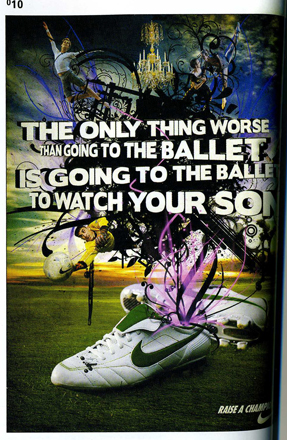
Back to the issue of the messages boys get that discourage them from doing things coded feminine, Nathan M. (see his truly awesome artwork at The House of Tomorrow) sent in a link to this Nike ad (found at gigposters), which makes it clear that parents are supposed to be horrified at the idea that their son would be in ballet:

Thanks, AK and Nathan!


This excellent documentary documents the powerful interests behind Disney and criticizes the extent to which young American children’s childhoods are influenced by the company. The comments on the messages behind Beauty and the Beast are particularly troubling.


Via Adverbox.

Edward L. sent in a link to Ultra Culture’s post about trailers for the new Will Smith movie “Seven Pounds” market the movie differently depending on whether the target audience is men or women. Ultra Culture’s analysis is funnier than anything I’d say, so I’m just going to quote it.

Here’s one trailer:

[youtube]https://www.youtube.com/watch?v=7kpK1fKzoDs[/youtube]

Ultra Culture says:

WOMEN!
This is the film for you! Its got that sexy Will Smith in it (from Hitch!) and just look at all the emotional turmoil he’s going through with Rosario Dawson. And did you see that? It’s directed by the guy who did Pursuit of Happyness! What a lovely, life-affirming film that was.

Another trailer:

Again from Ultra Culture:

MEN!
This is the film for you! Its got that cool Will Smith in it (from Hancock!) and just look at all that fast paced action he’s going through with that gruff-voiced man. And those fast cuts, whooshing noises and gradually fading words remind me of Enemy of the State! What a heart-pounding thrill-ride that was.

You might pair this with a discussion of how other products are marketed differently to men and women, such as cars or food.

Thanks, Edward!

Gwen Sharp is an associate professor of sociology at Nevada State College. You can follow her on Twitter at @gwensharpnv.

A Cracked article compiled their candidates for the Nine Most Racist Disney Characters. Select stolen clips and liberal quoting below:

American Indians in Peter Pan:

Why do Native Americans ask you “how?” According to the song, it’s because the Native American always thirsts for knowledge. OK, that’s not so bad, we guess. What gives the Native Americans their distinctive coloring? The song says a long time ago, a Native American blushed red when he kissed a girl, and, as science dictates, it’s been part of their race’s genetic make up since. You see, there had to be some kind of event to change their skin from the normal, human color of “white.”

The bad guys in Alladin:

“Where they cut off your ear if they don’t like your face” is the offending line, which was changed on the DVD to the much less provocative “Where it’s flat and immense and the heat is intense.”

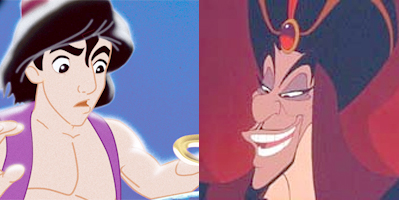
In a city full of Arabic men and women, where the hell does a midwestern-accented, white piece of cornbread like Aladdin come from? Here he is next to the more, um, ethnic looking villain, Jafar.

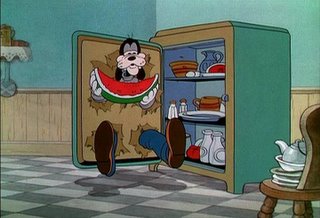
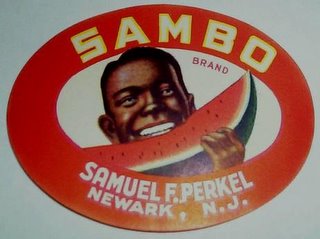
NEW: Miguel (of El Forastero) sent in a post from El Blog Ausente that compares an image of Goofy, a character generally portrayed as sort of dumb and lazy, to a traditional Sambo-type image:

sandia_goofy

sambo_watermelon

The post suggests that Goofy is a racial archetype, built on stereotypical African American caricatures. I can’t remember ever seeing anything that suggested this, but that doesn’t mean much, and I certainly don’t put it past Disney to do so. Does anyone know of any other examples of Goofy supposedly being based on African American stereotypes? On the other hand, is it possible to depict a character eating watermelon in an exuberant manner without drawing on those racist images? When I look at the image of Goofy above, I have to say…that’s pretty much what it looks like when my (mostly White) family cuts a watermelon open out on the picnic table in the summer and everybody gets a piece and they all have ridiculous looks on their faces as they dribble juice all down themselves eating big chunks (I say “they” because I’m a weirdo who doesn’t really care for watermelon, so I rarely eat any, and even then only if I can put salt on it). I’m fairly certain that I couldn’t put up a photo of my family eating watermelon like that without it seeming, to many people, to draw on the Sambo-type imagery. It brings up some interesting thoughts about cultural and historical contexts, and how and in what circumstances you can (or can’t) escape them, regardless of your intent.

Lisa Wade, PhD is an Associate Professor at Tulane University. She is the author of American Hookup, a book about college sexual culture; a textbook about gender; and a forthcoming introductory text: Terrible Magnificent Sociology. You can follow her on Twitter and Instagram.

Freud distinguished between a “mature” (vaginal) and “immature” (clitoral) orgasm, telling women that to require clitoral stimulation for orgasm was a psychological problem. Contesting this, in 1970 Anne Koedt wrote The Myth of the Vaginal Orgasm.  She explains:

Frigidity has generally been defined by men as the failure of women to have vaginal orgasms. Actually the vagina is not a highly sensitive area and is not constructed to achieve orgasm. It is the clitoris which is the center of sexual sensitivity and which is the female equivalent of the penis… Rather than tracing female frigidity to the false assumptions about female anatomy, our “experts” have declared frigidity a psychological problem of women.

Indeed, studies show that about 1/3rd of women regularly reach orgasm during penile-vaginal sex.  The rest (that is, the majority) require more direct clitoral stimulation.  Koedt goes on (my emphasis):

All this leads to some interesting questions about conventional sex and our role in it. Men have orgasms essentially by friction with the vagina, not the clitoral area, which is external and not able to cause friction the way penetration does. Women have thus been defined sexually in terms of what pleases men; our own biology has not been properly analyzed. Instead, we are fed the myth of the liberated woman and her vaginal orgasm – an orgasm which in fact does not exist.

Koedt’s article was highly influential and rejecting the notion of the “vaginal orgasm” (both anatomically and functionally) was part of second wave feminism. 

Still, the vaginal orgasm keeps coming back.  During the ’90s, it came back in the form of the G-spot.  You, too, can have a vaginal orgasm if you can just find that totally-orgasmic-pleasure-spot-rich-in-blood-vessels-and-nerve-endings-that-makes-for-wildly-amazing-orgasms-with-ejaculation that you, strangely, never knew was there!  (See what Betty Dodson has to say about the g-spot here.)

Most recently, the vaginal orgasm has come back in the form of orgasmic birth.  The idea is that women can, if they really want to, have an orgasm (or orgasms) during childbirth. 

Now, I don’t want to argue that women never have orgasms from penile-vaginal intercourse.  They do.  I also don’t care to debate whether a g-spot exists.  And I am certainly not going to look a mother in the face and tell her she did not have an orgasm during childbirth.  I am sure some women do.  (And, anyway, I get a kick out of thinking about such a mother telling her teenager the story of his birth, so I’m going to keep believing it is true).

Anyway, what I do want to do is discuss how the video below uses the idea of orgasmic birth to reinscribe the myth of the vaginal orgasm.  The reporter says that orgasmic birth is just “basic science” and then turns to interview an M.D.  The M.D. uses the vaginal orgasm as scientific evidence for the possibility of orgasmic birth.  She says: obviously a baby would cause an orgasm when it comes out the vagina, since a penis causes an orgasm when it goes into the vagina.  But, of course, it usually doesn’t.  That last part isn’t “basic science,” it’s ideology (as Koedt so nicely points out).

I wonder how many women now feel doubly bad.  Not only can they not have orgasms from penile-vaginal intercourse, they also experienced pain during childbirth!  Bad ladies!  Watch the whole 8-minute clip or start at 3:28 to see the interview with the M.D.:

Via Jezebel.

Velanie W. sent me this video (found at here), in which the parents clearly think it’s funny that when their toddler daughter says “sparkling wiggles,” it sounds like she’s saying something very different:

(after the jump b/c it automatically plays and that gets annoying)…
more...