
Search results for embed

My student, Jacob G., just returned from a semester abroad in Australia. He reports that Foster’s beer is nearly nowhere to be found in Australia and, when it is, it is not considered centrally Australian, but instead, cheap and nasty. This is in dramatic contrast to Foster’s beer commercials. For example:

So, Foster’s beer is being marketing to the U.S. with the notion that it is essentially Australian. Australian-ness, if you watch many Foster’s beer commercials, includes hypermasculinity. This is troubling for Australians–many of whom, I suspect, are not particularly hypermasculine–but it also interesting in that it illustrates how a product can be marketed by branding it with a nation.

We used to have a post up about Milgram’s famous obedience study, in which he led people to think they were giving other participants electric shocks, including some that were supposedly at a fatal level. It’s often used as an example of unethical research, since some participants suffered mental distress because they thought they had seriously hurt or even killed someone. We took the original post down when the videos we linked to disappeared, but I just found another video of some footage. For some reason it won’t embed, but here’s a link.

UPDATE: The original footage has been taken down, but the BBC did a replication:

Fascinating:

Bush’s comment is offensive (yes, all pro-choice women are ugly, angry, and undesirable). Clinton’s complicity is unfortunate.

In the comments, Sabriel asks what my “sociological angle” is.  Sabriel, I think Bush’s comment and Clinton’s complicity reveals that it’s still essentially fine to be hateful towards women, especially those who refuse to play by the rules of patriarchy (whether that be measured by attention to their attractiveness to men or accepting that their role of mother should take precedence over any and all other needs and desires). Regarding Clinton’s complicity: Imagine the flak he would have taken had he defended the woman that Bush castigates. By and large, at least in politics, it is easier to be sexist than it is to be feminist.

Via Feministe.

In this video, from the New York Times, Nicholas Kristof argues that sweatshops are, despite their drawbacks, the best option for many people in many places… and that anti-sweatshop activists should keep that in mind.

Hyundai, like all the other automakers, experienced a sharp drop in sales. According to the Examiner Las Vegas, Hyundai sales are down 40%. In an effort to attract buyers, the company now offers what they call the Assurance Program. Here’s a commercial that explains the program:

It’s a pretty interesting program. A company is basically saying, “If you aren’t buying a new car because you worry that your financial situation is unstable and the economy sucks and it would not be a fiscally responsible decision for you, don’t worry–we’ll let you back out if you really need to.”

This brings up what appears to me to be an economic paradox. On the one hand, for the economy to improve, consumers need to buy things so businesses, factories, and other employers can put people to work. So from that perspective, this program is good: it might give consumers the confidence to go ahead and buy a car. But as an individual, it seems like in an economic downturn it’s probably in your individual interest to cut back on spending and save money in case of job loss–unless you are wealthy enough and have enough savings to really not be concerned about the downturn. From that viewpoint, buying a car, particularly a new one, is probably a poor decision, unless it is absolutely necessary. Even with the Assurance Program, you still have made a number of months’ worth of payments, plus a down payment, and have nothing to show for it.

This might be useful for a discussion of self-interest and the possible conflicts between what is good for the group (and the individual members of it) in the long term and what is best for the individuals in a more immediate sense. Should we, as consumers, reduce our financial risk by saving as much money as we can, limiting consumption and spending as a result? Or should we increase our personal risk by participating in behavior that very well may lead to better conditions, but not immediately, and possibly not for us if we end up with fewer financial reserves to fall back on in case of a job loss? How do you convince people to do something that might be good for the group when it might not appear to be in their self-interest on a personal level? And does it matter that companies are asking individuals to take possible financial risks so the company can make a profit?

On a non-sociological note, holy crap the automakers are desperate.

Two readers, Muriel M. M. and Lauren D., sent in this advertisement for the Oslo Gay Festival.

Three thoughts:

First, notice how the narrative reproduces the idea of the goal-oriented sentient sperm.  (We’ve got a fun post on that idea here, and here’s another good one.)  Remember, sperm do not have goals; they do not have ideas; they do not think.  It’s just chemistry.

Second, I think it’s interesting how this video associates anal sex with gay men.  How do gay men have sex?   Well, they must copy straight people as closely as possible.  Therefore, they must put the penis in an opening “down there.”  Ah ha!  I bet they all have anal sex all the time!  I’m sure some gay men do have anal sex, but some surely don’t, and lots of straight couples do!  I bet a lot of lesbian couples find a way to do it, too.  I’m just sayin’.

Third, for what it’s worth: It also occurred to me that, in that this commercial celebrates the infertile sex act, we’ve come a long way from the Christian ethic against wasting your seed.

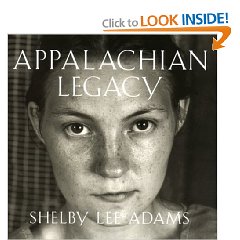
Shelby Lee Adams is a photographer most famous for his pictures of Appalachia. Here is the cover one of his books:

This post is based on a documentary about Adams work called The True Meaning of Pictures.

Adams has come under severe criticism.  Critics argue that his photography exploits the poverty and disempowerment in Appalachia and reproduces negative stereotypes. The idea the Appalachian people are imbred, dumb, and barbaric was made famous in the movie Deliverance. Here is the (at once charming and chilling) dueling banjo scene:

Critics argue, also, that Adams features the worst conditions of life in Appalachia.  Bill Gorman, the Mayor of Hazard, Kentucky, says:

“I don’t think this is average… I think it’s the kind of thing that sells.”

For example, one picture is argued to be staged. Adams admits to buying the pig and arranging the butchering (the family was too poor to have pigs).

In the documentary, we also see Adams instructing his subjects in how they should stand and what facial expression to make.

A.D. Coleman, an art critic, thinks that images are purposefully made to seem “ominous” and “spooky.”  And, while Adams gets permission from the people in his pictures to use their images, Coleman suggests that they are not necessarily capable of understanding exactly what they are consenting to.  He explains:

“They [the pictures] call for a very sophisticated kind of reading.  And I’m not sure that these people have the education, the visual educational background, to understand how these pictures read.”

Others suggest that that doesn’t give the Appalacians enough credit.

Adams argues that he’s taking pictures of his own culture. In fact, Shelby did grow up in Appalachia, though he was middle class compared to those he photographs.  He also abdicates responsibility for any objective representation.  He says:

“I’m trying to express myself with that culture. So it’s not an objective document. It’s not an object. It’s me. It’s life. And it’s my subjects lives. Who are my friends.”

You can see more of his photographs here and here.

The controversy over Adams’ work brings up some interesting questions regarding art and representation:

1.  What is art for?  Is it for representing things as they are?  Is it for the expression of the artist?  Is it for the furtherance of social justice?

2.  Who decides the meaning of a picture?  Does Adams’ intention count?  Or does the only thing that counts what the viewer sees?  Which viewer?  How many viewers must we predict will judge Appalachia badly upon viewing the pictures before we decide that they undermine social justice efforts (if, in fact, we decide social justice is relevant to art)?

3.  If, in fact, the pictures do represent the poorest Appalachians, does that mean they should not be photographed?  Is that criticism, in itself, a good one?  Who gets to decide who really represents Appalachia?

4.  So what if Adams is making money off of the pictures?  Does this make him a bad person?  Does it make the pictures exploitative?  When things are done for money, does that mean that they are automatically not about love and care?  Many of us, I imagine, sure hope that’s not true for preachers and teachers.  So how do we decide whether the fact that Adams benefits is a problem?

Thoughts?  Other questions we could ask?

Lisa Wade, PhD is an Associate Professor at Tulane University. She is the author of American Hookup, a book about college sexual culture; a textbook about gender; and a forthcoming introductory text: Terrible Magnificent Sociology. You can follow her on Twitter and Instagram.

Below is a video, found via The Daily Dish, of a girl, maybe four or five, mimicking the dancing in a music video featuring Beyonce.  She’s amazing!  Watch her go:

Wow!

Okay… now for sociological comments… these are all Gwen’s ideas, by the way, even though I’m posting it:

We often think of childhood socialization as a top-down process.  That is, we imagine that children are empty vessels and adults, mostly parents maybe, fill them up with whatever they please.  It may be true that the parents of this little girl actively, even aggressively, encouraged her to learn this dance.  But it’s also possible that this is driven by that little girl.  In which case, it may illustrate how kids can take an active part in their own socialization.  Clearly these parents don’t mind that their daughter is watching Beyonce, but she may be taking the initiative to emulate a public figure she’s seeing in the media (which surely includes messages about how to look, dress, etc.).  Even if these parents don’t like everything about that message (or other models she might follow), they can’t actually protect her from the ever-present messages about femininity that are all around her, which are going to affect how she thinks about herself, what she should be, etc.

Lisa Wade, PhD is an Associate Professor at Tulane University. She is the author of American Hookup, a book about college sexual culture; a textbook about gender; and a forthcoming introductory text: Terrible Magnificent Sociology. You can follow her on Twitter and Instagram.