Search results for The

Cross-posted at The Huffington Post.

Last month Jet — a magazine marketed to African-American population — featured their first gay male couple in their wedding announcements.  The announcement may be a sign that African-American attitudes towards gay marriage may be turning around.  While the group has typically endorsed gay marriage at lower rates than White Americans, the gap between Blacks and Whites has been narrowing.

The Pew Research Center reports that the percent of Whites opposed to gay marriage dropped from 51% in 2008 to 41% in 2012.  Among Blacks, the percent in opposition dropped from 63% to 49%.  African-Americans and Whites are now separated by eight percentage points instead of twelve.
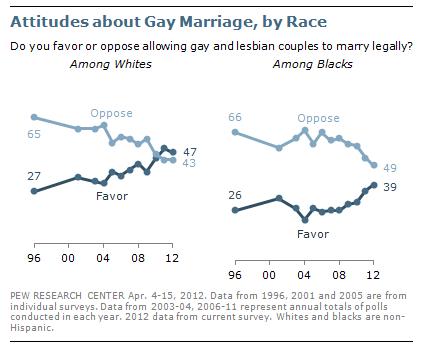
The data above was collected in April of 2012.  In May, Obama announced that he supported gay marriage.  It remains to be seen whether Obama’s modeling of a pro-gay stance will influence the opinions of the African-American community further.

Lisa Wade, PhD is an Associate Professor at Tulane University. She is the author of American Hookup, a book about college sexual culture; a textbook about gender; and a forthcoming introductory text: Terrible Magnificent Sociology. You can follow her on Twitter and Instagram.

Cross-posted at Racialicious.
Sociologist Jooyoung Lee is writing what sounds like a truly fascinating book. Titled Blowing Up: Rap Dreams in LA, it follows a series of young Black men who are trying to make it as rappers.  “Together,” Lee writes, “their stories show how rapping — and Hip Hop culture more generally — transform the social worlds of urban poor black youths.”

The video below gives us a taste of his findings.  In it, he’s asked why he thinks rappers are “so maligned in our culture.”  He explains that it’s because people often “take violent and misogynistic lyrics” literally.  Doing so, however, is to misunderstand “how the creative process works.”  He goes on to explain how one of the men he studied was pressured by a music label to cultivate an image that conformed to stereotypes of young, urban Black men.

Lisa Wade, PhD is an Associate Professor at Tulane University. She is the author of American Hookup, a book about college sexual culture; a textbook about gender; and a forthcoming introductory text: Terrible Magnificent Sociology. You can follow her on Twitter and Instagram.
Cross-posted at Family Unequal.

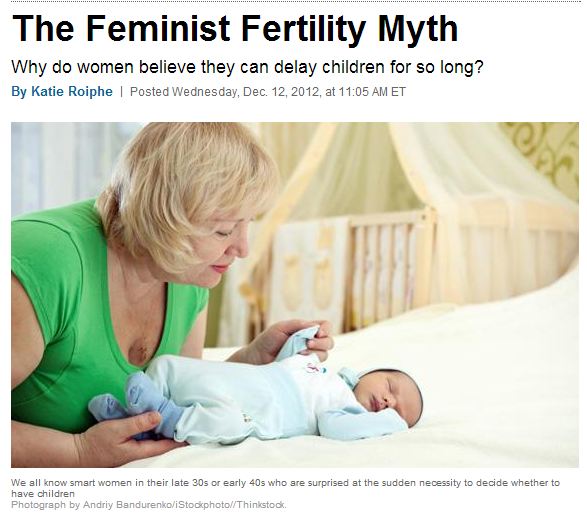
As I wrote about the older-birth-mothers issue recently (first, and then), I didn’t comment on the photo illustrations people are using with the stories. But when an alert reader sent this one to me, from Katie Roiphe’s post in Slate, I couldn’t help it:

Something about that picture and “women in their late 30s or 40s” rubbed my correspondent the wrong way, or rather, led her to write, “Late 30s or early 40s?!?”

Since this was from a legit website that credits its stock agency, I was able to visit Thinkstock and search for the photo. Sure enough:

Of course, it’s not news, so the title “Middle-aged woman holding her newborn grandson” doesn’t make it a less true illustration of the older-mother phenomenon than one captioned “Desperate aging woman clings to feminist myth that it’s OK to delay childbearing.” But it gives you an idea of what the Slate editor was looking for in the stock photo.

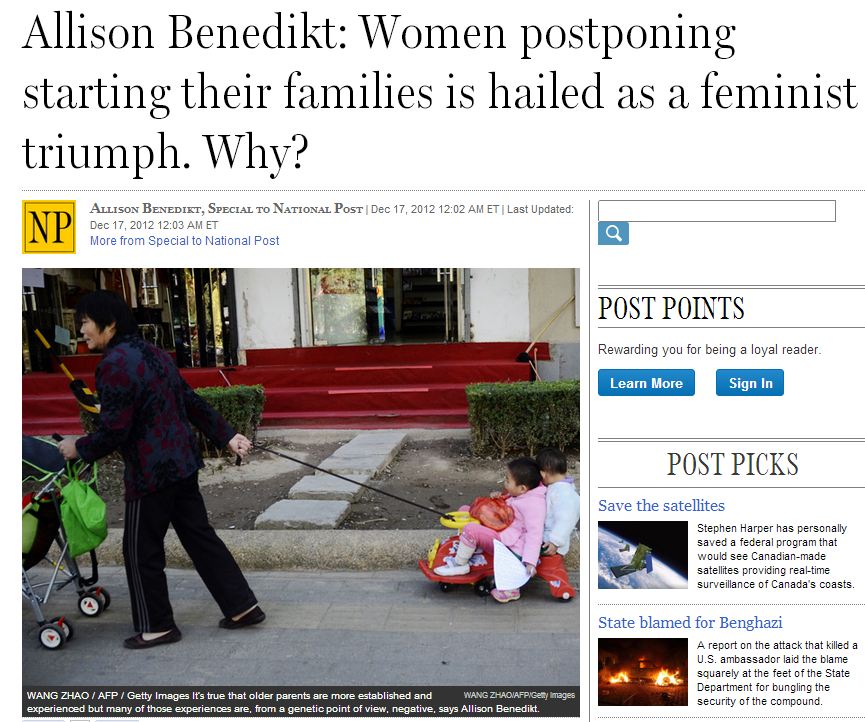
I looked around a little, and found one other funny one. Another Slate essay,this one by Allison Benedikt, was reprinted in Canada’s National Post, and they laid it out like this:

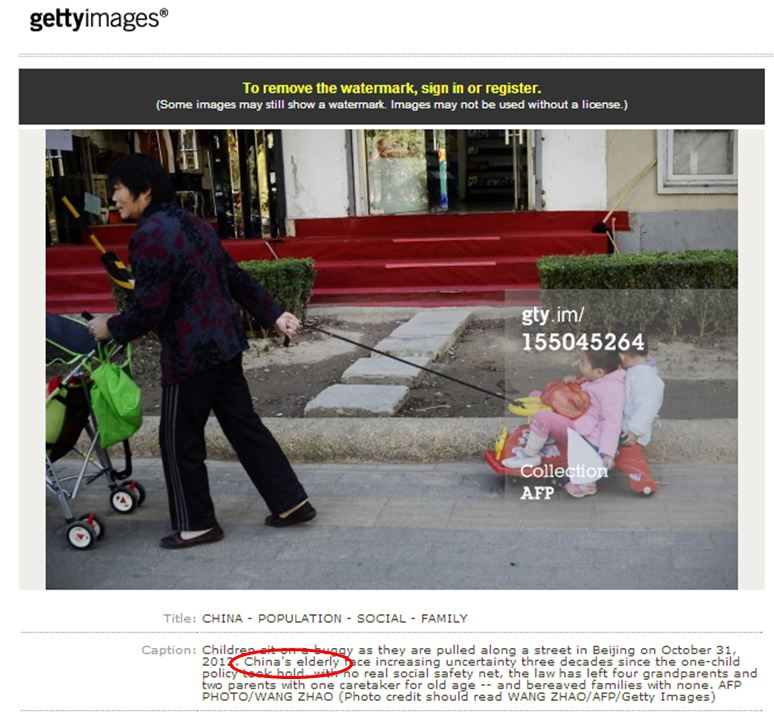
When I visited the Getty Images site, I discovered this picture was taken in China. Here’s how it’s presented:

This one, which is a picture of real people, looks like it could be a grandmother, or maybe more likely a caretaker. Regardless, it’s sold as an illustration of a story about China’s elderly having too few grandchildren to take care of them, which is vaguely related to the content of the story, but that’s not what the Post’s caption points to:

It’s true that older parents are more established and experienced but many of those experiences are, from a genetic point of view, negative, says Allison Benedikt.

Anyway, there were others where the women looked pretty old for the story, but I couldn’t find them in the catalogs, so I stopped.

This is all relevant to one of my critiques of these stories, which is that they make it seem like having children at older ages has become more common than it was in the past. That’s true compared with 1980, but not 1960. The difference is it’s more likely to be their first child nowadays. So Benedikt is way off when she writes,

Remember how there was that one kid in your high school class whose parents were sooooo old that it was weird and creepy? That’s all of us now. Oops.

As I showed, 40-year-old women are less likely to have children now than they were when she was a kid. And when Roiphe writes of the “50-year-old mother in the kindergarten class [who] attracts a certain amount of catty interest and disapproval,” she should be aware that the disapproval — which I don’t doubt exists — is not about the increased frequency of older mothers, but about how people think about them.

Philip N. Cohen is a professor of sociology at the University of Maryland, College Park, and writes the blog Family Inequality. You can follow him on Twitter or Facebook.

Cross-posted at Montclair SocioBlog.

“Silver Linings Playbook,” the new David O. Russell movie, starts off by making the audience uncomfortable.  We want to like Pat (Bradley Cooper).  We root for him to overcome the internal demons that landed him in a mental hospital for eight months.  We do like him.  But he keeps doing things we don’t like.  He is socially insensitive and often offensive, utterly absorbed in his own deluded ideas and obsessions, and although we know that these emanate from his psychiatric condition, it’s impossible to separate the personal from the psychiatric.  He is his mental illness, and it’s often not pretty. We’re actually glad to see the cop who shows up to enforce the restraining order.  (Usually in American films, when a uniformed cop restrains the hero, the moral question is so clear the cop might as well be wearing a Nazi uniform.)

At some point, the film takes a turn away from the complicated and difficult.  It calls on a smooth, familiar recipe and gives us comfort food — sweet chocolate pudding, spoonful after spoonful.  It’s made from good chocolate, but it’s predictable  pudding nonetheless.

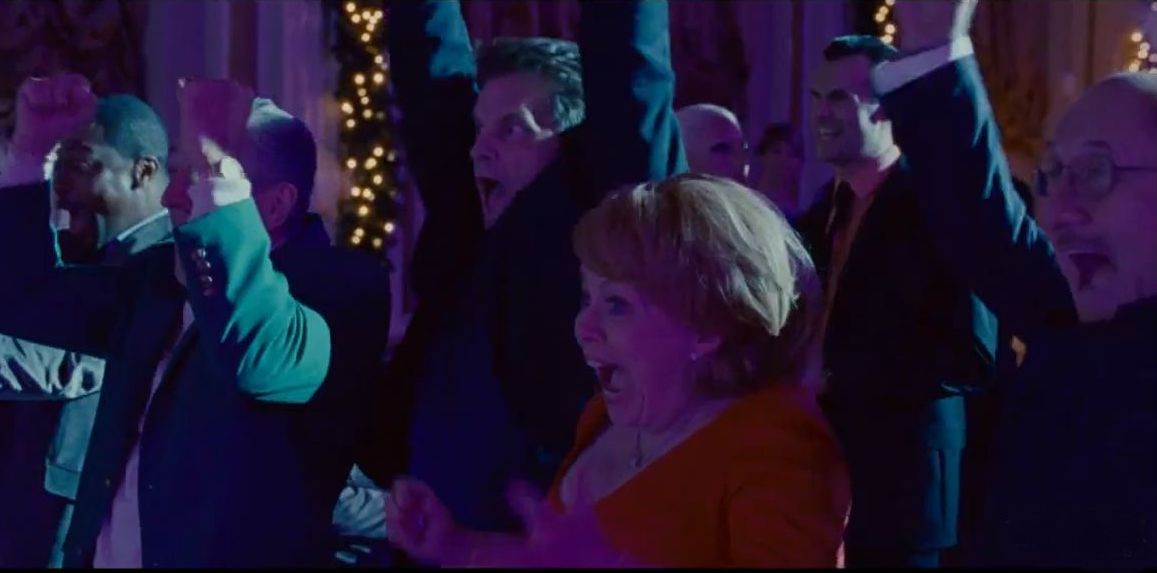
It all leads up to a climactic scene that we all know from countless other movies.  In this case, it’s a ballroom dancing competition:

The movie plays on one long-standing idea in American movies and TV: all moral questions, all questions of character, can be settled in a contest. Typically, the story sets out some difficulties for the hero — conflicts with the society, conflicts with some other person or organization, conflicts within himself. It all leads up to some climactic  contest.  Usually the hero wins, occasionally he loses. But the outcome doesn’t matter so much as the nobility of the fight, for win or lose, the hero has fought, and that seems to resolve all issues.   Rocky is the obvious example…

That’s from six years ago in one of the first posts on this blog.  (I’ve edited it lightly.)  That post was about the first episode of Friday Night Lights.   But it could have been about “Silver Linings Playbook” — “Rocky” meets “Dancing With the Stars.”

For a nearly complete plot summary, watch the trailer.

The contest seems to melt all problems no matter how complicated, no matter how seemingly unrelated to the competition itself – problems between a man and a woman, a son and father, friend and friend.

“Silver Linings Playbook” hits all three of those plus husband and wife, brother and brother, and maybe some others.  Other seemingly insoluble problems – from Pat’s obsession with his estranged wife to the side effects of medications – vanish.  And in case the pudding wasn’t already sweet enough, there’s an added Hollywood-ending bonus involving a large bet on the Cowboys-Eagles game, an outcome so predictable I’m not even putting in a spoiler warning.

And they all live happily ever after.

These themes are not inherent in movie contests.  In British films of the sixties – “The Loneliness of the Long Distance Runner” or “This Sporting Life” for example – athletic contests bring a heightened consciousness of the class system.  But in American movies, regardless of the setting – the boxing ring, the pool hall, the poker game, the karate dojo, the dance floor, etc. – competition works its magic and allows the heroes to overcome all personal and interpersonal problems.

—————————

Jay Livingston is the chair of the Sociology Department at Montclair State University.  You can follow him at Montclair SocioBlog or on Twitter.

Cross-posted at Reports from the Economic Front.

Many expected that the severity of the Great Recession, a recognition that prior expansion was largely based on unsustainable “bubbles,” and an anemic post-crisis recovery, would lead to serious discussion about the need to transform our economy.   Yet, it hasn’t happened.

One important reason is that not everyone has experienced the Great Recession and its aftermath the same. Jordan Weissmann, writing in the Atlantic, published a figure from the work of Edward Wolff. The charts shows the rise and fall of median and mean net worth among Americans: how much one owns (e.g., savings, investments, and property) minus how much one owes (e.g., credit card debt and outstanding loans).

Both the mean and the median are interesting because, while they’re both measures of central tendency, one is more sensitive to extremes than the other. The mean is the statistical average (literally, all the numbers added up and divided by the number of numbers), so it is influenced by very low and very high numbers.  The median, in contrast is, literally, the number in the middle of the sample of numbers.  So, if there are very high or low numbers, their status as outliers doesn’t shape the measure.

Back to the figure: as of 2010, median household net worth (dark purple) had fallen back to levels last seen in the early 1960s.  In contrast, mean household net worth (light purple) had only retreated to the 2000s.  This shows that a small number of outliers — the very, very rich — have weathered the Great Recession much better than the rest of us.

Wolff_Mean_and_Median_Net_Wealth-thumb-615x433-106876

The great disparity between median and mean wealth declines is a reflection of the ability of those at the top of the wealth distribution to maintain most of their past gains.  And the lack of discussion about the need for change in our economic system is largely a reflection of the ability of those very same people to influence our political leaders and shape our policy choices.

—————————

Martin Hart-Landsberg is a professor of Economics and Director of the Political Economy Program at Lewis and Clark College.  You can follow him at Reports from the Economic Front.

Cross-posted at Reports from the Economic Front.

One of the subthemes of current discussions about how best to reduce our national debt is that we must rein in out-of-control spending on federal safety net programs.   The reality is quite different.

The chart below shows spending trends in terms of GDP for the ten major needs-tested benefit programs that make-up our federal social safety net. The programs, in the order listed on the chart, are:

  • The refundable portion of the health insurance tax credit enacted in the 2010 health care reform law
  • Medicaid and the Children’s Health Insurance Program (CHIP)
  • The Supplemental Nutrition Assistance Program (SNAP)
  • Financial assistance for post-secondary students (Pell Grants)
  • Compensatory Education Grants to school districts
  • Assisted Housing
  • The Earned Income Tax Credit (EITC)
  • The Additional Child Tax Credit (ACTC)
  • Supplemental Security Income (SSI)
  • Family Support Payments

lowincprogs

As Jared Bernstein explains:

…for all the popular wisdom that programs to help low-income people are swallowing the economy, the truth is that like so much else that plagues our fiscal future, it’s all about health care spending.  The figure shows that as a share of GDP, prior to the Great Recession, non-health care spending was cruising along at around 1.5% for decades.  It was Medicaid/CHIP (Medicaid expansion for kids) that did most of the growing.

The takeaway from this: we need a new health care system (think single payer).

Regardless, the recent explosion in the ratio of Medicare/CHIP spending to GDP is largely due to the severity of the Great Recession, not the generosity of the programs. The recession increased poverty and thus eligibility for the programs, thereby pushing up the numerator, while simultaneously lowering GDP, the denominator.   Moreover, spending on all non-health care safety net programs is on course to dramatically decline as a share of GDP. Even Medicare/Chip spending is projected to stabilize as a share of GDP.

These programs are essential given the poor performance of the economy, and in most cases poorly-funded. Cutting their budgets will not only deny people access to health care, housing, education, and food, it will also further weaken the economy, in both the short and long run.

—————————

Martin Hart-Landsberg is a professor of Economics and Director of the Political Economy Program at Lewis and Clark College.  You can follow him at Reports from the Economic Front.

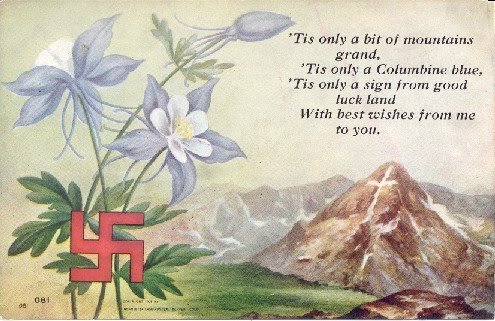
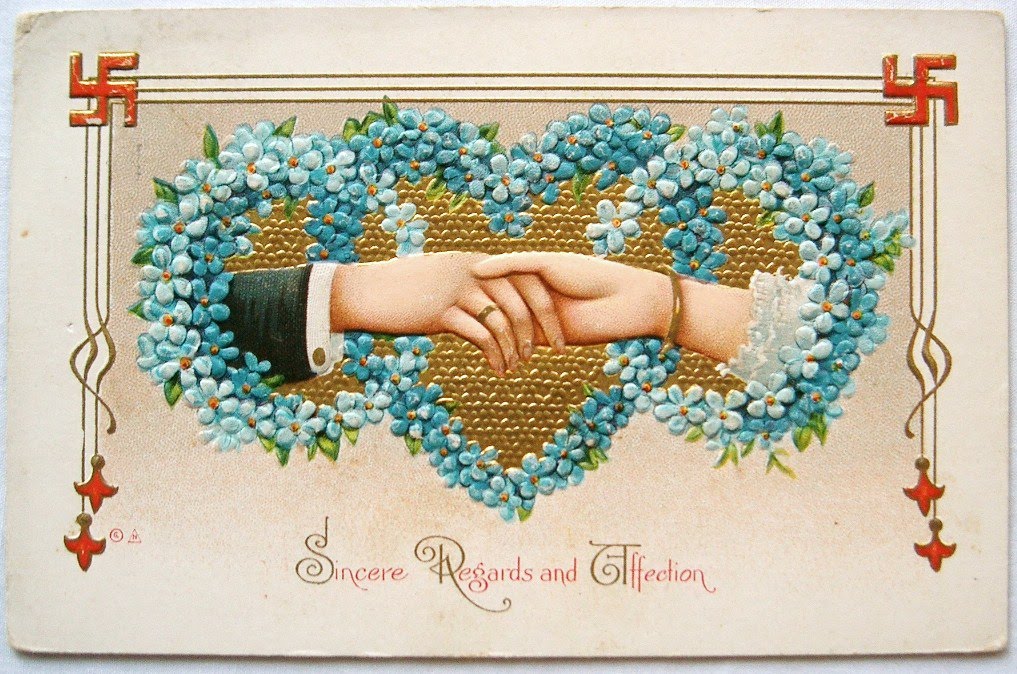
It’s a little known fact that the swastika, famously appropriated and perverted by the Nazis, is (or was) a symbol of good luck.  Dating back to the Neolithic period, the symbol was frequently included in greetings and used as decoration.  A 1917 ad for swastika jewelry, for example, called the symbol the “oldest cross” and explained it like this: “To the wearer of swastika will come from the four winds of heaven good luck, long life and prosperity.”

Here are some additional examples of the swastika being used to send hopeful messages to loved ones, found by Tom Megginson at The Ethical Adman along with the one above:

Happy New Year, everyone.

Lisa Wade, PhD is an Associate Professor at Tulane University. She is the author of American Hookup, a book about college sexual culture; a textbook about gender; and a forthcoming introductory text: Terrible Magnificent Sociology. You can follow her on Twitter and Instagram.

For the last week of December, we’re re-posting some of our favorite posts from 2012.

We often hear that Christopher Columbus “discovered” America, a word that erases the 50 million-plus inhabitants of the continent that were already here when his boat arrived. A person can’t discover something that another person already knows about.  In the American telling of the story, however, the indigenous population don’t count as people. They’re knowledge isn’t real.

This dismissal of knowledge-of-a-thing until the “right” people know about it is a common tendency, and another example was sent in by Jordan G. last week.  CNNABCCBS, and the Los Angeles Times, among other news outlets, reported that a new species of monkey was “discovered.”

So where did they find this monkey?  Tied to a post in a Congolese village; it was a pet.  

Cercopithecus lomamiensis (Lesula)
By John A. Hart et al. Wikimedia Commons.

So someone knew about these monkeys.  It just wasn’t the right kind of person.  In this case, the right kind of person was a (bonafide) scientist (with credentials and institutional privileges not un-related to living in the West).

Now I’m not saying that it doesn’t matter that a trained scientist encountered the monkey and established it as a unique and previously undocumented species.  The team did a lot of work to establish this.  As the Times, which otherwise does a fine job on the story, explains:

Convinced the species was novel, team leader John Hart began an exhaustive three-year study to describe the monkey, and to differentiate it from its nearest neighbor, the owl face monkey. The study included geneticists and biological anthropologists, who helped confirm that the monkey was different from the owl face, though the two share a common genetic ancestor.

In other words, something significant happened because those scientists happened upon this monkey.  But to say that they “discovered” it is to mischaracterize what occurred. The scientists write that it was “previously undescribed,” which is far more accurate. Their language also doesn’t erase the consciousness of the people of the Congo, where this monkey is “endemic.”   In fact, they recommend the short-hand name “lesula,” “as it is the vernacular name used [by people who’ve known about it, probably for generations] over most of its known range.”  In doing so, they acknowledge the species’ relationship to a population of human beings, making them visible and significant.

Lisa Wade, PhD is an Associate Professor at Tulane University. She is the author of American Hookup, a book about college sexual culture; a textbook about gender; and a forthcoming introductory text: Terrible Magnificent Sociology. You can follow her on Twitter and Instagram.