Search results for The

A reader named Caroline sent in a really nice email.  “I just wanted to tell you – again,” she wrote, “how much of an impression you’ve made on my 17yo daughter Eliza.”  She explains that they’d been reading SocImages together for “years (yes, years!).”  We can’t express how much that means to us!

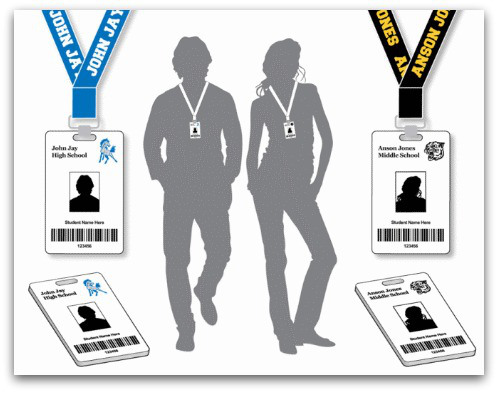
Caroline was inspired to write because Eliza had brought to her attention this image accompanying a story about a high school’s trackable ID badges:
1

Eliza had noted that, while the male figure was walking more-or-less directly towards the viewer, the female figure was standing with her torso contorted and her hip cocked.

Likewise, @low_hana sent us this screenshot of DC Comics Underoos available for sale. Men are posed like, well, superheroes, but the women twist, fiddle, and turn their backs:

1 (3)

Now, this might seem like a small thing, and unimpressive in the singular.  But, in fact, we see this kind of thing all the time, even in ostensibly objective medical textbooks and anatomy illustrations.  We even see it when only faces are involved, as in this series of movie posters featuring men looking straight at the camera and women looking askance.  Here’s one example:

2

As these types of images add up in our subconscious, they tell us a story about masculinity and femininity.  It’s a complicated one, but might include lessons like this: men face things head on, while women are uncertain; women pose and men take action;  men are straightforward, women sly.

Thanks Caroline, for sending in another example of such an insidious and largely invisible cultural pattern.  And great job, Eliza, for spotting it!

Lisa Wade, PhD is an Associate Professor at Tulane University. She is the author of American Hookup, a book about college sexual culture; a textbook about gender; and a forthcoming introductory text: Terrible Magnificent Sociology. You can follow her on Twitter and Instagram.

Screenshot_1In this charming minute-and-a-half, Walter Cronkite demos the home office of 2001, as envisioned in 1967.  Amazingly, reality seems to have far outpaced their imagination!

I love the first line, by the way: “This is where a man might spend most of his time in the home of the 21st century.”  Apparently professional futurists in 1967 couldn’t imagine women working!

Via Cyborgology.

Lisa Wade, PhD is an Associate Professor at Tulane University. She is the author of American Hookup, a book about college sexual culture; a textbook about gender; and a forthcoming introductory text: Terrible Magnificent Sociology. You can follow her on Twitter and Instagram.
Screenshot_15Naama Nagar tweeted us an interesting video commentary about hipsters.  In it, Mike Rugnetta uses Pierre Bourdieu’s idea of cultural capital to describe the difference between nerds and hipsters.

This is a topic I’ve enjoyed thinking about myself (on CNN and here at SocImages).  I think Rugnetta makes an interesting argument that resonates with the observations of sociologists: being a hipster is about borrowing other people’s authentic cultural signifiers as their main or only consistent cultural practice.  Check it out:

Lisa Wade, PhD is an Associate Professor at Tulane University. She is the author of American Hookup, a book about college sexual culture; a textbook about gender; and a forthcoming introductory text: Terrible Magnificent Sociology. You can follow her on Twitter and Instagram.
How many Americans think about the war in Afghanistan regularly? The daily realities of war are inescapable for military members and their families, but the rest are largely able to stay disconnected from it. The issues of foreign policy and war dropped off the radar entirely for most Americans before the 2012 election.

About 68,000 U.S. troops are still deployed in Afghanistan, down from the peak of 101,000 (not to mention the those who were in Iraq). Without a draft, WWII-style war bond campaigns, or highly visible war industry, most Americans need to be reminded that we’re at war.  Unlike veterans and military families, civilians not directly connected to the military have a kind of privilege to forget the conflict in their daily lives. The result is a growing chasm between U.S. civilians and the Armed Forces.

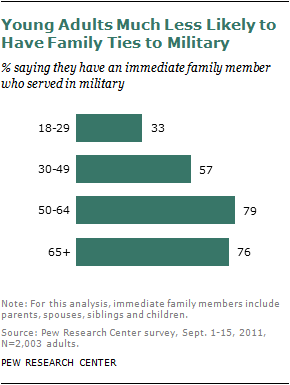
In 2011, the Pew Research Center surveyed Americans about their connections to the military and found a considerable gap: “Never has the U.S. public been so separate, so removed, so isolated from the people it pays to protect it.” The vast majority of those over 50 had an immediate family member who had served (mostly due to WWII and Vietnam). Of those 30-49 years old, 57%  had someone in their immediate family serve. Those between 18-29 are the most disconnected from war; only 33% have a close family member with military experience:

2011-family-connections-01

picture2

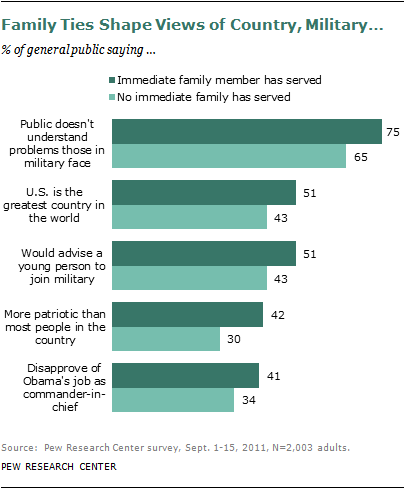
This leads to differences in views about the military. Those from military families are more likely to believe that civilians do not understand what they go through, that the U.S. “is the greatest country in the world,” and that they are “more patriotic than most people in the country.” They’re also more likely to recommend the armed forces to a young person — though only about half would do so:

picture3

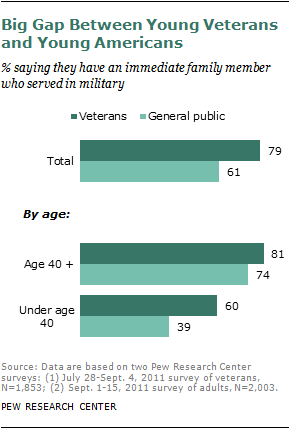
My own research on the experiences of military families during deployment supports the Pew findings. And patterns in who joins the armed forces may lead to an increased gap. Those with veterans in their family are more likely to join the military; 79% of young veterans, compared to 61% of the public, have family members who served. As fewer Americans have relatives who were in the military, making them less likely to join themselves, insulation from the military grows.

This bumper sticker reflects this gap between military families and everyone else. It draws a distinction between “my” service member and “your” freedom, while seeming to assume a lack of support from non-military Americans:

bumper sticker

Military families believe that others don’t understand what they go through during deployment. As one mother told me, “We understand why we try to be strong but automatically cry when we see the foot powder display at Wal-Mart.” Or as an Iraq war veteran explained to Time,

The gap between the military and everybody else is getting worse because people don’t know–and don’t want to know–what you’ve been through…There are no bond drives. There are no tax hikes. There are no food drives or rubber drives … It’s hard not to think of my war as a bizarre camping trip that no one else went on.

Veterans return to a country where very few understand what they have been through, which makes reentry into civilian life more difficult — just one of the consequences of having a small segment of the country assume the burdens of war.

——————–

Wendy Christensen is an Assistant Professor at William Paterson University whose specialty includes the intersection of gender, war, and the media.

Cross-posted at Racialicious and Family Inequality.

Trying to summarize a few historical trends for the last half century, I thought of framing them in terms of diversity.

Diversity is often an unsatisfying concept, used to describe hierarchical inequality as mere difference. But inequality is a form of diversity — a kind of difference. And further, not all social diversity is inequality. When people belong to categories and the categories are not ranked hierarchically (or you’re not interested in the ranking for whatever reason), the concept of diversity is useful.

There are various ways of constructing a diversity index, but I use the one sometimes called the Blau index, which is easy to calculate and has a nice interpretation: the probability that two randomly selected individuals are from different groups.

Example: Religion

Take religion. According to the 2001 census of India, this was the religious breakdown of the population:

1.jpg

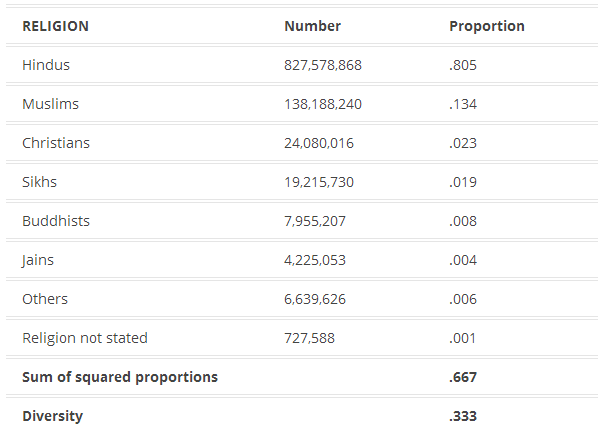
Diversity is calculated by summing the squares of the proportions in each category, and subtracting the sum from 1. So in India in 2001, if you picked two people at random, you had a 1/3 chance of getting people with different religions (as measured by the census).

Is .33 a lot of religious diversity? Not really, it turns out. I was surprised to read on the cover of this book by a Harvard professor that the United States is “the world’s most religiously diverse nation.” When I flipped through the book, though, I was disappointed to see it doesn’t actually talk much about other countries, and does not seem to offer the systematic comparison necessary to make such a claim.

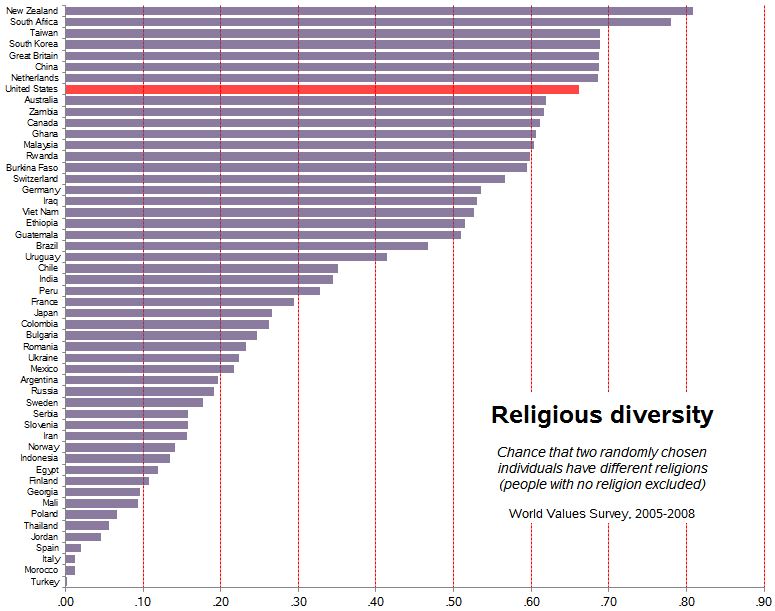
With our diversity index, it’s not hard to compare religious diversity across 52 countries using data from World Values Survey, with this result:

2

The U.S. is quite diverse — .66 — but a number of countries rank higher.


Increasing U.S. Diversity

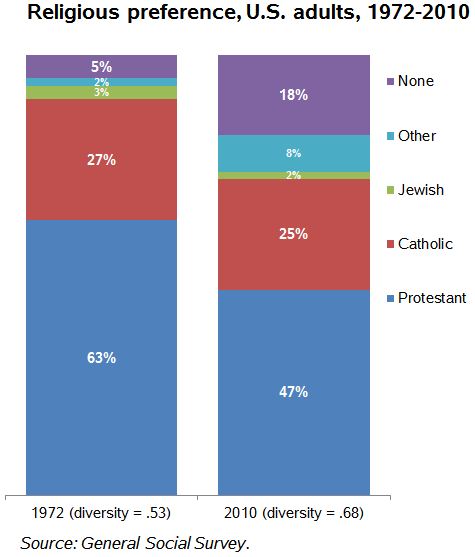
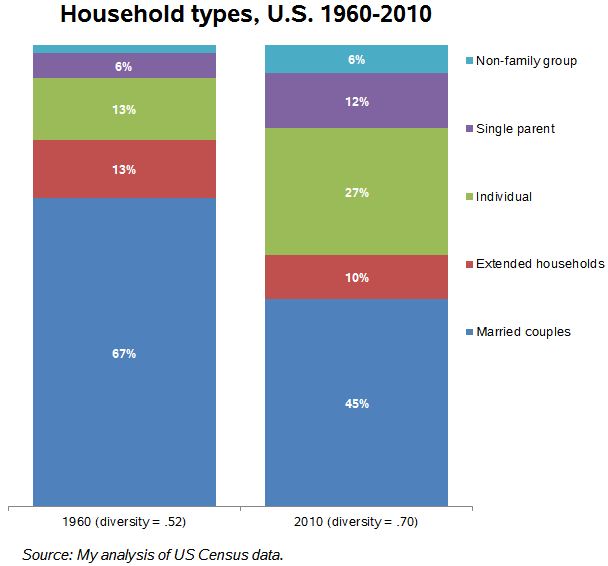
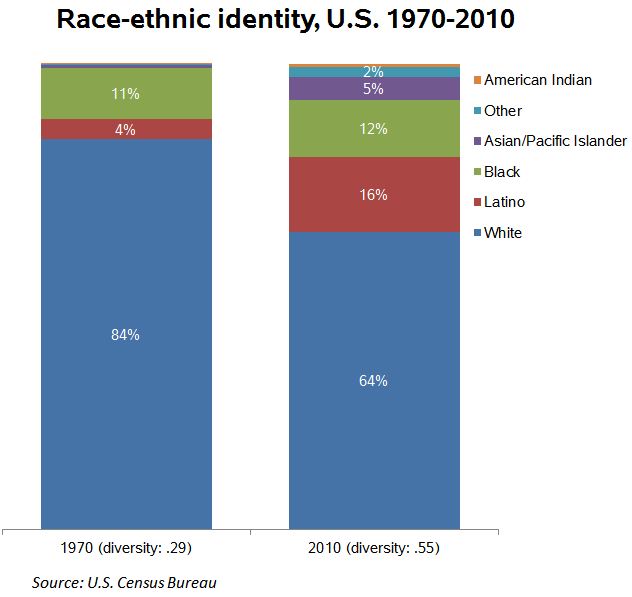
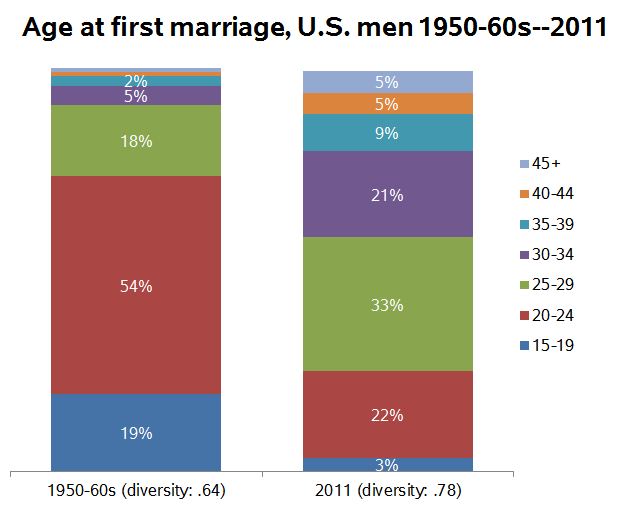
Anyway, back to describing the last half century in the U.S. On four important measures I’ve got easy-to-identify increasing diversity:

3

5

4

6

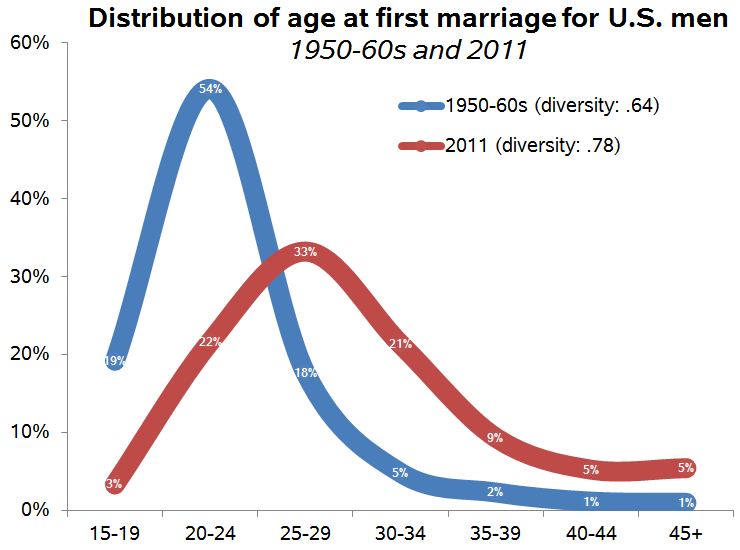
The last one is a little tricky. It’s common to report that the median age at marriage has increased since the 1950s (having fallen before the 1950s). But I realized it’s not just the average increasing, but the dispersion: More people marrying at different ages. So the experience of marriage is not just shifting rightward on the age distribution, but spreading out. Here’s another view of the same data:

7

I calculated these using the Panel Study of Income Dynamics from 1968 (for those married in the years 1950-1968) and comparing it with the 2011 American Community Survey for those married in the previous year. There might be a better way, of course.

I have complained before that using the 1950s or thereabouts as a benchmark is misleading because it was an unusual period, marked by high conformity, especially with regard to family matters. But it is still the case that since then diversity on a number of important measures has increased. Over the period of several generations, in important ways the people we randomly encounter are more likely to be different from ourselves (and each other).

Philip N. Cohen is a professor of sociology at the University of Maryland, College Park, and writes the blog Family Inequality. You can follow him on Twitter or Facebook.

Cross-posted at The Huffington Post.

Justin J.W. Powell and Liat Ben-Moshe have written a great short history of the icon signifying accessibility for people who use wheelchairs for the magazine Stimulus Respond.  The story, they argue, is one of “exclusion to inclusion.”

For most of American history, they begin, there was no icon at all.  This is because people in wheelchairs were largely excluded from public life.  There were no efforts to ensure accessibility, so no signs of accessibility were needed.

In the late ’60s, however, Rehabilitation International partnered with the United Nations and the International Standards Organisation to sponsor an international competition for an icon.  The winner, a Danish design student named Susanne Koefoed, had submitted the icon on the left.  In committee, they noted that Koefoed’s design erased the person in the wheelchair.  They added a head, creating what people around the world recognize as a symbol of accessibility.

1

The symbol is still evolving. Powell and Ben-Moshe note that recent revisions have been aimed at emphasizing that people in wheelchairs are active users, not passive ones.  Accordingly, some organizations have shifted to using a symbol that captures the fact that people in wheelchairs get themselves around.  I’ve snapped pictures of the icons used by the Huntington Gardens and a T.J. Maxx (both in CA): the former has the users’ arms bent behind them to signify pushing their chair forward, while the latter leans the figure forward and adds motion lines.

2

Another trend involves trying to break down the categorical binary between abled and disabled people, instead recognizing that there is a spectrum of ability. For example, this icon (source):

3

Ultimately, Powell and Ben-Moshe hope that access will be so universally designed into public buildings that it will eliminate the need for an icon at all: architecture would no longer be designed around a specific type of person considered “normal,” but instead would be designed for the range of people who will use the spaces.  This full integration would mean that differently-abled people would be considered just “people” and we wouldn’t need an icon at all.

Lisa Wade, PhD is an Associate Professor at Tulane University. She is the author of American Hookup, a book about college sexual culture; a textbook about gender; and a forthcoming introductory text: Terrible Magnificent Sociology. You can follow her on Twitter and Instagram.
A new example prompts us to re-post this fun one from 2010.

We’ve posted in the past about the way in which “male” is often taken to be the default or neutral category, with “female” a notable, marked, non-default one. For instance, the Body Worlds exhibit, “regular” t-shirts are men’s, Best Buy assumes customers are male, stick figures on signs are generally male, and default avatars tend to be male.

We’ve collected several more examples of the tendency to present men as the norm, while women are a marked, non-default category. @LydNicholas tweeted us this example of a LEGO product advertised on their website.  Notice that the blue version is a LEGO Time-Teach Minifigure Watch and Clock, while the pink version specifies that it’s for girls:


Jessica J. noticed that Wal-Mart Target helpfully lets you know where to find both neutral, plain old deodorant and women’s deodorant:

Jane G. sent us this photo of t-ball sets, one for girls and the other with no sex specified:

Aline, in Brazil, found these two wall painting kits.  One is just a painting kit and the other is specifically “for women” (“para mulheres”).  The latter, she said, claims to be a special offer, but is actually about $2 U.S. dollars more.

1

Eric Stoller pointed out that ESPN differentiates between college basketball and “women’s” basketball:

Lindsay H. pointed out that when you go to the U.S. Post Office’s website to forward your mail, it offers you the chance to subscribe to magazines. Those aimed at women (Cosmopolitan, First for Women, etc.) are in the category “Women,” while equivalent magazines for men (Esquire, Maxim) are not in a category titled “Men” but, rather, “Lifestyle”:

And Jane V.S. noticed that REI has various types of marked, “non-standard” sleeping bags, including those for tall people and women:

Renée Y. sent along another example, bike helmets:

 Jessica B. spotted this pair of sibling outfits, coming in “Awesome Girl” and “Awesome Kid”:

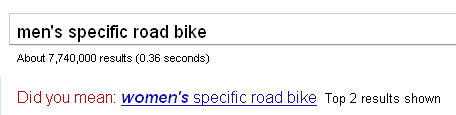
E.W. searched Google for men’s specific road bikes and Google asked, “Don’t you mean women’s specific road bikes”?  Because there are road bikes for people and road bikes for women.

Ann C. sent a screenshot of bubblebox, a site for children’s games.  Notice that along the top there are seven options.  The last is “girls,” suggesting that all the rest are for boys.

So, there you have it.  In this world, all too often, there are people and there are women and girls.

Gwen Sharp is an associate professor of sociology at Nevada State College. You can follow her on Twitter at @gwensharpnv.

The current political discourse is so focused on a single form of government revenue, that the word taxes has become essentially synonymous with just one tax in particular; the federal income tax.  In fact, unless there is a foreign policy crisis, the federal income tax usually dominates most political discussion given how the federal budget (or increasingly the federal debt) relates to almost anything and everything the federal government does (or does not do in more and more instances).

For example, during the closing months of 2012 we watched how a fight over a sunset of the Bush Tax Cuts almost shoved the United States over a fiscal cliff.  Just prior to this near crisis, the most discussed difference between 2012 presidential candidates was their disagreement about a 4 point increase in the highest federal income bracket.  Also, Mitt Romney will likely be remembered mostly for his disparagement and disregard of “The 47% of United States Citizens who pay no federal income tax.”

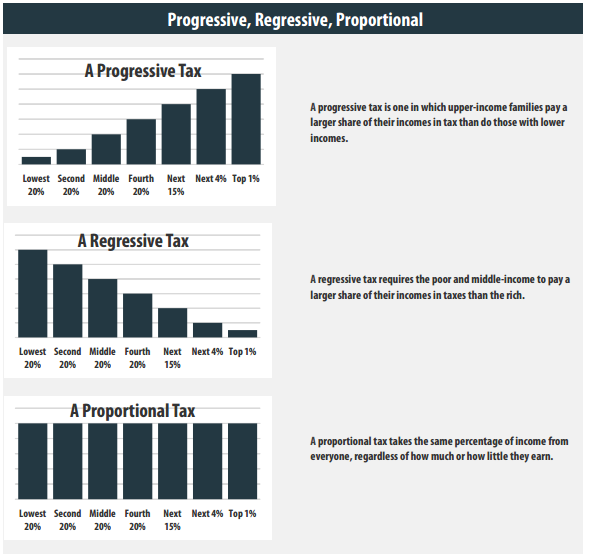
However, limiting discussion about government funding and spending to just the federal income tax and ignoring the other types of payments we make to the treasury is not without consequence, especially given how the federal income tax is actually a very unique kind of tax.  Unlike excise taxes, payroll deductions, sales taxes and most property taxes that are regressive or require the poor to pay a larger proportion of their resources than the wealthy; the federal income tax is one of the few progressive taxes in the United States because at least on paper (I say that because these marginal rates often do not equate the larger effective rates given that the wealthy are afforded more loopholes, deductions, and lower rates on investment income), the rich pay larger marginal rates than the middle-class and poor.   Thus, with our political discussion largely limited to the federal income tax, it should come as no surprise conservatives are so easily able to frame “The State,” especially the federal government, as a perverse Robin Hood who steals from the rich (the makers as they are being called now) to give to the poor (the takers).

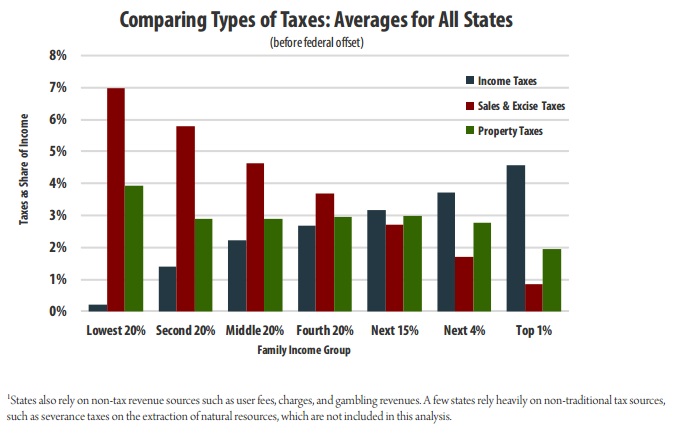
The non-profit, non-partisan Institution on Taxation and Economic Policy recently released its research on the taxes families in the United States paid in 2010.  These findings reveal when the focus is taken off the federal income tax and the entire tax system is examined, cumulative household taxes in nearly every state are regressive because the less money a family makes, the larger proportion they pay to the different levels of government.  As the graph below shows, the cumulative tax system is regressive because sales, excise and property taxes offset progressive income taxes at both the state, and federal levels.

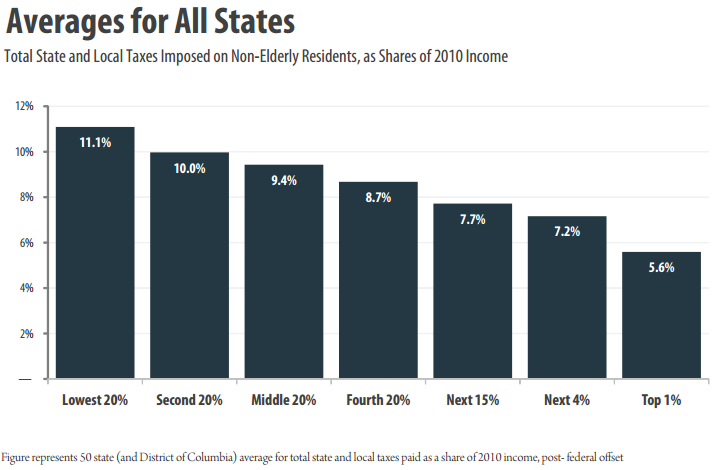
The tax system as a whole is largely regressive because the higher one’s class standing, the lower the proportion of total taxes they pay.  While the report provides great details in the variations across each state, the graph below shows that on average, the lowest 20% of earners pays an overall tax rate that is more than twice of what the top 1% of earners pay.

While many citizens perceive the U.S. tax code as inherently unfair because the wealthy have higher marginal rates on their federal income tax (the only one anyone ever seems to talk about); an examination of the entire system reveals the opposite as cumulatively, the poor pay a larger proportion of their income to local, state, and the federal governments.

—————————

Jason Eastman is an Assistant Professor of Sociology at Coastal Carolina University who researches how culture and identity influence social inequalities.