Search results for The

Originally posted in 2009. Re-posted in honor of Women’s History Month; cross-posted at Mental Floss.

Several factors were in play in the 1920s for the emergence of what came to be known as flappers, teenagers and young women who flaunted convention and spent their time pursuing fun instead of settling down to raise children in the prime of their lives. Many entered college or the workforce and felt entitled to make their own decisions about how to live their lives.

4502flappers

A lot of young men did not return home from World War I, which left an entire cohort of women without enough husbands to go around. The horror of the war (and the Spanish flu pandemic of 1918) also impressed young people with the knowledge that life is short and could end at any moment. Instead of staying home preparing to marry a man who might never come, young women wanted to spend what time they had enjoying all that life had to offer.

450thomasbrooks

Movies popularized the image of the fun-loving and free-thinking woman throughout the US and Europe. The 1920 movie The Flapper introduced the term in the United States. The title character, Ginger, was a wayward girl who flouted the rules of society. Played by Olive Thomas, a former Ziegfeld Girl (left), Ginger had so much fun that a generation of lonely young women wanted to be like her. Another role model was stage and screen actress Louise Brooks (right), who also modeled for artists and fashion designers. She was the inspiration for the flapper comic strip Dixie Dugan.


450clarabow

Clara Bow wasn’t the first flapper on screen, but she was certainly a role model for young women of the era. She didn’t play by the rules, and was tabloid fodder for years for her sexual escapades with the biggest movie stars of the time. Bow’s first film was in 1922 and her career peaked in 1927 with the film It. “It” was defined as the sexual allure some girls have and others don’t. Bow’s fans wanted “it”, so they copied her look and behavior.

450twentiescar

The rise of the automobile was another factor in the rise of flapper culture. Cars meant a woman could come and go as she pleased, travel to speakeasys and other entertainment venues, and use the large vehicles of the day for heavy petting or even sex.

450flappertoon

These young women had plenty of opportunities for fun. Although Prohibition drove alcohol underground, that only added to its allure. Postwar prosperity allowed for leisure time and the means to spend that time drinking, dancing, and hanging out with free thinkers.

425flapperfashion

Being a flapper wasn’t all about fashion. It was about rebellion. In this article from 1922, a would-be flapper (but still a “nice girl”) explains her lifestyle choices to her parents. Flappers did what society did not expect from young women. They danced to Jazz Age music, they smoked, they wore makeup, they spoke their own language, and they lived for the moment. Flapper fashion followed the lifestyle. Skirts became shorter to make dancing easier. Corsets were discarded in favor of brassieres that bound their breasts, again to make dancing easier. The straight shapeless dresses were easy to make and blurred the line between the rich and everyone else. The look became fashionable because of the lifestyle. The short hair? That was pure rebellion against the older generation’s veneration of long feminine locks.

450loneflapper

The party stopped when the economy crashed and the Great Depression curtailed the night life. Although the flapper lifestyle died along with the Roaring Twenties, the freedoms women tasted in that era weren’t easily given up. They may have gone back to marriage and long hours of toil for little pay, but hemlines stayed above the ankle, and the corset never went back to everyday status. And we’ve been driving cars ever since.

Miss Cellania is a newlywed mother of four, full-time blogger, former radio announcer, and worst of all, a Baby Boomer. In addition to mental_floss, she posts at Neatorama, YesButNoButYes, Geeks Are Sexy, and Miss Cellania. Miss C considers herself an expert on no particular subject at all.

Re-posted to add to the discussion about sexual assault and rape culture in the aftermath of the Steubenville verdict.

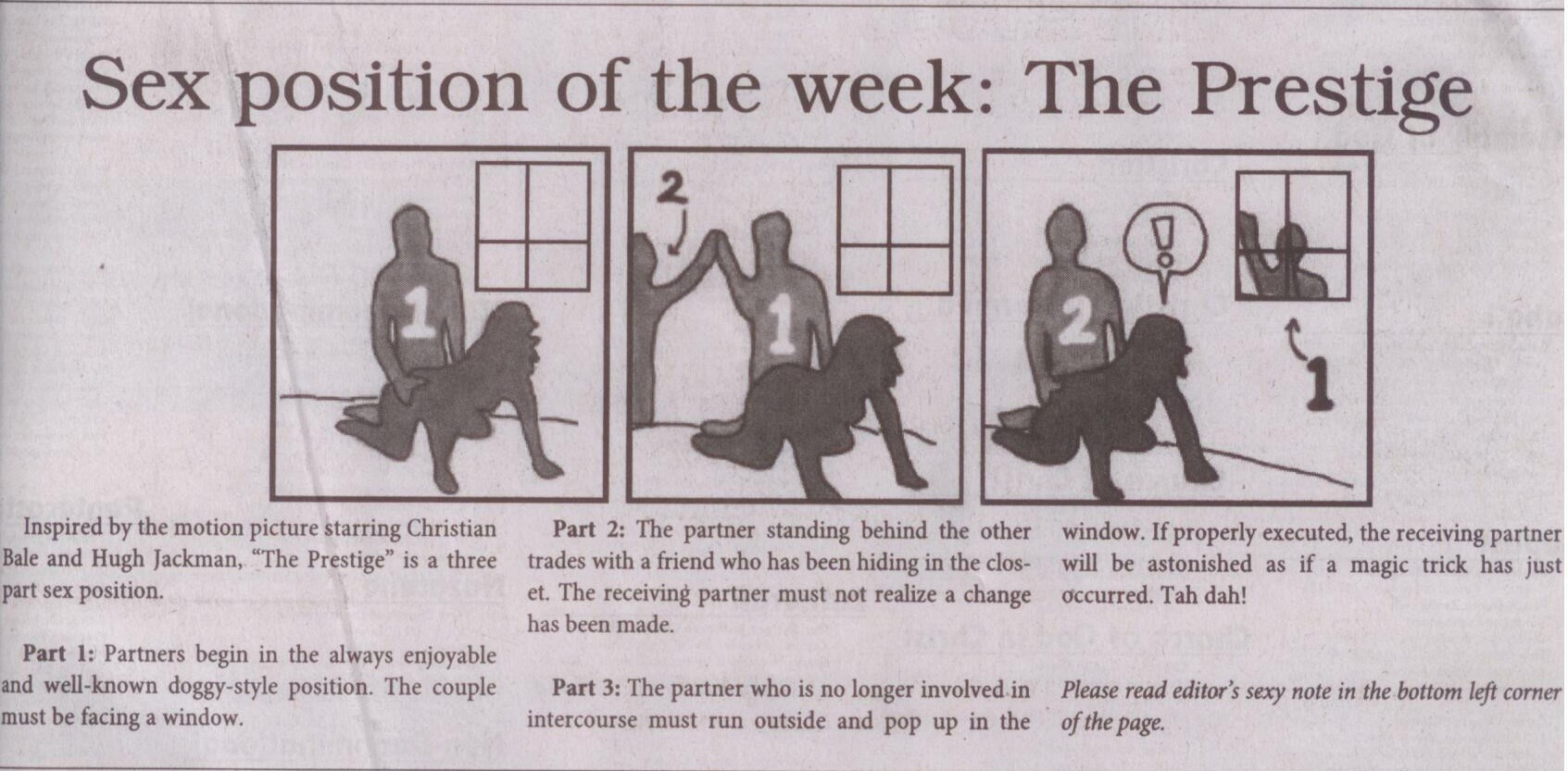
On the heels of yesterday’s cartoon making light of lynching published in Eastern Michigan University’s newspaper, Michaela N. submitted an intended-to-be-humorous visual making light of rape in The Purdue Exponent, the Purdue University student newspaper.  Part of a “sex position of the week” series, this one suggests that one man should pass a female partner off to another man without her knowledge.

This is another piece of evidence that suggests that we live in a rape culture: a society that, at best, trivializes and, at worst endorses, sexual assault.

UPDATE: Zoe Hayes, editor-in-chief of The Purdue Exponent, sent along a note asking that we link to their apology.  To their credit, unlike the non-apology issues in the case of the lynching cartoon linked to above, they express genuine empathy, remorse, and responsiveness.

For more indications that we live in a rape culture, see our posts on media coverage of a rape video game and the George Sodini murders, rapists as hyperconformists to ideal masculinity, the rape scene in Observe and Report, and t-shirts endorsing sex with “drunk girls”.

Lisa Wade, PhD is an Associate Professor at Tulane University. She is the author of American Hookup, a book about college sexual culture; a textbook about gender; and a forthcoming introductory text: Terrible Magnificent Sociology. You can follow her on Twitter and Instagram.

Re-posted to add to the discussion about sexual assault in the aftermath of the Steubenville rape trial, the Senate hearing on rape and harassment in the military, and the controversy at Occidental College.

Nizam A. sent in a rather stunning two-minute, 15-second clip put together by Media Matters.  It is a montage of the use of rape as a metaphor by right wing pundits (trigger warning).  To be fair, I don’t know if a similar video could be made using left wing pundits, so it may be best in comments to stick to a conversation about the metaphor itself.

Why it this such a popular way of talking about the world?

How does it work?  Does the metaphor, given that we think of rape as a crime that men do to women, feminize and masculinize?   Or is it about a gendering of the very notion of violation and vulnerability?  So are these pundits trying to transfer listener’s beliefs about protecting women and girls to other categories (e.g., the rich and the people of New York)?

Does using it as a metaphor give more power to, or trivialize and make invisible, actual rape?

Is there not some irony in how frequently we use it to describe something horribly violating, given the high rates of rape in the U.S., the frequency of non-reporting, our dismal treatment of victims, and the wildly low incidence of trials and convictions?

See also our post on violent metaphors, including rape.

Lisa Wade, PhD is an Associate Professor at Tulane University. She is the author of American Hookup, a book about college sexual culture; a textbook about gender; and a forthcoming introductory text: Terrible Magnificent Sociology. You can follow her on Twitter and Instagram.

Cross-posted at Reports from the Economic Front.

While newspapers give a lot of ink to arguments about whether reducing the budget deficit will boost or reduce growth, they seem to have little interest in the related issue of whether economic growth really benefits the great majority.

David Cay Johnston, the Pulitzer Prize winning financial journalist, recently addressed this issue drawing on the work of economists Emmanuel Saez and Thomas Piketty:

In 2011 entry into the top 10 percent… required an adjusted gross income of at least $110,651. The top 1 percent started at $366,623.

The top 1 percent enjoyed 81 percent of all the increased income since 2009. Just over half of the gains went to the top one-tenth of 1 percent, and 39 percent of the gains went to the top 1 percent of the top 1 percent.

Ponder that last fact for a moment — the top 1 percent of the top 1 percent, those making at least $7.97 million in 2011, enjoyed 39 percent of all the income gains in America.

So, 81 percent of all the new income generated from 2009 to 2011 was captured by the top 1 percent income earners, where income is defined as adjusted gross income, which refers to income minus deductions or taxable income.  In other words, growth, even accelerated growth, is not going to do the majority much good if the economic structure remains the same.

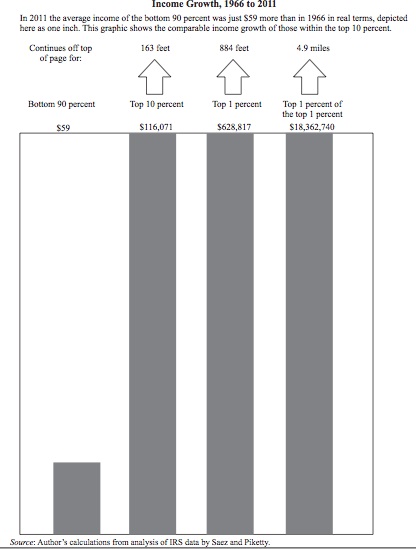
Johnston highlights the problem with our existing economic model with perhaps an even more shocking example.  He compares the average income growth of the bottom 90 percent with the average income growth of the top 10 percent, 1 percent, and top 1 percent of the top 1 percent over the period 1966 to 2011.

It turns out that the average income of the bottom 90 percent rose by a miniscule $59 over the period (as measured in 2011 dollars).  By comparison, the average income of the top 10 percent rose by $116,071, the average income of the top 1 percent rose by $628,817, and the average income of the top 1 percent of the top 1 percent increased by a whopping $18,362,740.  In short, growth alone means little if the great majority of people are structurally excluded from the benefits.

In an effort to highlight this extreme disparity in adjusted income growth rates, Johnston suggests plotting the numbers on a chart, with $59, the amount gained by the bottom 90 percent, represented by a bar one inch high.  As the chart below shows, the bar representing average gains for the top 10 percent would be 163 feet high, that for the top 1 percent would be 884 feet high, and that for the top 1 percent of the top 1 percent would be 4.9 miles high.

1

In sum, the real challenge facing the great majority of Americans is not figuring out how to make the economy growth faster.  Rather, it is figuring out how to create space for a real debate about how to transform our economy so that growth will actually satisfy majority needs.

Martin Hart-Landsberg is a professor of economics at Lewis and Clark College. You can follow him at Reports from the Economic Front.

The Geena Davis Institute on Gender in Media has released several research reports detailing gender inequalities in Hollywood, both in front of and behind the camera.

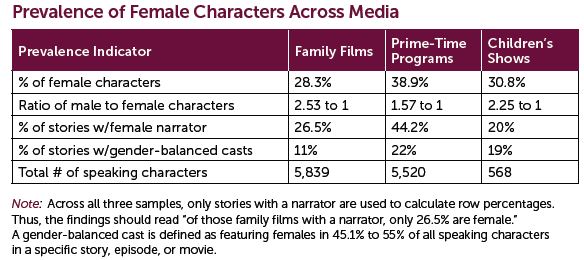
To get a sense of how men and women are portrayed on the large and small screen, researchers analyzed 11,927 speaking parts from three sources: 129 top-grossing family films (rated PG-13 or lower) released from 2006 to 2011, 275 prime-time programs from 2012 (from 10 broadcast and cable channels), and 36 kids’ programs that aired on PBS, Nickelodeon, or Disney in 2011. The analysis indicated that women are underrepresented as characters in speaking roles, as well as narrators:

gender characters

However, gender differences in representation aren’t just about who is on the screen; it matters how they’re depicted, too. Female characters in the sample were more likely to be sexualized, including factors such as sexy clothing, exposed skin, and having their attractiveness specifically referenced by another character:

sexiness

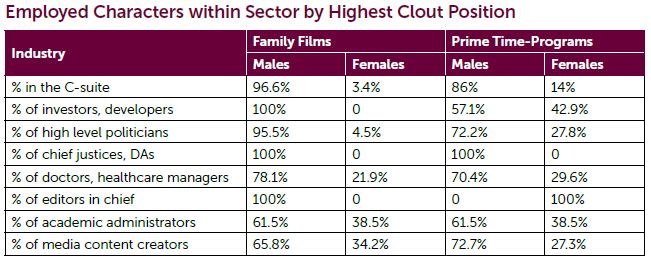
Men and women were also depicted differently in the workplace. In the sample, few female characters were presented in high-level positions within their occupations:

jobs

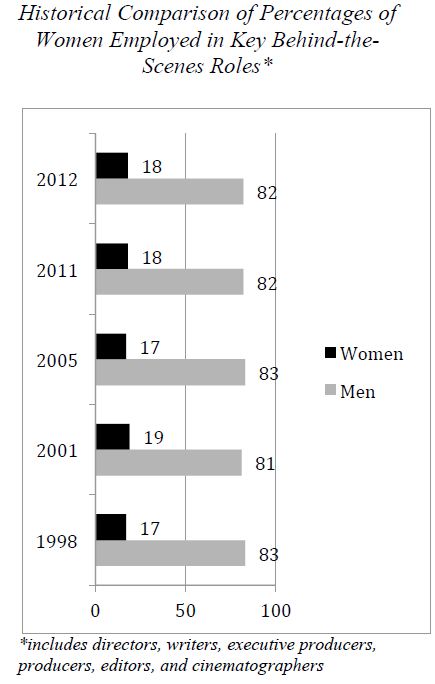
What about behind the scenes? Researchers associated with the institute looked at the gender breakdown of those employed in behind-the-scenes jobs (writers, directors, producers, etc.) in Hollywood as well. Unsurprisingly, the results indicate that women remain significantly underrepresented in these positions.

According to their analysis of the 250 highest-grossing films in the U.S. in 2012, women held just 18% of these positions. In fact, women’s representation in these behind-the-scenes roles has been basically stagnant for over a decade:

pic1

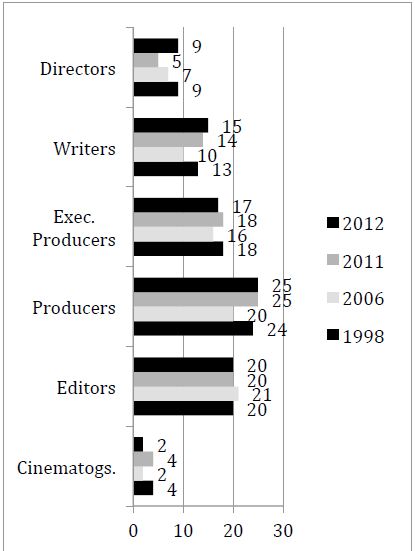
There’s significant variation behind the scenes as well. Women made up a quarter of producers and one in five editors, but only 9% of directors and 2% of cinematographers:

pic2

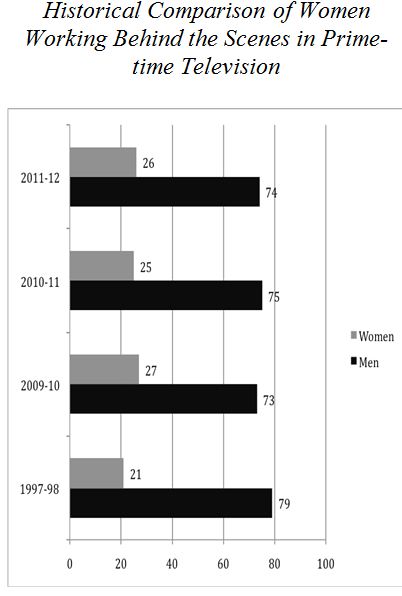
Women hold a larger proportion of behind-the-scenes roles in broadcast television than in the film industry. Looking at a randomly-selected episode of every drama, comedy, or reality show that aired during prime time in the 2011-2012 season, 26% of these roles went to women:

pic3

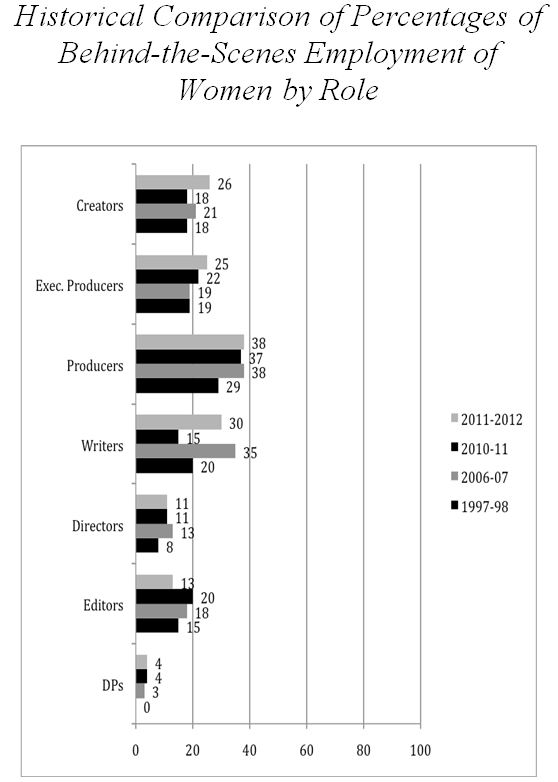
Again we see wide variation in the different behind-the-scenes jobs. Women are much more likely to be producers than directors in the sampled episodes, and only 4% of directors of photography were women. And while the percent of female creators and writers for prime time TV shows jumped in 2011-2012, less than a third of either position was held by women:

pic4

For more on representations in Hollywood, see our earlier posts on race and gender in films and Anita Sarkeesian applying the Bechdel test to the 2012 Oscar Best Picture nominees.

Gwen Sharp is an associate professor of sociology at Nevada State College. You can follow her on Twitter at @gwensharpnv.

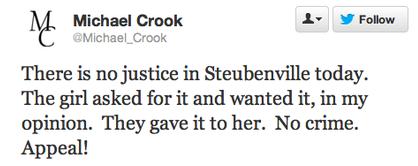
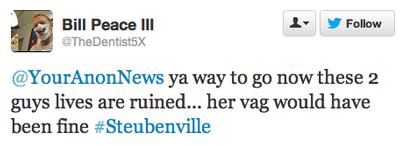
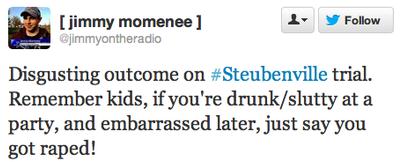
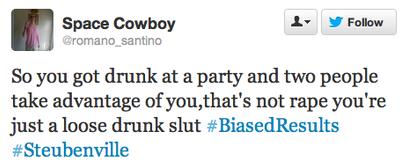
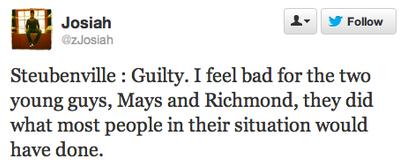
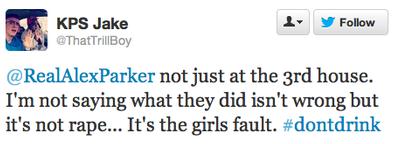
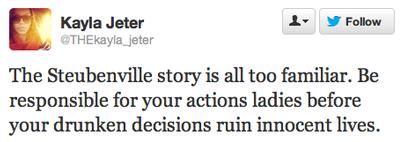
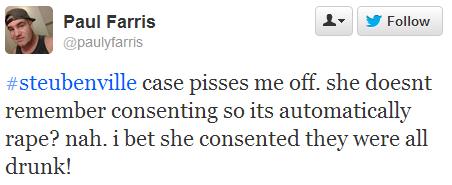
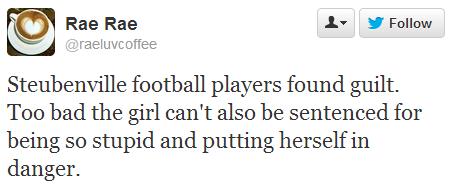
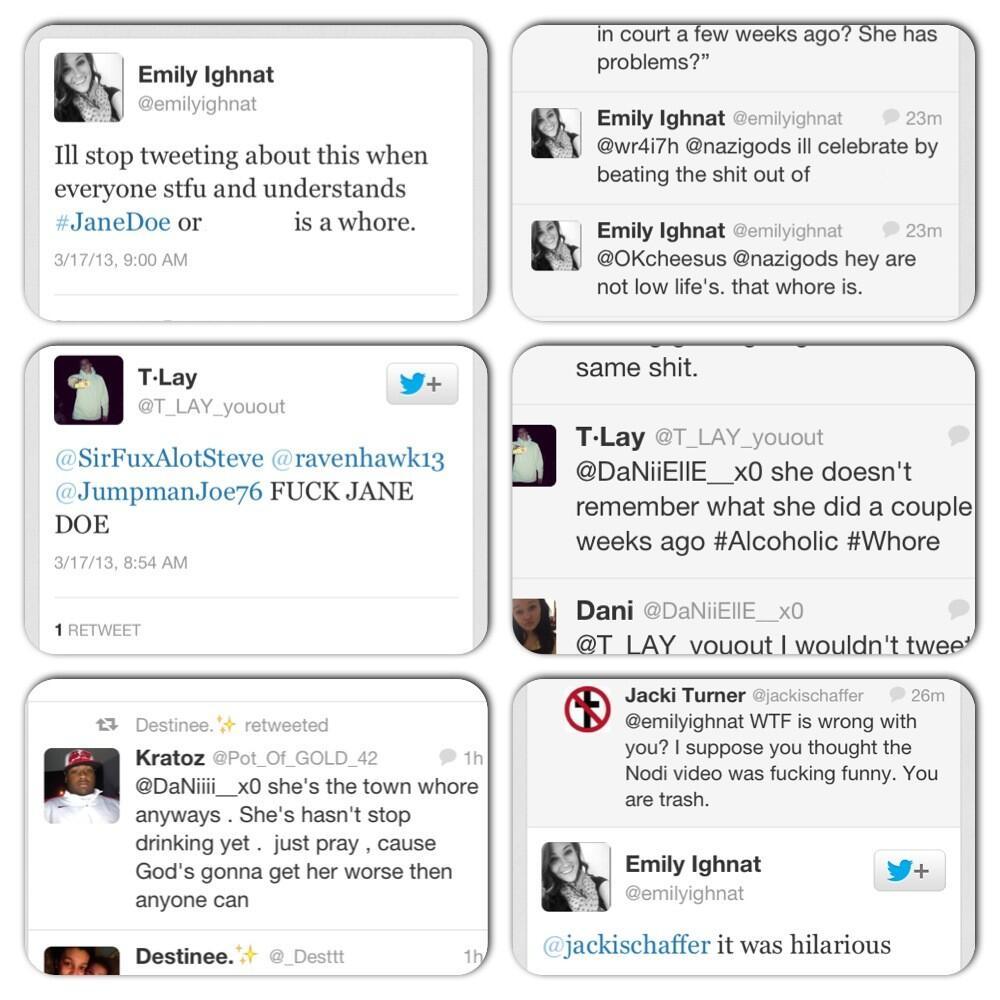
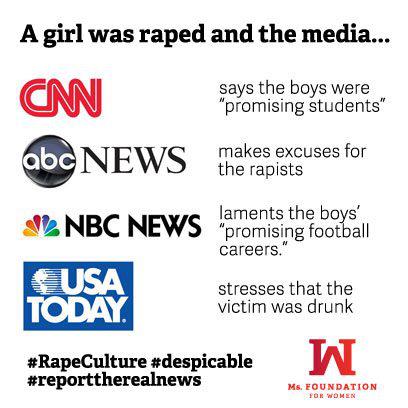
Yesterday two juvenile men were convicted of rape, one was convicted of distributing a nude photo of a minor (NPR). The response by a segment of society reflects rape culture: “an environment in which rape is prevalent and in which sexual violence against women is normalized and excused in the media and popular culture” (source).  Below are a series of concrete examples. Trigger warning for rape apologists and victim blaming.

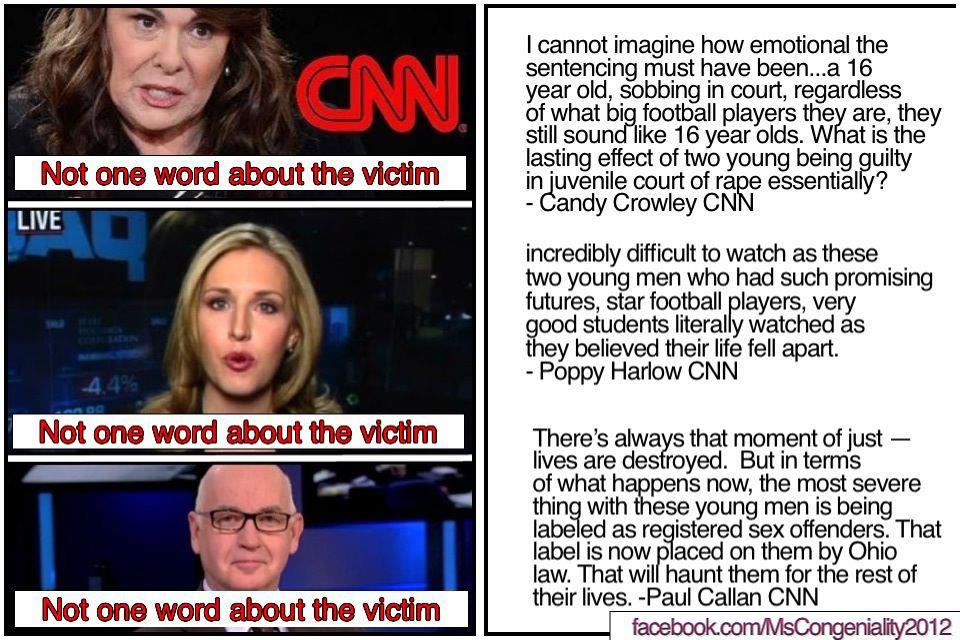
CNN coverage of the verdict spends six minutes on how sad the conviction is for the rapists:

It was incredibly emotional… to watch what happened as these two young men that had such promising futures, star football players, very good students, literally watched as, as they believed their life fell apart.

MsCongeniality:

11

A selection of tweets collected by Public Shaming:

1 2 3 4 5 6 7

A selection of tweets collected by Mommyish:

20 21 22 23

A selection of tweets collected by Persephone Magazine:

8 9

Tweets collected by The Inquisitr:10

Ms. Foundation for Women:

10

Great coverage from around the web:

Finally, a satire from The Onion, from two years agoCollege Basketball Star Heroically Overcomes Tragic Rape He Committed

Lisa Wade, PhD is an Associate Professor at Tulane University. She is the author of American Hookup, a book about college sexual culture; a textbook about gender; and a forthcoming introductory text: Terrible Magnificent Sociology. You can follow her on Twitter and Instagram.

Cross-posted at Montclair SocioBlog.

Jeb Bush told CPAC that the Republican party had an image problem.

Way too many people believe that Republicans are anti-immigrant, anti-woman, anti-science, anti-gay, anti-worker.

People have good reason to believe those things.  But the “way too many” suggests that the GOP’s problem is not image or brand, it’s demography.  For five years or longer, the Republican faithful have been complaining that “their” country was being taken away from them, and they were going to take it back (e.g., see my “Repo Men” post).

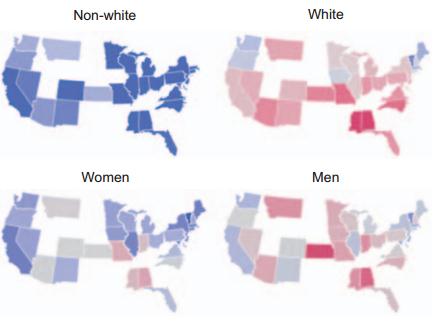
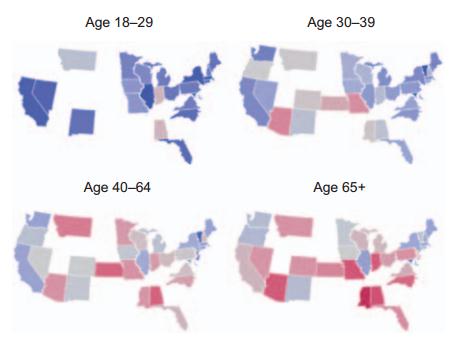
They were right.  Their country, a country dominated by older white men, is fading in the demographic tide.  The groups whose numbers in the electorate are on the rise don’t look like them.  Andrew Gelman (here) recently published these graphs as an update to his 2009 Red State, Blue State.  They reveal the tendency for different groups to vote more Democratic (blue) and Republican (red):

1

(The exit poll the data are based on sampled only in the 30 most competitive state. Texas and Georgia are large, and they have significant non-White populations. But demographic changes there are unlikely to have much effect on which party gets their electoral votes.)

Unfortunately for the GOP, the non-White proportion of the electorate will continue to grow. The female proportion may also increase, especially as education levels of women rise (more educated people are more likely to vote than are the less educated).

The key factor is party loyalty.  And, at least in presidential elections, people do remain loyal. I think I once read, “If you can get them for two consecutive elections, you’ve got them for life.”  Or words to that effect.  If that’s true, the age patterns of the last two elections should be what the Republicans are worrying about.

2

Trying to make themselves more attractive to younger people will not be easy.  Oldsmobile tried it not so long ago (a post on that campaign is here).  “This is not your father’s GOP” might have similar lack of success.  But insisting that this is still your father’s GOP (or more accurately, some white dude’s father’s GOP) seems like a formula for failure.

Jay Livingston is the chair of the Sociology Department at Montclair State University. You can follow him at Montclair SocioBlog or on Twitter.

Cross-posted at Racialicious.1The Harlem Shake is a syncopated dance form that first appeared on the New York hip-hop scene in the early 1980s. In 2012 music producer Baueer created an electronic dance tune, unfortunately calling it The Harlem Shake. Baueer’s song inspired an Internet meme in which people rhythmlessly shake their upper bodies and grind their hips in a tasteless perversion of the original dance.

This fake Harlem Shake meme has become so ubiquitous that it has been “performed” by the English National Ballet, and gone further globally with a video from the Norwegian army, and in Tunisia and Egypt, where the song and imitation dance has become a protest anthem.

The irony of an African-American cultural relic being white-washed to the point where other people of color perform its bastardized version is not lost, and this takes on a whole new level as teams with majority African-American members such as the Miami Heat and Denver Nuggets add to the fake Shake canon.

A major problematic of this meme is that it takes an already marginalized group in America, one whose history and culture has often been appropriated and co-opted in fetishistic ways by the white majority, and makes a mockery of not just them, but an entire dance tradition.  This is not lost on residents of Harlem, many of whom recognize cultural appropriation and malrepresentation when they see it:

In spite of a number of calls online from African-American writers, artists, scholars and supporters like myself to bring attention to the real Harlem Shake, every day there is instead a new group adding to the misappropriated dance. When you Google “The Harlem Shake” you must scroll through pages before you reach any posts about the actual hip-hop tradition.

This literal erasure of black culture and its replacement with an absurdist movement and meme needs to be considered in light of African-American oppression and institutionalized racism in the United States. Supplanting the sinuous artistry of the Harlem Shake with frenetic styleless arm flailing and hip thrusting is yet another brick in a grand wall of symbolic and structural violence that further relegates an entire culture to the margins, both on and offline.

As the Harlem residents said in response to the meme: “Stop that shit.”

P.S. Here’s how to actually do the Harlem Shake. 

Sezin Koehler is a half-American half-Sri Lankan informal ethnographer and novelist living in Lighthouse Point, Florida.