Search results for The

2Over at Feministing, Maya Dusenbery made a great observation about the conservative response to Beyoncé’s Super Bowl halftime show.  Conservatives widely criticized her for sexually objectifying herself.  She made her “sex appeal the main attraction,” said one commentator, who said that Beyoncé “humping the stage and flashing her lady bits to the camera” made her “sad.” Another said that her performance was “tasteless and unedifying.”

Dusenbery notes that the definition of sexual objectification is the reduction of a person to their sex appeal only.  And, ironically, this is what the conservative commentators did to Beyoncé, not something she did to herself.  Sexual objectification is not found in a person’s clothing choices or dance moves; instead:

[Objectification is] watching Beyoncé’s show — where she demonstrated enormous professional skill by singing live, with an awesome all-women band I might add, while dancing her ass off in front of millions of people — and not being able to see anything besides her sexy outfit.

Indeed, these conservative commentators are arguing that Beyoncé’s talent can only be fully be appreciated in the absence of sex appeal (whatever that might look like).  And that is the problem. Dusenbery continues:

These commentators reflect a “culture in which too many people seem to find it difficult to understand that it is possible to simultaneously find a woman sexually attractive and treat her like a full human being deserving of basic respect.”

Right on.  To me, Beyoncé’s performance — along with those of her band mates and fellow dancers and singers — embodied strength and confidence; the pleasure of being comfortable in one’s own skin and the ability to use your body to tell a story; and the power that comes from being admired for the talents you’ve worked so hard to cultivate.  I don’t see how you could watch this and only see a sexual object:

Via Racialicious.

Lisa Wade, PhD is an Associate Professor at Tulane University. She is the author of American Hookup, a book about college sexual culture; a textbook about gender; and a forthcoming introductory text: Terrible Magnificent Sociology. You can follow her on Twitter and Instagram.
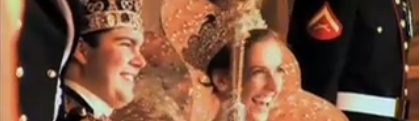
Few people outside of the South know that the first Mardi Gras celebration was held in Mobile, Alabama in 1703, 15 years before New Orleans was a city.  A 2008 documentary, The Order of Myths, chronicles the politics of the town’s Mardi Gras celebration today, which remains almost entirely segregated by race. The black and white communities throw two separate Mardi Gras celebrations. In this clip, starting at 40secs, a woman describes this segregation:

The documentary isn’t heavy-handed about it, but the film does a wonderful job of showing how race is, isn’t, and is sorta talked about in Mobile.  The trailer gives you an idea:

Manohla Dargis, reviewing the movie for the New York Times, tries to capture the uncomfortable co-existence, separation, and choreographed intersections of the black and white communities:

The black queen and king — Stefannie Lucas and Joseph Roberson, both schoolteachers — are cautious yet optimistic about their city and its racial divide. They see change, glimmers of real progress, but they don’t have the luxury of naïveté. Most of the white revelers — including the queen and king, Helen Meaher and Max Bruckmann — all of whom appear significantly wealthier than the black participants, are either vaguely or keenly aware of race. Mr. Bruckmann, a jovial type with the round face of a well-fed baby, and Ms. Meaher, a willowy blonde who’s all but swallowed up by her heavily jeweled costume, are swaddled in privilege, tradition and culture. It’s hard not to notice that every hand that serves them is black.

I highly recommend the film not only for it’s coverage of the role race plays in Mardi Gras, but for it’s portrayal of the unique racial politics of the South more generally.

Lisa Wade, PhD is an Associate Professor at Tulane University. She is the author of American Hookup, a book about college sexual culture; a textbook about gender; and a forthcoming introductory text: Terrible Magnificent Sociology. You can follow her on Twitter and Instagram.
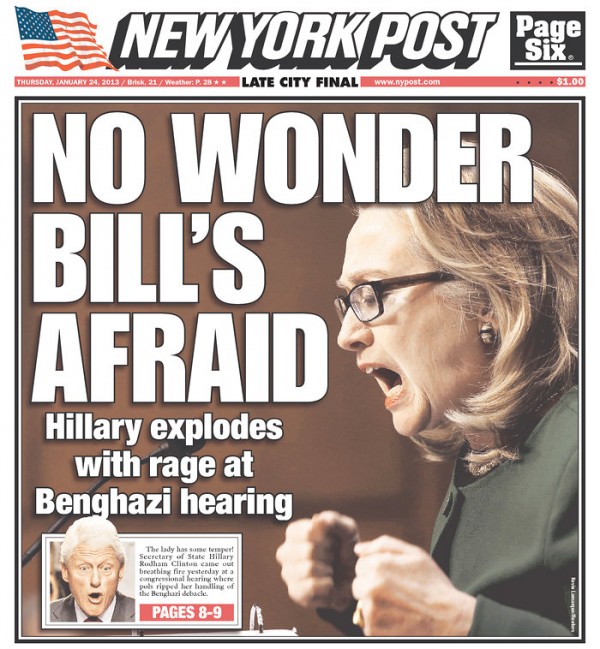
Last month the New York Post ran with this unflattering cover photo of Hillary Clinton responding strongly to congressional questioning and the tagline “No Wonder Bill’s Afraid.”

The not-so-subtle sexist messages include:

  • Even if you’re secretary of state in the most powerful country in the world, it’s not alright to get angry if you’re a woman;
  • when a powerful woman raises her voice to make a point, she is out of control — “exploding with rage”;
  • and when a man is married to a powerful woman, even a man who used to lead the free world, he is automatically cowed by her.

Despite rapid gains in women’s political and corporate leadership since the 1970s, powerful women are still held to the damaging double-bind of appearing “properly” masculine in order to appear
leaderly and “properly” feminine so as to not violate social expectations.

Caroline Heldman is a professor of politics at Occidental College. You can follow her at her blog and on Twitter and Facebook.

Cross-posted at Native Appropriations.

Florida State has been the “Seminoles” since 1947, and have had a “relationship” with the Seminole Tribe of Florida for many years, but it was solidified more recently. In 2005, the NCAA passed a resolution, calling Native American Mascots “hostile and abusive,” and prohibiting schools with these mascots from hosting post-season events. The Seminole Tribe of Florida then officially gave their permission to use Osceola as the mascot, letting FSU get a waiver from the NCAA rule.

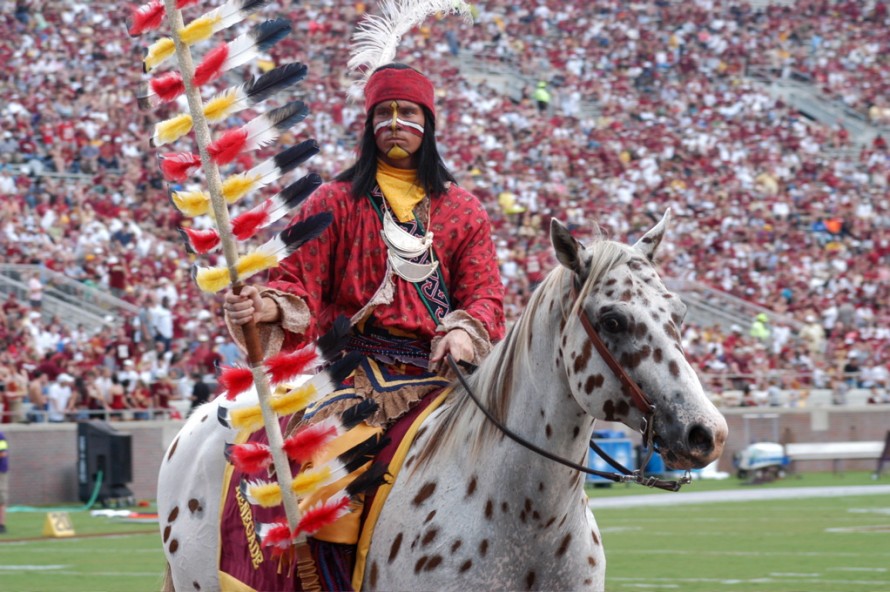
Disclaimer, and a big one — I am not Seminole, and I don’t want to speak for the tribe. I am offering my interpretation and perspective, but it’s just mine. I am going to be up front and say that I don’t agree with the choice to give the university permission to mock Native culture (see the billboard and video I posted earlier), and I don’t find a “stoic” dude in a wig and redface throwing a flaming spear“honoring” (see photo above), and I definitely don’t think that the “war chant” is respectful in any way. In fact I find it quite “hostile and abusive.”

I do want to put the decision of the tribe into context, however. From what I understand, prior to the formalized relationship with the tribe in the 1970′s, the image of the university was not Osceola (who is a real person, in case you didn’t know. Though the image is the profile of a white faculty member), but a stereotypical mis-mash named “Sammy Seminole” who was accompanied by “Chief Fullabull,” both of whom wore cartoonish and stereotypical outfits and clowned around at games. Trying to be more “sensitive” they changed “Fullabull” to “Chief Wampumstompum.” I’m not kidding. Osceola and Renegade (the horse) were introduced in the late 70′s.

So, by entering into a relationship with the university, the mascot now represents an actual Seminole figure, and wears (close to) traditional Seminole regalia, made by tribal members. In addition to control and “collaboration” over how the image is used and portrayed, I’ve heard the tribe gets a cut of the merchandising profits, which I’m sure is no small amount of money. The president of the university also established full scholarships for Seminole students (though only 8 Seminole students have graduated in the history of the school), a Seminole color guard brings in the flag at commencement, and the tribe was recently honored at homecoming. The Seminole of FL are also one of the most successful gaming tribes in the US, and my personal opinion is that keeping the state happy on the FSU front can only be good for relations around gaming contracts.

In summary, while the mascot is far from being respectful in my opinion, at least the tribe is gaining both economic and social benefits from engaging in this relationship. At least, at the games, as the student section is tomahawk chopping and yelling “scalp ‘em”, they can look down at the field and see a real Seminole every once and awhile to counter the image of Osceola. But is it perfect? Of course not. In a lot of ways it is similar to Derrick Bell’s theory of Interest Convergence — the idea that whites will only consent to racial progress when it benefits them directly — but turned around. The tribe is consenting to this, because they benefit directly. The interests of the two parties converge.

But the hard thing about FSU is that it always gives fodder to the mascot defenders. “But the Seminole approve of Florida State!  They don’t care!” Hopefully I’ve made a bit of a case as to why they’ve consented to have their image used, but I also want to point out that just because one faction of a marginalized group believes one thing, it doesn’t mean that everyone feels that way. Can you imagine if we expected all white folks to feel the same about a controversial issue… like gun control, for example? Not gonna happen. I also think that it ties back into the dilemma I’ve brought up again and again — is it better to be completely invisible as Native people, or be misrepresented? In the case of the Seminole tribe of Florida, they took the step to at least try and gain some control and power over how their people and community are represented.

For more, check out this awesome resource pulled together by Rob Schmidt of Blue Corn Comics/Newspaper Rock — offers more history, counter-arguments, quotes from news articles and Native scholars, and more: Why FSU’s Seminoles aren’t ok.

—————————

Adrienne Keene is a Cherokee doctoral candidate at the Harvard University Graduate School of Education, where she studies access to higher education for Native students.  She blogs about cultural appropriation at Native Appropriations.  You can follow her on Twitter and Facebook.

Cross-posted at The Huffington Post.

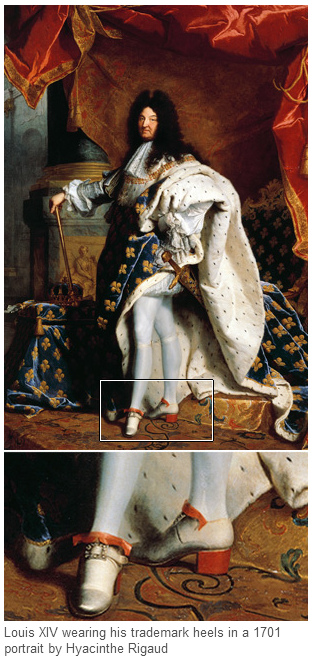
Why do women wear high heels?  Because men did.

Men were the first sex to don the shoe. They were adopted by the European aristocracy of the 1600s as a signal of status.  The logic was: only someone who didn’t have to work could possibly go around in such impractical footwear.  (Interestingly, this was the same logic that encouraged footbinding in China.)

Women started wearing heels as a way of trying to appropriate masculine power.  In the BBC article on the topic, Elizabeth Semmelhack, who curates a shoe museum, explains:

In the 1630s you had women cutting their hair, adding epaulettes to their outfits…

They would smoke pipes, they would wear hats that were very masculine. And this is why women adopted the heel — it was in an effort to masculinise their outfits.

The lower classes also began to wear high heels, as fashions typically filter down from elite.

How did the elite respond to imitation from “lesser” people: women and workers?  First, the heels worn by the elite became increasingly high in order to maintain upper class distinction.  And, second, heels were differentiated into two types: fat and skinny. Fat heels were for men, skinny for women.

This is a beautiful illustration of Pierre Bourdieu’s theory of class distinction.  Bourdieu argued that aesthetic choices function as markers of class difference.  Accordingly, the elite will take action to present themselves differently than non-elites, choosing different clothing, food, decor, etc.  Expensive prices help keep certain things the province of elites, allowing them to signify their power; but imitation is inevitable.  Once something no longer effectively differentiates the rich from the rest, the rich will drop it.  This, I argue elsewhere, is why some people care about counterfeit purses (because it’s not about the quality, it’s about the distinction).

Eventually men quit wearing heels because their association with women tainted their power as a status symbol for men.  (This, by the way, is exactly what happened with cheerleading, originally exclusively for men).  With the Enlightenment, which emphasized rationality (i.e., practical footwear), everyone quit wearing high heels.

What brought heels back for women? Pornography.  Mid-nineteenth century pornographers began posing female nudes in high heels, and the rest is history.

Lisa Wade, PhD is an Associate Professor at Tulane University. She is the author of American Hookup, a book about college sexual culture; a textbook about gender; and a forthcoming introductory text: Terrible Magnificent Sociology. You can follow her on Twitter and Instagram.
Cross-posted at Montclair SocioBlog.

I’m generally skeptical about claims that names in the media have a big impact on parents’ choices of what to name the baby (see this earlier post on “Twilight” names).  But Hilary Parker points out some examples where celebrity influence is unmistakable.  Like Farrah.

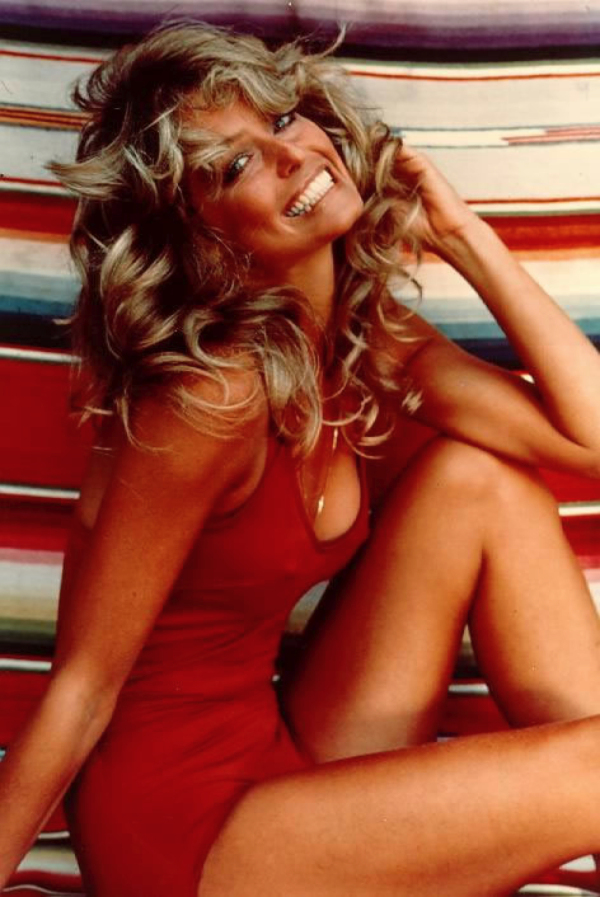
“Charlie’s Angels” came to TV in 1976, and the angel prima inter pares was Farrah Fawcett.  This poster was seemingly everywhere (and in 1976, that barely noticeable nipple was a big deal):

But as with most names that rise quickly, Farrah went quickly out of style.  If you see a Farrah on a dating site listing her age as 29, she’s lying by six or seven years.

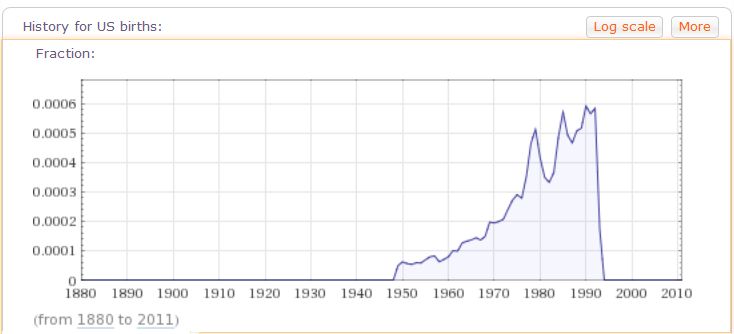
Hilary is different.  The name grew gradually in popularity, probably flowing down through the social class system.  There was no sudden burst of popularity caused by the outside force of a celebrity name (see Gabriel Rossman’s post on endogenous and exogenous influences).  Then in 1992, Hilary seemed to have been totally banned from the obstetrics ward.

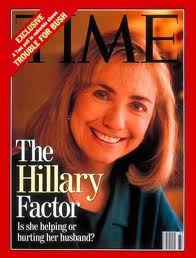
Surely, the effect came not from word of mouth but from a prominent Hilary (or in this case, the rarer spelling Hillary), the one who said she wasn’t going to stay home and bake cookies.

Maybe now that Hillary is getting a favorable press — good reviews for her stint as Secretary of State — the name might return to its 1980s popularity.

Jay Livingston is the chair of the Sociology Department at Montclair State University. You can follow him at Montclair SocioBlog or on Twitter.

Cross-posted at Montclair SocioBlog.

The Wall Street Journal had an op-ed this week by Donald Boudreaux and Mark Perry claiming that things are great for the middle class.  Here’s why:

No single measure of well-being is more informative or important than life expectancy. Happily, an American born today can expect to live approximately 79 years — a full five years longer than in 1980 and more than a decade longer than in 1950.

Yes, but.  If life-expectancy is the all-important measure of well-being, then we Americans are less well off than are people in many other countries, including Cuba.

The authors also claim that we’re better off because things are cheaper:

…spending by households on many of modern life’s “basics” — food at home, automobiles, clothing and footwear, household furnishings and equipment, and housing and utilities — fell from 53% of disposable income in 1950 to 44% in 1970 to 32% today.

Globalization probably has much to do with these lower costs.  But when I reread the list of “basics,” I noticed that a couple of items were missing, items less likely to be imported or outsourced, like housing and health care.  So, we’re spending less on food and clothes, but more on health care and houses. Take housing.  The median home values for childless couples increased by 26% between just 1984 and 2001 (inflation-adjusted); for married couples with children, who are competing to get into good school districts, median home value ballooned by 78% (source).

The authors also make the argument that technology reduces the consuming gap between the rich and the middle class.  There’s not much difference between the iPhone that I can buy and the one that Mitt Romney has.  True, but it says only that products filter down through the economic strata just as they always have.  The first ball-point pens cost as much as dinner for two in a fine restaurant.  But if we look forward, not back, we know that tomorrow the wealthy will be playing with some new toy most of us cannot afford. Then, in a few years, prices will come down, everyone will have one, and by that time the wealthy will have moved on to something else for us to envy.

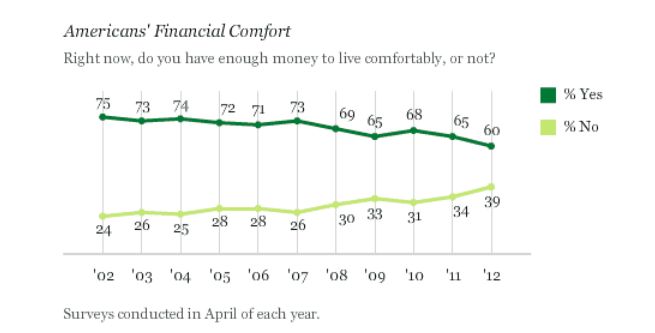
The readers and editors of the Wall Street Journal may find comfort in hearing Boudreaux and Perry’s good news about the middle class.  Middle-class people themselves, however, may be a bit skeptical on being told that they’ve never had it so good (source).

Some of the people in the Gallup sample are not middle class, and they may contribute disproportionately to the pessimistic side.  But Boudreaux and Perry do not specify who they include as middle class.  But it’s the trend in the lines that is important.  Despite the iPhones, airline tickets, laptops and other consumer goods the authors mention, fewer people feel that they have enough money to live comfortably.

Boudreaux and Perry insist that the middle-class stagnation is a myth, though they also say that

The average hourly wage in real dollars has remained largely unchanged from at least 1964—when the Bureau of Labor Statistics (BLS) started reporting it.

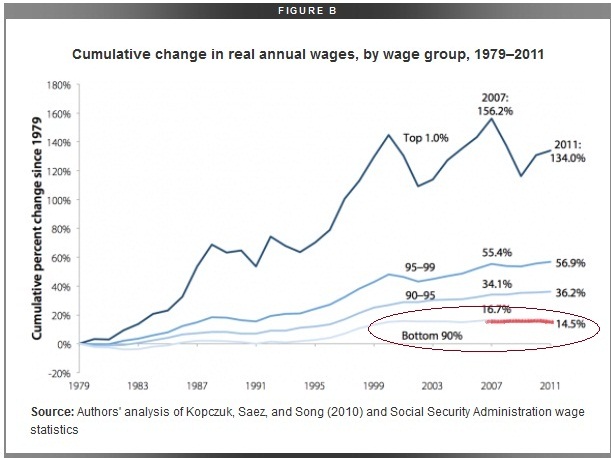
Apparently“largely unchanged” is completely different from “stagnation.”  But, as even the mainstream media have reported, some incomes have changed quite a bit (source).

The top 10% and especially the top 1% have done well in this century.  The 90%, not so much. You don’t have to be too much of a Marxist to think that maybe the Wall Street Journal crowd has some ulterior motive in telling the middle class that all is well and getting better all the time.

—————————

Jay Livingston is the chair of the Sociology Department at Montclair State University.  You can follow him at Montclair SocioBlog or on Twitter.

Cross-posted at Family Inequality.

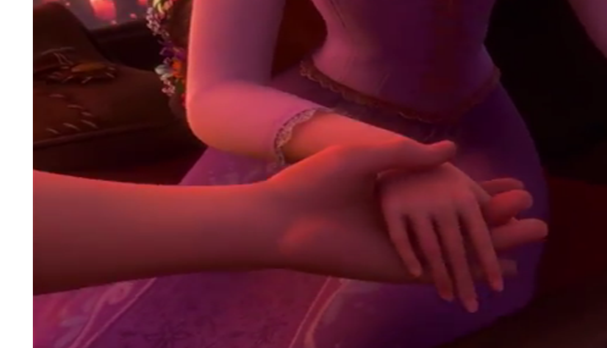
previously complained about Tangled‘s 75%-male cast and extreme sex dimorphism — the habit of exaggerating average differences between men and women — in the romantic leads, as seen in this hand shot:

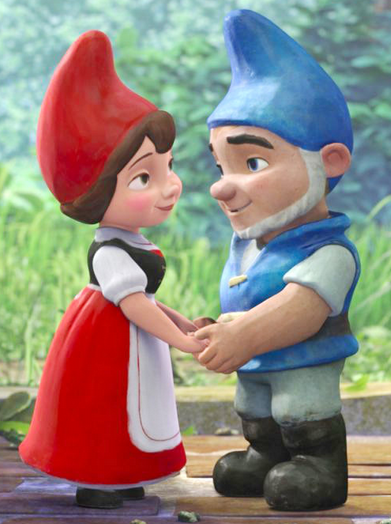
Keeping to my policy of two-year delays in movie reviews, let me add the same complaint about Gnomeo and Juliet, the charming adaptation from Disney’s Touchstone imprint. Here, a writing team of 8 men and 2 women (including Shakespeare) gives us a named cast of 14 men and 7 women, in a love story featuring these two adorable garden gnomes:

He’s only a little taller, and (judging by the gray beard) a little older. And in the movie she demonstrates bravery and feats of strength, as is now the norm. But look at those hands! Take a closer look:

What is it about hands that makes it so essential for men and women to have such differences?

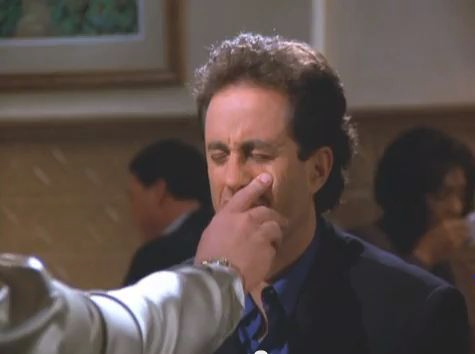
In the “man hands” episode of Seinfeld we learned how distressing it can be for a man to find out the woman to whom he was attracted has large hands.

That scene required a hand double. In real life, men’s and women’s hands differ on average but with a lot of overlap in the distributions — lots of men have hands smaller than lots of women. But in animation the gloves are off — and Disney is free to pair up couples who are many standard deviations apart in hand size.

Philip N. Cohen is a professor of sociology at the University of Maryland, College Park, and writes the blog Family Inequality. You can follow him on Twitter or Facebook.