Search results for The

The ’60s is often held up as a time of dramatic upheaval in American life.  It brought us civil rights victories, the sexual revolution, the women’s movement, the gay liberation movement, and anti-war activism.  It was, in short, antiestablishmentarian.

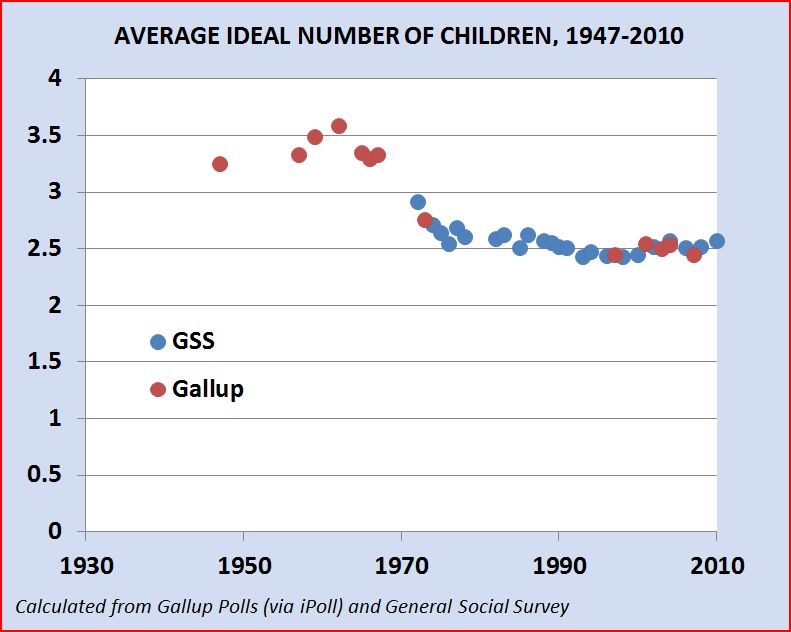
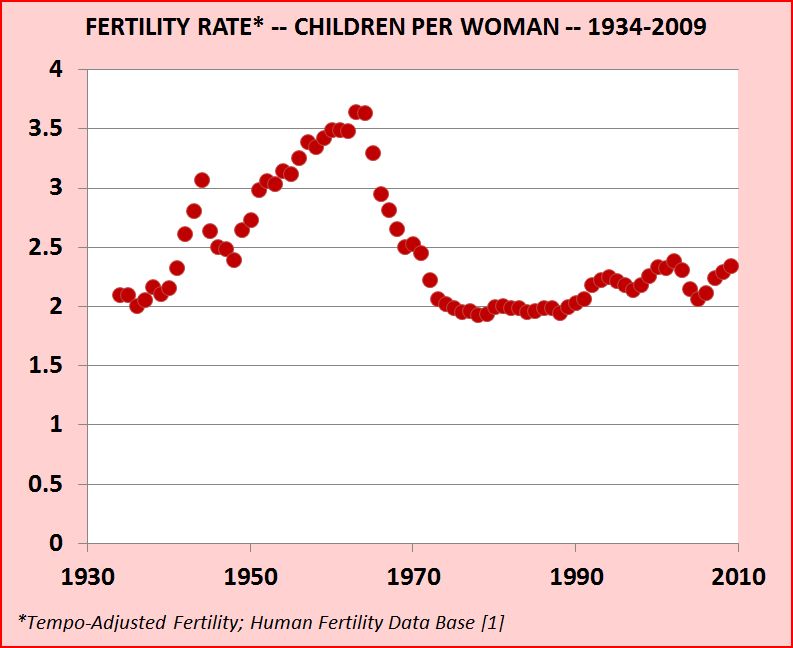
What were the concrete impacts of these changes?  One is the birth rate, as illustrated in a post by Made in America‘s Claude S. Fischer. Far from introducing a new normal, the ’60s reversed what was a relatively recent a rise in the ideal number of children and actual fertility rate.

While data not shown suggest that the ideal number of children in the ’30s was under three, the ideal had risen to 3.6 by 1962.  This dropped quickly across the rest of the decade.
2

Likewise, the actual number of children born to the average woman in the 1930s was about two, but this started shooting up in the late ’30s and ’40s.  Then, just as quickly as it had risen, it plummeted again:
1

This data reminds us of how unusual the ’50s really was.  It was an especially pro-natal family-centered time.  As historian Stephanie Coontz puts it:

At the end of the 1940s, all the trends characterizing the rest of the twentieth century suddenly reversed themselves. For the first time in more than one hundred years, the age for marriage and motherhood fell, fertility increased, divorce rates declined, and women’s degree of educational parity with men dropped sharply.  In a period of less than ten years, the proportion of never-married persons declined by as much as it had during the entire previous half century.

So, while in some ways the 1960s dramatically changed American culture, in other ways it simply put us back on track.

Lisa Wade, PhD is an Associate Professor at Tulane University. She is the author of American Hookup, a book about college sexual culture; a textbook about gender; and a forthcoming introductory text: Terrible Magnificent Sociology. You can follow her on Twitter and Instagram.
Originally posted in 2010. Re-posted in honor of Women’s History Month.

When I teach gender I always talk about the ways in which societies actively construct ideas that men and women have very different bodies, capable of different things. In the U.S., our gender ideology includes the belief that female bodies are weaker than male ones, more fragile. Particularly in the Victorian Era, this belief led doctors to discourage physical activity by women. Among a range of other concerns, doctors argued that physical exertion in women might cause their organs (particularly the reproductive organs) to become dislodged and wander around the body, causing all types of problems. I know I’d certainly be distressed if my uterus migrated and I ended up pregnant and carrying a fetus in, say, my elbow.

A result of this, of course, is that (White) women were discouraged from being physically active and taking part in sports. This, combined with heavy clothing and corsets that actually did shove organs around, led to the condition that the medical community claimed already existed: women’s bodies were less capable of physical exertion than men’s and they were more likely to faint (corsets often making it difficult to breathe adequately). It’s a self-fulfilling prophecy: if you believe women’s bodies are weaker than men’s and thus discourage or even prohibit women from being physically active, you create differences in physical capability and fitness that you can then claim prove you were right all along.

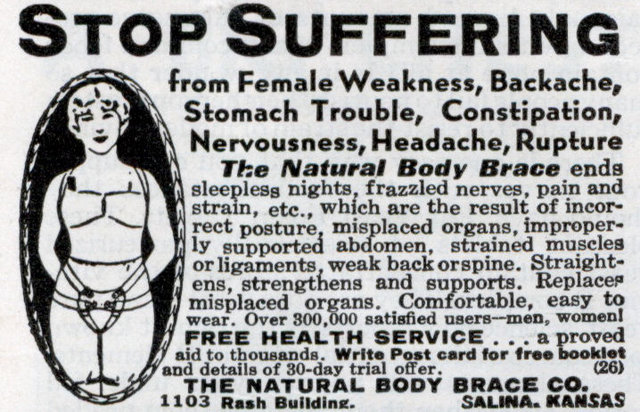
James T. found this awesome ad for a product that, among other amazing things, ends “misplaced organs” and will even move them back where they belong (from Modern Mechanix). The ad (from 1934) says that satisfied users include both men and women, but concerns about misplaced organs were a concern applied predominantly to women:

Medical practitioners weren’t just worried about physical exertion. They believed mental activity could be harmful to women as well; perhaps all that thinking meant the brain would take blood away from the reproductive organs and lead to infertility. A common diagnosis for women was “hysteria,” a general term that could be applied to almost any woman. A common “cure” for hysteria was bed rest, preventing both physical and mental activity. The diagnosis of hysteria served as a justification for severely limiting women’s activities, drawing on the ideology of the fragile female body. Charlotte Perkins Gilman wrote the classic short story “The Yellow Wallpaper” after her own experience of being forced to stay in bed with no mental stimulation, not even books.

Hysteria was also often associated with sexual problems, including a lack of interest in sex. The cure for this was “vaginal massage,” which was exactly what you think it was. This was done manually in doctors’ offices, but eventually mechanical vibrators became widely available, allowing women to treat their hysteria more cheaply and at home, and reducing the time it took to produce a “paroxysm”.

I find it fascinating that the construction of (middle/upper class White) women as “hysterical” and often sexually repressed and frigid made it acceptable for them to purchase a product that allowed them to sexually satisfy themselves at a time when masturbation was still widely vilified, and excuse it on the grounds that it was medically prescribed.

Gwen Sharp is an associate professor of sociology at Nevada State College. You can follow her on Twitter at @gwensharpnv.

Originally posted in 2009. Re-posted in honor of Women’s History Month.

I still remember when the female characters on the sitcom Friends started the trend of visible nipples:

680f6_celebrity-pictures-jennifer-anniston-nipples-friends

As long as I’d been alive and paying attention, hard nipples were embarrassing. Then, suddenly, they weren’t. I even remember hearing that women could get the all-hard-all-the-time look by buying those tiny rubber bands (that I only associate with the plastic bags aquarium fish come in) and fitting them tightly around your nipples. Nipples are still big, if measured by mannequins (Wicked Anomie noticed too).

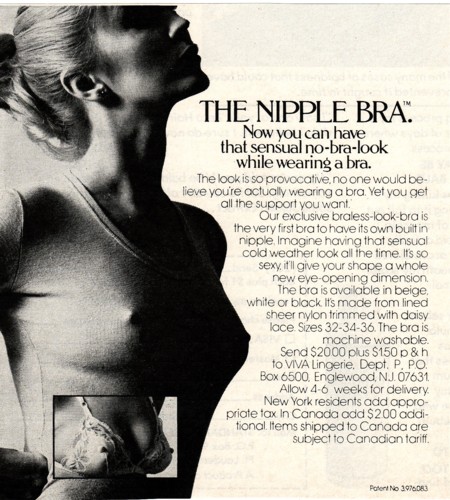
It turns out this comes in fits and starts.  This vintage ad (no date on the source), for example, features a bra with built-in hard nipples! (Apparently it had been a trend before I’d been alive and paying attention.)

0_2806c_528ae45_l

In the comments, Dmitriy T.C. added a link to the patent for this device. I can’t resist adding this particular paragraph explaining why a bra with fake nipples is important:

…simulated nipples for a brassiere would offer an acceptable compromise for ladies who do not wish to go without a brassiere and a welcome release from the subconscious effects of the suppression brought on by wearing brassieres of the types variously available, which obliterate the nipple.

LOL.

Anyhow, Tracey at Unapologetically Female wondered about wearing such a bra:

Didn’t anyone ever start to wonder why these women’s nipples were ALWAYS hard? And what if their real nipples (realistically probably located somewhere a bit lower than the bra’s) ever poked through, creating a quadruple effect?! Horrifying.

I find this whole thing especially funny, since, while shopping recently, Katie and I were making fun of these bras with built-in “modesty panels” that provide extra padding so that the nipple will never make an appearance. Times sure have changed.

Except times haven’t changed in the sense that women’s bodies still aren’t allowed to just be. Their nipples either must show, or must not show, or they should show in some contexts, or are allowed to show, but in other contexts they better not show.  (Remember the outcry over Hilary Clinton’s “cleavage”?  Can you imagine if she’d shown some nip!?)

So apparently we’re supposed to have nipple bras, bras with “modesty panels,” and a couple rubber bands in our pockets just in case. The one thing that is clearly less than ideal in all this: actual nipples doing what they do.

Lisa Wade, PhD is an Associate Professor at Tulane University. She is the author of American Hookup, a book about college sexual culture; a textbook about gender; and a forthcoming introductory text: Terrible Magnificent Sociology. You can follow her on Twitter and Instagram.

Cross-posted at The Huffington Post.

Last week I posted about our college President’s suggestion that he is disinclined to believe students who report sexual assault.  In response to this, and a series of other problems with our sexual assault policy, the Occidental Sexual Assault Coalition is filing a federal complaint with the Office for Civil Rights and a Clery Act complaint.  No longer confident that our President and his administration will agree to implement the best practices for reporting and adjudicating sexual assault, faculty and students are turning to external mechanisms.

These seem like extraordinary measures, but I want to be clear that there is nothing extraordinary about the number of sexual assaults or the mishandling of reports by the Occidental administration.  Occidental is no more or less unsafe than the vast majority of residential colleges and universities around the country.  College attendance is a risk factor for sexual assault — it raises the likelihood that a person will be a victim of an attempted or completed assault — and Occidental is no different in that regard.

Instead of a sign that Occidental has a uniquely broken system, the activities on campus reflect a commitment to making the college a nationwide model.   You see, we do believe that Occidental is different than other colleges.  It’s extraordinary.  And we’re committed to holding it to a higher standard.  We want Occidental to usher in a new era of sexual assault policy and improved campus sexual culture.  There will be a day when honest, transparent, and fair reporting and adjudication of sexual assaults will be the norm.  When that happens, the approach we find on essentially all college campuses today — a high rate of non-report, pressure on victims to stay quiet, sloppy and biased adjudication, and suppression of sexual assault data — will be considered backward, inhumane, and unjust.  That day is coming, and we want Oxy to get there first.

Photo credit: Chris Ellis and the Occidental Weekly.

Lisa Wade, PhD is an Associate Professor at Tulane University. She is the author of American Hookup, a book about college sexual culture; a textbook about gender; and a forthcoming introductory text: Terrible Magnificent Sociology. You can follow her on Twitter and Instagram.
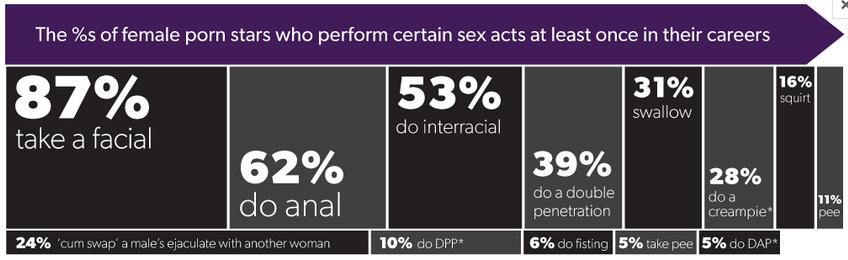
John Millward, a self-described “ideas detective,” has done something intriguing.  He cracked the Internet Adult Film Database (IAFD) and used a sample of 10,000 porn stars to tell a story about porn.  Here are some of his findings.

Demographics

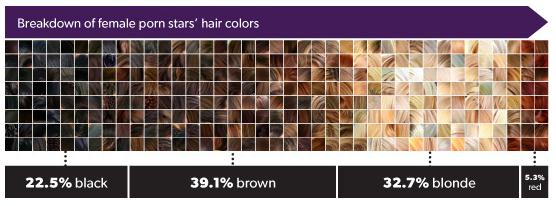
The average female porn star, he discovered, was 5’5″ and weighed 117 pounds.  She doesn’t have a double-D bra size; she’s a 34B.  And she’s not blonde:

1

She’s also not disproportionately white.  Millward found that the racial breakdown among porn actresses somewhat matched U.S. population demographics:

    Race                             % of actresses                     % of the population

  • White                            70.5                                       78.1
  • Black                              14.0                                       13.1
  • Latina                              9.3                                       16.7
  • Asian                               5.2                                         5.0
  • American Indian        no data                                        1.2

Career

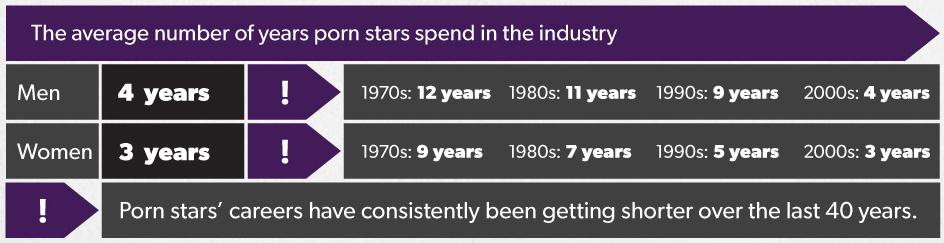
The average woman begins her career at 22.  This has been unchanged for the last 40 years.  The average age for men was 29 in the ’70s, but it’s dropped to 24.  Careers were longer in the ’70s.  Men quite after 12 years, women after nine.  Today men quit, on average, after four years and women after three.

4

Interestingly, success for male porn stars is much more concentrated than for female.  There are fewer of them (70% of all porn stars are women) and they’re less interchanged.  Millward reports that 96 of the most prolific porn stars of all time — measured by number of films — are men.  Women, on average, do fewer films each.  Just over half (53%) do three or more.

Content

The IAFD records all of the sex acts that actors do on film.  Accordingly to Millward’s analysis, this is what actresses do:

2

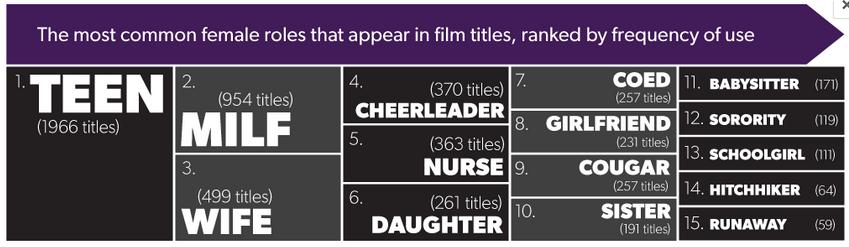
And here are the roles they play:

3

Wives in porn, by the way, are not typically having sex with their husbands.

For more data porn, visit Millward’s site.

Lisa Wade, PhD is an Associate Professor at Tulane University. She is the author of American Hookup, a book about college sexual culture; a textbook about gender; and a forthcoming introductory text: Terrible Magnificent Sociology. You can follow her on Twitter and Instagram.
New data about the science aptitude of boys and girls around the world inspires me to re-post this discussion from 2010.
Math ability, in some societies, is gendered.  That is, many people believe that boys and men are better at math than girls and women and, further, that this difference is biological (hormonal, neurological, or somehow encoded on the Y chromosome).

But actual data about gender differences in math ability tell a very different story.  Natalie Angier and Kenneth Chang reviewed these differences in the New York Times.  They report the following (based on the US unless otherwise noted):

•  There is no difference in math aptitude before age 7.  Starting in adolescence, some differences appear (boys score approximately 30-35 points higher than girls on the math portion of the SAT).  But, scores on different subcategories of math vary tremendously (often with girls outperforming boys consistently).

•  When boys do better, they are usually also doing worse.   Boys are also more likely than girls to get nearly all the answers wrong.  So they overpopulate both tails of the bell curve; boys are both better, and worse, than girls at math.

•  That means that how we test for math ability is a political choice.  If you report who is best at math, the answer is boys.  If you report average math ability, it’s about the same.

•  How you decide to test math ability is also political.  Even though boys outperform girls on the SAT, it turns out those scores do not predict math performance in classes.  Girls frequently outperform boys in the classroom.

•  And, since girls often outperform boys in a practical setting, math aptitude (even measured at the levels of outstanding instead of average performance) doesn’t explain sex disparities in science careers (most of which, incidentally, only require you to be pretty good at math, as opposed to wildly genius at it).   In any case, scoring high in math is only loosely related to who opts for a scientific career, especially for girls. Many high scoring girls don’t go into science, and many poor scoring boys do.

Now, let’s look at some international comparisons:

•  Boys do better in only about ½ of the OECD nations. For nearly all the other countries, there were no significant sex differences. In Iceland, girls outshine boys significantly.

•  In Japan, though girls perform less well than the boys, they generally outperform U.S. boys considerably.  So finding that boys outperform girls within a country does not mean that boys outperform girls across all countries.

•  Still, even in Iceland, girls overwhelmingly express more negative attitudes towards math.

So what’s the real story here?  Well, one study found that the gender gap in math ability and the level of gender inequality in a society were highly correlated. That is, “…the gender gap in math, although it historically favors boys, disappears in more gender-equal societies.”

Part of the problem, then, is simply that  girls and boys internalize the idea that they will be bad and good at math respectively because of crap like the “Math class is tough!” Barbie (sold and then retracted in 1992):

However, girls’ insecurity regarding their own math ability isn’t just because they internalize cultural norm, their elementary school teachers, who are over 90% female, sometimes do to and they teach math anxiety by example.  A recent study has shown that, when they do, girl students do worse at math.  From the abstract (this is pretty amazing):

There was no relation between a teacher’s [level of] math anxiety and her students’ math achievement at the beginning of the school year.  By the school year’s end, however, the more anxious teachers were about math, the more likely girls (but not boys) were to endorse the commonly held stereotype that “boys are good at math, and girls are good at reading” and the lower these girls’ math achievement.  Indeed, by the end of the school year, girls who endorsed this stereotype had significantly worse math achievement than girls who did not and than boys overall.

So, with only the possible exception of genius-level math talent, men and women likely have equal potential to be good (or bad) at math.  But, in societies in which women are told that they shouldn’t or can’t do math, they don’t.  And, as Fatistician said, “math is a skill.”  People who think practicing it is pointless won’t practice it.  And those who don’t practice, won’t be any good at it… Y chromosome or no.

Lisa Wade, PhD is an Associate Professor at Tulane University. She is the author of American Hookup, a book about college sexual culture; a textbook about gender; and a forthcoming introductory text: Terrible Magnificent Sociology. You can follow her on Twitter and Instagram.
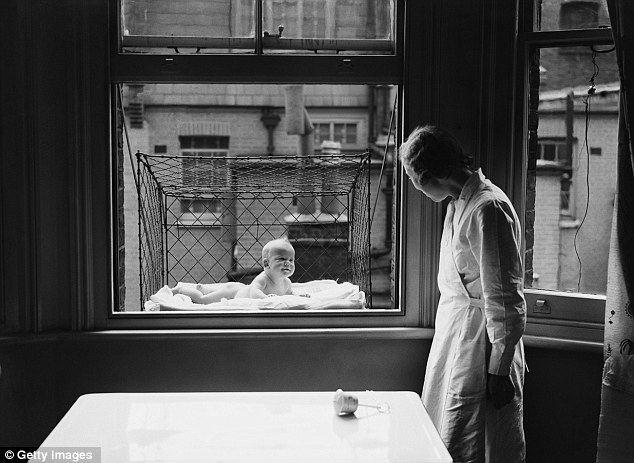
Inequality by (Interior) Design, a blog by sociologist Tristan Bridges, turned one-year-old last month and it is quickly becoming one of my favorites.  In a recent post, Bridges featured a product that reminds us all why history is awesome: the “portable baby cage”:

1 2

As I discussed in a previous post, with industrialization came cities and with cities came crowded, cramped living quarters.  The baby cage kept infants out of harm’s way and gave the family a bit more space.  As Bridges discusses, it also coincided with the idea that babies needed a lot of fresh air to be healthy.  The baby cage seemed like the perfect solution.

Lisa Wade, PhD is an Associate Professor at Tulane University. She is the author of American Hookup, a book about college sexual culture; a textbook about gender; and a forthcoming introductory text: Terrible Magnificent Sociology. You can follow her on Twitter and Instagram.
1In the two-minute animation below, sociologist Dalton Conley describes how inequality between families can create inequality within families. My favorite of his examples: if a family doesn’t have a lot of resources, it will often pour more of them into the most promising child instead of spreading the goods around equally to everyone.

For more, watch:

More at Norton Sociology’s YouTube page.

Lisa Wade, PhD is an Associate Professor at Tulane University. She is the author of American Hookup, a book about college sexual culture; a textbook about gender; and a forthcoming introductory text: Terrible Magnificent Sociology. You can follow her on Twitter and Instagram.