Search results for The

In Something from the Oven, Laura Shapiro explains that, after WWII, the U.S. government made a huge push to get women out of jobs and back into the kitchen. So much for Rosie the Riveter.

Part of the propaganda involved a return to time-consuming home cooked meals. But this propanganda was up against a contradictory need of food-related companies to market to the general public the advances they had made during the war in non-perishable and pre-cooked and packaged food.  So, on the one hand, women were encouraged to spend all day on a roast and, on the other hand, they were encouraged to take advantage of new food technologies. 

This ad, from the 1940s, incites women to take advantage of Campbell’s pre-made soup:
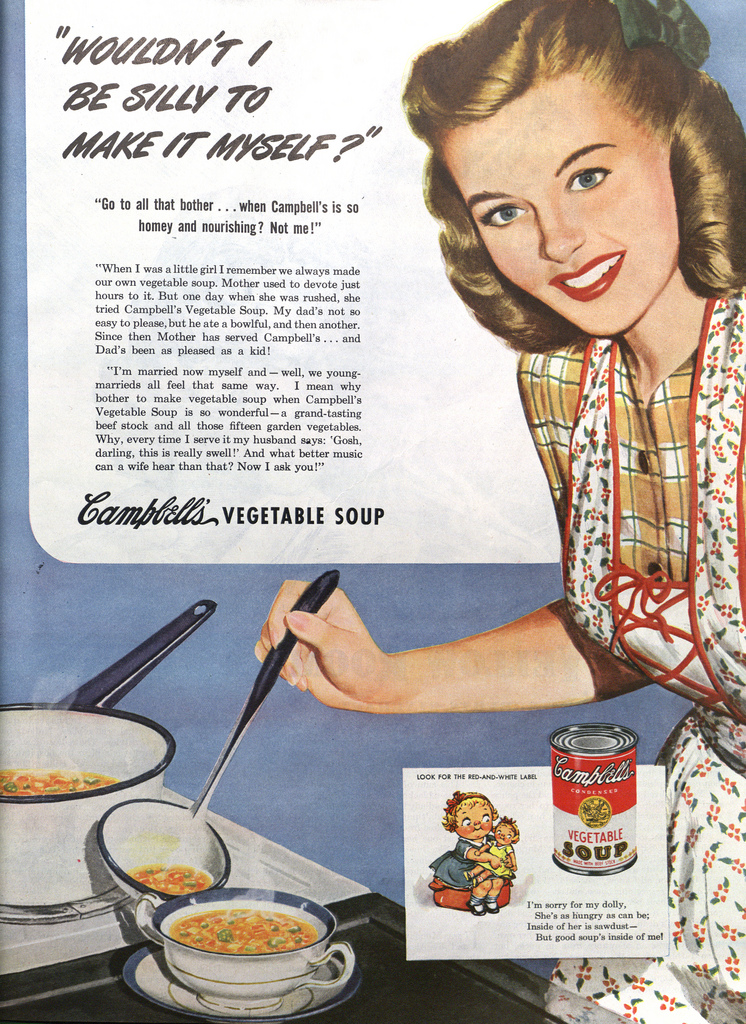
Text:

“WOULDN’T I BE SILLY TO MAKE IT MYSELF?”

“Go to all that bother.. when Campbell’s is so homey and nourishing?  Not me!”

“When I was a little girl I remember we always made our own vegetable soup.  Mother used to devote just hours to to it. But one day when she was rushed, she tried Campbell’s Vegetable Soup.  My dad’s not so easy to please, but he ate a bowlful, and then another.  Since the Mother has served Campbell’s… and Dad’s been as pleased as a kid!

“I’m married now myself and — well, we young-marrieds all feel that same way.  I mean why bothe to make vegetable soup when Campbell’s Vegetable Soup is so wonderful — a grand-tasting beef stck and all those fifteen garden vegetables.  Why, every time I serve it my husband says: ‘Gosh, daring, this is really swell!’  And what better music can a wife hear than that?  Now I ask you!”

Ad via Found in Mom’s Basement.

Mary T. sent in a photo she took of the cover of the Spanish (as in, from Spain) magazine Muy Interesante. It’s Not Safe for Work.

more...

A Washington Post article reports that the company who is selling the dolls says: “the dolls are not made to be exact replicas of the first couple’s daughters and are not based on the Obama girls.”

Obama’s press secretary says: “We feel it is inappropriate to use young, private citizens for marketing purposes.”

What do you think?

UPDATE: The company has reportedly retired the Sasha and Malia dolls.

Sabrina W. sent in this ad for an herbal toothpaste (from Thailand?), found at Sinosplice:

[youtube]https://www.youtube.com/watch?v=5Y7eg0REXZM[/youtube]

I don’t quite know what to make of it. I mean, in theory it would be a nice message that stereotypes are often extremely misleading. But “looks can be deceiving” applying to Black people? It’s not actually undermining the idea that Black men look scary (just like herbal toothpaste might look disgusting), it’s just that it turns out that in some cases, they’re actually nice, kind people! And presumably the toothpaste tastes better than it looks.

It’s interesting that the woman is afraid the Black man is going to hurt or maybe kidnap her child. In the U.S., I don’t think that’s usually the major concern–there’s the stereotype of Blacks as muggers, and women (particularly White women) often fear that they might be sexually aggressive, but I don’t think Black men are usually depicted as child molesters or kidnappers here–the stereotype of those groups is usually of middle-aged White men.

Thanks, Sabrina!

Gwen Sharp is an associate professor of sociology at Nevada State College. You can follow her on Twitter at @gwensharpnv.

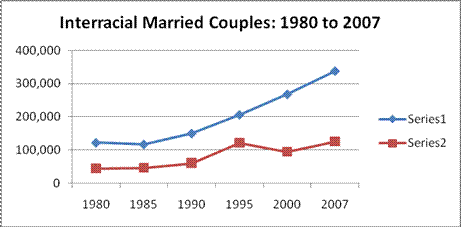
Over at Everyday Sociology, Janis Inniss posted about interracial relationships and she offered a graph showing 30 years of marriages of white men to black women and black men to white women.  Describing it, she writes:

Looking at the graph below, you will see that the black female/white male pairings of today are about what they were 30 years ago for black male/white female dyads. (The blue line represents black husband/white wife). In other words, today, white men and black women marry at about the same rate that black men and white men married about three decades ago.

So, why would there be a difference in the marriages between white men/black women and black men/white women? I suspect that this has to do with the intersection of gender and race. Consider: according to American cultural stereotypes, black people, both men and women, are more masculine than white people. Black men are seen as, somehow, more masculine than white men: they are, stereotypically, more aggressive, more violent, larger, more sexual, and more athletic. Black women, too, as seen as more masculine than white women: they are louder, bossier, more opinionated and, like men, more sexual and more athletic.

If men are supposed to be sexy by virtue of their masculinity and women sexy by virtue of their femininity, then black men and white women will be seen as the more sexually attractive than white men and black women.  So, while white men may not find black women particularly attractive, white women may very well find black men attractive.  In this is so, we might see the patterns that Inniss demonstrates with her table.

These concrete statistics, as well as the cultural stereotypes that position black women as undesirable, help explain why interracial dating is politicized by many in the black community.  It is not trivial that black men can date outside of their race and black women are less able to do so.  It means that many black women have less opportunity to form long-term relationships.

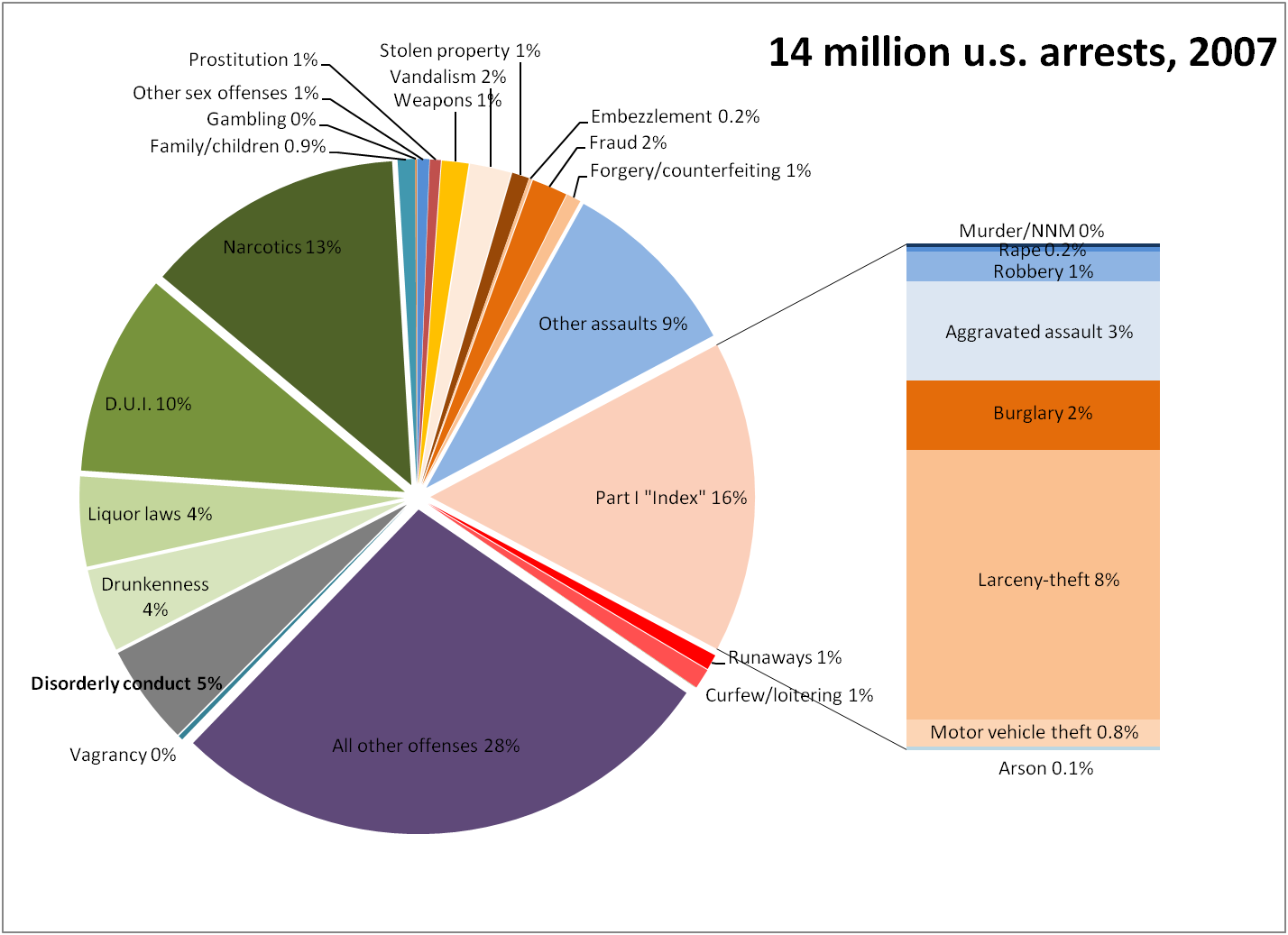
Chris Uggen put together a pie chart of U.S. arrests (FBI statistics 2007) in order to show that “only a small proportion of arrests involve violent crimes such as murder, rape, robbery, and aggravated assault” (see it here):

In 2007, only 4% of arrests were for violent crimes; another 12% were for crimes like burglary, theft, and arson; drug offenses (including drunkenness and DUIs) accounted for 31% of arrests.

Uggen mentions that he shows this data, in part, to talk about the way in which arrests for drug offenses disrupt families and neighborhoods.  Low income neighborhoods are devastated by the transfer (to put it nicely) of huge numbers of adult males to jails and prisons.  Those men are not overwhelmingly committing violent crimes (as stereotype suggest), but are imprisoned because of the intensive policing of drug crimes in those neighborhoods.  In another post, we put up a table that showed how the “drug war” that started in the 1980s disproportionately affected blacks.

For more on crime and imprisonment, see this post on the ineffectiveness of racial profiling, this table on the percentage of children with parents in prison by race, and this table that compares incarceration rates across countries.

This commercial hints at the femininity of a driver who is not driving a Chevy Silverado truck. Discourses of masculinity and femininity are pretty common in advertising, but notice that all the spokesperson (Howie Long, Hall of Fame football player and all-around manly tough guy) has to do is hint at it here:

[youtube]http://www.youtube.com/watch?v=cagPZOAtZp4[/youtube]

I am curious as to what you, Readers, think of the recent rash of advertising capitalizing on Obama’s “brand.” Here are some examples (found here, here, here, and here).

Budweiser American Ale:

A language school in Israel:

Ikea:

In other posts we’ve suggested that ads that appropriate feminism trivialize gender inequality and ultimatly undermine feminist efforts to attain social justice for women (see here, here, here, here, here, here, herehere, here, and here).  Like many of the “feminist” ads, these ads seem to be genuinely celebrating Obama’s election.  Do they?  Or do they trivialize everything he claim to stand for and the difficult road ahead for both him and the country? Something in between? Something else entirely?

What do you think?

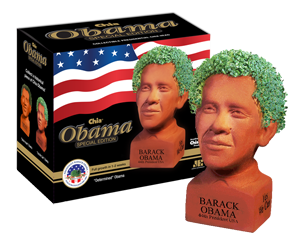
NEW: Breck C. pointed out the Obama Chia Pet:

Amid a controversy that the Obama Chia pet was racist, Walgreens pulled the product.

Lisa Wade, PhD is an Associate Professor at Tulane University. She is the author of American Hookup, a book about college sexual culture; a textbook about gender; and a forthcoming introductory text: Terrible Magnificent Sociology. You can follow her on Twitter and Instagram.