Search results for The

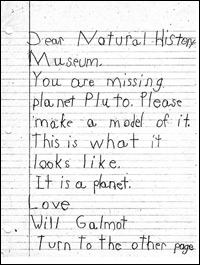
In case you missed it, a few years back there was a major brouhaha (limited mostly to the U.S.) because some astronomers began to argue that Pluto should be reclassified as a dwarf planet, part of the Kuiper belt. This started when, in 2001, the American Museum of Natural History (in New York) created a display about the solar system that did not include Pluto. At first the museum received letters (often from children) pointed out that Pluto was missing, such as this one (from an NPR story on the subject):
galmotone200

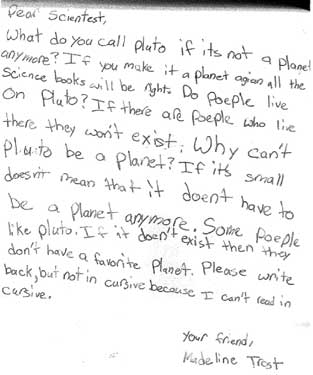
But then word got out that the museum left Pluto out of the display on purpose, and that the director of the museum argued that Pluto is not a planet. Then a real letter-writing campaign began, from both kids and adults (found here):
dn16480-1_313

Text [some errors corrected for ease of reading]:

Dear Scientist,

What do you call Pluto if it’s not a planet anymore? If you make it a planet again all the science books will be right. Do people live on Pluto? If there are people who live there they won’t exist. Why can’t Pluto be a planet? If it’s small doesn’t mean that it doesn’t have to be a planet anymore. Some people like Pluto. If it doesn’t exist then they don’t have a favorite planet. Please write back, but not in cursive because I can’t read in cursive.

A Save Pluto movement had begun, including pro-Pluto websites, t-shirts, bumperstickers, and so on (at CafePress):
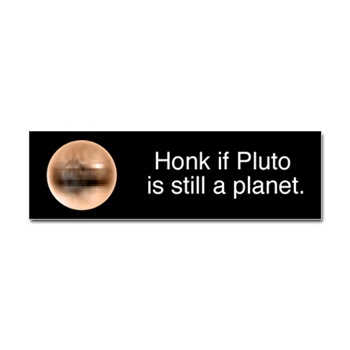
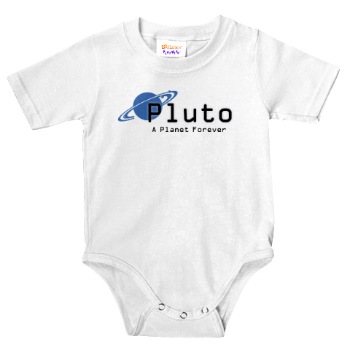
71612518v7_350x350_front

72008103v1_350x350_front_color-white

Some of these were clearly meant in a joking manner, but many of the letters sent to the museum or published in newspapers expressed realy anger over the change. Headlines announced that Pluto was being “demoted” from planet status. Amid lots of angry debate even among themselves, astronomers eventually voted to recategorized Pluto as a dwarf planet.

You might use these to talk about public controversies about scientific research. This is a particularly odd example because the public concern didn’t spring from arguments that the research was immoral or dangerous (claims used to oppose, say, embryonic stem cell research or cloning). The outrage about Pluto’s change in status mostly occurred in the U.S. and was based on the fact that people just seem to really like Pluto and consider it their “favorite” planet. Neil DeGrasse Tyson, director of the museum, suggests that this might be because of Disney’s cartoon dog Pluto. Regardless, a significant number of people wrote angry and even threatening letters to various outlets about a scientific reclassification that didn’t affect them in any real way; they just didn’t like it.

It’s also interested that Pluto’s reclassification was interpreted as a “demotion,” as though being a dwarf planet is clearly inferior to being a “real” planet, as though the objects in the solar system are arranged in a hierarchy based on size, and being anything other than a planet is a sad, sad fate. DeGrasse Tyson stresses that to astronomers, a dwarf planet isn’t “inferior to” a “regular” one–it’s just another category of things that exist in the galaxy. It’s an interesting example of how scientists’ perceptions of what their research means and the public’s interpretations may differ wildly.

NOTE: Mordecai comments,

First I want to say: All scientific classification is arbitrary.  There is no such thing as a planet, or a mammal.  These are terms humans put on them to try to make sense of the universe, not some built in truth.

Absolutely. I didn’t mean to imply the scientists were applying some ultimate truth about the universe when they re-classified Pluto. What I find interesting is what the controversy was based on: not “we think the data is wrong,” or “this is immoral or harmful,” but “Leave Pluto alone! It’s our favorite!” And the fact that it was really only a scandal in the U.S. is striking as well–whether it’s the character of Pluto or not, for some reason Americans are pretty much uniquely concerned about Pluto’s status.

Nearly a month ago Daphne L. sent us this poster advertising the new television show about lawyers, Damages.  I saw it all around town and maybe you did, too.

I have been trying to think of something interesting to say about it.  I have rejected my first instinct–that the ad represents woman-on-woman violence designed to titillate men and reproduce the stereotype of women as catty–as totally off.  I am not having any luck coming up with an idea of how it fits into our collective consciousnesses. 

damagesposter_l

There is certainly something fascinating here, but it may just be the way in which Glenn Close is looking calmly into the camera, while the brunette doesn’t even seem to notice or care that she is there.  Perhaps some advertising is just meant to surprise or disturb the reader and be memorable by virtue of failing to make any sense at all.  

I leave it to you, oh readers, to articulate objections, explanations, and defenses.  Or shall we just simply agree with Daphne that it is “unnerving” and leave it at that?

Piper A. sent us a link to a post at Cake Wrecks featuring “redneck” wedding cakes. As someone who recently received an invitation to a cousin’s wedding that included the words “hitched,” “shotgun,” “Honkers,” “Tri-Tip,” and “beer tenders,” I feel especially qualified to comment on these cakes.*

The fact that these cakes are considered “wrecks” reveals that we expect people to follow wedding rules. You are not allowed to have any cake you want, you must have a wedding cake and that cake must conform to certain specifications (apparently three tiers is not sufficient, neither is white frosting, and a sense of humor appears to be out). If you don’t conform, you are getting married wrong. In this case, if I may infer from the “redneck” statement, your wedding has no “class.”

See also this related post on “taste” and two more posts on how to do weddings right (i.e., girls should be skinny and be chosen).

* Extra credit for anyone who can tell from that list of words where my extended family lives.

Lisa Wade, PhD is an Associate Professor at Tulane University. She is the author of American Hookup, a book about college sexual culture; a textbook about gender; and a forthcoming introductory text: Terrible Magnificent Sociology. You can follow her on Twitter and Instagram.

In From Motherhood to Citizenship, Nitza Berkovich traces a global shift.  Sometime during the 20th century, nation-states became convinced that women could boost national economies and foster development.  Accordingly, states began thinking of their women as potential productive workers instead of reproductive mothers.  It was this economic argument, not necessarily a feminist one, that led to women’s incorporation into the public sphere as citizens (workers, voters, etc).

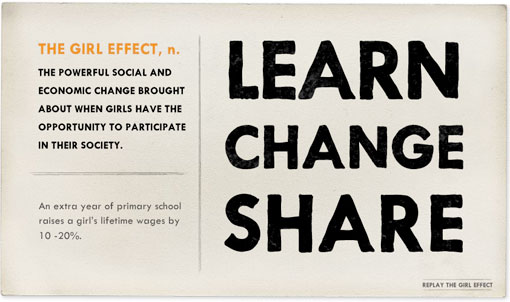
I was reminded of Berkovitch’s book by a short video sent in by Fran.  The video, produced by a non-profit called Girl Effect*, argues that if you get girls into school and give them cows, the world will be a better place.  As Fran puts it:  “Apparently, girls are only worth supporting if they improve the economy!” Here is an image from the website:

girleffect_01

“Girl Effect” is defined as:

The powerful social and economic change brought about when girls have the opportunity to participate in their society.

The logic is not that girls deserve education or the opportunity to sustain their livelihoods (a feminist argument); the logic is that we should invest in girls because it is good for the world (a global improvement or humanist argument or something).  I’m not arguing that the former is better or worse than the latter, only pointing out that it’s interesting that feminist initiatives (helping girls) can be supported with non-feminist logics.

The video:

*  As an aside, I always think it’s interesting when and how people choose to use the word “girl” as opposed to “woman.”  In this case, I suspect the activists think girls are more sympathetic than women.  Kids always pull at the heart purse strings moreso than adults.  I suppose this is because we ascribe to children a sort of innocence.  That, in itself (though socially constructed), doesn’t seem troublesome… but, if we can give the benefit of the doubt, we can also take it away.  I always wonder, for example: When do boys growing up in poverty transition from innocent victims of circumstance to potential criminals?  When do their sisters transition to welfare queens?  When do we decide to retract our generous offering of benevolence and replace it with malevolence?  These are just things I wonder.

Please peruse the posts we’ve enriched this month:

The idea of interracial and cross-national sex as cultural tourism came up at PostSecret.  We added a postcard to an earlier post on the topic.

We added a video about the video game BoneTown to this post about Miss Bimbo and Sexy Beach 3. BoneTown, supposedly the “world’s first action adventure porno video game, is exactly what you’d think it is, except with Mormons, American Indians in business suits, and a mysterious thing called Jew Magic. It’s pretty fascinating.

In a comments thread, Mordicai alerted us to “Man Glaze,” i.e., finger polish for men.  We added it to our thread on make-up for guys here.  Scroll down.

We added an o.b. tampon ad sent in by Claire T. to this post about marketing products with eco-conscious messages as evidence that “being green” (at least in theory) is becoming increasingly mainstream.

We added a commercial, also sent in by Claire T., for the EU’s “Cool Capitals” tourism campaign, to this post about imagery of cheating (polygamy?) in AirFrance advertising. The EU commercial documents the case of Francine, a fictional polygamist with husbands in five European capital cities.

In the comments thread to our post about the NOT FOR GIRLS candy bar, Trevor pointed us to the girl version.  But it is a girl version?  I couldn’t figure out the message.  Can you? We also added an image of Men’s Pocky, pointed to by Lis Riba.

Pharmacopaeia alerted us to another ad campaign on the “Thank God You’re A Man” theme.

We found another instance of pre-nazi uses of the swastika, this time the symbol was used in a warm, cozy quilt.  Thanks to Felicity who pointed us to it in the comments!

Taylor D. sent us another add for Wate-On, a product that supposedly helped women gain weight, this one targeted to African American women. We added it to this post about weight-gain supplements.

We added two more ads, sent in by Taylor D., to this post about non-subtle uses of sex in advertising.

We added another Gillette ad to this post about how body wash is marketed to men.

Finally, we added the Obama Chia Pet to a post about advertising products with Obama.

I just discovered that PBS provides the entire documentary “A Class Divided” online. The video discusses the experiment a teacher conducted in her classroom, in which she divided her 3rd-grade class into groups with blue eyes and brown eyes and told them the blue-eyed groups were “the better people in this room,” later changing the rules and saying that brown-eyed kids are better (she started this experiment the day after Martin Luther King, Jr., was shot). It’s an interesting look at stereotyping and social psychology, particularly how quickly groups will change their behavior if they are told they have a superior or inferior characteristic.

The website also has clips from a class reunion 14 years later where the people who took part in the experiment talk about it, as well as when the teacher was hired to conduct the experiment on Corrections Department employees to teach them about discrimination and stereotyping.

You might also discuss this experiment when you’re looking at ethics of research–would we allow something like this now? How would parents likely react today if they found out their child was told they were in an “inferior” group? My guess is a teacher would face a lot of opposition trying to do this now.

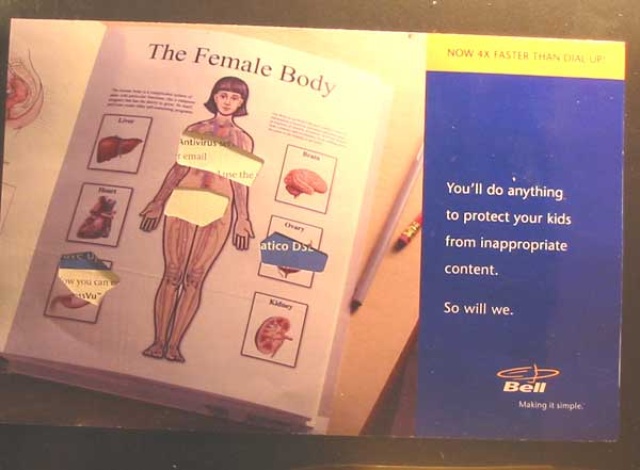
Julie C. drew our attention to this ad for an internet service that filters “inappropriate” content:

bell-ad-large

Lizvang nicely articulates an objection (my emphasis):

The breasts, the vagina, the uterus and the colon is cut out of an anatomical text book. When did biology and education about our bodies become shameful? Haven’t we as a society moved past the “a woman’s body is dirty” mindset?

dasl-drunk-woman_thumb

Text:

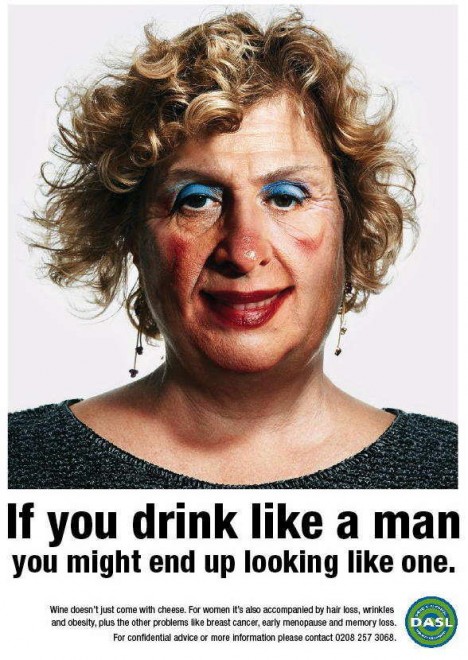
Wine doesn’t just come with cheese.  For women it’s also accompanied by hair loss, wrinkles, and obesity, plus the other problems like breast cancer, early menopause and memory loss.

This ad rests on women’s fear of looking like men (whatever that means)

(1) Interestingly, none of the side-effects of alcoholism listed seem, to me, to be masculinizing.  I can only imagine that the creators of this ad thought that straying from the norms of youthful femininity makes a woman seem masculine, thereby conflating aging with masculinization in women.

(2)  Also, notice the excessive make-up.  The ad is relying on the viewer being disgusted at the idea of a masculine face covered in make-up.  That is part of what is supposed to create a negative reaction.  But make-up and masculinity are not intrinsically or naturally at odds.  We only believe this to be so.

(By the way, the fact that most men do not wear make-up, I think, is a beautiful example of the triumph of gender ideology over capitalism.  For example.  But see here.)

(3) Finally, what’s “drink like a man” all about?  I guess men can have all the wine and cheese that they want without getting wrinkles because, gosh darn it, it’s just how men drink!   Maybe they even get more masculine!  (Hmmmm… as someone who loves her liquor, suddenly I do have penis envy.)

Thanks to Julie C. for the link!

NEW! This vintage ad (found here) uses the same logic:

capture33