Search results for The

What do we really mean when we ask someone if they’re a dog person or a cat person?  Wait… think hard… what are you really asking?

I think we’re asking if a person is more masculine or feminine.  After all, don’t we stereotype women as cat people and men as dog people?  And don’t we think men with cats are a little femmy or, at minimum, sweeter than most… even, maybe, gay?  And don’t we imagine that chicks with dogs are a little less girly than most, a little more rough and tumble?  The cat person/dog person dichotomy is gendered.

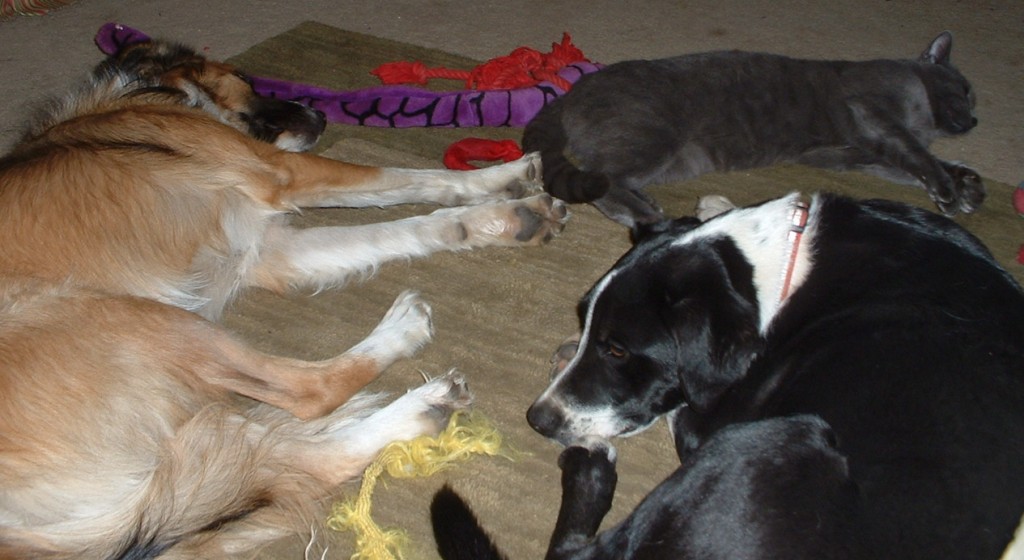
This might explain why we continue to insist that dogs and cats are natural enemies. We tend to insist that dogs and cats don’t get along in the face of millions of households in which they get along just fine.  These are Gwen’s pets (clockwise Shadow Cat, Rocky, and Corky):
september

They are clearly at each other’s throats constantly.

And, have you ever noticed that being a dog person is sort of cooler?  Like, it’s cool to be a dog person, but less cool to be a cat person?  I mean, no one ever fears ending up a “crazy dog lady,” and it’s not just because of the lack of alliteration.  You see because gender is hierarchical, so is the dog person/cat person dichotomy. I hate being asked if I’m a dog or cat person.  I have two cats, but I love dogs equally, and that doesn’t make me less cool than Gwen.  (We’re obviously equally cool.)

Also!

Cats aren’t all alike.  Neither are dogs.  So you can’t be a dog person or a cat person.  It’s nonsensical.

And another thing!

If you want to get all stereotypical about it, I’ll just say that (1) if dogs are dependent, passive, and happily subordinated to their owners, while cats are independent but offer nice companionship, and (2) women are “cat people” and men are “dog people,” then (3) men are really oppressive bastards who can’t stand a relationship with an equal and women are inherently democratic and don’t desire power (none of which I believe).  So let’s not go there, okay?

Lisa Wade, PhD is an Associate Professor at Tulane University. She is the author of American Hookup, a book about college sexual culture; a textbook about gender; and a forthcoming introductory text: Terrible Magnificent Sociology. You can follow her on Twitter and Instagram.

Margaret McE. sent in an image of Gro-Shu kids’ shoes (found at Hoyden About Town), which are sold at Payless Shoes in Australia. They’re a great example of the gendering of products: notice that the boys’ shoe is called Maths and the girls’ is Drama.

picture-1

I mean, really?

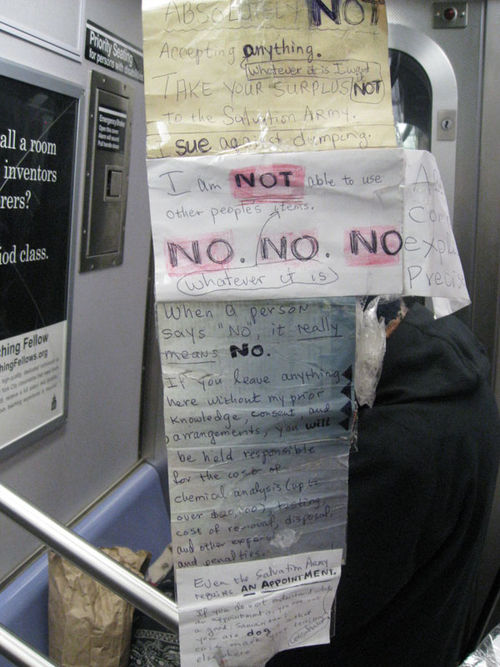
Miriam B. sent in a link to a blog post about a (presumably–I may be totally wrong) homeless woman on public transportation. I didn’t immediately post it because I kept going back and forth about whether it was appropriate. For one thing, it’s a personal blog, not something put out by an artist, ad agency, political group, etc., and with a few exceptions we usually don’t repost things from personal blogs (unless they’re images of things in the public domain, such as a billboard). I was also trying to decide if I wanted to post images of a possibly mentally-ill woman when it might be opening her up for ridicule (which was the point of the original post), even though she’s not clearly visible in any of them. After talking to Lisa about it, I decided to go ahead, but I’m aware some of you may object.

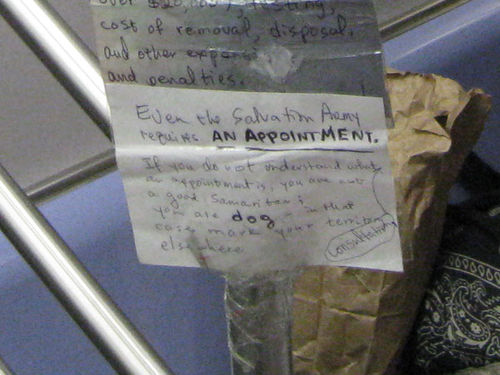
All that said…the point of the original post is that the poster/photographer noticed that the woman has sectioned off a seat on the subway and put up signs, which she clearly spent a lot of time putting together, stating that she didn’t want people’s things:

6a00d83451b8c369e2010536eaf9c4970c-500wi

6a00d83451b8c369e2010536eb0431970c-500wi

As Miriam said,

What caused this woman to write such a strongly worded set of rules? What does it imply about how people have treated her in the past?  Homeless people have personal boundaries too.

What I found interesting was the tone of the original blog post and the comments to it: basically, a) I can assure that crazy lady, I had no intention of giving her anything in the first place! and b) what an uppity homeless person! What position is she in to say she doesn’t want stuff from strangers?

Of course, the woman might be mentally ill, and that explains her reaction. But it’s also possible that she just does not want people offering her handouts, for whatever reason–maybe sick of them, doesn’t think of herself as a beggar, sense of pride, isn’t homeless, whatever. Or some combination of all of the above. I can see an onlooker finding the vehemence of her statements amusing. But the reaction to her brings up a bigger issue, which seems to be a sense that her insistence that she doesn’t want donations is a sense of “entitlement,” as the original poster called it.

It brings up some interesting questions. Do homeless people lose the right to personal boundaries or to turn down handouts? I think many people will argue the point is the tone of her statements, but I wonder–if a fellow subway passenger offered her a dollar and she kindly said “no, thank you, I’m not a beggar,” would the reaction necessarily be much better? Is part of the problem that she is openly and unapologetically marking off some space on public transit as hers (though not much more space than a lot of people take up with their oversized purses, briefcases, etc.)? Is it that she’s ridiculing the idea of the rest of us as Good Samaritans when we give money or items to the poor?

I might be more sympathetic to her message than most because I’ve worked at a number of non-profits and see some of the weird issues that can arise around donations. People or businesses will sometimes show up with large quantities of products that, while we might be thrilled to have some of them, were difficult to deal with all at once, store, etc. If individuals called and offered things that we couldn’t use, no matter how how politely we explained that we didn’t need or could store the item, the reaction was generally a sense of moral outrage–we were a service agency being offered free stuff! How dare we not immediately say yes, offer to come get it ourselves, and express our gratitude? People seemed to take it very personally if we could not accept a particular donation.  [For the record: of course organizations want donations. But if it’s a large amount, oddly sized, etc., you might call ahead and make sure it’s something they have room for. And seriously, don’t use non-profits as an alternative to taking real, true junk to the dump or whatever–they can’t use your permanently-broken washing machine any more than you can.]

I don’t know. Thoughts?

(And yes, it did make me think of the “Seinfeld” episode where Elaine and Kramer are trying to get rid of all the muffin stumps and the woman at the shelter yells at them, saying just because people are homeless doesn’t mean they want their stumps.)

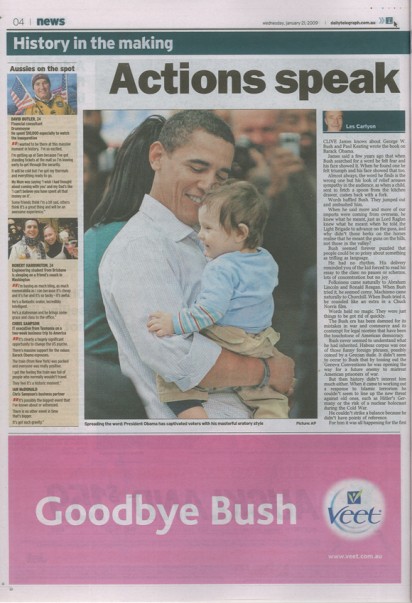
While some companies are capitalizing on Obama’s election, others are using the end of Bush’s presidency in advertising.   Check out the ad at the bottom of this page:

veetbush-412x6031

(Veet is for hair removal.)

Found here.

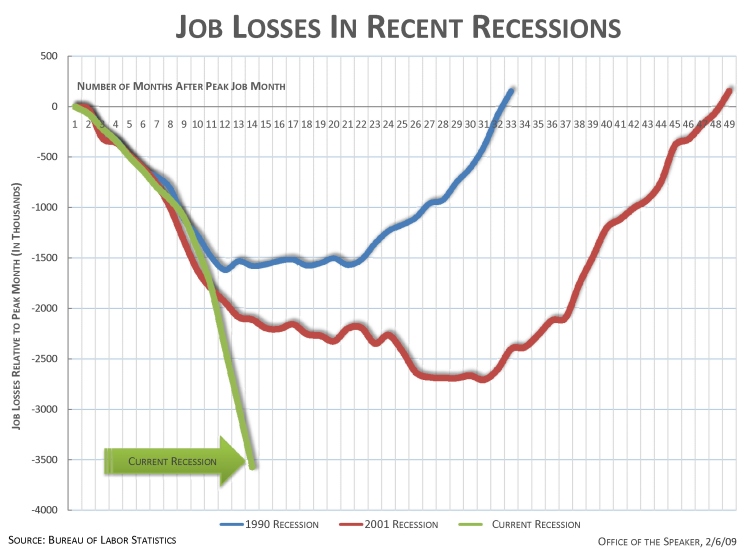
This graph, based on U.S. Bureau of Labor statistics and current as of February 6th, compares the number of jobs lost during the 1990 (blue), 2001 (red), and current (green) recessions:

jobsrecessions

Found at The Daily Kos thanks to Jerry A.

I spent the last few days in Savannah, Georgia at the winter meeting of Sociologists for Women in Society. I’m from Maine and didn’t travel much in the U.S. as a child. It wasn’t until I was 27 that I ventured south of Washington, D.C. The history of slavery is something that I’ve always wanted to learn more about.

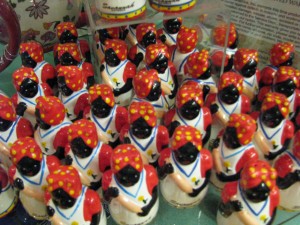
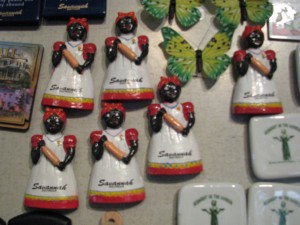
After spending a day at the Civil Rights Museum and touring the historic First African Baptist Church, I was stunned to find these items for sale in nearly every tourist souvenir shop.

img_5734

img_5728

img_5733

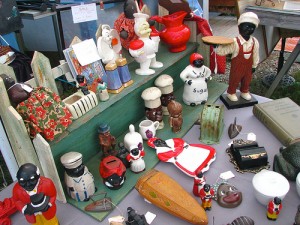
These make me uncomfortable. They’re caricatures of Black women without any kind of historical context. Like Gwen in this post, I have less of a hard time with old, historic artifacts (like the antiques pictured below that I found at a flea market). But, I do think they belong in a museum alongside other historic artifacts and information.

2753464164_0dcdd978de

But, newly made, currently produced reproductions of Black women slaves, as salt shakers and magnets? How is that alright? To me this is almost as creepy as if they were selling Klu Klux Klan robe magnets. Is it that as a Northerner I’m more uncomfortable around issues of slavery, than, say, a Southerner would be? I feel a similiar way when I see confederate flags outside of their historical context– and there were plenty those for sale in tourist stores as well. I’d love to hear thoughts on this use of racist “history” for marketing and tourism in a city like Savannah that is filled with history of slave trade and segregation.

Hortense at Jezebel writes:

The ad depicts a horde of completely insane women, screaming with excitement… if, as the ad claims, these packs are “goodies for grown-ups,” then why are women the only ones going crazy over the cookies in this ad? The men in this ad react to the woman with a mix of “WTF” and “oh my god, you’re crazy” which only serves to make the women look even more pathetic and ridiculous.

This commercial tells a similar story: women totally lose it in the face of low calorie sweets.

NEW (Nov. ’09)! And, of course, there is holiday shopping (found at Ad Freak):

[youtube]https://www.youtube.com/watch?v=wer7b29mreA[/youtube]

Lisa Wade, PhD is an Associate Professor at Tulane University. She is the author of American Hookup, a book about college sexual culture; a textbook about gender; and a forthcoming introductory text: Terrible Magnificent Sociology. You can follow her on Twitter and Instagram.
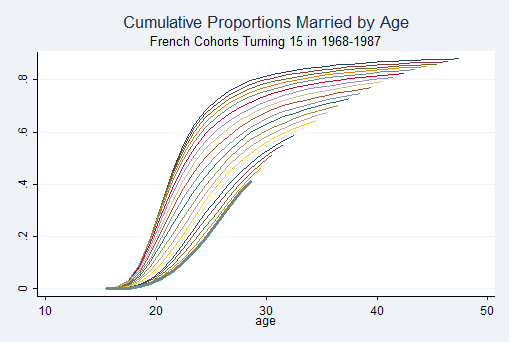
This graphic shows the age at which successive cohorts of French women are marrying.  Along the bottom of the graphic, the thick grey line represents women who were age 15 in 1987 (the oldest at the end of data collection is a little less than 30, which is why the line stops).  Each line above that represents an earlier cohort of women.  The data shows that, while the earliest cohorts largely married in their early 20s, with just a few stragglers.  The younger cohorts increasingly spread out the typical age of marriage.  It takes nearly 15 years for the most recent cohort to have married off the same proportion of women that were married in the older cohort in the five years between 15 and 20.

proportions_married_by_age

This image was borrowed from a new Contexts blog called Graphic Sociology.  Check it out.

Citation: German Rodriguez (2006) Office of Population Research, Princeton University. Problem Set 4: Marriage in France.  Research Methods in Demography.