Search results for The

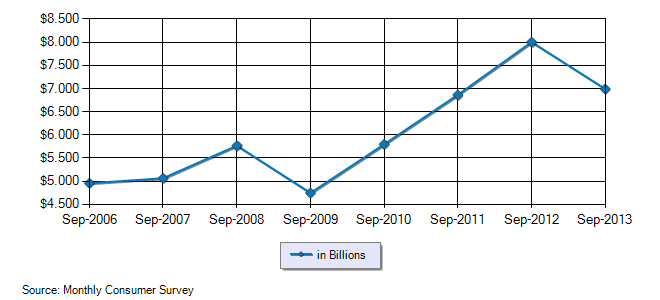
The National Retail Federation estimates that Americans will spend $7.4 billion dollars celebrating Halloween this year. In total, 74% of households will buy something for Halloween and, among those, the average will spend $125.
2

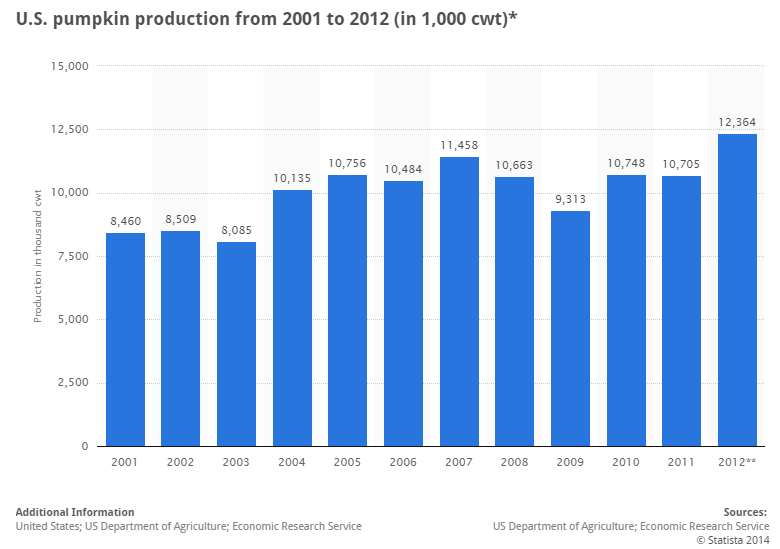
There’ll be a bumper crop of pumpkins, more than ever before, and worth about $149 million dollars.
4

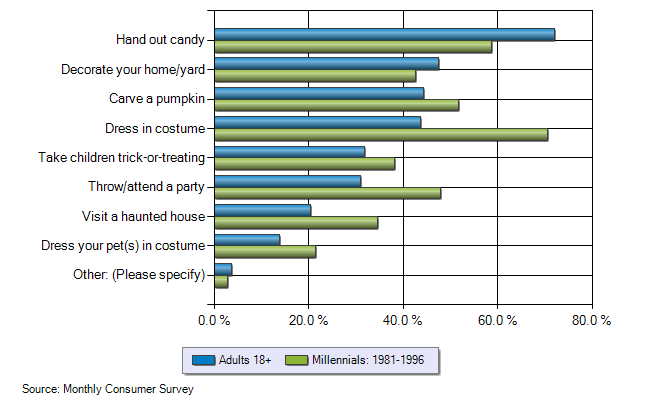
A full two-thirds of the population will buy a costume, spending an average of $77.52 each. That’s a record in terms of both spending and the sheer number of costumes sold.
3

Interestingly, the holiday has evolved from primarily a children’s holiday to one celebrated by adults, especially millenials. Less than half of the money spent on costumes is going to costumes for children. Adults dress up (to the tune of $1.4 million) and their dress up their pets ($350 million). They also throw parties for other adults and patronize bars and clubs, which increasingly feature Halloween-themed events, food, and drinks.

Lisa Wade, PhD is an Associate Professor at Tulane University. She is the author of American Hookup, a book about college sexual culture; a textbook about gender; and a forthcoming introductory text: Terrible Magnificent Sociology. You can follow her on Twitter and Instagram.
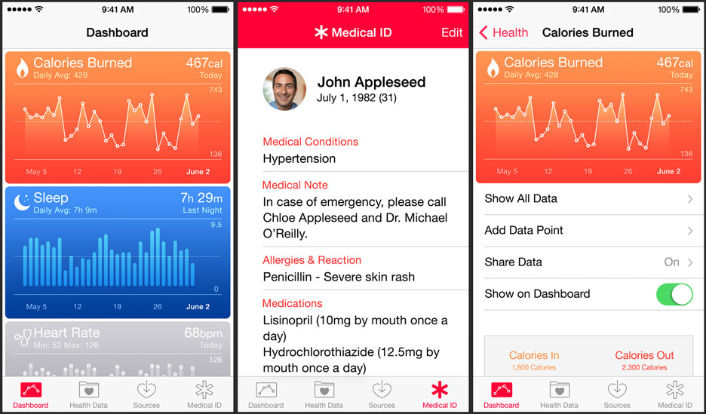
In truth, I didn’t pay a tremendous amount of attention to iOS8 until a post scrolled by on my Tumblr feed, which disturbed me a good deal: The new iteration of Apple’s OS included “Health”, an app that – among many other things – contains a weight tracker and a calorie counter.

And can’t be deleted.

1 (3) - Copy

Okay, so why is this a big deal? Pretty much all “health” apps include those features. I have one (third-party). A lot of people have one. They can be very useful. Apple sticking non-removable apps into its OS is annoying, but why would it be something worth getting up in arms over? This is where it becomes a bit difficult to explain, and where you’re likely to encounter two kinds of people (somewhat oversimplified, but go with me here). One group will react with mild bafflement. The other will immediately understand what’s at stake.

The Health app is literally dangerous, specifically to people dealing with/in recovery from eating disorders and related obsessive-compulsive behaviors. Obsessive weight tracking and calorie counting are classic symptoms. These disorders literally kill people. A lot of people. Apple’s Health app is an enabler of this behavior, a temptation to fall back into self-destructive habits. The fact that it can’t be deleted makes it worse by orders of magnitude.

So why can’t people just not use it? Why not just hide it? That’s not how obsessive-compulsive behavior works. One of the nastiest things about OCD symptoms – and one of the most difficult to understand for people who haven’t experienced them – is the fact that a brain with this kind of chemical imbalance can and will make you do things you don’t want to do. That’s what “compulsive” means. Things you know you shouldn’t do, that will hurt you. When it’s at its worst it’s almost impossible to fight, and it’s painful and frightening. I don’t deal with disordered eating, but my messed-up neurochemistry has forced me to do things I desperately didn’t want to do, things that damaged me. The very presence of this app on a device is a very real threat (from post linked above):

Whilst of course the app cannot force you to use it, it cannot be deleted, so will be present within your apps and can be a source of feelings of temptation to record numbers and of guilt and judgement for not using the app.

Apple doesn’t hate people with eating disorders. They probably weren’t thinking about people with eating disorders at all. That’s the problem.

Then this weekend another post caught my attention: The Health app doesn’t include the ability to track menstrual cycles, something that’s actually kind of important for the health of people who menstruate. Again: so? Apple thinks a number of other forms of incredibly specific tracking were important enough to include:

In case you’re wondering whether Health is only concerned with a few basics: Apple has predicted the need to input data about blood oxygen saturation, your daily molybdenum or pathogenic acid intake, cycling distance, number of times fallen and your electrodermal activity, but nothing to do with recording information about your menstrual cycle.

Again: Apple almost certainly doesn’t actively hate cisgender women, or anyone else who menstruates. They didn’t consider including a cycle tracker and then went “PFFT SCREW WOMEN.” They probably weren’t thinking about women at all.

During the design phase of this OS, half the world’s population was probably invisible. The specific needs of this half of the population were folded into an unspecified default. Which doesn’t – generally – menstruate.

I should note that – of course – third-party menstrual cycle tracking apps exist. But people have problems with these (problems I share), and it would have been nice if Apple had provided an escape from them:

There are already many apps designed for tracking periods, although many of my survey respondents mentioned that they’re too gendered (there were many complaints about colour schemes, needless ornamentation and twee language), difficult to use, too focused on conceiving, or not taking into account things that the respondents wanted to track.

Both of these problems are part of a larger design issue, and it’s one we’ve talked about before, more than once. The design of things – pretty much all things – reflects assumptions about what kind of people are going to be using the things, and how those people are going to use them. That means that design isn’t neutral. Design is a picture of inequality, of systems of power and domination both subtle and not. Apple didn’t consider what people with eating disorders might be dealing with; that’s ableism. Apple didn’t consider what menstruating women might need to do with a health app; that’s sexism.

The fact that the app cannot be removed is a further problem. For all intents and purposes, updating to a new OS is almost mandatory for users of Apple devices, at least eventually. Apple already has a kind of control over a device that’s a bit worrying, blurring the line between owner and user and threatening to replace one with the other. The Health app is a glimpse of a kind of well-meaning but ultimately harmful paternalist approach to design: We know what you need, what you want; we know what’s best. We don’t need to give you control over this. We know what we’re doing.

This isn’t just about failure of the imagination. This is about social power. And it’s troubling.

Sarah Wanenchak is a PhD student at the University of Maryland, College Park. Her current research focuses on contentious politics and communications technology in a global context, particularly the role of emotion mediated by technology as a mobilizing force. She blogs at Cyborgology, where this post originally appearedand you can follow her at @dynamicsymmetry.

For those of us in favor of same-sex marriage rights, it’s been an exciting few years. Politicians and legislatures have been increasingly tipping toward marriage equality. Lots of us are commending the powerful and high-profile individuals who have decided to support the cause.

But, let’s not be too grateful.

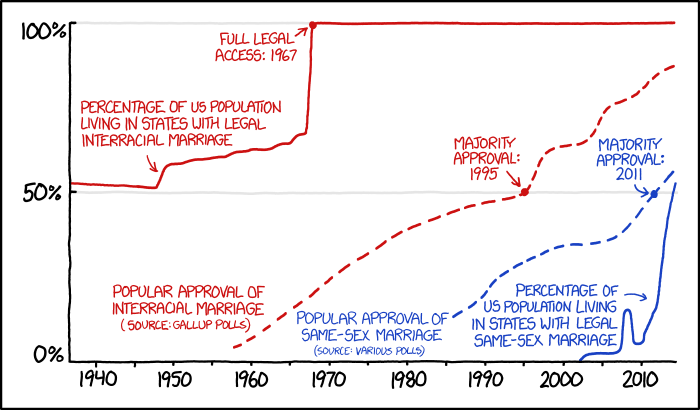
A figure at xkcd puts this in perspective. It traces four pieces of data over time: popular approval and legalization of both interracial marriage and same-sex marriage. It shows that the state-by-state legalization of same-sex marriage is following public opinion, whereas the legalization of interracial marriage led public opinion.

2

There’s a reason that we look back at Civil Rights legislation and see leadership. Politicians, litigators, and activists were pushing for rights that the public wasn’t necessarily ready to extend. In comparison, today’s power brokers appear to be following public opinion, changing their mind because the wind is suddenly blowing a new way.

I’m sure there are politicians out there taking risks at the local level. On the whole, though, this doesn’t look like leadership, it looks like political expedience.

Cross-posted at Pacific Standard.

Lisa Wade, PhD is an Associate Professor at Tulane University. She is the author of American Hookup, a book about college sexual culture; a textbook about gender; and a forthcoming introductory text: Terrible Magnificent Sociology. You can follow her on Twitter and Instagram.
Flashback Friday.

While preparing a lecture on sex tourism, I ran across this video about men who have sex with female tourists in the Caribbean:

There’s a lot of interesting stuff going on there, no? I was fascinated by the female hotel owner who talks about the men “preying” on the female tourists, clearly placing the power in the hands the men who, she argues, use the female tourists for money but don’t really care about them. I tried to imagine someone talking similarly about female sex workers “preying” on foreign men’s need for affection and attention.

This might make for a great discussion about perceptions of sexual agency: how do gendered sexual norms, economic differences, and the different races and nationalities of the individuals involved affect how we think of their interactions and who we see as the victim?

In her chapter on sex tourism in Race, Ethnicity, and Sexuality), sociologist Joane Nagel discusses the role of racialized sexualities in making some groups attractive tourists looking for an ethnosexual adventure. In the Caribbean, dark-skinned men with dreads are particularly attractive to some female tourists because of stereotypes of Black men as extremely sexual and masculine, which plays into fantasies of being swept away by a strong, skilled lover. At the same time, White Western women may represent the possibility of a better life (through continued gifts of money even after the vacation is over) and sexualized adventures to the men they sleep with while on vacation. Nagel argues that these encounters generally reinforce, rather than challenge, existing racial and gender inequalities, since they play on stereotypes of sexualized Others as animalistic, primitive, and, in the case of men, as super-masculine (and super-endowed).

Then again, Nagel also questions whether any relationship between tourists and “local” men should count as sex work. The individuals involved don’t necessarily think of their interactions in those terms. And who is to decide if a particular situation is “sex tourism” as opposed to a “real” relationship? How does that assumption invalidate the possibility that Black men and White women might have real, meaningful relationships? Or primarily sexual relationships, but with both partners respecting the other?

Originally posted in 2009.

Gwen Sharp is an associate professor of sociology at Nevada State College. You can follow her on Twitter at @gwensharpnv.

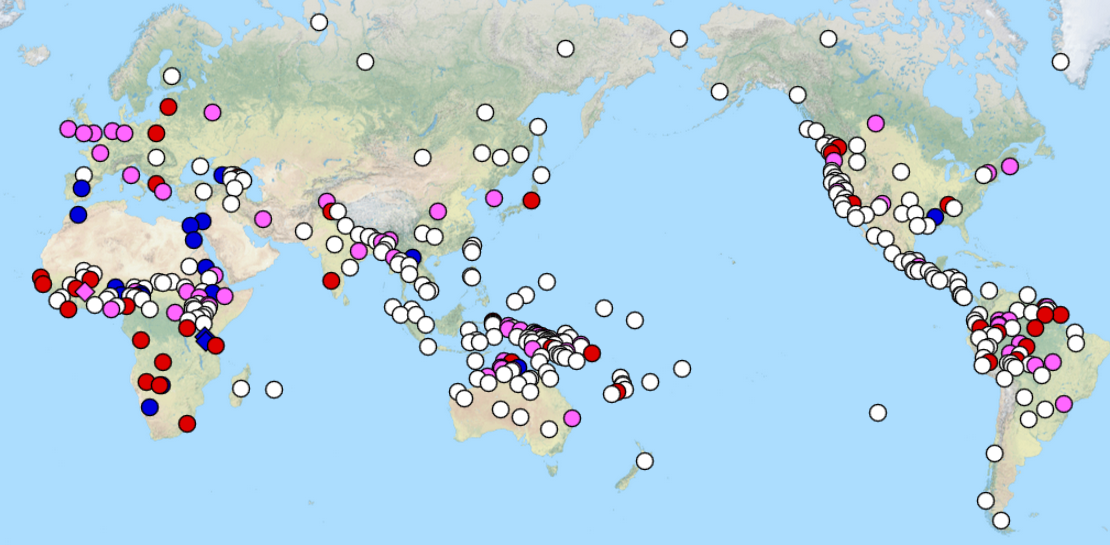
The map below is an interactive available at the World Atlas of Language Structures.  It represents an extensive, but not quite comprehensive collection of world languages. Each dot represents one. White dots are languages that do not include gendered pronouns. No “he” or “she.” Just a gender neutral word that means person.

2

The colored dots refer to languages with gendered pronouns, but there are more than one kind, as indicated by the Values key. The number on the right, further, indicates how many languages fit into each group. Notice that the majority of languages represented here (57%) DO NOT have gendered pronouns.

3The map at the site is interactive. Go there to click on those dots and explore.

Lisa Wade, PhD is an Associate Professor at Tulane University. She is the author of American Hookup, a book about college sexual culture; a textbook about gender; and a forthcoming introductory text: Terrible Magnificent Sociology. You can follow her on Twitter and Instagram.
I don’t yet have a copy of Matt Richtel’s new book, A Deadly Wandering: A Tale of Tragedy and Redemption in the Age of Attention. Based on his Pulitzer-prize winning reporting for the New York Times, however, I’m afraid it’s unlikely to do justice to the complexity of the relationship between mobile phones and motor vehicle accidents. Worse, I fear it distracts attention from the most important cause of traffic fatalities: driving.

A bad sign

The other day Richtel tweeted a link to this old news article that claims texting causes more fatal accidents for teens than alcohol. The article says some researcher estimates “more than 3,000 annual teen deaths from texting,” but there is no reference to a study or any source for the data used to make the estimate. As I previously noted, that’s not plausible.

In fact, only 2,823 teens teens died in motor vehicle accidents in 2012 (only 2,228 of whom were vehicle occupants). So, I get 7.7 teens per day dying in motor vehicle accidents, regardless of the cause. I’m no Pulitzer-prize winning New York Times journalist, but I reckon that makes this giant factoid on Richtel’s website wrong, which doesn’t bode well for the book:

1 (2)

In fact, I suspect the 11-per-day meme comes from Mother Jones (or someone they got it from) doing the math wrong on that Newsdaynumber of 3,000 per year and calling it “nearly a dozen” (3,000 is 8.2 per day). And if you Google around looking for this 11-per day statistic, you find sites like textinganddrivingsafety.com, which, like Richtel does in his website video, attributes the statistic to the “Institute for Highway Safety.” I think they mean the Insurance Institute for Highway Safety, which is the source I used for the 2,823 number above. (The fact that he gets the name wrong suggests he got the statistic second-hand.) IIHS has an extensive page of facts on distracted driving, which doesn’t have any fact like this (they actually express skepticism about inflated claims of cellphone effects).

After I contacted him to complain about that 11-teens-per-day statistic, Richtel pointed out that the page I linked to is run by his publisher, not him, and that he had asked them to “deal with that stat.” I now see that the page includes a footnote that says, “Statistic taken from the Insurance Institute for Highway Safety’s Fatality Facts.” I don’t think that’s true, however, since the “Fatality Facts” page for teenagers still shows 2,228 teens (passengers and drivers) killed in 2012. Richtel added in his email to me:

As I’ve written in previous writings, the cell phone industry also takes your position that fatality rates have fallen. It’s a fair question. Many safety advocates point to air bags, anti-lock brakes and wider roads — billions spent on safety — driving down accident rates (although accidents per miles driven is more complex). These advocates say that accidents would’ve fallen far faster without mobile phones and texting. And they point out that rates have fallen far faster in other countries (deaths per 100,000 drivers) that have tougher laws. In fact, the U.S. rates, they say, have fallen less far than most other countries. Thank you for your thoughtful commentary on this. I think it’s a worthy issue for conversation.

I appreciate his response. Now I’ll read the book before complaining about him any more.

The shocking truth

I generally oppose scare-mongering manipulations of data that take advantage of common ignorance. The people selling mobile-phone panic don’t dwell on the fact that the roads are getting safer and safer, and just let you go on assuming they’re getting more and more dangerous. I reviewed all that here, showing the increase in mobile phone subscriptions relative to the decline in traffic accidents, injuries, and deaths.

That doesn’t mean texting and driving isn’t dangerous. I’m sure it is. Cell phone bans may be a good idea, although the evidence that they save lives is mixed. But the overall situation is surely more complicated than TEXTING-WHILE-DRIVING EPIDEMIC suggests. The whole story doesn’t seem right — how can phones be so dangerous, and growing more and more pervasive, while accidents and injuries fall? At the very least, a powerful part of the explanation is being left out. (I wonder if phones displace other distractions, like eating and putting on makeup; or if some people drive more cautiously while they’re using their phones, to compensate for their distraction; or if distracted phone users were simply the worst drivers already.)

Beyond the general complaint about misleading people and abusing our ignorance, however, the texting scare distracts us (I know, it’s ironic) from the giant problem staring us in the face: our addiction to private vehicles itself costs thousands of lives a year (not including the environmental effects).

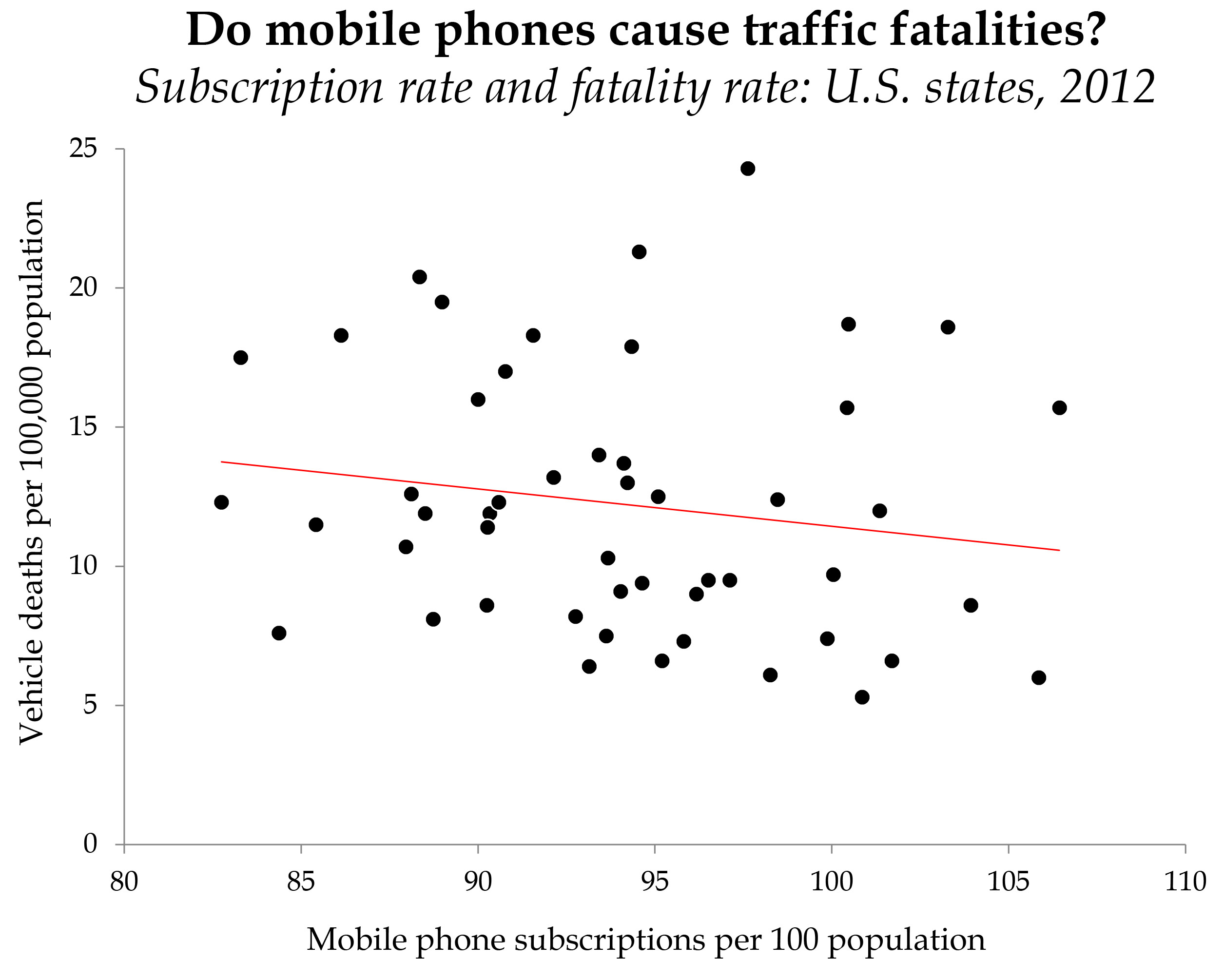
To illustrate this, I went through all the trouble of getting data on mobile phone subscriptions by state, to compare with state traffic fatality rates, only to find this: nothing:

cellphones traffic deaths with NEJM.xlsx

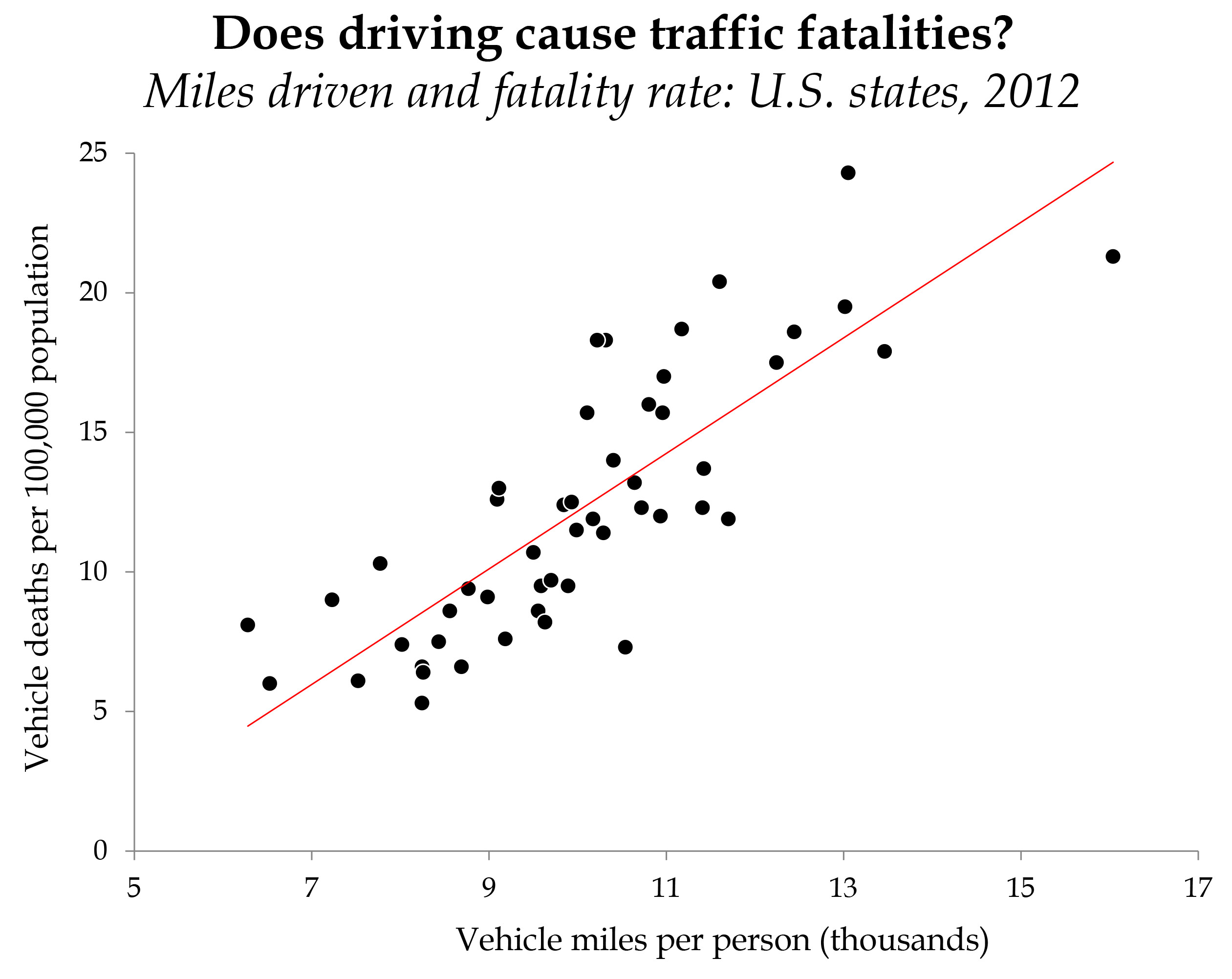
What does predict deaths? Driving. This isn’t a joke. Sometimes the obvious answer is obvious because it’s the answer:

cellphones traffic deaths with NEJM.xlsx

If you’re interested, I also put both of these variables in a regression, along with age and sex composition of the states, and the percentage of employed people who drive to work. Only the miles and drive-to-work rates were correlated with vehicle deaths. Mobile phone subscriptions had no effect at all.

Also, pickups?

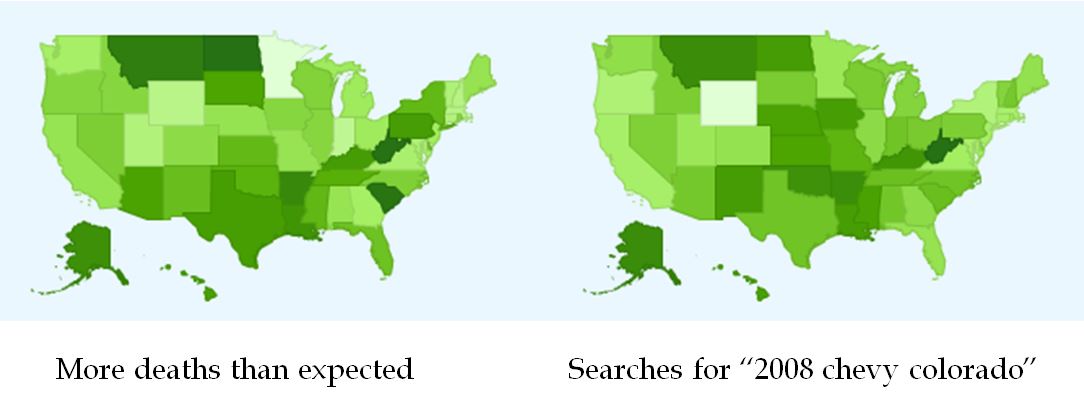
Failing to find a demographic predictor that accounts for any of the variation after that explained by miles driven, I tried one more thing. I calculated each state’s deviation from the line predicted by miles driven (for example Alaska, where they only drive 6.3 thousand miles per person, is predicted to have 4.5 deaths per 100,000 but they actually have 8.1, putting that state 3.6 points above the line). Taking those numbers and pouring them into the Google correlate tool, I asked what people in those states with higher-than-expected death rates are searching for. And the leading answer is large, American pickup trucks. Among the 100 searches most correlated with this variable, 10 were about Chevy, Dodge, or Ford pickup trucks, like “2008 chevy colorado” (r = .68), shown here:

1 (4) - Copy

I could think of several reasons why places where people are into pickup trucks have more than their predicted share of fatal accidents.

So, to sum up: texting while driving is dangerous and getting more common as driving is getting safer, but driving still kills thousands of Americans every year, making it the umbrella social problem under which texting may be one contributing factor.

I used this analogy before, and the parallel isn’t perfect, but the texting panic reminds me of the 1970s “Crying Indian” ad I used to see when I was watching Saturday morning cartoons. The ad famously pivoted from industrial pollution to littering in the climactic final seconds:

Conclusion: Keep your eye on the ball.

Philip N. Cohen is a professor of sociology at the University of Maryland, College Park, and writes the blog Family Inequality. You can follow him on Twitter or Facebook.

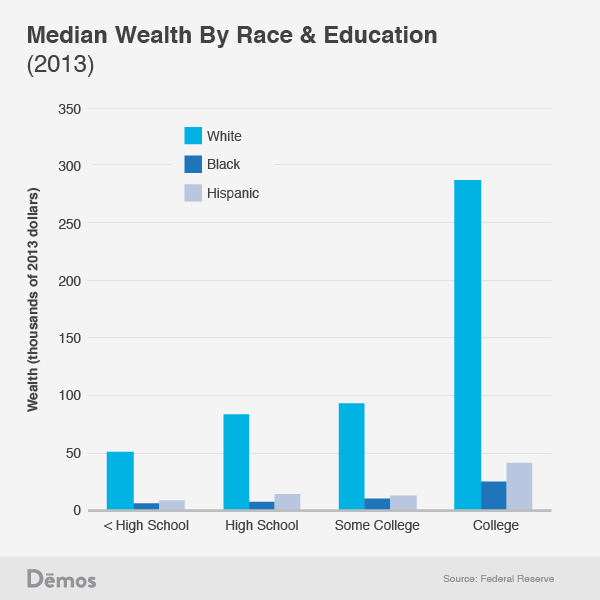
Here’s a doozy in the theme of the racial wealth gap: households headed by white people who dropped out of high school have greater assets than those headed by blacks and Latinos with college degrees.

2

At Demos, where Matt Bruenig posted this graph, he writes:

The median white family with an education level below high school has a net worth of $51.3k, while the median black and hispanic family with a college degree has a net worth of $25.9k and $41k respectively.

You’re better off being a white high school dropout than a black or Latino college grad. Ouch.

Lisa Wade, PhD is an Associate Professor at Tulane University. She is the author of American Hookup, a book about college sexual culture; a textbook about gender; and a forthcoming introductory text: Terrible Magnificent Sociology. You can follow her on Twitter and Instagram.

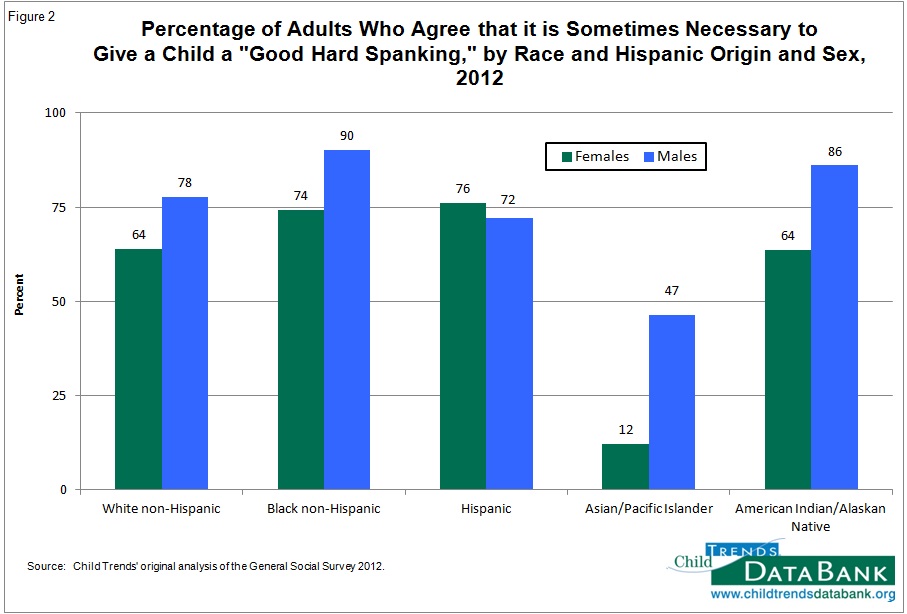
Football fans like me have undoubtedly heard about the indictment of Adrian Peterson on child abuse charges for striking his 4-year-old son with a thin tree branch. Pictures revealing multiple lacerations on the child’s thigh have surfaced, and exchanges regarding another of his children show Peterson has used physical discipline more than once. The case has further ignited intense debates about the use of corporal punishment. While many of us may recoil at pictures and wonder how an adult could inflict physical harm on a child, views of corporal punishment are not uniform. They have changed over time and vary by racial group.

Take American attitudes about spanking over the past 50 years. In 1968, 94% of American adults approved of spanking a child, but by 2012, the figure dropped to 70%. While the majority of American parents still spank their children, some are more likely to spank than others. According a recent study of 20,000 kindergartners and their parents, black parents are the most likely to spank their children (89%) and Asian parents, least likely (73%). White and Hispanic parents fell in between, at 79% and 80%, respectively.

1 (2)

That Asian parents are less likely to use corporal punishment has led to speculation that there must be something unique about East Asian culture that promotes discipline without relying on physical force.

If this were the case, we would expect to see corporal punishment banned in East Asian countries, since national bans on corporal punishment reflect cultural norms and are associated with a decline in its support and reported use. Currently, 24 countries have banned corporal punishment; nineteen are in Europe. There are no national bans in Asia.

That no Asian country has banned the use of corporal punishment and that it remains an accepted form of discipline reveal that differences in the use of corporal punishment cannot be attributed to culture alone.

So how do we explain the differences across racial groups? Parental education and socioeconomic status are stronger drivers of parenting strategies than differences in race or culture. Highly educated, middle-class parents are less likely to use corporal punishment to discipline their children than less-educated, working-class, and poor parents. Asian Americans are, on average, more highly educated than other Americans, including whites.

This is a result of the hyper-selectivity of Asian immigration from countries like India, China, and Korea, in which immigrants from these countries are not only more highly educated than their counterparts who did not immigrate, but are also more highly educated than the general U.S. population. Hence, Asian immigrants are not a random sample of all Asians. Rather, they represent a highly educated subgroup, which explains why they are the least likely to use physical force to discipline their children.

In my research with Min Zhou, we interviewed the adult children of Chinese and Vietnamese immigrants in Los Angeles about their experiences of growing up American. As expected, those with more highly educated parents were more likely to have been disciplined with socioemotional strategies. Rather than use physical force, their parents would verbally express their disappointment or give a stern facial cue that signaled their disapproval.

Moreover, these parents praised the positive behavior of other children, both in front of their children and in front of other parents and children. By lauding positive behavior privately and publicly, these parents indirectly reinforced their expectations and provided concrete role models for their children to emulate. This dual socioemotional strategy of internal disapproval and external praise provided their children with a clear-cut portrait of model behavior, in spite intergenerational and linguistic differences between immigrant parents and their U.S.-born children. While the second-generation Chinese and Vietnamese admitted that the constant comparisons were “irritating,” they acknowledged that their parents provided a clear signal of what behavior to follow.

Still, some of our interviewees admitted experiencing physical abuse that would rival that experienced by Adrian Peterson’s young son. In fact, some told us the abuse continued into their teenage years and stemmed from severe intergenerational conflicts that exploded over which college a child should attend or what career trajectory he or she should follow.

A third group of parents took socioemotional strategies to an extreme, telling their children that they were so disappointed that they could not face other parents. They were just that embarrassed about their child’s behavior or lack of accomplishments. So, the use of socioemotional strategies may help reinforce certain positive behaviors, but used carelessly or as a manipulation, it can leave children feeling just as powerless and despondent as any physical punishment.

Jennifer Lee, PhD, is a sociologist at the University of California, Irvine. Her book, The Diversity Paradox, examines patterns of intermarriage and multiracial identification among Asians, Latinos, and African Americans.  

Cross-posted at The Society Pages Specials.