Search results for The

Breast Cancer-Themed Pink Sexy Leopard-ish Costume Blows Our Mind » Sociological ImagesSocial Psychology

Inequality and Breast Cancer Care

Pinkwashing

Sexual Objectification in Breast Cancer Awareness

Breast Cancer and the Social Construction of Gender

Simply Absurd

Lisa Wade, PhD is an Associate Professor at Tulane University. She is the author of American Hookup, a book about college sexual culture; a textbook about gender; and a forthcoming introductory text: Terrible Magnificent Sociology. You can follow her on Twitter and Instagram.
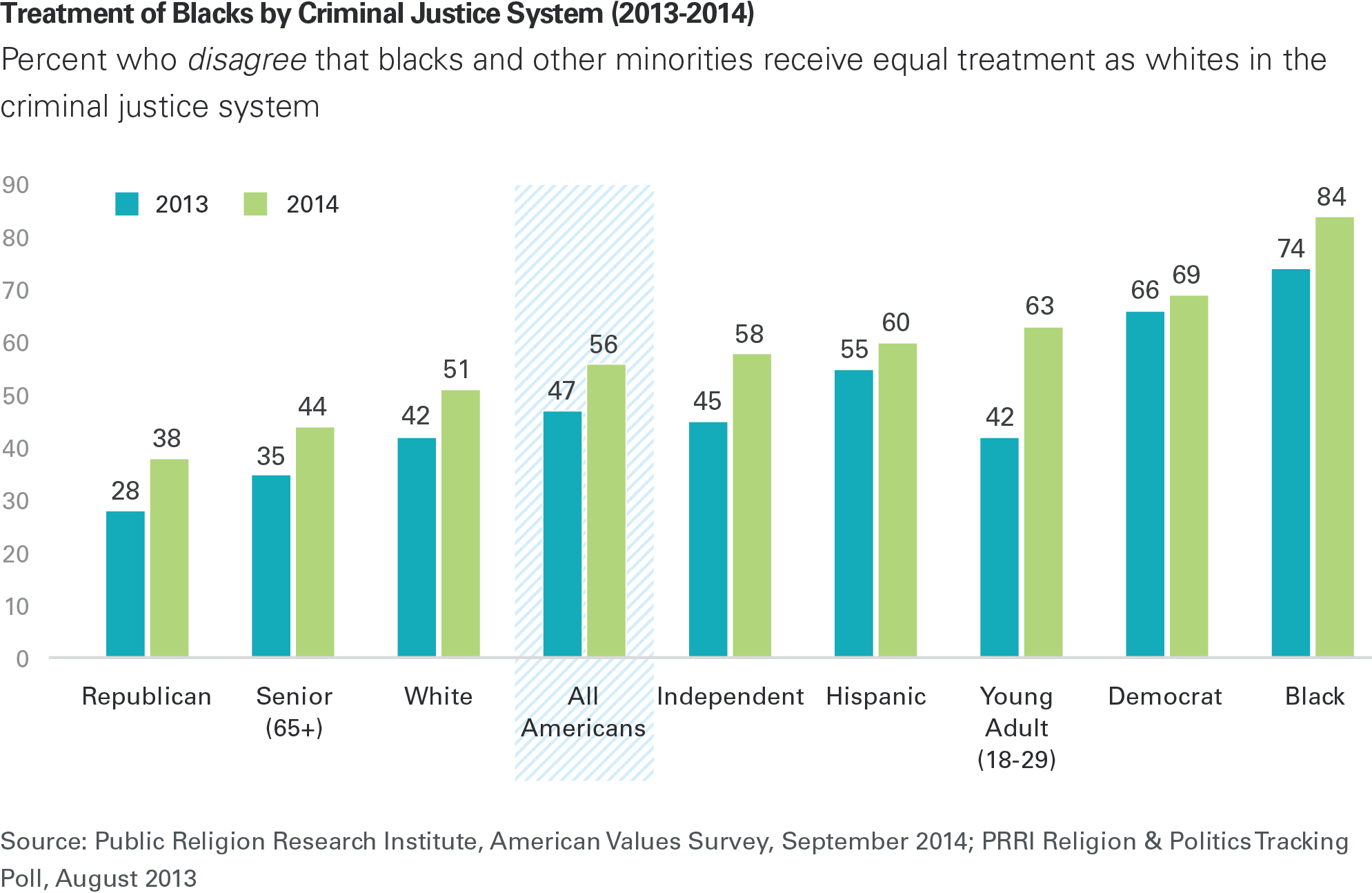
According to polling by the Public Religion Research Institute, the percent of American who say that the criminal justice system treats black people unfairly rose by 9 percentage points in just one year.  In fact, every category of person polled was more likely to think so in 2014 than in 2013, including Republicans, people over 65, and whites.

The biggest jump was among young people 18-29, 63% of whom believed the criminal justice system was unfair in 2014, compared to 42% in 2016.  The smallest jump was among Democrats — just 3 percentage points — but they mostly thought the system was jacked to begin with.

2

America has a history of making changes once police violence is caught on tape and shared widely. One of the first instances was after police attacked peaceful Civil Rights marchers in Selma, Alabama. The television had just become a ubiquitous appliance and the disturbing images of brutality were hard to ignore when they flashed across living rooms.

The death of Mike Brown in Ferguson, MO, and the aftermath is the likely candidate for this change. If you do a quick Google Image search for the word “ferguson,” the dominant visual story of that conflict seems solidly on the side of the protesters, not the police.

Click to see these images larger and judge for yourself:

2

H/t @seanmcelwee.

Lisa Wade, PhD is an Associate Professor at Tulane University. She is the author of American Hookup, a book about college sexual culture; a textbook about gender; and a forthcoming introductory text: Terrible Magnificent Sociology. You can follow her on Twitter and Instagram.

The graph below represents the share of the income growth that went to the richest 10% of Americans in ten different economic recoveries.  The chart comes from economist Pavlina Tcherneva.

1 (2)

It’s quite clear from the far right blue and red columns that the top 10% have captured 100% of the income gains in the most recent economic “recovery,” while the bottom 90% have seen a decline in incomes even post-recession.

It’s also quite clear that the economic benefits of recoveries haven’t always gone to the rich, but that they have done so increasingly so over time. None of this is inevitable; change our economic policies, change the numbers.

Via Andrew Sullivan.

Lisa Wade, PhD is an Associate Professor at Tulane University. She is the author of American Hookup, a book about college sexual culture; a textbook about gender; and a forthcoming introductory text: Terrible Magnificent Sociology. You can follow her on Twitter and Instagram.

Flashback Friday.

p10100814

Flipping through Safari magazine, something that struck me as odd.  Because the magazine is aimed, primarily, at selling hunting safaris, the vast majority of the pictures were people posing with their kills.

What I noticed was that, in nearly 100 percent of the pictures, the animals were posed so as to look alive: resting or sleeping. Most often, the animal was on its belly with its legs folded naturally beneath it and, even, its head held or propped up. The hunters posed behind the animal, often with a hand on it, as if they were simply petting the animal.  Further, there was almost never any evidence of the wound: no holes, no blood (though sometimes the weapon is included in the picture). It is almost as if the people are at a petting zoo and the animal is blissfully enjoying the human attention. A more systematic analysis of hunting magazines found the same pattern.

Imagine for a minute how challenging this must be to pull off.  If you shoot an animal, it likely falls into any number of positions, many of which make it look like it’s just been shot (legs akimbo, head at an awkward angle, etc).  The hunter and his or her companions must have to wrangle this 500, 1,000, 1,500 pound dead weight into the position in which it appears in the images.

Why do they do it?

I don’t know. But maybe it has something to do with the relationship to nature that hunter culture endorses.  Instead of a destructive, violent relationship to nature that would be represented by picturing animals in their death poses, these pictures suggest a custodial relationship in which humans take care of or chaperone a nature to which they feel tenderly.

That is, they don’t destroy nature with their guns, they tame it.

Originally posted in 2009.

Lisa Wade, PhD is an Associate Professor at Tulane University. She is the author of American Hookup, a book about college sexual culture; a textbook about gender; and a forthcoming introductory text: Terrible Magnificent Sociology. You can follow her on Twitter and Instagram.

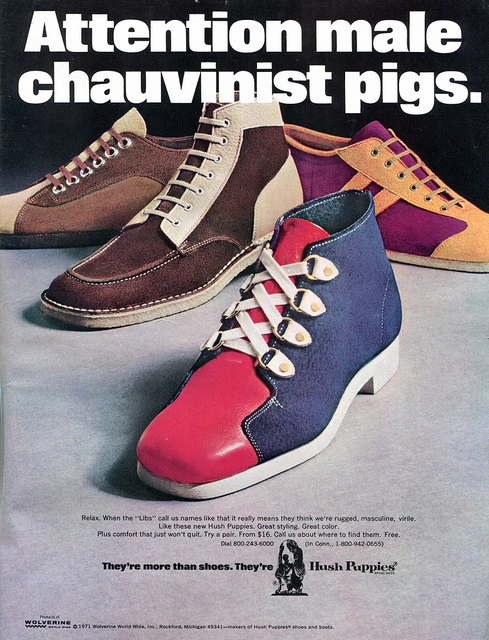
When you hear the phrase Hush Puppies, think of basset hounds, and see these shoes, do you think “rugged, masculine, virile”? Because that’s what the copy says. In fact, this ad argues that wearing these shoes might make a women’s rights advocate call you a male chauvinist pig because they’re that masculine.

2

If this isn’t evidence of the fact that masculinity is socially constructed and changes over time, I don’t know what is.

Found at Vintage Ads.

Lisa Wade, PhD is an Associate Professor at Tulane University. She is the author of American Hookup, a book about college sexual culture; a textbook about gender; and a forthcoming introductory text: Terrible Magnificent Sociology. You can follow her on Twitter and Instagram.
In the Yunnan and Sichuan provinces of China lives a small ethnic group called the Mosuo. Among the Mosuo, romantic and family life are separated into different spheres by design. Children are usually raised in the home of their maternal grandmother with the help of their mother. She may maintain a long-term, monogamous romantic relationship with the father but, unlike in the West, this is considered separate from her role as a mother.

The role of the biological father is discretionary.  There is no word in their language, in fact, for husband or father.  A father is allowed, but not required to provide financial support and he is usually permitted to visit the mother and their child(ren) only at night. They call it “Axia” or “Walking Marriage.” The children’s primary male role models are usually their uncles, who remain under the authority of the children’s grandmother as they live under her roof.

From the Mosuo point of view, separating marriage from the raising of children ensures that the vagaries of romance do not disrupt the happiness and health of the child and its mother. Nor can the father wield power over the mother by threatening to withdraw from the marriage. Meanwhile, because the family of origin is never eclipsed by a procreative family, the Mosuo system reduces the likelihood that elders will be abandoned by their families when they need support in old age.

“Think about it,” writes an expert at Mosuo Project.

Divorce is a non-issue…there are no questions over child custody (the child belongs to the mother’s family), splitting of property (property is never shared), etc. If a parent dies, there is still a large extended family to provide care.

This way of organizing families is an excellent refutation of the hegemonic view that children need the biological father to live under their roof (and by implication, to be their patriarch). You can learn more about the Mosuo in the documentaries The Women’s Kingdom and The Mosuo Sisters.

Dr. Jonathan Harrison earned a PhD in Sociology from the University of Leicester, UK. His research interests include the Holocaust, comparative religion, racism, and the history of African Americans in Florida. He teaches at Florida Gulf Coast University and Hodges University. 

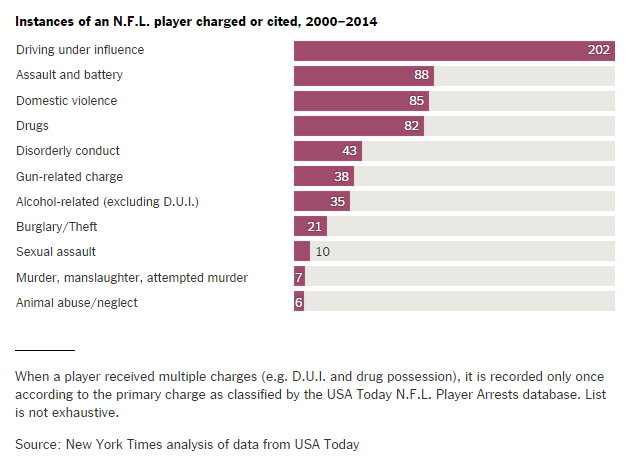
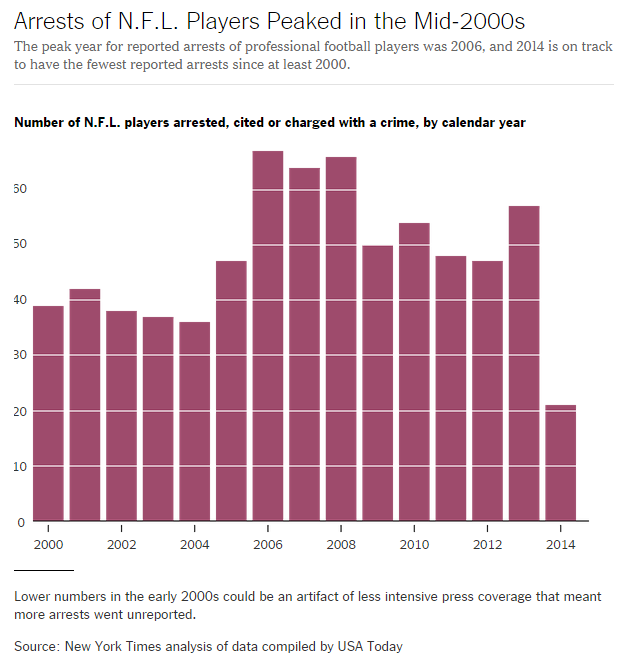
Ray Rice’s violent assault of Janay Palmer has placed a spotlight on the criminal records of professional football players more generally. It is tempting to presume that men who spend their lives perfecting the use of violence are more violent in their day-to-day lives, but we don’t have to speculate. We have some data.

USA Today maintains a database of charges, citations, and arrests of NFL players since 2000 (ones they found out about, in any case). According to their records, 2.53% of players are arrested in any given year. This is lower than the national average for men of the same age. And, despite the publicity, this year looks like it will be the least criminal on record.

2

Domestic violence is the third most common charge or cite, following closely behind another violent crime, assault and battery. But by far the most common trouble NFL players face is being charged with a DUI.

3

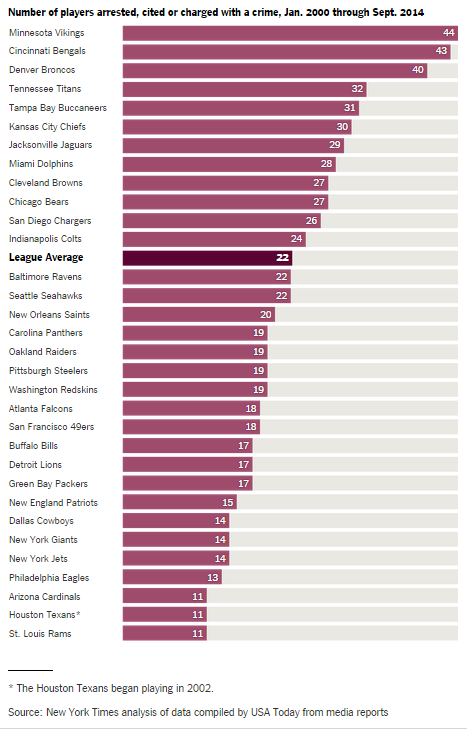
Interestingly, not all teams have similar rates of arrests, charges, or cites. These data below reflect 15 years of data, showing the wide disparity among teams. The number of run-ins with police tend to correlate well year-to-year, so this chart represents a stable trend.

4

Neil Irwin, writing at the New York Times, says that varying levels of criminal activity may be related to club culture (that is, some franchise’s may be better at suppressing or inciting criminal activity than others) or it may be influenced by the cities they play for (e.g., there won’t be as many DUIs in cities like New York City where there’s substantially less driving). Both are great sociological explanations for the variation between teams and consistency across seasons.

Lisa Wade, PhD is an Associate Professor at Tulane University. She is the author of American Hookup, a book about college sexual culture; a textbook about gender; and a forthcoming introductory text: Terrible Magnificent Sociology. You can follow her on Twitter and Instagram.
One of the better things about social media is that if you manage to curate social feeds with just the right balance of entertaining spirits and brilliant intellects, it delivers unto you amazing content you would have otherwise missed.

I woke up one of these days — Sunday? Monday? I’m dissertating — to find dozens of messages from social media comrades about John Oliver’s take-down of for-profit colleges. You can watch it here:

It’s very satisfying.

It is particularly satisfying if you’ve experienced what education professor Kevin Kinser rightly points out is the oddly sporadic nature of public interest in a 100 year old institutional practice of selling education for profit. Oliver is one of the best in the entertainment-as-news genre. He reaches people that mainstream media does not. He makes difficult issues palatable for general, concerned audiences.

And if you think about debt, precarity, credentialism, and financial cronyism, like I do, it is gratifying to see someone like Oliver take on an issue most people could care less about until someone they care about borrows $50,000 for a veterinary assistant’s degree. Then they’re emailing you like the roof is on fire.

I do have a greater hope, though, than that something I study benefit from the spotlight of people like Oliver.

I wish we could talk about impoverished educations without ignoring impoverished conditions.

Here’s the thing, for-profit colleges have manipulated a system primed for manipulation. No doubt about that. But eliminating for-profit colleges does not eliminate the conditions that cause people to seek them out.

By and large, none of the people I have interviewed, observed or worked with is an idiot without agency. They have sometimes been lied to and led astray; occasionally they are bamboozled by sparkly advertising and aggressive sales tactics. They do sign documents they do not completely understand and they trust authority that has little incentive to counsel as opposed to sell. All of that is true.

But most students picked up the phone to “call today; start tomorrow” because they have been unemployed, underemployed, marginalized, and otherwise made vulnerable by socio-economic conditions.

So, by all means, crib Oliver’s letter. It’s a doozy.

But maybe keep in mind that moving inequality around isn’t exactly the same as addressing inequality.

Tressie McMillan Cottom is a PhD candidate in the Sociology Department at Emory University in Atlanta, GA.  Her doctoral research is a comparative study of the expansion of for-profit colleges.  You can follow her on twitter and at her blog, where this post originally appeared.