Search results for The

Stokely Carmichael, later Kwame Ture, was an activist and Civil Rights leader, rising to prominence in the Student Nonviolent Coordinating Committee, the Black Panther Party, and the All-African Peoples Revolutionary Party.

He popularized the phrase “black power,” which he defined simply as “black people coming together to form a political force and either electing representatives or forcing their representatives to speak their needs.” 

Ture believed in the value of nonviolence as a tactic, but did not identify as a pacifist. Violence was a tactic he believed in, too, when it was necessary. And it has, in fact, been a successful tool in the activist toolkit. As Ta-Nehisi Coates writes at The Atlantic:

“Property damage and looting” — perhaps more than nonviolence — has also been a significant tool in black “social progress.” … [It’s] a fairly accurate description of the emancipation of black people in 1865, who only five years earlier constituted some $4 billion in property. The Civil Rights Bill of 1964 is inseparable from the threat of riots. The housing bill of 1968 — the most proactive civil-rights legislation on the books — is a direct response to the riots that swept American cities after King was killed. Violence, lingering on the outside, often backed nonviolence during the civil-rights movement.

What cannot be said is that America does not really believe in nonviolence… so much as it believes in order.

Black people may have to disrupt that order and return violence with violence, yet again. As Stokely Carmichael explains in the video below:

Existentialist philosophers talk about the executioner-victim relationship… The victims begin to fight and agitate for their liberation. They use all types of means to get their liberation… fighting for a position of equality.

After [the victim] tries a number of means and they do not work, he then begins to imitate the means by which his executioner has kept him down. That is usually through force and violence… breaking the one taboo that they’ve never been able to break: hitting back against the executioners.

So that you ought not to be upset if we are violent. The Unites States taught us very well how to be violent.

Watch him here:

As we live our lives increasingly in the digital realm, the sights, sounds, and moving images of the internet impact our conception of the world around us. Take, for example, the many online mapping services.  What began as simple tools to find driving directions have evolved into advanced applications that map multiple layers of data.

But who decides what we see? What features are considered sufficiently important to be included? And what information about our country do those design decisions make invisible?

Here’s the map of South Dakota provided by Google Maps. Notice that the many Indian reservations are unmarked and invisible.  If you scroll in, eventually the reservations appear. At the state level, though, they’re invisible.

3

In contrast, Indian reservations do show up on Bing:

4

Among the other map services, Yahoo! Maps and MapQuest do label Indian reservations while OpenStreetMap does not.

While these mapping tools certainly empower the individual, it is the designers and the developers behind them who hold the real power.  I can only speculate as to why Google Maps does not include reservations at the state level, but their decision impacts the way we understand (or don’t understand) the geographic and social reality of this country.

Stephen Bridenstine is pursuing a history masters degree at the University of British Columbia, where he studies popular attitudes and public memory concerning Indigenous peoples, the historic fur trade, and the natural environment. He blogs about non-Native America’s weird obsession with everything “Indian” at his blog Drawing on Indians, where this post originally appeared.

This post was updated to reflect 2014; it originally appeared on SocImages in 2011.

A four minute introduction to Marxism, featuring Super Mario Bros., by Wisecrack:

Lisa Wade, PhD is an Associate Professor at Tulane University. She is the author of American Hookup, a book about college sexual culture; a textbook about gender; and a forthcoming introductory text: Terrible Magnificent Sociology. You can follow her on Twitter and Instagram.

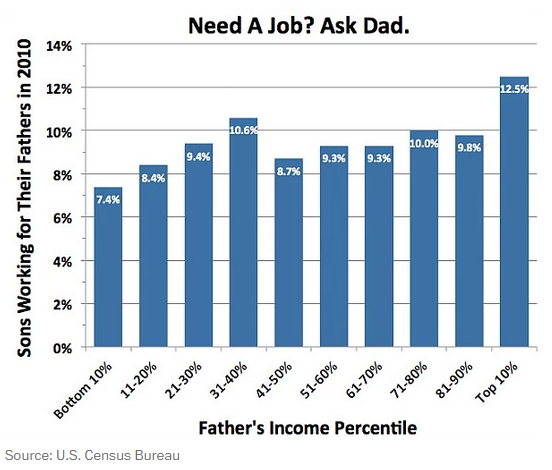
A new paper by Martha Stinson and Christopher Wignall found that 9.6% of working-age men were working for their dad in 2010. The likelihood of nepotistic opportunism was related to class, generally climbing with the father’s income.

2

This is just a “snapshot,” writes Matt O’Brien for The Washington Post. It’s just one year. If we consider whether men have ever worked for their dads, the numbers get much higher. More than a quarter of men spend at least some time working for the same company as their fathers before their 30th birthday. O’Brien also cites a study by economist Miles Corak revealing that 70% of sons of the 1% in Canada have worked at the same place as their dad.

As O’Brien says: “The easiest way to get your foot in the door is for your dad to hold it open for you.”

Cross-posted at Pacific Standard.

Lisa Wade, PhD is an Associate Professor at Tulane University. She is the author of American Hookup, a book about college sexual culture; a textbook about gender; and a forthcoming introductory text: Terrible Magnificent Sociology. You can follow her on Twitter and Instagram.

Flashback Friday.

In a great book, The Averaged American, sociologist Sarah Igo uses case studies to tell the intellectual history of statistics, polling, and sampling. The premise is fascinating:  Today we’re bombarded with statistics about the U.S. population, but this is a new development.  Before the science developed, the concept was elusive and the knowledge was impossible. In other words, before statistics, there was no “average American.”

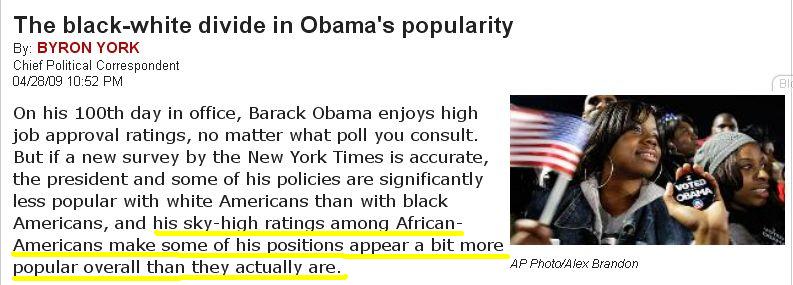
There are lots of fascinating insights in her book, but a post by Byron York brought one in particular to mind.  Here’s a screenshot of his opening lines (emphasis added by Jay Livingston):

00_actually

The implication here is, of course, that Black Americans aren’t “real” Americans and that including them in opinion poll data is literally skewing the results.

Scientists designed the famous Middletown study with exactly this mentality.  Trying to determine who the average American was, scientists excluded Black Americans out of hand.  Of course, that was in the 1920s and ’30s.  How wild to see the same mentality in the 2000s.

Originally posted in 2009.

Lisa Wade, PhD is an Associate Professor at Tulane University. She is the author of American Hookup, a book about college sexual culture; a textbook about gender; and a forthcoming introductory text: Terrible Magnificent Sociology. You can follow her on Twitter and Instagram.

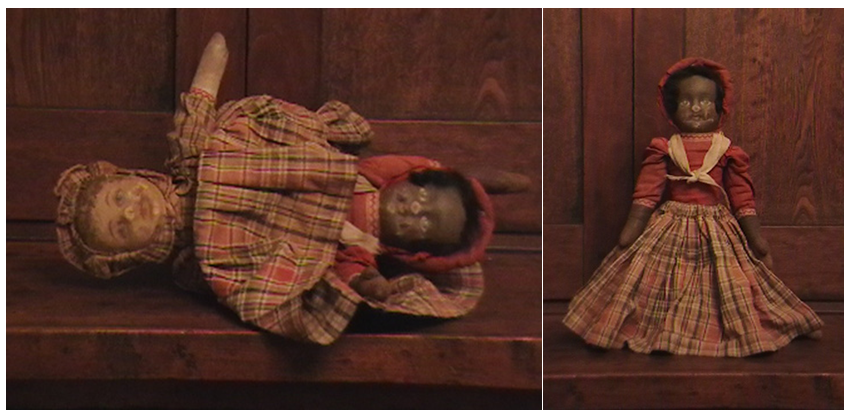
Lisa Hix has written a really nice story, “Why Black Dolls Matter,” for Collectors Weekly. The history of the topsy-turvy doll really caught my interest. The one below is characteristic. Believed to be from the 1870s, it is the head and torso of a black and a white doll, sewed together in the middle with a long skirt. The doll can be flipped from one side to the other.

2

The general consensus seems to be that these dolls were primarily for enslaved children, but the purpose of the dolls isn’t clearly understood.

Hix quotes one of the founders of the National Black Doll Museum, Debra Britt, who says that the dolls enabled enslave children to have something forbidden: a doll that looked like them. “When the slave master was gone,” she explained, “the kids would have the black side, but when the slave master was around, they would have the white side.”

At wikipedia, though, the entry for the dolls cites the author of American Folk Dolls, who makes the opposite claim.

It has recently been suggested that these dolls were often made for Black children who desired a forbidden white doll (a baby like the ones their mothers cared for); they would flip the doll to the black side when an overseer passed them at play.

Kimberly Wallace-Sanders, author of Mammy: A Century of Race, Gender, and Southern Memory, suggests that the dolls might not have been disallowed at all. Since enslaved black women often cared for their own children and the children of their white captors, perhaps the doll was designed to socialize young enslaved girls into their future roles as mothers to children of both races. According to Historical Folk Toys, the black doll sometimes was dressed in a headscarf and the white doll in antebellum-style dress, supporting Wallace-Sanders’ theory that the idea was to socialize girls into their role.

And, of course, we have even less of an idea of how the children themselves thought of these dolls or where their imagination led them.

Cross-posted at Pacific Standard.

Lisa Wade, PhD is an Associate Professor at Tulane University. She is the author of American Hookup, a book about college sexual culture; a textbook about gender; and a forthcoming introductory text: Terrible Magnificent Sociology. You can follow her on Twitter and Instagram.

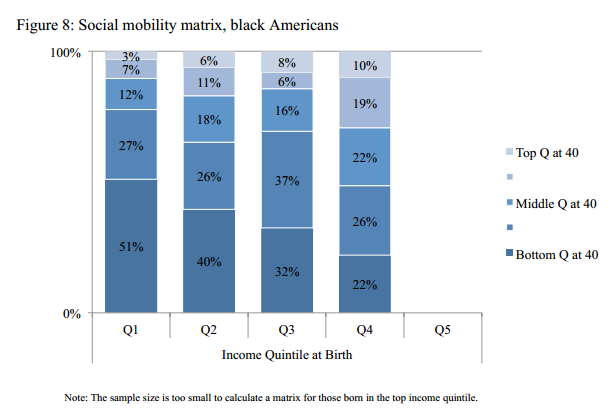
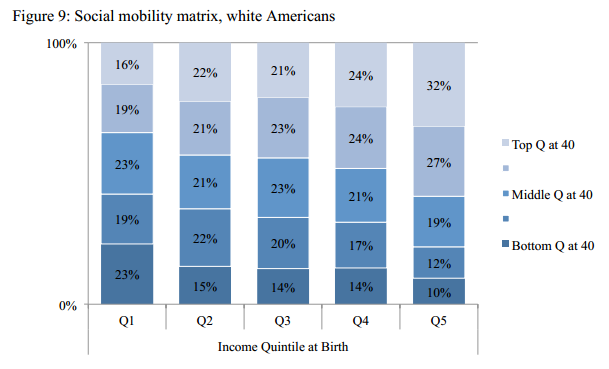
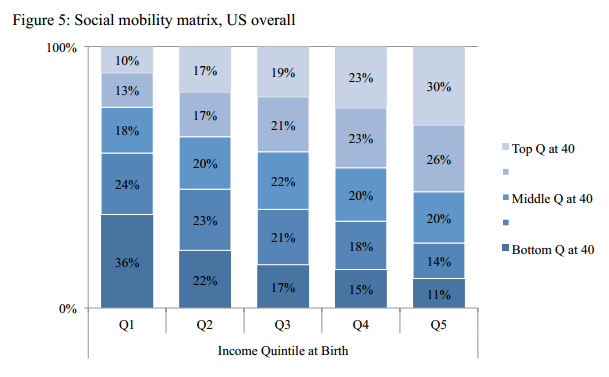
Social mobility refers to likelihood that a person born in one social class will end up in another as an adult. A new study by Richard Reeves and Isabel Sawhill for the Brookings Institute offered a devastating picture of the possibilities for black youth. To summarize: most black children see downward mobility and are poorer as adults than they were as children.

4More than half of black children born into the poorest 1/5th of households will remain there as adults. That’s only true for 36% of similarly-situated Americans overall. Poor black children, then, are less likely than Americans in general to be able to escape poverty.

Black children born into the middle class — literally the middle 5th of Americans as measured by household income — overwhelmingly see downward mobility. 16% will remain somewhere in the middle, 14% will be richer than their parents, and a whopping 69% will end up less economically stable. In comparison, only 38% of Americans, overall, born into the middle 5th see a decline in their status as adults.

As you may have noticed from the hole in the far right of the chart, the researchers didn’t have enough cases to even estimate outcomes for blacks born rich.

Below is the data for whites (first) and all Americans (second) for comparison:

32Here’s the first author, Richard Reeves, explaining social mobility, using Legos of course:

H/t Joe Feagin. Cross-posted at Pacific Standard.

Lisa Wade, PhD is an Associate Professor at Tulane University. She is the author of American Hookup, a book about college sexual culture; a textbook about gender; and a forthcoming introductory text: Terrible Magnificent Sociology. You can follow her on Twitter and Instagram.

Way back in 1996, sociologist Sharon Hays coined the phrase “the ideology of intensive motherhood.” She intended to draw attention to a new norm for mothering that involved, among other things, making children the center of one’s life and subordinating your own needs and wants to theirs.

I can’t help but think of Hays and her beleaguered mothers every time I see this commercial:

“When we’re having this much fun,” the voiceover says, “why quit?”

And I think, “No, seriously, quit it.”

But the mother in the ad doesn’t tell the kid to quit it. She beams. And then she gives the younger child his own glass of chocolate milk and claps as he learns how to blow bubbles in it.

Bounty glamorizes the clean-up work the mother has to do after her child blows his chocolate milk all over the kitchen table and floor. As if letting a child make an unnecessary mess is the most unselfish sign of love. It’s an excellent example of the ideology of intensive motherhood: everyone knows that this is going to be additional work for the mother, but the kids are having a good time and that’s what’s important.

Cross-posted at Pacific Standard.

Lisa Wade, PhD is an Associate Professor at Tulane University. She is the author of American Hookup, a book about college sexual culture; a textbook about gender; and a forthcoming introductory text: Terrible Magnificent Sociology. You can follow her on Twitter and Instagram.