Search results for The

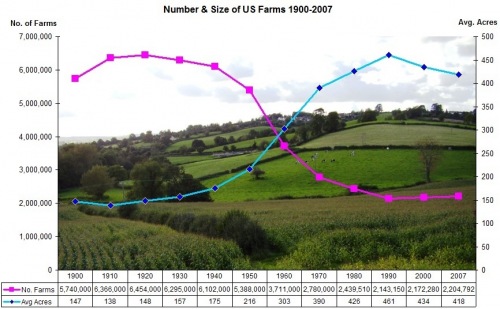
Recently I posted about the loss of genetic diversity in industrial agriculture, partially due to increasing concentration at every link in food commodity chains, from the farm to the grocery store. This image from the Centre for Research on Globalization, sent in by Rick T. of the University of Western Ontario, illustrates the process of concentration at the farm level. In the U.S., the total number of farms has fallen from an all-time high of over 6.3 million to just over 2.2 million. Meanwhile, the average size per farm nearly tripled between 1900 and 2007, from 147 to 418 acres.
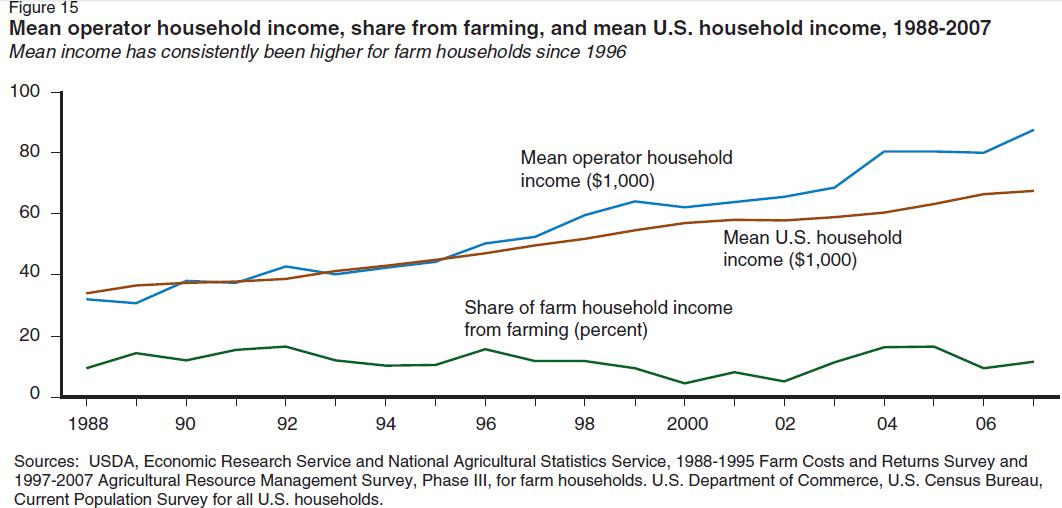
A 2010 USDA report provides detailed information about the structure of U.S. agriculture. For instance, overall, average farm household income is higher than the U.S. average, though I’d rather see the median income to reduce the impact of outliers on the calculation. But as the bottom line shows, farm households are highly dependent on non-farm income for their survival. Overall, farm income accounts for less than 20% of the total income of farming families:
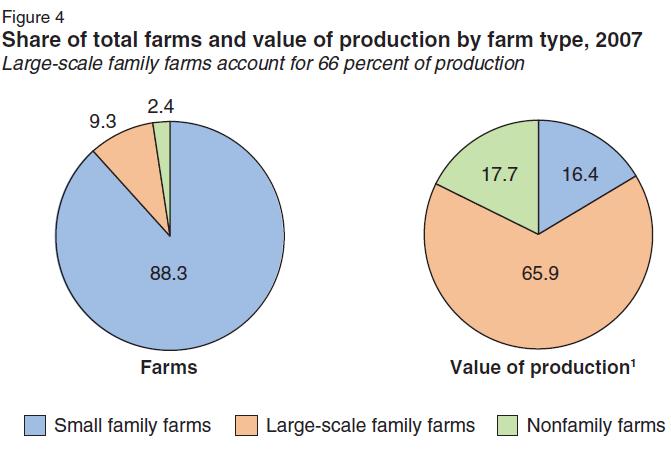
And as we saw recently with the mortgage interest deduction program, the benefits of farm subsidies are unevenly distribution. Small-scale family farms (defined as operator-owned farms with less than $250,000 in sales — which does not mean $250,000 in profit, of course) make up 88.3% of all farms in the U.S., while large-scale family farms (operator-owned farms with sales over $250,000) are 9.3%:
While small-scale family farmers receive the majority of land-retirement payments — that is, subsidies in return for taking land out of agricultural production — large-scale family farms are the major beneficiaries of commodity payments such as price supports that subsidize the cost of production:
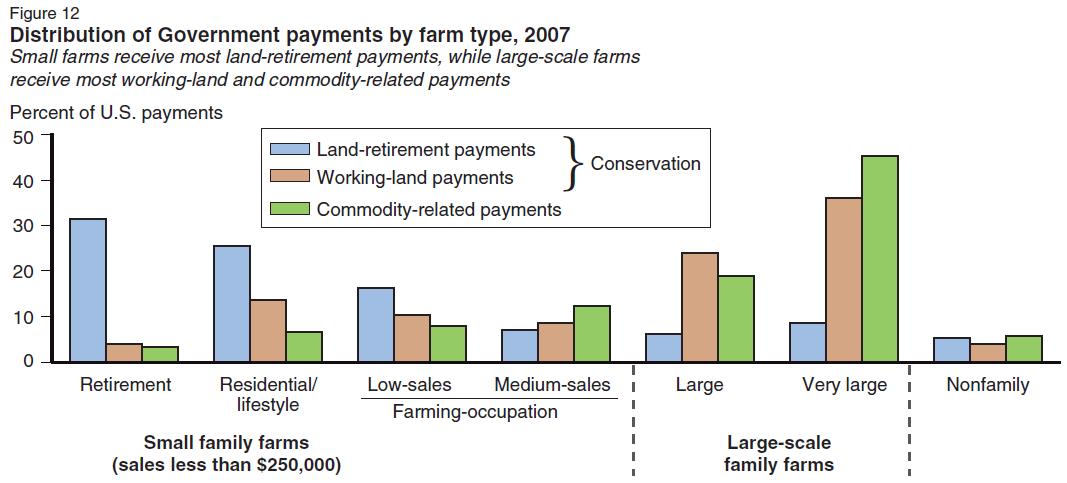
Of course, that doesn’t mean that small-scale producers don’t benefit from farm subsidy programs, but as with the mortgage interest tax deduction, they are set up to reward size — the more you have, the more you get. Whether farm subsidies are essential to preserving small family farms or actually hurt them by artificially supporting capital-intensive large-scale production is a topic of much debate within agricultural circles.
In Buying In: What We Buy and Who We Are, Rob Walker discusses one of the central dilemmas facing marketers: they are trying to get large numbers of people to buy the same thing, while convincing them that doing so in no way makes them conformists. How do you “keep it real” (a phrase repeated ad nauseam by the marketers Walker interviewed) and appear authentic and non-conformist while trying to get as many people as possible to buy the same product?

One solution is to frame buying your product not as a boring act of conformity, but instead as a way of expressing your own unique personal identity. Buying a product you’ve seen advertised doesn’t detract from your authenticity, it enhances it — even if you’re buying a mass-produced product that thousands or even millions of other people purchased identical copies of.

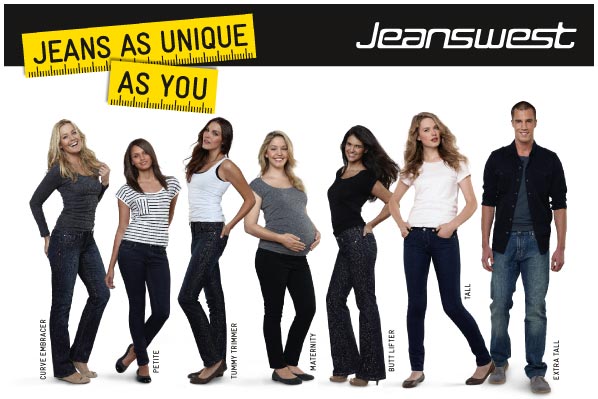
Bec G. sent in this an ad from Jeanswest Australia that illustrates this, asserting that their jeans are “as unique as you”:

Of course, as Bec pointed out, the models they chose to represent how unique Jeanswest customers are are all pretty uniformly thin, even the pregnant woman.

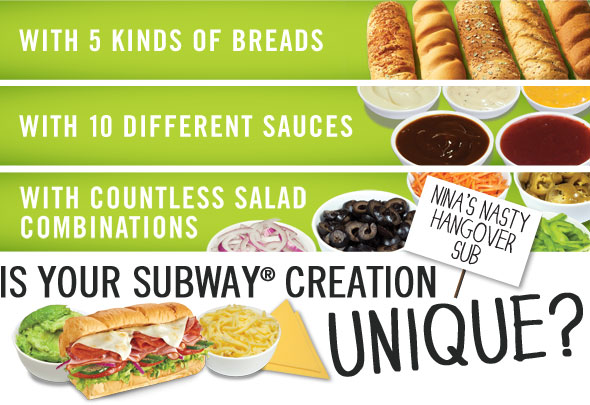
Sarah F. sent in another example. The Australian website for the sandwich chain Subway asks customers whether their preferred sandwich is unique:

I filled out the quiz, creating the only thing I ever get if I eat at Subway: a standard veggie sandwich, no tomatoes. I was then asked to give this amazing item its very own name, to be saved for posterity on the Subway website (if they approve the name): “You’ve just created a Sub that is a reflection of you, so let’s give it a name. Feel free to be creative, after all this is YOUR creation!”

Then it was time for the big reveal. The webpage reinforced the message that designing my very own personalized sandwich from their relatively limited stock list of ingredients is an important expression of my inner being:

I was so nervous! What if my sandwich wasn’t special? Was the honey oat bread too mainstream a choice? Oh, why didn’t I go with the chipotle sauce?!

But it all turned out ok!

In Australia, at least, I now know that my Subway sandwich choice separates me from the masses. What a relief!

Cross-posted at Montclair SocioBlog.

Changes in language seem to just happen. Nobody sets out to introduce a change, but suddenly people are saying “groovy” or “my bad.” And then they’re not. Even written language changes, though the evolution is slower.

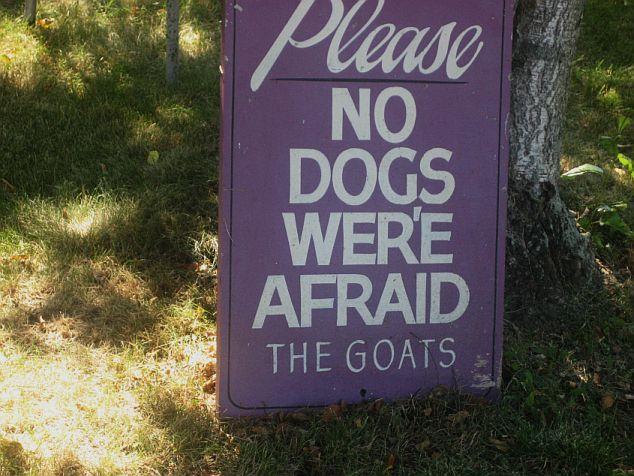
Last weekend, I saw this sign at a goat farm on Long Island.


WER’E ??

I used to care about the apostrophe, but after years of reading student papers about “different society’s,” I have long accepted that the tide is against me. The apostrophe today is where spelling was a few hundred years ago – you can pretty much make up your own rules.

Sometimes the rule is fairly clear: use an apostrophe in plurals when leaving it out makes the word look like a different word rather than a plural form of the original. Change the “y” in “society” to “ies” and it looks too different. “Of all the cafe’s, I like the one with lime martini’s.” The “correct” version is cafes and martinis. but I think they take a nanosecond or two longer to mentally process.

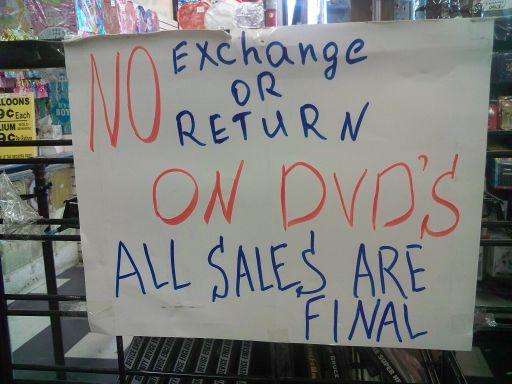
Or these

Technically, it should be “ON DVDS.” But DVDS looks like it’s some government agency (I gotta go down to the DVDS tomorrow) or maybe a disease.

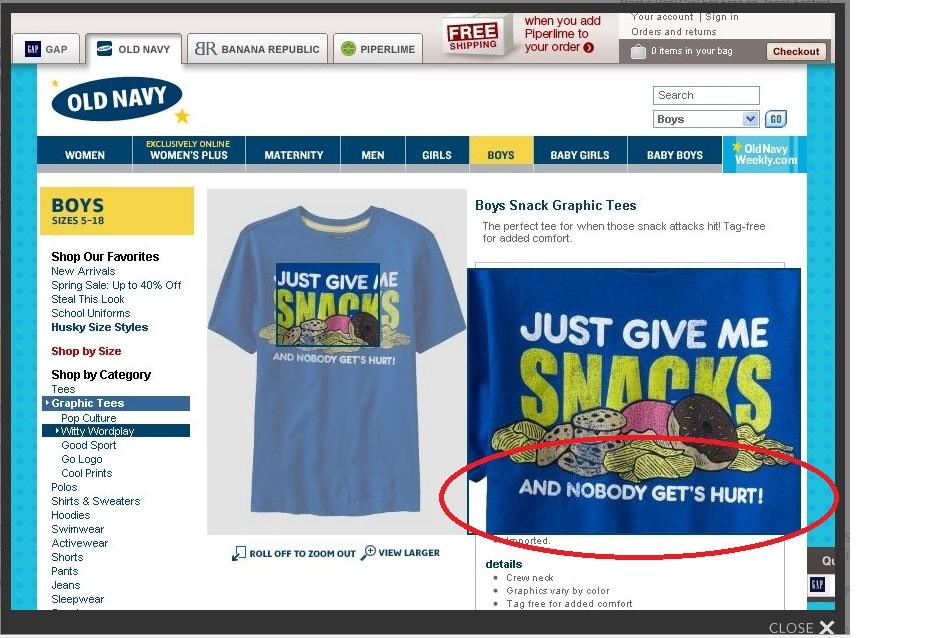
It’s not always easy to figure out what rule or logic the writer is following. The little apostrophe seems to be plunked in almost at random. Not random, really. It’s usually before an “s.” But why does Old Navy say, “Nobody get’s hurt”?

There’s a prescriptivist Website, ApostropheAbuse.com, that collects these (that’s where I found the DVDS and Old Navy pictures). They’re fighting a losing battle.

Technology matters – I guess that’s the sociological point here. The invention of print and then the widespread dissemination of identical texts herded us towards standardization. Printers became a separate professional group (not part of the church or state), and most of them were in the same place (London). They had a stranglehold on published spelling.

For the last few decades, anyone could be a printer. The page you are now reading might harbor countless errors in punctuation and spelling (though spell-checkers greatly reduce misspellings), but it looks just as good as an online article in the Times, and it’s published in a similar way to potentially as many readers. And now there’s texting. It’s already pushing upper case letters off the screen, and the apostrophe forecast doesn’t look so good either. But what will still be interesting is not the missing apostrophe but the apostrophe added where, by traditional rules, it doesn’t belong.

I still can’t figure out WER’E.

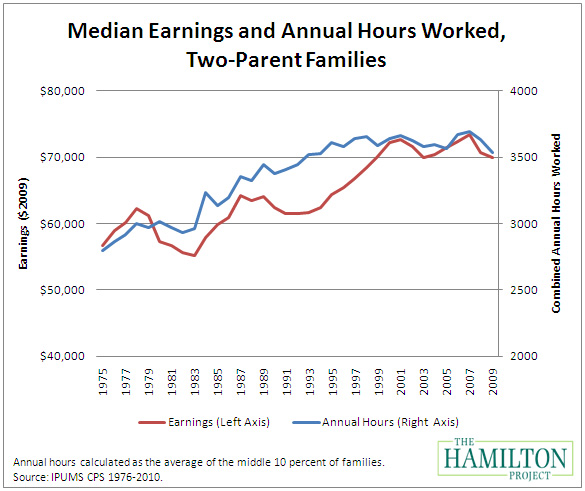
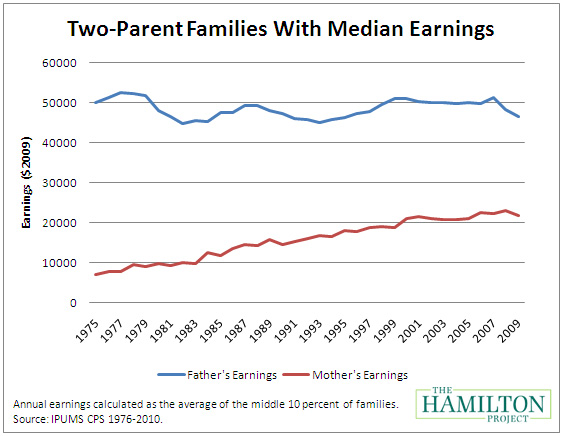
Deeb Kitchen sent in an essay at The Brookings Institution with a graph comparing the number of hours worked and earnings in middle-class, two-parent households (the 10% of households that are in the very middle of the income distribution).   Controlling for inflation (results are in 2009 dollars), we see that these households are earning more, for sure, but also working more.  In other words, they’re getting about as much buck for their bang as they were in 1975.

The authors of the post argue that the 26% increase in the number of hours worked is due mostly to mothers increasing their work hours.  Wages, as you can see below, have been stagnant for fathers, but gone up for mothers:

See also: more men and less women earning poverty wages and why did married mothers go to work.

Lisa Wade, PhD is an Associate Professor at Tulane University. She is the author of American Hookup, a book about college sexual culture; a textbook about gender; and a forthcoming introductory text: Terrible Magnificent Sociology. You can follow her on Twitter and Instagram.

Megan H. and Ami R. sent in contrasting examples of using gender to market fuel-efficient cars. Megan saw this ad (one in a series that plays on the “I’m a Mac/I’m a PC” Apple ads) advocating electric cars over gasoline-powered ones. In this ad, femininity is associated with environmental responsibility. The most stereotypically masculine man in the ad — the blue-collar worker in a hard hat and filthy clothes — represents the harmful oil industry. Beneficial, good wind energy, on the other hand, is personified by a pretty woman in a filmy dress. Her beauty renders the bad guys speechless:

Dodge, on the other hand, wants to distance its claims to fuel efficiency from any association with femininity. Ami found this ad for the new Dodge Charger in the magazine for Go! Chapel Hill, an organization that advocates less car use:

So here, fuel efficiency with is also associated with femininity, but in the negative sense of emasculation. The Charger is the one exception to the other fuel efficient cars out there. You can get better gas mileage and still protect your manly reputation.

For other examples of gender representations of the environment or environmental movement, see our previous posts on femininity and benign nature, using PETA tactics to oppose the BP oil spill, nature in vintage men’s magazines, and even girls can drive electric cars!


Dmitriy T.M. sent in this hilarious 2-minute rap about first world problems. The idea is to draw attention to how the daily frustrations faced by those of us in the most advantaged and developed countries in the world are really, really, like really small.

Edit: Sociologist Michael Kimmel reminds me that, though in certain ways the above is definitely true, it’s also not useful to trivialize the ways in which advantaged and developed countries still create suffering. Some of us benefit from our overall advantage more than others.

Lisa Wade, PhD is an Associate Professor at Tulane University. She is the author of American Hookup, a book about college sexual culture; a textbook about gender; and a forthcoming introductory text: Terrible Magnificent Sociology. You can follow her on Twitter and Instagram.

In his classic 1973 overview of U.S. agribusiness and its effects on the food we eat, Hard Tomatoes, Hard Times, Jim Hightower discusses how the search for market efficiencies had changed the tomatoes Americans could buy in their local supermarkets. Tomatoes posed a number of problems for modern industrial agriculture; in particular, they tended to get bruised or smashed when harvested by machine and transported long distances. To facilitate mechanical harvest and shipping, varieties were developed that were harder and tougher — often at the expense of other qualities, such as taste. This same process has occurred with many crops. For instance, I can buy huge, bright red strawberries year-round in the U.S. these days, as long as I don’t mind that they have only a hint of the rich taste of the strawberries my grandma used to grow.

As a result of concentration in agribusiness (including grocery chains) and selection of varieties that can withstand the mechanical harvesting and long-distance shipping required by the industrial food system, we see fewer and fewer varieties of crops on the shelf. Despite the efforts of heritage seed banks and heirloom variety enthusiasts, many have disappeared altogether; others are dangerously close to doing so. It’s an enormous loss of genetic diversity, of varieties that were developed over many years based on flavor, resistance to pests, ability to withstand drought, frosts, or other environmental stresses, and so on.

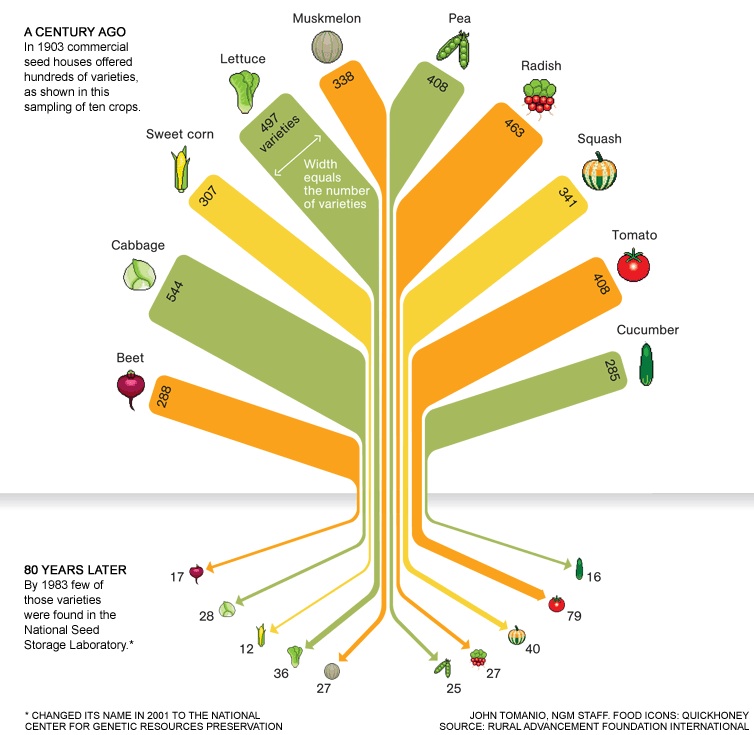
Dolores R. let us know that National Geographic posted an image based on a 1983 study by the Rural Advancement Foundation International that illustrates the loss of this genetic diversity. RAFI looked at a typical commercial seed catalog from 1903 — that is, a catalog of seeds targeting farmers producing for the market. They found a large number of varieties available.

But then they looked at the seed collection at the National Seed Storage Laboratory (now the National Center for Genetic Resources Preservation). This government entity is in charge of collecting and storing seeds to preserve genetic diversity among crops and livestock. The bottom half of this image shows how many of the varieties in the 1903 catalog were in the lab’s collection as of 1983:

Of course, the NCGRP isn’t the only organization storing seeds; many private groups, such as Seed Savers Exchange, preserve heirloom varieties. And many varieties have been introduced, such as the Round-Up Ready crops developed by Monsanto to be compatible with Round-Up weed killer. The NCGRP has also added greatly to its collection over time. Nonetheless, many varieties have simply disappeared, reducing the genetic diversity available in our current agricultural system and increasing the risks should a virulent pest or disease attack the dominant varieties of crops and livestock. For more on this, see the full National Geographic article.

Cross-posted at Love Isn’t Enough.

The West has a long history in which Black and African people were stereotyped as more in touch with nature and more like animals than White and European people.  This elision still haunts us, and Sasha H. sent in a link to an example. To be fair, I went through several pages of Google search results and found only two instances of this particular mistake, but I thought it was worth pointing out as a cautionary tale.

Sasha’s link was to an amusement-focused website called Silly Village.  They posted a series of photographs of a little girl, named Tippi Degré, who was born to wildlife photographers in Namibia, where she grew up. The photos are of her with lots of animals and the set of photos is titled “Young Girl Life with Wild Animals.”  The thing is, though, two of the photos do not include animals, but include only her and local Africans, no animals at all.

I found this same mistake at a more serious source, one that should have editors who are more careful than this, The Telegraph.  The story, titled “The Real-Life Mowgli who Grew Up with Africa’s Wild Animals,” includes a slideshow introduced with this language:

A remarkable range of pictures in a new book show Tippi Degre — a French girl labelled the ‘real-life Mowgli’ — growing up with wild animals.

But the slideshow includes three images, again conflating African animals with African people.

If this happened rarely, it could be chocked up to a random mistake, but this conflation is actually rather ubiquitous.  We’ve posted on this many times. Here are three choice posts: animalizing women of color, Africa is wild and you can be too, and choosing girls of color for animal costumes.

Lisa Wade, PhD is an Associate Professor at Tulane University. She is the author of American Hookup, a book about college sexual culture; a textbook about gender; and a forthcoming introductory text: Terrible Magnificent Sociology. You can follow her on Twitter and Instagram.