Search results for The

I traveled to Silsbee, Texas five times in the past six months, with conservative blogger Brandon Darby, to investigate why, despite the volume of evidence, a grand jury did not indict two football players accused of raping a high school cheerleader (who was later kicked off the squad for refusing to cheer for one of them).  The case is a troubling example of what many victims experience when they dare to report their rape and proceed with a prosecution.  In this post, I’d like to highlight the community reaction.

Hillaire was found half-clothed and crying under the pool table, saying she’d been raped.  She reported that Rakheem Bolton, a star high school football player, raped her while another football player, Christian Rountree, held her down. Three students outside the room heard her cries of “stop” and broke through the door, only to find that three of the four athletes in the room had fled out the window, breaking it in the process.

As Bolton ran off, Stacy Riley, the homeowner, heard him yell:

I didn’t rape no white girl.  I wouldn’t use anyone else’s dick to fuck her. I didn’t put my dick up inside her. I don’t know if she has AIDS. I don’t even know that girl.

Bolton would later admit to penetrating Hillaire.

This was not a he said/she said situation and you can read the evidence in more detail in the full report at my blog. Suffice to say: Witness statements from the police report confirm that Hillaire was raped. An inexperienced drinker, Hillaire was exceedingly intoxicated after drinking a beer and six shots and could not legally consent. Before her friends cut her off, Hillaire made out with a guy in the living room and was egged on to kiss a female friend by a group of ogling young men. Bolton and his friends arrived late to the party, and, seeing an intoxicated and flirtatious Hillaire, isolated her in the pool room.

Hillaire spent the early morning hours after the rape at the police station and at a nearby clinic.  Of the four guys in the room, Bolton and Rountree were charged with “child sexual assault” (because Hillaire was a minor and they were “of age”) which carries a prison term of two to twenty years.

Hillaire assumed this crime would be fairly prosecuted. Instead, she faced intense mistreatment from her peers, many residents of Silsbee, school officials, public officials prosecuting the case, and the local press.  When she returned to school she faced a chilly environment from her peers and school administrators. School officials urged her to take a low profile, and the cheer squad wanted Hillaire to skip homecoming because, according to a fellow cheerleader, “Someone from another city had called and threatened her. If she cheered at another game, they were going to shoot her.” Hillaire went anyway, and some students painted Bolton’s and Rountree’s jersey numbers on their faces to protest their removal from the football team. Students also chanted “free tree” (referring to Rountree) at the homecoming bonfire within earshot of Hillaire.

Many in Silsbee bought the “slut” defense – that Hillaire was to blame for what happened that night because she made out with several people at the party. Describing Hillaire’s sexual behavior at the party, Sarah [name changed], a fellow student and cheerleader, told me that she believe Hillaire was raped and that “a majority of the school felt this way.”  Hillaire was called a “slut” several times to her face.

An anonymous letter to Hillaire’s family laid bare the “slut” defense that so many in Silsbee seem to hold:

These boys are nice respectable boys and you can’t tell me that there were no other girls that wanted to be with them so they raped your daughter (please).  Just think how you have ruined these children [sic] lives and your daughter gets to carry on and be a cheerleader after drinkingherself and going against your family values… This makes your daughter [sic] reputation look very bad and if you think people will forget, remember we live in Silsbee. Someone will always remember!  (Don’t think she won’t be talked about).

A toddler approached Hillaire at a town parade shortly after the rape and called her a “bitch.”

Hillaire’s status as a popular cheerleader at the high school couldn’t compete with the popularity of high school sports that grants the best male players special privileges. The high school stadium seats 7,000—equal to the town’s population—and it’s full on game days. Celebrating high school sports is ingrained in Southeast Texas cultures, so it’s no wonder that many in Silsbee rallied behind Bolton and Rountree.  A common argument, articulated to me by one student, is that Bolton wouldn’t rape anyone because “he was popular. A lot of girls wanted to be with him.”

Bolton and Rountree did not receive the same chilly treatment as Hillaire. In a taped interview with The Silsbee Bee, Rountree’s mother thanked “all the members of the Silsbee community that have supported us; all the love and prayers that have been sent out. We’ve had a tremendous, just a tremendous outpouring of support and we just appreciate everyone and thank you for believing in these boys.”

[wpvideo eWIYrDXp]

The local paper, The Silsbee Bee, favorably covered the accused, even publishing an article titled, “Sexual Assault Prosecutions Cost County Nearly $20,000.” It was hard to miss the implication that this was money ill spent.

Later the editor of the Silsbee Bee would resign.

In many ways Hillaire was the perfect victim.  She’s pretty, white, and underage; a cheerleader in a football-loving town. She went to the police and the health clinic immediately after her assault. In addition to the physical evidence that was collected, she brought into court the testimony of witnesses and a threat from her rapist.  Detective Dennis Hughes, the officer assigned to the case, told Hillaire’s father that, given his four decades of police experience, “This is a slam dunk case. There’s more evidence than we see in most sexual assault cases, and we’ve got lots of witnesses.”

Still, despite all of this, the community turned against her. It’s no wonder that rape victims are reluctant to report their assaults; how much evidence, and how much privilege, does one need to get justice?  Three months after the rape, a grand jury dismissed the case.  Later Bolton would plea guilty to assault, a misdemeanor.

——————

For more — including ways to help Hillaire and protest her treatment, as well as details about the role of the NAACP and highly suspicious ties between Bolton’s family, the police, and the district attorney – see the unabridged reporting on this story here.

When someone gave us this chunky dinosaur puzzle, I did a double-take. Yes, that’s a caveman there with the dinosaurs:

The blurb on the company’s website says that, along with the puzzle, “ The accompanying board book teaches young learners about dinosaurs.” Teaches, that is, with lessons like this:

A little harmless fun, or a little creationist indoctrination? (Do sociologists even believe in “harmless fun”?)

According to the Shure company, they deliver these “common threads” in all their products: “Originality and inventiveness; Excellence in design; Attention to detail; Exceptional quality; Educational merit.” So, not just entertainment.

A quick perusal suggests the rest of their products are not creationist — just the usual toy-gendering. They do have a Noah’s Ark puzzle, but it doesn’t claim to be educational. In that Shure is just keeping up Melissa & Doug (whose puzzle is at least Genesis-correct in not naming Noah’s wife):

And anyway, the story of Noah’s Ark is actually not a bad way to talk about reproduction.

But back to dinosaurs and people. Dinosaurs are not really more problematic for creationism than any other creatures that pre-date humans. But maybe because kids love dinosaurs so much, creationists spend inordinate energy trying to place them chronologically with people. Writes one such site:

The idea of millions of years of evolution is just the evolutionists’ story about the past. No scientist was there to see the dinosaurs live through this supposed dinosaur age. In fact, there is no proof whatsoever that the world and its fossil layers are millions of years old. No scientist observed dinosaurs die. Scientists only find the bones in the here and now, and because many of them are evolutionists, they try to fit the story of the dinosaurs into their view.

Up against this kind of propaganda, it is tempting to bring the hammer down on “harmless fun” featuring humans and dinosaurs playing together. That would mean no B.C. comic, no Flinstones, and no Barney either. That is basically the argument of James Wilson, a University of Sussex lecturer, who has a talk on the subject here on Youtube.

In any case, we may be so used to seeing toys or other products like this — with humans and dinosaurs side-by-side — that we forget to ask whether they’re teaching kids a lesson, one that is at odds with science.

————————

By the way, for non-biologists, like me, who like evolution and want some ammunition to defend it, I recommend Richard Dawkins’ recent book The Greatest Show on Earth. Some do find it a little dogmatic, and in the grand scheme I prefer Stephen Jay Gould, but it’s good for this purpose. Because rather than block access to dinosaur cartoons, I would rather arm myself – and the surrounding children – with the tools they need to handle them with confidence.

Philip N. Cohen is a professor of sociology at the University of Maryland, College Park, and writes the blog Family Inequality. You can follow him on Twitter or Facebook.

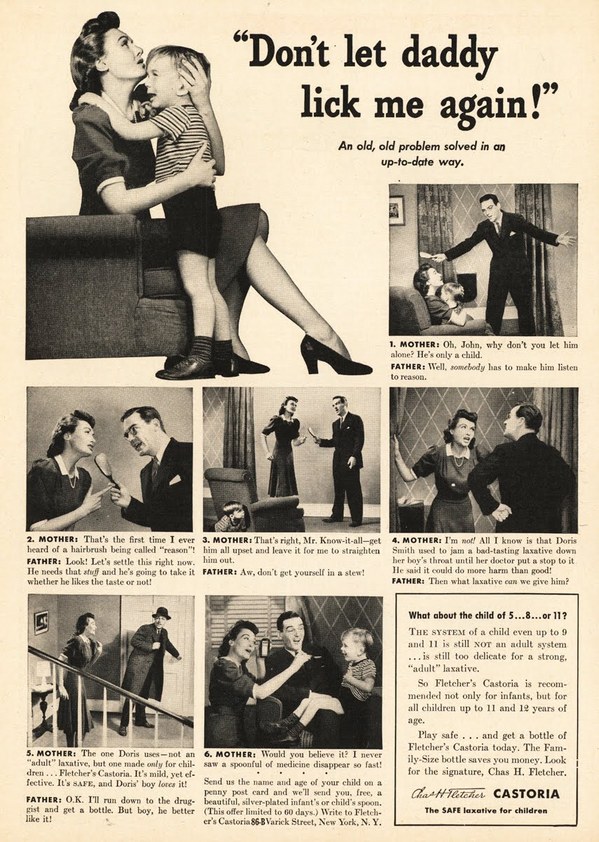
A while back Yvette sent us a vintage ad for a children’s laxative that was posted over at Boing Boing. It’s a great example of changing expectations of parenting, disciplining children, and parental anger. In the ad, the mom and dad are arguing because the dad wants to use a hairbrush to spank his son, who is apparently crying because he doesn’t want to take a nasty-tasting laxative:

Transcript of dialogue:

“Don’t let daddy lick me again!” An old, old problem solved in an up-to-date way.

1. Mother: Oh, John, why don’t you let him alone? He’s only a child.

Father: Well, somebody has to make him listen to reason.

2. Mother: That’s the first time I ever heard of a hairbrush being called “reason”!

Father: Look! Let’s settle this right now! He needs that stuff and he’s going to take it whether he likes the taste or not!

3. Mother: That’s right, Mr. Know-it-all — get him all upset and and leave it for me to straighten him out.

Father: Aw, don’t get yourself in a stew!

4. Mother: I’m not! All I know is that Doris Smith used to jam a bad-tasting laxative down her boy’s throat until her doctor put a stop to it. He said it could do more harm than good!

Father: Then what laxative can we give him?

5. Mother: The one Doris uses — not an “adult” laxative, but one made only for children…Fletcher’s Castoria. It’s mild, yet effective. It’s safe, and Doris’ boy loves it!

Father: OK. I’ll run down to the druggist and get a bottle. But boy, he better like it!

6. Mother: Would you believe it? I never saw a spoonful of medicine disappear so fast!

The mom wins out, and clearly spanking the boy isn’t being advocated. But the company felt perfectly comfortable presenting a dad as angry and even aggressive, and in need of calming from his wife to avoid him spanking his child with a household item, yet still a perfectly good dad once Mom had intervened and fixed the immediate problem, returning family harmony.

Given increased attention to issues such as child abuse and domestic violence, and changes in expectations of parenting that have replaced the “father as nothing but breadwinner and strict disciplinarian” role, many viewers today would likely interpret the narrative in the ad (not to mention the line “Don’t let Daddy lick me again!”) as inherently problematic, not as a taken-for-granted commentary on family life and the need for helpful products to smooth over domestic conflicts.

Dolores R. sent us this Saturday Morning Breakfast cartoon commenting on conspicuous consumption.  The phenomenon is often described with things like Hummers and high-priced purses.  The cartoon, though, suggests that intellectuals have their own breed of conspicuous consumption, even as they criticize the Hummer drivers: the conspicuous consumption of intellectual products, the more obscure and dense the better.

It reminds me of this hilarious clip from the sketch comedy show Portlandia in which friends end up in an inadvertent competition over who is more informed/has read more of the right stuff lately.

See also: conspicuous conservation.

Lisa Wade, PhD is an Associate Professor at Tulane University. She is the author of American Hookup, a book about college sexual culture; a textbook about gender; and a forthcoming introductory text: Terrible Magnificent Sociology. You can follow her on Twitter and Instagram.

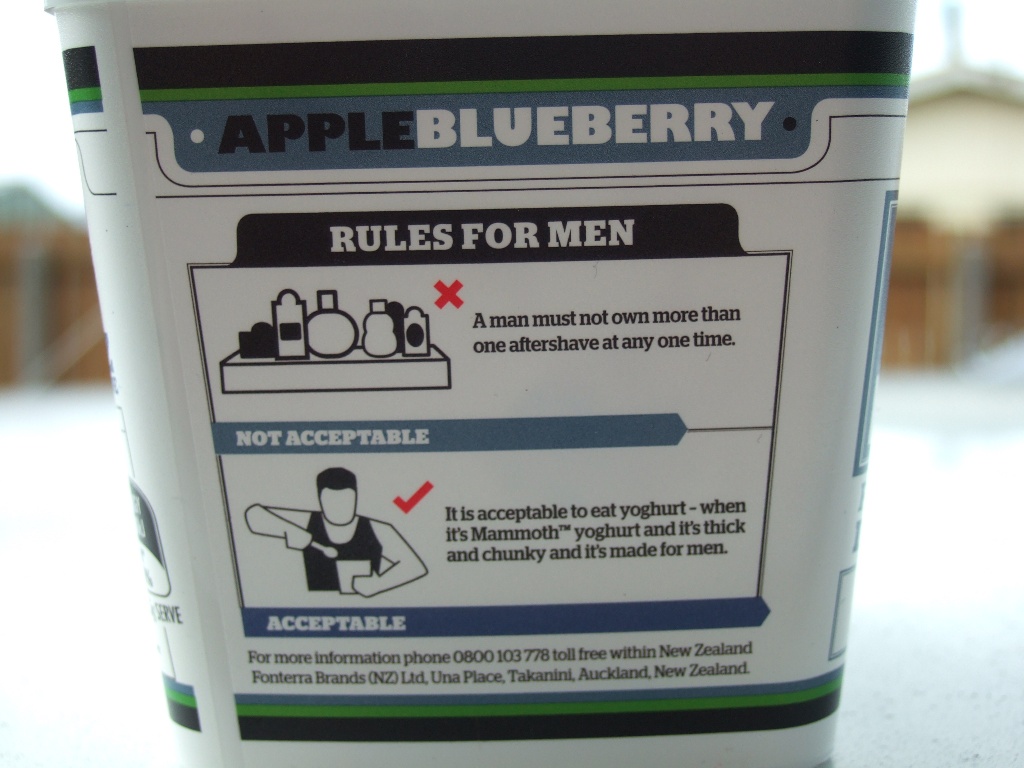
Jeremiah, Sarah S., Nikki R., and Erin H. sent us a great example of a company trying to make a feminized food safe for men. New Zealand’s Mammoth Supply Co. (a subsidiary of the multinational dairy giant Fonterra) is trying to convince men that yogurt is super manly and tough, “built to tame a man’s hunger.” The ads reinforce a whole range of rules about masculinity, which Erin nicely sums up as “the same old mythbashing that men need things that are big, tough, substantial, strong and rugged, and that coded-feminine activities (crying, being too involved in one’s personal appearance, coming into physical contact with people of the same sex) are inferior and weak”:

Via Copyranter.

The website, which assures the reader that this is “real man food, man,” as well as each carton of yogurt includes additional helpful tips:

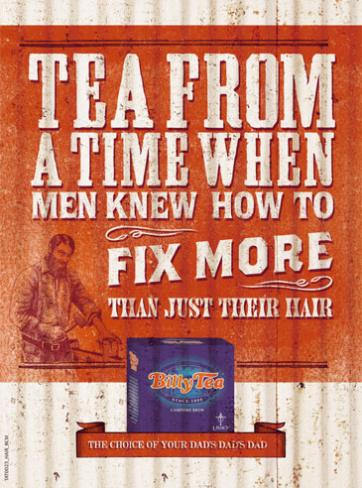
Lisa K. recently saw an ad for Billy Tea in a newspaper that implies men and women are no longer sufficiently masculine and feminine, unlike the good old days when the tea was first produced:

Here’s another one of their ads:

Sarah B. sent in this Miller High Life ad (which she blogged about at Adventures in Mediocrity) that makes it clear that the only types of salad men should eat are the type without, you know, girly vegetables:

In another example of gendering foods, Lisa R. pointed out Applebee’s commercials for its set of dishes with under 550 calories. Women love eating low-calorie meals:

The commercial aimed at men, titled “Manly Man,” presents ordering from the 550-calorie menu as something men might be a bit embarrassed about, but don’t worry — once the guys see your huge plate of food, your masculinity will once again be unquestioned:

Cross-posted at Montclair SocioBlog.

Is the SAT biased?  If so, against who is it biased?

It has long been part of the leftist creed that the SAT and other standardized tests are biased against the culturally disadvantaged – racial minorities, the poor, etc.  Those kids may be just as academically capable as more privileged kids, but the tests don’t show it.

But maybe SATs are biased against privileged kids.  That’s the implication in a blog post by Greg Mankiw.  Mankiw is not a liberal.  In the Bush-Cheney first term, he was the head of the Council of Economic Advisors.  He is also a Harvard professor and the author of a best-selling economics text book.  Back in May he had a blog post called “A Regression I’d Like to See.” If tests are biased in the way liberals say they are, says Mankiw, let’s regress GPA on SAT scores and family income.  The correlation with family income should be negative.

…a lower-income student should do better in college, holding reported SAT score constant, because he managed to get that SAT score without all those extra benefits.

In fact, the regression had been done, and Mankiw added this update:

Todd Stinebrickner, an economist at The University of Western Ontario, emails me this comment:

“Regardless, within the income groups we examine, students from higher income backgrounds have significantly higher grades throughout college conditional on college entrance exam . . . scores.” [Mankiw added the boldface]

What this means is that if you are a college admissions officer trying to identify the students who will do best in college, as measured by grades, you would give positive rather than negative weight on family income.

Not to give positive weight to income, therefore, is bias against those with higher incomes.

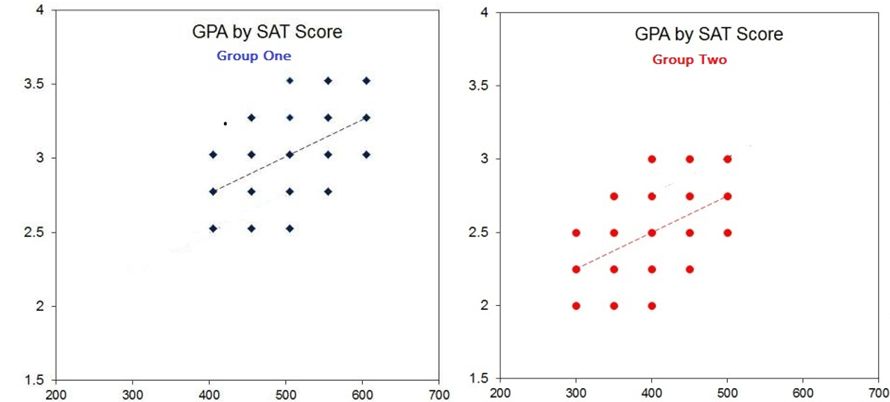
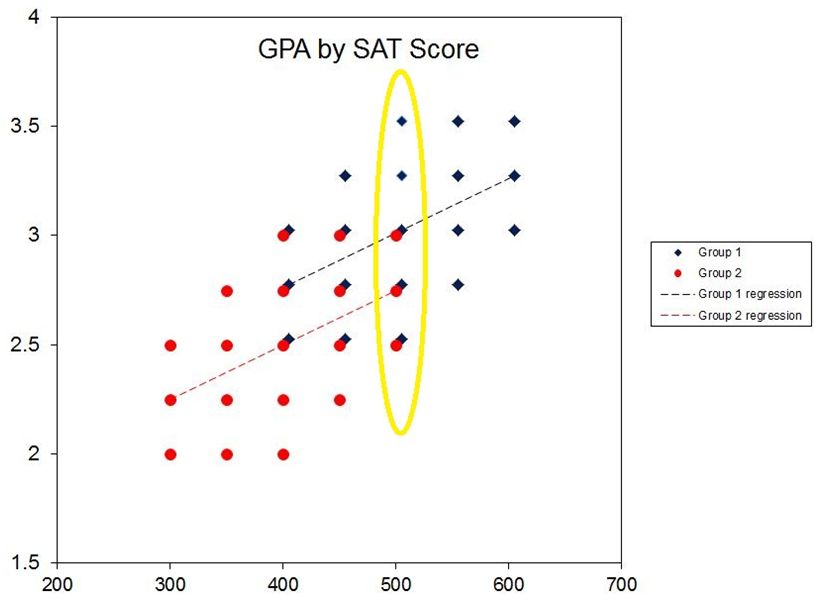
To see what Mankiw means, look at some made-up data on two groups.  To keep things civil, I’m just going to call them Group One and Group Two.  (You might imagine them as White and Black, Richer and Poorer, or whatever your preferred categories of injustice are.  I’m sticking with One and Two.)  Following Mankiw, we regress GPA on SAT scores.  That is, we use SAT scores as our predictor and we measure how well they predict students’ performance in college (their GPA).

In both groups, the higher the SAT, the higher the GPA.  As the regression line shows, the test is a good predictor of performance.  But you can also see that the Group One students are higher on both.  If we put the two groups together we get this.

Just as Mankiw says, if you’re a college admissions director and you want the students who do best, at any level of SAT score, you should give preference to Group One.  For example, look at all the students who scored 500 on the SAT (i.e., holding SAT constant at 500).  The Group One kids got better grades than did the Group Two kids.  So just using the SATs, without taking the Group factor (e..g., income ) into account, biases things against Group One.  The Group One students can complain: “the SAT underestimates our abilities, so the SAT is biased against us.”

Case closed?  Not yet.  I hesitate to go up against an academic superstar like Mankiw, and I don’t want to insult him (I’ll leave that to Paul Krugman).  But there are two ways to regress the data.  So there’s another regression, maybe one that Mankiw does not want to see.

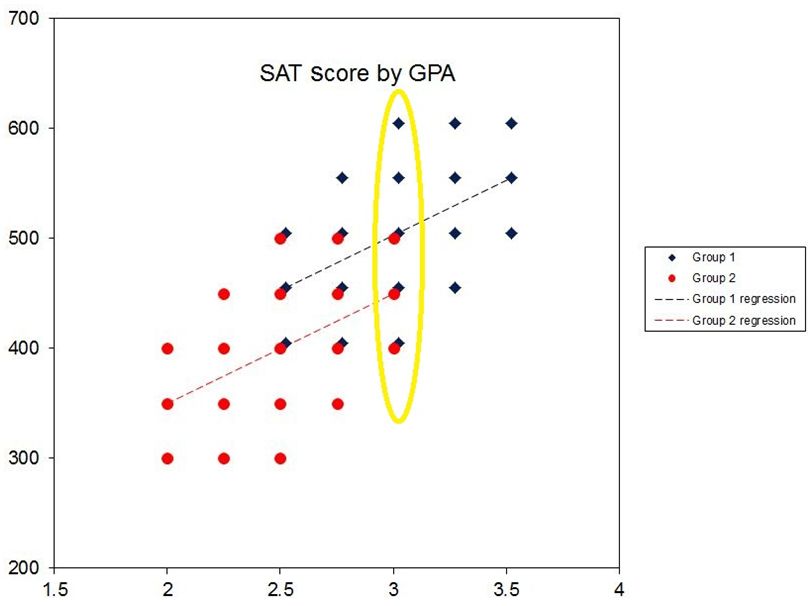
What happens if we take the same data and regress SAT scores on GPA?  Now GPA is our predictor variable.  In effect, we’re using it as an indicator of how smart the student really is, the same way we used the SAT in the first graph.

Let’s hold GPA constant at 3.0.  The Group One students at that GPA have, on average, higher SAT scores.  So the Group Two students can legitimately say, “We’re just as smart as the Group One kids; we have the same GPA.  But the SAT gives the impression that we’re less smart.  So the SAT is biased against us.”

So where are we?

  • The test makers say that it’s a good test – it predicts who will do well in college.
  • The Group One students say the test is biased against them.
  • The Group Two students say the test is biased against them.

And they all are right.

————————

Huge hat tip to my brother, S.A. Livingston.  He told me of this idea (it dates back to a paper from the1970s by Nancy Cole) and provided the made-up data to illustrate it.  He also suggested these lines from Gilbert and Sullivan:

And you’ll allow, as I expect
That they are right to so object
And I am right, and you are right
And everything is quite correct.


Adrienne K., from the excellent blog Native Appropriations, recently appeared on the Al Jazeera English show The Stream to discuss issues of cultural appropriation of Native American cultures in fashion and home decor, sports mascots, and so on. It’s a great segment about Native American concerns specifically, and the broader issues of appropriation, respecting different cultures, and how responsible different groups are for educating themselves and others about cultural traditions:

Cross-posted at Family Inequality.

I have criticized sloppy statistical work by some international feminist organizations, so I’m glad to have a chance to point out a useful new report and website.

The Progress of the World’s Women is from the United Nations Entity for Gender Equality and the Empowerment of Women. The full-blown site has an executive summary, a long report, and a statistics index page with a download of the complete spreadsheet. I selected a few of the interesting graphics.

Skewed sex ratios (which I’ve written about here and here) are in the news, with the publication of Unnatural Selection, by Mara Hvistendahl. The report shows some of the countries with the most skewed sex ratios, reflecting the practice of parents aborting female fetuses (Vietnam and Taiwan should  be in there, too). With the exception of Korea, they’ve all gotten more skewed since the 1990s, when ultrasounds became more widely available, allowing parents to find out the sex of the fetus early in the pregnancy.

The most egregious inequality between women of the world is probably in maternal mortality. This chart shows, for example, that the chance of a woman dying during pregnancy or birth is about 100- 39-times higher in Africa than Europe. The chart also shows how many of those deaths are from unsafe abortions.

Finally, I made this one myself, showing women as a percentage of parliament in most of the world’s rich countries (the spreadsheet has the whole list). The USA, with 90 women out of 535 members of Congress, comes in at 17%.

The report focuses on law and justice issues, including rape and violence against women, as well as reparations, property rights, and judicial reform. They boil down their conclusions to: “Ten proven approaches to make justice systems work for women“:

1. Support women’s legal organizations

2. Support one-stop shops and specialized services to reduce attrition in the justice chain [that refers to rape cases, for example, not making their way from charge to conviction -pnc]

3. Implement gender-sensitive law reform

4. Use quotas to boost the number of women legislators

5. Put women on the front line of law enforcement

6. Train judges and monitor decisions

7. Increase women’s access to courts and truth commissions in conflict and post-conflict contexts.

8. Implement gender-responsive reparations programmes

9. Invest in women’s access to justice

10. Put gender equality at the heart of the Millennium Development Goals