Search results for The

Cross-posted at Scientopia.

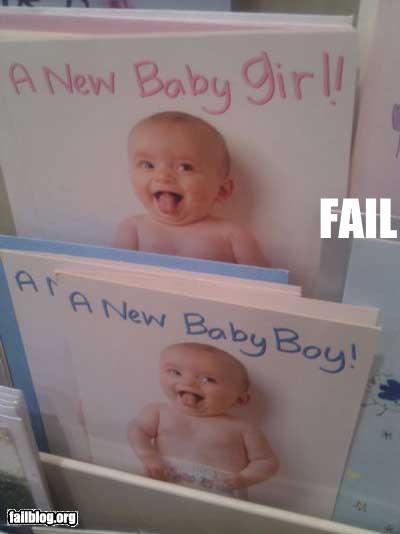
In March we posted a set of greeting cards: a pink and a blue one congratulating new parents on a girl and a blue respectively.  The cards pictured exactly the same baby, revealing the way in which we gender infants before there are any discernable signs of sex (outside of the genitals).  Since then we’ve received two more examples of the phenomenon.  The first, sent in by Christine, is from FailBlog:
The second is for a (pointlessly gendered) hygiene kit at Walmart, sent in by Laura Confer:
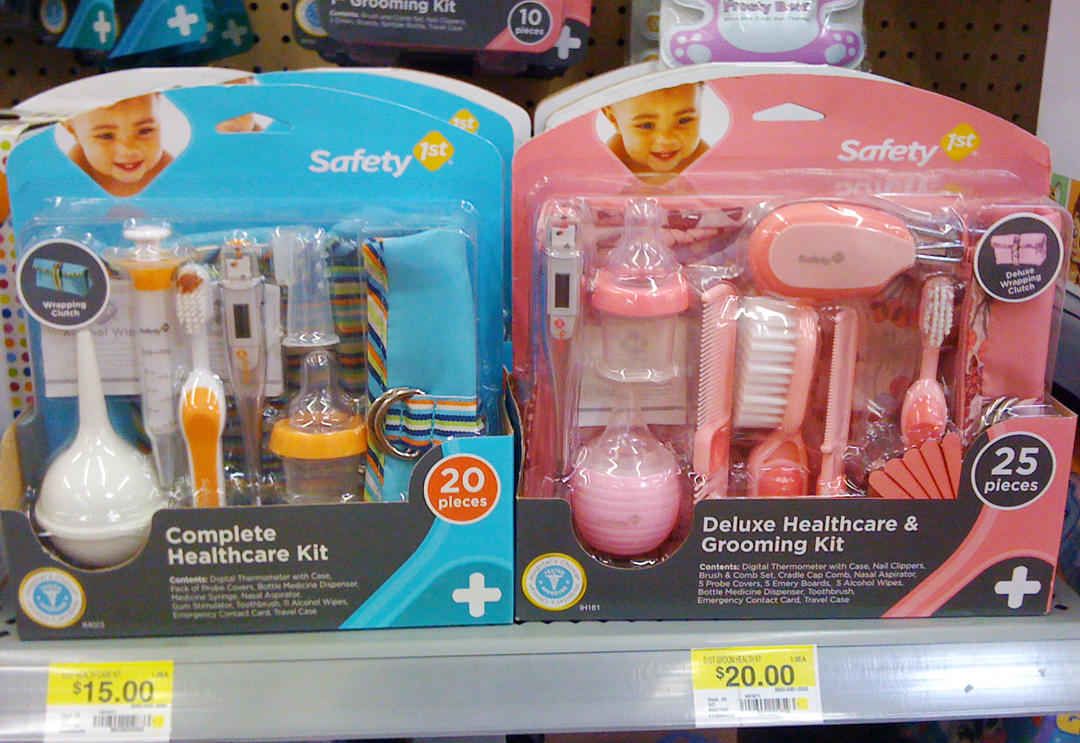
The use of exactly the same baby just tickles me.  The marketers know that babies look like, well, babies.  We aren’t “opposite sexes,” especially at six months old.  But the sex of the child is very important to adults.  So they use color cues to make the consumer feel like they’re choosing the “right” or the “cutest” item.  But they can use any child — girl or boy — to sell the item… because that’s not what it’s actually about.

Lisa Wade, PhD is an Associate Professor at Tulane University. She is the author of American Hookup, a book about college sexual culture; a textbook about gender; and a forthcoming introductory text: Terrible Magnificent Sociology. You can follow her on Twitter and Instagram.
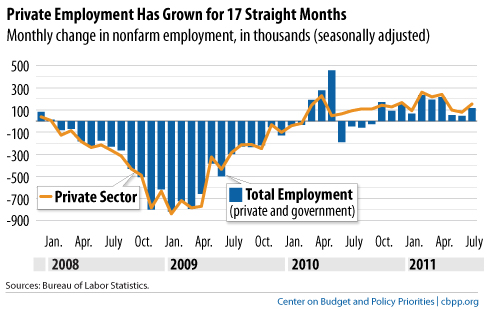
Laura E. sent in a link to the Off the Charts blog by the Center for Budget and Policy Priorities. They posted a set of charts highlighting ongoing unemployment in the U.S. Overall, the private sector has been adding jobs, but at generally very low levels:

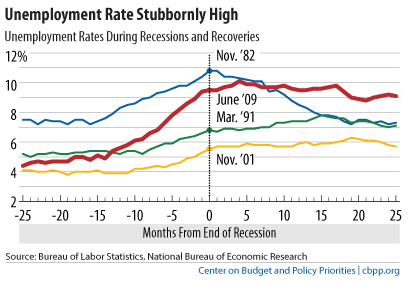
But we lost so many jobs relative to the overall working-age population during this recession that the slow job growth simply isn’t enough to significantly alter the unemployment rate, which is still hovering around 9% (though much higher for some groups, particularly young people and racial and ethnic minorities):

The increased labor force participation we saw during the 1990s and 200s have been erased:

The CBPP has a collection of recession-related charts, including this graph of the number of individuals needing a job per each available job opening, a ratio that remains quite discouraging:

In the last few days since the debt ceiling fiasco, a number of economic experts have begun discussing the possibility of a double-dip recession and, as you may have heard, last night Standard & Poor’s downgraded the U.S. debt rating. Overall, it’s not an encouraging picture of our immediate economic future.

Dmitriy T.M. sent in a video put together by the Center for Investigative Reporting about some of the hidden costs of gasoline use in the U.S.:

Also check out our earlier posts on Lisa Margonelli’s TED talk about the political economy of oil in the U.S. as well as the inconsistent relationship between gas prices and how much we drive.

Cross-posted at Scientopia.

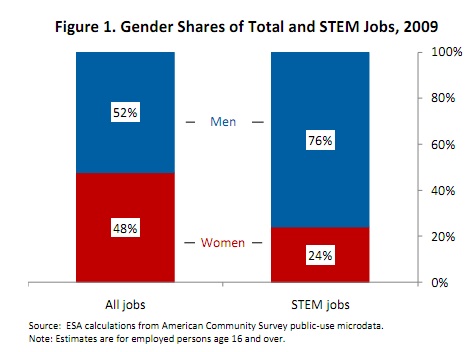
The U.S. Department of Commerce just released a report on the continuing gender gap in STEM jobs – that is, science, technology, engineering, and math. While women make up roughly half of the total paid workforce, they still held only a quarter of STEM jobs as of 2009:

In fact, we saw no change in the gender make-up of STEM fields between 2000 and 2009.

There is significant variation in the gender composition within the STEM category, however. At the high end, women hold 40% of jobs in the physical and life sciences; the low point is engineering, where only 14% of employees are women. And the proportion of women in computer science and math jobs actually fell between 2000 and 2009, from 30% to 27% of workers.

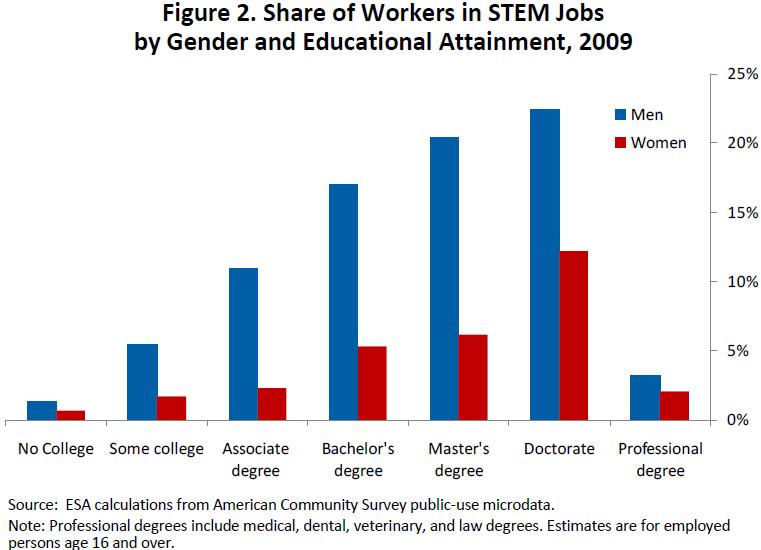
This isn’t simply because of differences in education, either. Here we see the proportion of both men and women in STEM jobs at various educational levels; while increased education correlates with a higher likelihood of having a STEM job for both groups, women are significantly less likely than men at every educational level to have a STEM job:

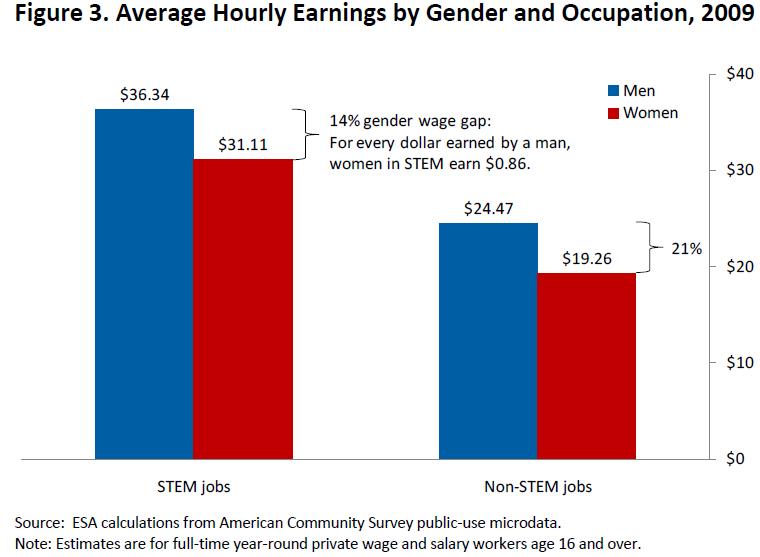
The gender disparity in STEM jobs is especially noteworthy because, on average, STEM occupations pay significantly more than other private-sector jobs, and the gender gap in pay is actually lower than in non-STEM sectors:

If we look only at women with bachelor’s degrees, women who earn STEM degrees and work in STEM jobs earn, on average, 29% more than other women.

So the underrepresentation of women in STEM jobs means that women are missing out on some of the best-paying occupations in the U.S.; in fact, this type of gender-segregation of jobs is one of the leading causes of gender gap in yearly and lifetime earnings.

The authors of the report don’t go into detail about potential causes of the gender gap in STEM careers, though they note that among those earning STEM degrees in college, women are significantly less likely than men to hold jobs in related STEM fields. They suggest this might be because STEM jobs are relatively unaccommodating to those who take time off for family obligations (disproportionately women), because of a lack of female role models in STEM fields (including as college professors), or because of gender stereotyping about math or science aptitude (like this, or this if you prefer a t-shirt) that pushes women away from STEM degrees and careers. [UPDATE: Broken links fixed!]

The complex interplay of factors that lead to a gender gap in who holds STEM-sector jobs provides significant challenges to increasing the proportion of women in these occupations — as indicated by the lack of change over the past decade. But particularly as we see increasing economic divergence between well-paid tech and information sector and low-paid service sector jobs, addressing the underrepresentation of women in STEM jobs will be essential as part of any effort to improve women’s lifetime earnings potential and overall economic outlook.

Yesterday I posted about some children’s luggage that normalizes gendered occupations. Given that, I thought I’d follow up with several more examples of gendering kids’ stuff that have been sitting in our inbox.

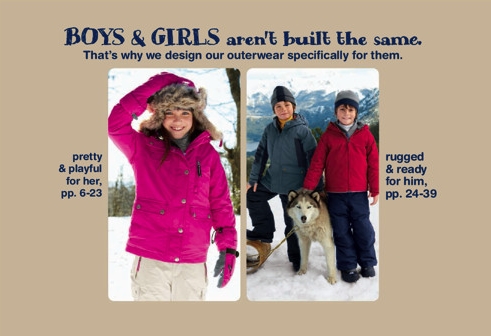
Erin M. saw this image in a Land’s End catalog for kids’ clothing a while back. It draws on the idea that boys and girls are just inherently different, with girls needing things that are “pretty” while boys need stuff that’s “rugged”:

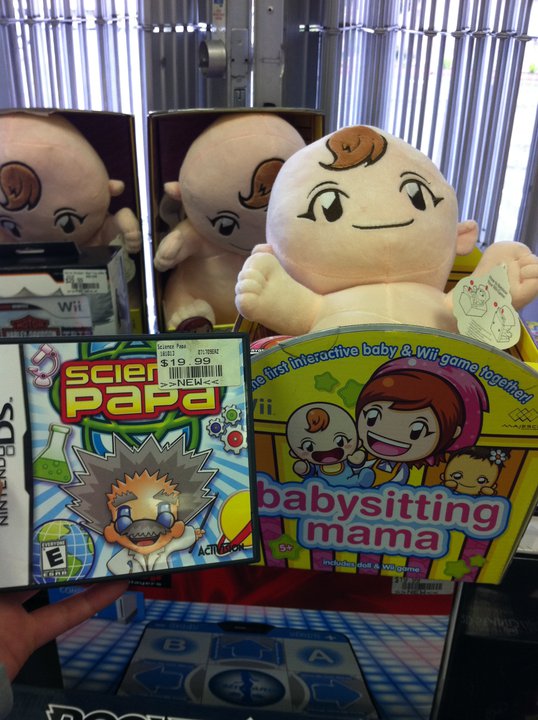
Caspian P. snapped this photo of two video games (by different companies) that efficiently summarize who we assume will be interested in what:

Finally, Cheryl S. noticed that J. Crew decided to market some of their boys’ clothing to girls. Rather than designating the clothes as unisex, or listing them as boys’ items in the boys’ section and girls’ items in the girls’ section, they instead created a section in the girls’ part of the website called Borrowed from My Brother:

As Cheryl points out, there is no “borrowed from my sister” section for boys. We accept the idea of women wearing men’s clothing, even seeing it as potentially sexy, in a way that we don’t tolerate or condone men crossing gender lines to wear women’s items or take on other aspects of femininity. J. Crew simply applies this wider cultural acceptance of women taking on some aspects of masculinity (as long as they balance it with enough signs of femininity), which we see in the marketing of “boyfriend jeans” to women, and applies it to kids.

Cross-posted at Scientopia.

One year ago today six black teenagers died in the Louisiana Red River.  They were wading in waist deep water when one, 15-year-old DeKendrix Warner, fell off an underwater ledge.  He struggled to swim and, one by one, six of his cousins and friends jumped in to help him and each other.  Warner was the only survivor.  The family members of the children watched in horror; none of them knew how to swim.

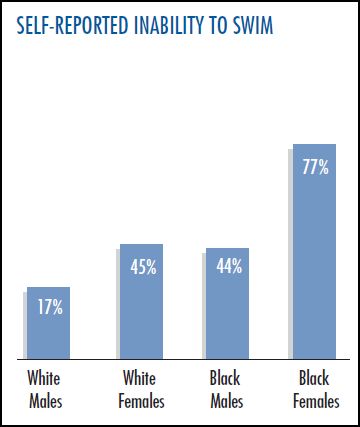
This draws attention to a rarely discussed and deadly disparity between blacks and whites.  Black people, especially black women, are much less likely than white people to know how to swim.  And, among children, 70% have no or low ability to swim.  The figure below, from the International Swimming Hall of Fame, shows that 77% of black women and 44% of black men say that they don’t know how to swim.  White women are as likely as black men, but much less likely than black women to report that they can’t swim.  White men are the most confident in their swimming ability.

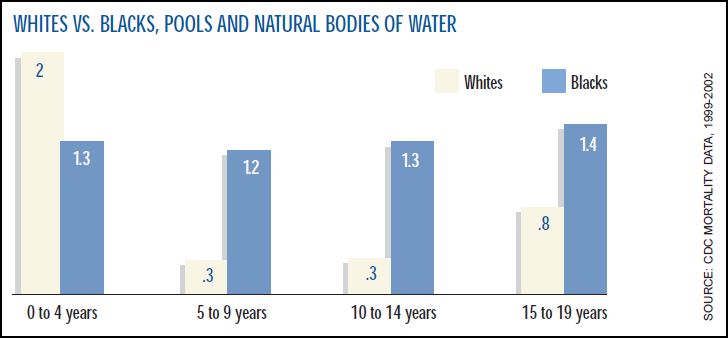
This translates into real tragedy.  Black people are significantly more likely to die from drowning than white people (number of drownings out of 100,000):

Why are black people less likely to learn to swim than whites?  Dr. Caroline Heldman, at FemmePolitical, argues that learning to swim is a class privilege.  To learn to swim, it is helpful to have access to a swimming pool.  Because a disproportionate number of blacks are working class or poor means that they don’t have backyard swimming pools; while residential segregation and economic disinvestment in poor and minority neighborhoods means that many black children don’t have access to community swimming pools.  Or, if they do, they sometimes face racism when they try to access them.

Even if all of these things are in place, however, learning to swim is facilitated by lessons.  If parents don’t know how to swim, they can’t teach their kids.  And if they don’t have the money to pay someone else, their kids may not learn.

I wonder, too, if the disparity between black women and men is due, in part, to the stigma of “black hair.”   Because we have racist standards of beauty, some women invest significant amounts of time and money on their hair in an effort to make it straight or wavy and long.  Getting their hair wet often means undoing this effort.  Then again, there is a gap between white men and white women too, so perhaps there is a more complicated gender story here.

These are my initial guesses at explaining the disparities.  Your thoughts?

Lisa Wade, PhD is an Associate Professor at Tulane University. She is the author of American Hookup, a book about college sexual culture; a textbook about gender; and a forthcoming introductory text: Terrible Magnificent Sociology. You can follow her on Twitter and Instagram.
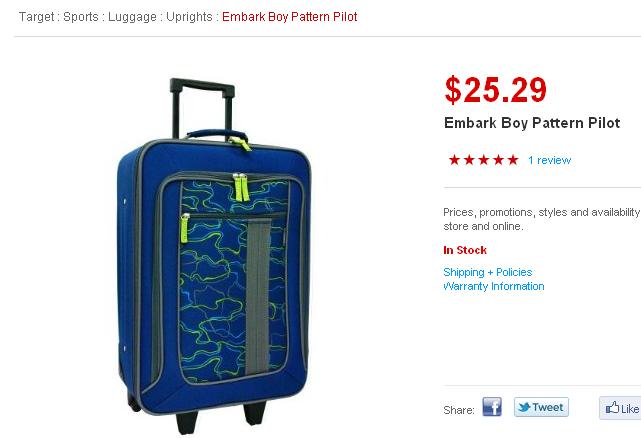
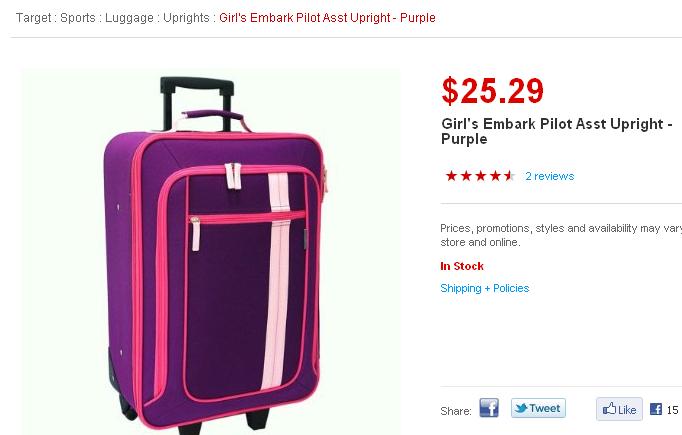
Emily H. sent in a great example of gendering kids’ products. She looked at kids’ luggage on the Target website and noticed a significant difference in the boys’ and girls’ version of one brand. The boys’ version, in the standard blue, is called “Embark Boy Pattern Pilot”:

The girls’ version is identical in size and construction. The girls’ versions are pink and purple, but that’s not the difference that drew Emily’s attention. Take a look:

Notice the name? Where the boys’ version is for pilots, the girls’ appears to be for the pilot’s assistant. Just a nice little example of the normalization of the idea that girls are supportive helpers to the boys who direct the show.

Cross-posted at Scientopia and Racialicious.

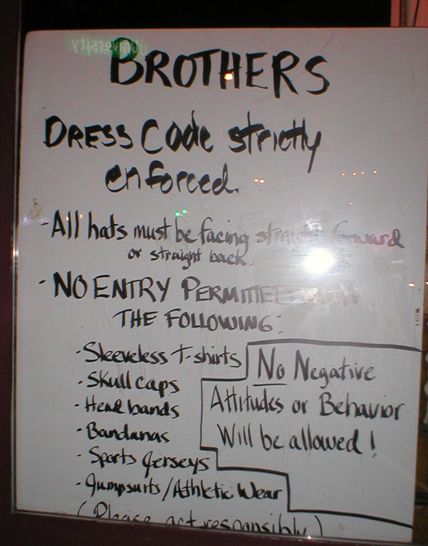
Several years ago I took this photo of the posted dress code for Brothers Bar in Madison, Wisconsin.   As an alumnus, I can tell you that the relationship between the college community and the community at large was strained, as it is in many college towns.  The college community was, on average, better off economically than much of the non-college community, with greater (potential) educational achievement, and overwhelmingly white.  There was less mingling between the “town” and “gown” than we might expect by random chance, and some businesses tried to attract the latter exclusively.

This was the case with Brothers Bar. Brothers sits within a block of campus, they wanted to attract the college students but push away young “townies,” as they were derogatorily called.  Of course, it’s illegal to say “Poor Black people keep out,” so, instead, they use symbolic codes to warn especially Black members of the non-college community that they’re not welcome: no crooked hats, no skullcaps, headbands, or bandanas, and no sports jerseys.

An enterprising journalist sat outside Brothers Bar to see just how the dress code was enforced.  Not “strictly,” it turned out.  The people who were turned away were overwhelmingly Black.  Meanwhile, they let in students wearing UW sports jerseys and other Bucky the Badger-themed “athletic wear.”  So much for color-blindness, this was a racist dress code with no reference to color at all.

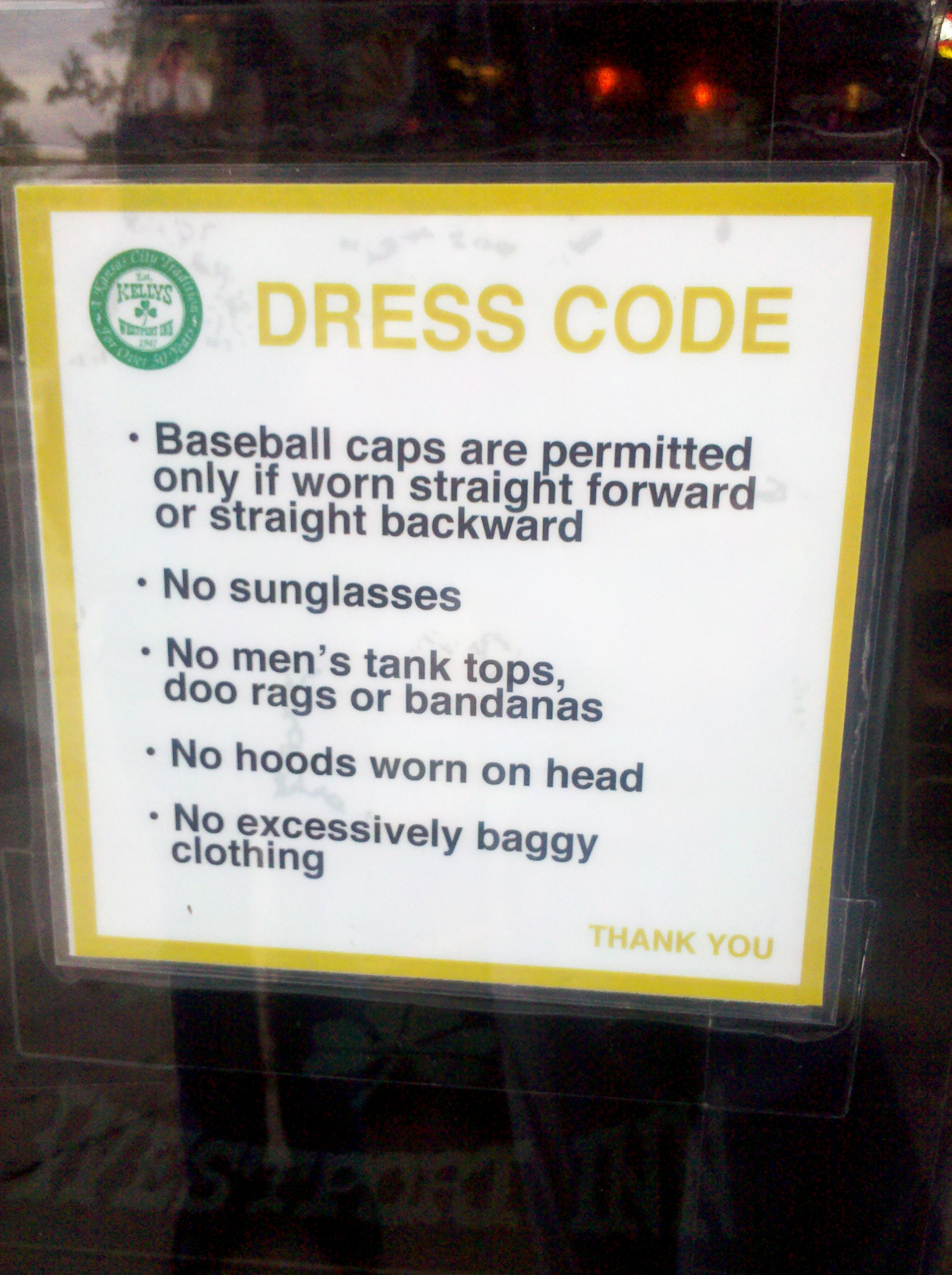
I was reminded of this incident when Stephen Wilson sent in photo of a similar dress code taken at Kelly’s in Kansas City.  Again we see racially-coded restrictions: the same no crooked hats rule, doo rags and bandanas are disallowed, as are hoods actually worn on the head (but not the preppy hoodies apparently), and “excessively” baggy clothes.

So, sure, Black people are allowed in these establishments, just not Black people “of a certain type.”  If they want to enter, they have to assimilate to white culture.  These dress codes seem to say:

Turn those hats on straight forward or straight back, pull up those pants, and take off whatever’s on your head!  It’s not that we don’t like Black people, we just prefer our Black people to defer to white standards.  See?  Not racist at all!  Cheers!

Lisa Wade, PhD is an Associate Professor at Tulane University. She is the author of American Hookup, a book about college sexual culture; a textbook about gender; and a forthcoming introductory text: Terrible Magnificent Sociology. You can follow her on Twitter and Instagram.