Search results for The


On this second-to-last day of Black History Month, let us return to posts past.

We have been urged to celebrate Black History Month…

<sarcasm> Good times. </sarcasm>

Lisa Wade, PhD is an Associate Professor at Tulane University. She is the author of American Hookup, a book about college sexual culture; a textbook about gender; and a forthcoming introductory text: Terrible Magnificent Sociology. You can follow her on Twitter and Instagram.
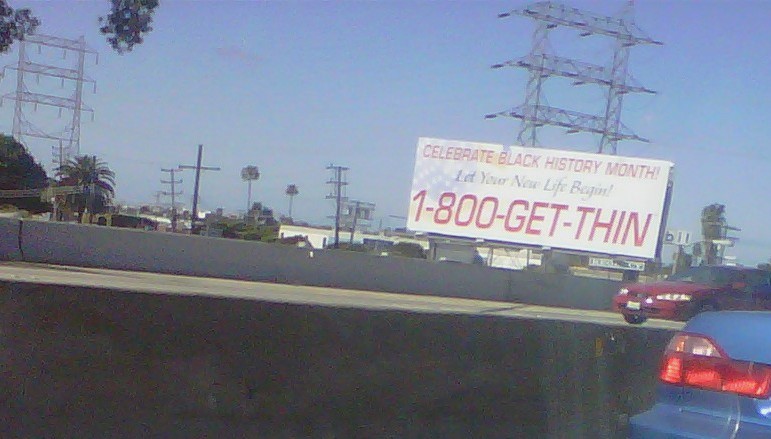
My Occidental College colleague, politics professor Caroline Heldman, snapped this photograph of a billboard on an L.A. freeway.  It suggests that one may celebrate Black History Month by calling 1-800-GET-THIN.  The billboard is another stunning example of the trivialization of black history by companies using it only as an excuse to market their product or service.

Lisa Wade, PhD is an Associate Professor at Tulane University. She is the author of American Hookup, a book about college sexual culture; a textbook about gender; and a forthcoming introductory text: Terrible Magnificent Sociology. You can follow her on Twitter and Instagram.
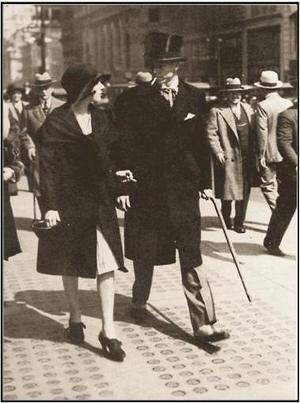
Edward Bernays (1891-1995) is largely considered the founder of public relations (or “engineering consent,” as he called it) but is not known very well outside of the marketing and advertising fields. A nephew of Sigmund Freud, Bernays was the first to theorize that people could be made to want things they don’t need by appealing to unconscious desires (to be free, to be successful etc.). Bernays, and propaganda theorist Walter Lippman, were members of the U.S. Government’s Committee on Public Information (CPI), which successfully convinced formally isolationist Americans to support entrance into World War I. While propaganda was commonly thought of as a negative way of manipulating the masses that should be avoided, Bernays believed that it was necessary for the functioning of a society, as otherwise people would be overwhelmed with too many choices. In his words:

Modern propaganda is a consistent, enduring effort to create or shape events to influence the relations of the public to an enterprise, idea or group.

[Source: Bernays, Propaganda, 1928, p. 52; available here.]

After WWI, Bernays was hired by the American Tobacco Company to encourage women to start smoking. While men smoked cigarettes, it was not publicly acceptable for women to smoke. Bernays staged a dramatic public display of women smoking during the Easter Day Parade in New York City. He then told the press to expect that women suffragists would light up “torches of freedom” during the parade to show they were equal to men. Like the “You’ve come a long way, baby” ads, this campaign commodified women’s progress and desire to be considered equal to men (relevant clip starts at 3:00):

“Cigarettes were a symbol of the penis and of male sexual power…Women would smoke because it was then that they’d have their own penises.”

Here are some of the news photographs of women smoking publicly during the Easter Parade:

[Photos via.]

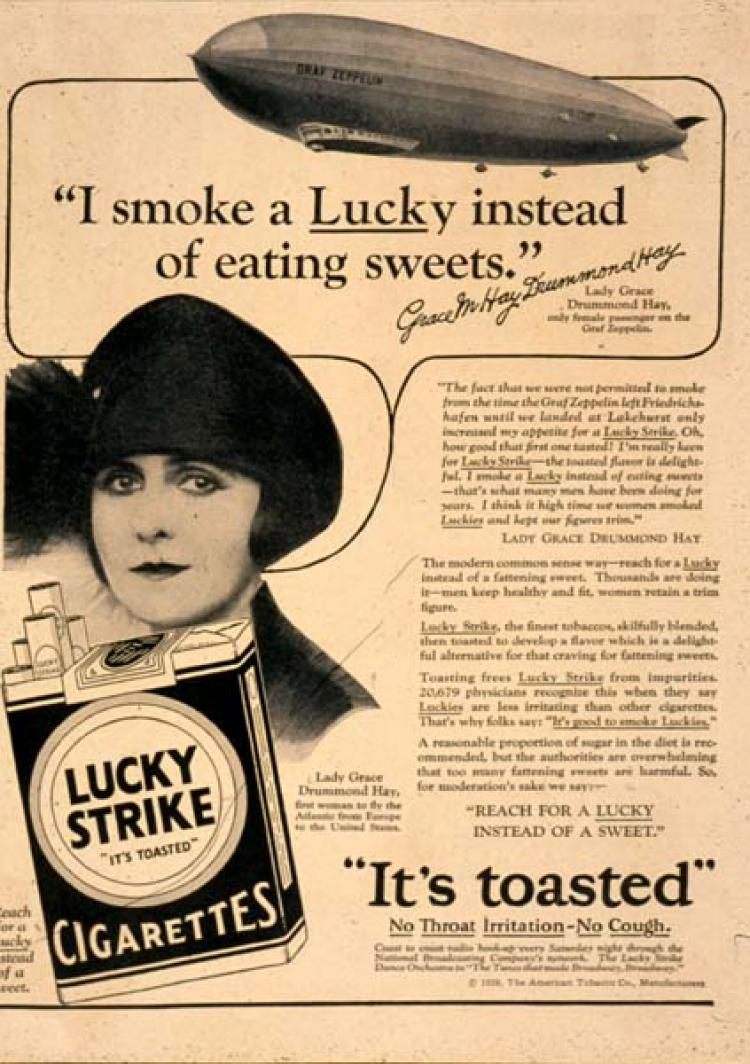
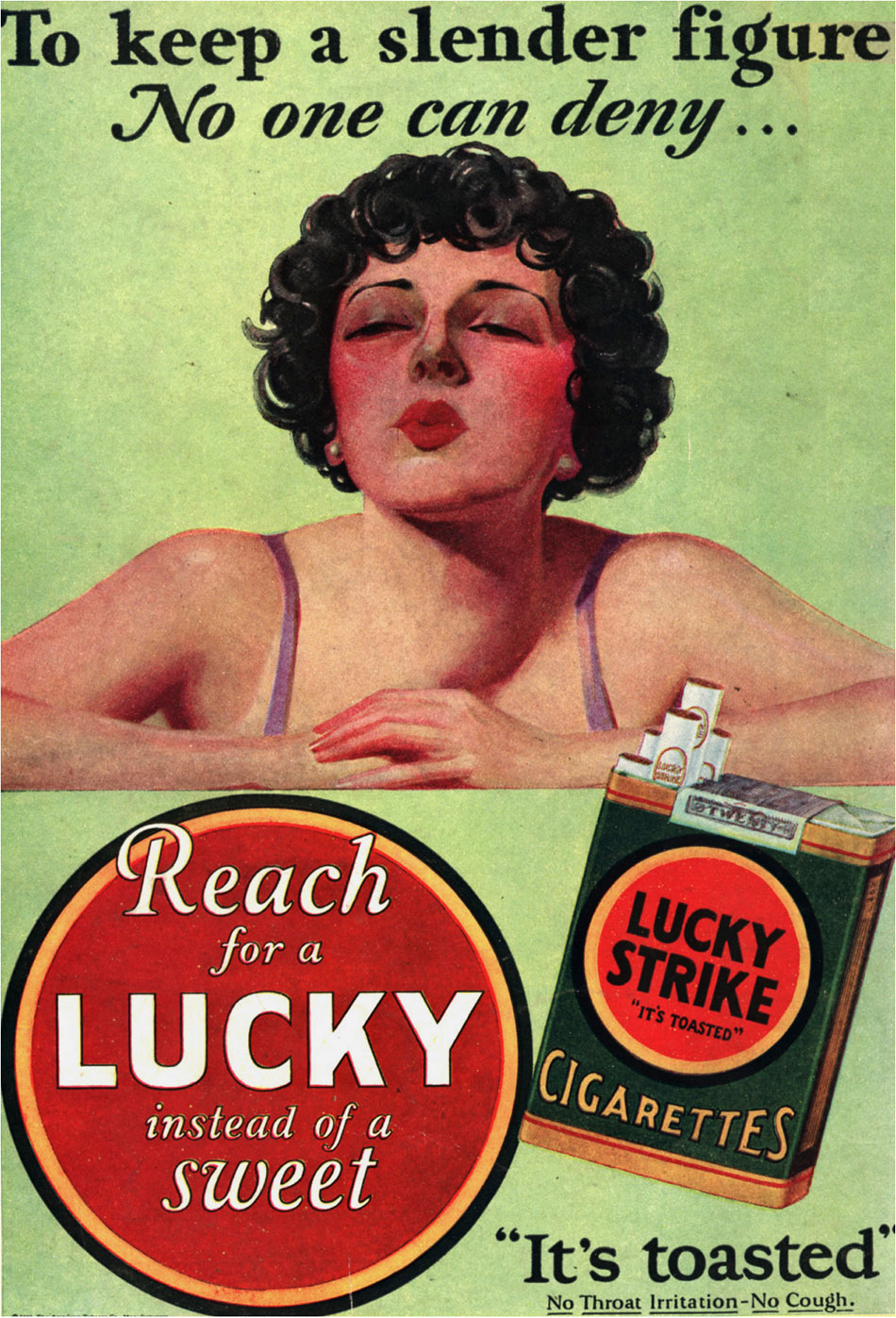
The campaign was considered successful as sales to women increased afterward. Cigarette companies followed Bernays’s lead and created ad campaigns that targeted women. Lucky Brand Cigarettes capitalized on recent fashions for skinny women by telling women to “Reach for a Lucky instead of a sweet”:

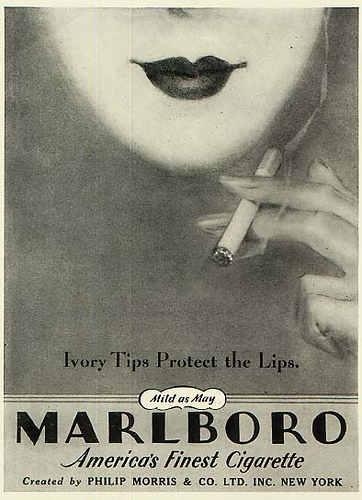
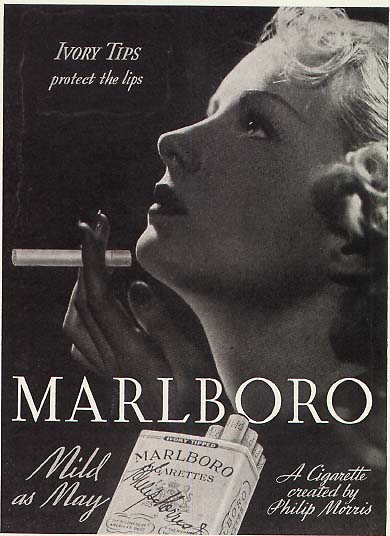
Marlboro, in stark contrast to the Marlboro Man ads we’re familiar with today, started the “Mild as May” campaign to encourage women to take up smoking cigarettes that were appropriately mild and easier to smoke:


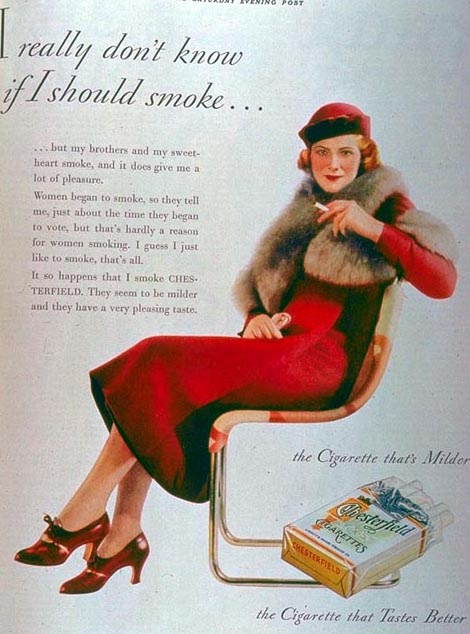
Chesterfield, in a 1930s ad, argued that “women started to smoke…just about the time they began to vote”:

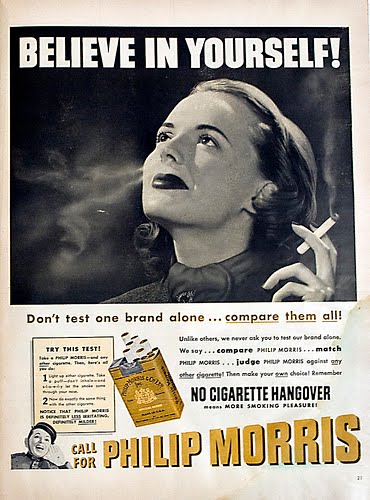
A later ad for Phillip Morris tells women to “Believe in yourself!”

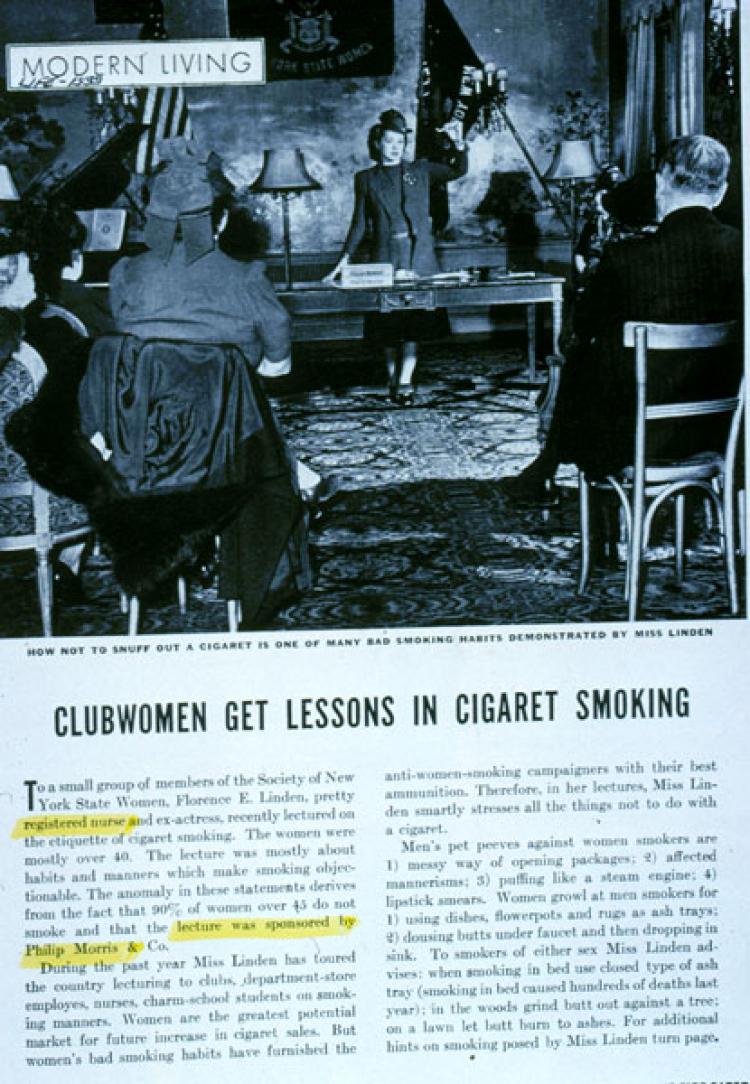
Cigarette makers also worked to teach women how to smoke properly. Ads often depicted women in the act of smoking. Some companies, like Philip Morris, even held smoking demonstrations for women:
[Via.]

The article describes how a “pretty registered nurse” is touring the country to teach women proper smoking etiquette. The article also lists “men’s pet peeves” and “women’s pet peeves” for men and women smokers. (Full text after the jump below.)

Together, these efforts to conflate smoking with freedom and make smoking acceptable for women created a new set of consumers and reinforced Bernays’s argument that demand could be created.

more...

On the heels of our guest post describing the surprising rise in hypersexually-objectified women on the cover of Rolling Stone, comes troubling research out of cognitive neuroscience, sent in by Dolores R.

Mina Cikara and colleagues did a series of experiments — using Implicit Association and fMRI — to test whether sexist and non-sexist men’s cognition varied when looking at sexualized versus non-sexualized images of women. In fact, when men who tested high on a scale of sexism were shown images of sexualized women, they associated them more easily with words that implied an objectified “thing” than a thinking “person.” This was reflected in the fMRI study.

The take home message? When sexist men are exposed to strongly sexualized messages, they are inclined to dehumanize women, to see them as things.  Seeing someone as a thing is the first step towards treating her like her desires, thoughts, and preferences do not exist (because objects don’t think).  In other words, it facilitates sexual assault.

So… hmmmm… who to pick on here.  How about American Apparel…

American Apparel, this is brain poison (after the jump; NSFW):

more...

Here’s another one for our collection of instances in which we describe light tan as “nude,” “skin-,” or “flesh-colored” (symbolically erasing the existence of people without light tan skin).  Yahoo’s OMG! describes uses the word “nude” to describe the color of Lil’ Kim shirt.

It’s always particularly amazing when they use the word to talk about something a black person is wearing.  Like, um, Michelle Obama.

For more examples, see our posts on products designed for white people, the widespread use of such language to describe light tan in the fashion world,  and lotion marketed as for “normal to darker skin.” See also our Contexts essay on race and “nude” as a color.

For contrast, see this post about how the generic human in Russian cartoons is colored black instead of white.

Lisa Wade, PhD is an Associate Professor at Tulane University. She is the author of American Hookup, a book about college sexual culture; a textbook about gender; and a forthcoming introductory text: Terrible Magnificent Sociology. You can follow her on Twitter and Instagram.

The New York Times recently ran an  interesting story on prison cemeteries in Texas.  For about $2,000, the state buries about 100 inmates a year. They die of lethal injection, old age, or illness, but they’re all dressed in dark pants, a white shirt, and tie, and are buried with a prayer from the prison chaplain.

When inmates die in custody, their bodies are sometimes unclaimed.  This may be because they have no family at all, or their family members don’t wish to claim the body.   Other times the inmate is cared for by family members who simply can’t afford to bury the person themselves.  So, occasionally the family members will decline to claim the body, but show up on the day of the burial to pay their respects.

Lisa Wade, PhD is an Associate Professor at Tulane University. She is the author of American Hookup, a book about college sexual culture; a textbook about gender; and a forthcoming introductory text: Terrible Magnificent Sociology. You can follow her on Twitter and Instagram.
Paula F. sent in a link to Babble.com’s list of the top 100 ‘mom blogs’ of 2011.  Mom blogs have become wildly popular in recent years as a way to document and comment on the experience of motherhood, and this particular list illustrates some interesting things about social privilege.  Paula was struck by the lack of racial diversity among the selected blogs and noted how women of color are vastly underrepresented.   For example, only 7 of the blogs are written by African-American moms, and 4 of those refer to the mother’s race in the title (although the same is not true for any of the blogs written by white women).

A quick review of the blogs reveals some other interesting issues related to social privilege and motherhood.  In addition to the lack of racial diversity, the blogs included in the list show very little variation in terms of class, sexuality, age, and marital status.   (The blogs were chosen by a panel of “experts” that took into consideration nominations from Babble readers, so it’s unclear how representative they are of mom blogs in general.)

While there is the more obvious privilege of the “digital divide,” or the disparate access that people have to technology and the internet, there is also privilege in having the spare time to devote to intensive writing/blogging and the connections necessarily to draw sponsorship and advertising.  Moreover, while some of the selected blogs do offer narratives that deviate from traditional ideas about mothering and motherhood (for example, several blogs discuss mental health issues, the struggles of parenting, and forming blended families), they nonetheless reproduce a narrow image of who mothers are, what they look like, and what they do.

 ————————

Christie Barcelos is a doctoral student, a mom, and a blogger, but not really a mom blogger.


Happy Fat Tuesday to all our friends in New Orleans! Don’t do anything we wouldn’t do!

If you’re not in the middle of the revelry, enjoy these Mardi Gras posts from previous years:

Lisa Wade, PhD is an Associate Professor at Tulane University. She is the author of American Hookup, a book about college sexual culture; a textbook about gender; and a forthcoming introductory text: Terrible Magnificent Sociology. You can follow her on Twitter and Instagram.