Search results for The

In 1964, in Jacobellis v. Ohio, a case regarding an allegedly obscene film, Supreme Court Justice Stewart Potter Stewart famously wrote in his opinion,

I shall not today attempt further to define the kinds of material I understand to be embraced within that shorthand description [of hard-core pornography]…But I know it when I see it…

Of course, the problem is that not everyone has the same reaction to what they see. While the 1964 case specifically dealt with a film, and a judgment on whether it crossed the line from pornographic (legal) to obscene (not), similar arguments are common regarding what is appropriate on TV. The Federal Communications Commission may impose penalties, including large fines or revoking a broadcaster’s license, on networks that air “indecent or profane programming during certain hours.” Last month the Supreme Court agreed to hear a case regarding the FCC’s regulations and whether they violate free speech guarantees.

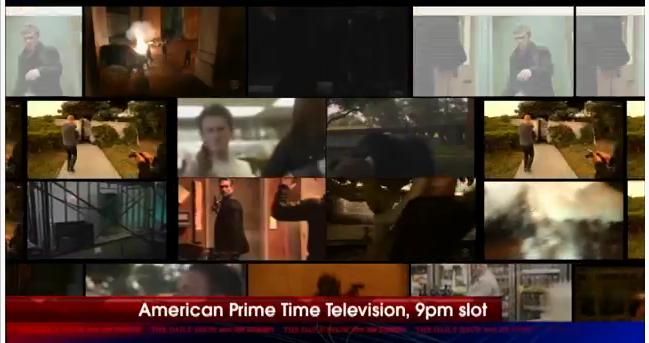
Dmitriy T.M. sent in a segment from The Daily Show that highlights some of the inconsistencies and contradictions in the FCC’s standards for prime time, and the seeming arbitrariness of decisions about what is “indecent”:
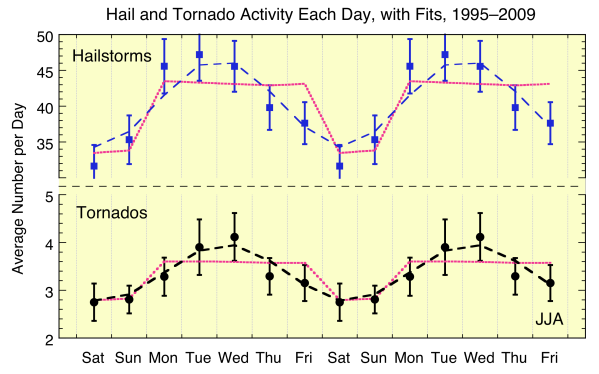
I’m a particular fan of looking at ways that society and nature intersect and a new study is a fantastic example.  Analysis of 15 years of storm data revealed that twisters and hailstorms were significantly more likely to occur during the week as compared to weekends.

According to the authors, Daniel Rosenfeld and Thomas Bell, the cause is pollution caused by commuting.  Charles Choi, writing for National Geographic, explains:

…moisture gathers around specks of pollutants, which leads to more cloud droplets. Computer models suggest these droplets get lofted up to higher, colder air, leading to more plentiful and larger hail.

Understanding how pollution can generate more tornadoes is a bit trickier. First, the large icy particles of hail that pollutants help seed possess less surface area than an equal mass of smaller “hydrometeors”—that is, particles of condensed water or ice.

As such, these large hydrometeors evaporate more slowly, and thus are not as likely to suck heat from the air. This makes it easier for warm air to help form a “supercell,” the cloud type that usually produces tornadoes and large hail.

So, there you have it. No need to choose between nature and nurture. We interact with our environment and shape it, just as it shapes us.

(Via BoingBoing.)

Lisa Wade, PhD is an Associate Professor at Tulane University. She is the author of American Hookup, a book about college sexual culture; a textbook about gender; and a forthcoming introductory text: Terrible Magnificent Sociology. You can follow her on Twitter and Instagram.

When I learned of Whitney Houston’s untimely death, I was in the process of re-reading James Baldwin’s short story “Sonny’s Blues.” Sonny, like so many entertainers struggled with addiction and the rigors of being an artist. I couldn’t help but think of Whitney. The tragedy of her death has resonated throughout our culture in both artistic and social contexts. It also ripped the curtain off the destructive underbelly of celebrity and its trappings.

We engage in the public consumption of images of the rich and famous as a way of life now. They live under an intensely bright and hot spotlight. Baldwin relates this quite eloquently.  In the process of Sonny’s recovery from heroin addiction, he returns to doing what he loves best –playing jazz piano. Sonny’s older brother agrees to accompany him to one of his performances. The brother, seated in a dark corner of the club, watches Sonny and his band mates prepare to perform. While sitting there he contemplates just how many of them have struggled with addiction like Sonny and how they would negotiate Sonny’s homecoming performance. The narration reads:

Then I watched… while they horsed around, standing just below the bandstand. The light from the bandstand spilled just a little short of them and, watching them laughing and gesturing and moving about, I had the feeling that they, nevertheless, were being most careful not to step into that circle of light too suddenly; that if they moved into the light too suddenly, without thinking, they would perish in flame.

Baldwin provides a powerful metaphor for the dangers of the spotlight and stepping into it too soon. When I read that passage, I thought of this image of Whitney from her 2009 American Music Awards performance. She sang “I Didn’t Know my Own Strength.” It was a “comeback” performance in which Whitney was trying to reclaim her image. She is wearing white, which looks absolutely beautiful against her cinnamon caramel skin. The stage is black and Whitney is lit from the back with a piercingly bright spotlight. In that moment we can see her balancing darkness with light, hope with pain, insularity with exposure.

We loved her voice. We rooted for her comeback. But perhaps she moved into the spotlight too suddenly. Perhaps the flame from the light burned her in places no one could see. As I write this, there have been no rulings on the cause of her death. So I do not want to speculate what contributed to her untimely passing. But I love this image because it is how I would like to remember Whitney. Regal, angelic, light and dark, embodying the very essence of humanity and its many contradictions.

————————

Stacie McCormick, PhD, is a literature scholar whose work focuses primarily on African Diaspora and Women’s literature. Presently she is working on a project exploring the black female body and how it is represented in print and visual culture (photographs, artist renderings, the theatrical stage, etc.).

Lisa Wade, PhD is an Associate Professor at Tulane University. She is the author of American Hookup, a book about college sexual culture; a textbook about gender; and a forthcoming introductory text: Terrible Magnificent Sociology. You can follow her on Twitter and Instagram.

Cross-posted at Compassionate Societies.

new study from Pew, based upon a large national survey, found that people reported a lot more cruelty and the absence of kindness that many would expect. This implies that social networking sites (SNS) could use a lot more compassion.

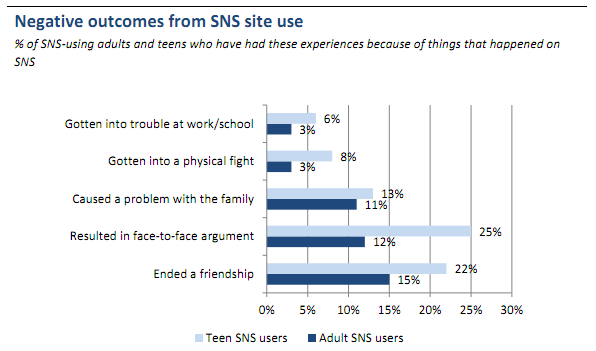
Among adults, 85% say that their experience on the sites is that people are mostly kind. Fewer teens said the same, only 69%.  More, social networking sites contributed to real life problems: including arguments and physical fights with friends, family members, teachers, or co-workers.  In all categories, teens were about twice as likely to report that SNS got them into trouble:

Racial minority populations encountered an even more cruel environment on SNS. Forty-two percent of Black and 33% of Hispanic SNS users said they frequently or sometimes saw language, images, or humor that they found offensive, compared with 22% of White SNS users.

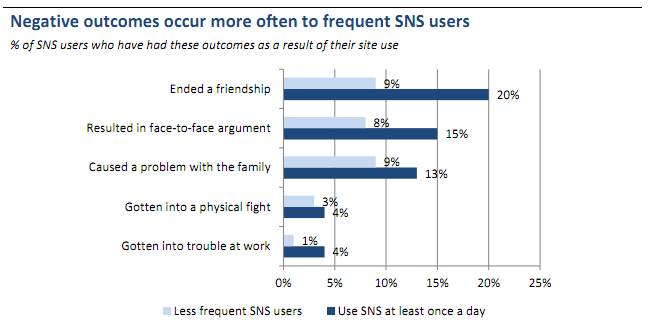
Interestingly, people who used social networking sites on a daily basis were far more likely to report experiencing negative things:

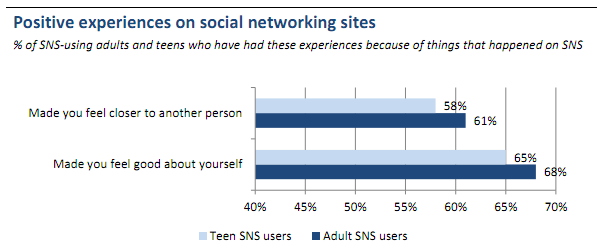
SNS users also reported positive experiences, suggesting that, for many, social networking is a mixed bag of good and bad:

————————

Ron Anderson, emeritus professor of sociology at the University of Minnesota, has written many books and hundreds of articles, mostly on technology. In his retirement, he is doing research and writing on compassion and suffering and maintains the website CompassionateSocieties.org.

One thing I love about sociology is the way it recognizes human creativity.  It acknowledges our ability to create meaning and invent practices.  Seeing the footage below, I couldn’t help but be amazed at the human ability to constantly innovate.

Via BoingBoing.

Lisa Wade, PhD is an Associate Professor at Tulane University. She is the author of American Hookup, a book about college sexual culture; a textbook about gender; and a forthcoming introductory text: Terrible Magnificent Sociology. You can follow her on Twitter and Instagram.

During half time of the 2012 Super Bowl, a commercial aired that represents a direct attack against unions and serves as an excellent demonstration of the use of ideology to promote false consciousness. The supposed union workers in the ad complain about unions taking such high union dues and state that they did not vote for the union, suggesting that they don’t want the union and that it does not represent their interests. The commercial’s narrator says “only 10% of people in unions today actually voted to join the union” and encourages people to support the Employee Rights Act, a bill that would make it much harder for workers to join unions and easier to de-certify existing ones (click here if the video isn’t embedding correctly):

The commercial was created by the anti-union Center for Union Facts, an astroturf organization founded by DC lobbyist Richard Berman and supported by big business interests. Astroturf organizations are advocacy groups promoting a political or corporate agenda but designed to make it appear like a grassroots movement. Note that one of the union “actors” in the video is played by Berman himself. These photos show Berman as he appears in the ad and in his normal attire as an anti-union lobbyist:

[Via Republic Report.]

Federal law requires that at least 50% of a company’s workforce vote in favor of the formation of a union, and most union members join unions formed years before, so it’s not surprising that many workers today weren’t involved in the votes that founded their unions. Furthermore, according to independent analysis by the Economic Policy Institute, laws like the Employee Rights Act hurt workers by leading to lower pensions; workers in unions actually have higher wages and health benefits because they can use their collective bargaining power to improve their working conditions.

In The German Ideology, Karl Marx argued that “The ideas of the ruling class are in every epoch the ruling ideas … The class which has the means of material production at its disposal, has control at the same time over the means of mental production.”  This ad demonstrates the use of ideology, or dominant ideas that help to perpetuate inequality. An advertisement (which cost about $3.5 million to air during the Super Bowl) produced by a large corporate-funded organization is meant to shape workers’ perception of unions in a negative light. With greater wealth (“the means of production”) and access to media (“the means of mental production”), they seek to discourage workers from joining unions, or even to leave those they are already members of, in hopes of making them easier to control. Ultimately, the goal is to convince workers to accept the ideology of the ruling class and act against their own class interests.

—————

Paul Dean is a PhD candidate in sociology at the University of Maryland. His research focuses on social inequality, including his dissertation which examines social responsibility movements that promote more socially responsible and sustainable business practices. He is also co-founder and co-editor of The Sociological Cinema.

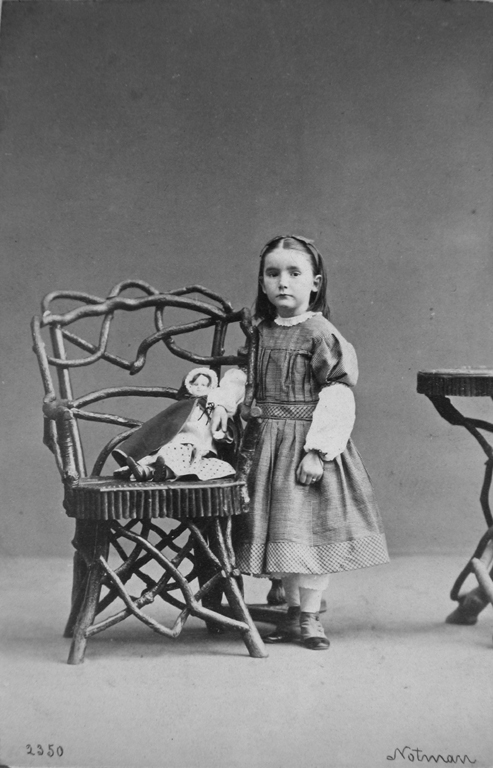
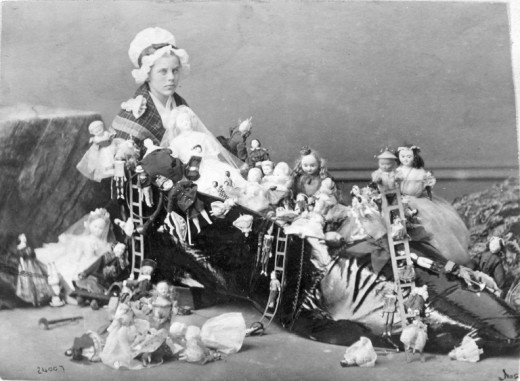
Retronaut recently posted a fun collection of vintage photographs of children posing with toys. What makes them interesting is how unhappy they look from a contemporary point of view: confused, bored, even morose.  Thinking through the vintage photographs you have in your mind’s eye, though, you’ll recall that almost all vintage photographs include blank faces.  No smiling, no bunny ears… just people.

The contrast between then and now reveals that how-to-act-when-someone’s-taking-your-picture is a social construction. Smiling didn’t come naturally, it had to evolve socially.  Today parents teach their children how to smile for photographs and, perhaps, even to act gleeful with toys.

More at Retronaut.

UPDATE: There’s a great conversation going on in the comments.  Some have pointed out that early photograph technology required a long exposure time, making smiling impractical.  Others are sharing their experiences in other countries, where it is still the norm to stop smiling when the camera comes out, even if everyone is having a jolly time.  Lots of stuff to think about…

Lisa Wade, PhD is an Associate Professor at Tulane University. She is the author of American Hookup, a book about college sexual culture; a textbook about gender; and a forthcoming introductory text: Terrible Magnificent Sociology. You can follow her on Twitter and Instagram.

Cross-posted at The Russell Sage Foundation.

Claude Steele and his colleagues have found ample evidence of “stereotype threat” in test-taking situations.  Stereotype threat occurs when people worry that poor performance on a task will inadvertently confirm a negative stereotype applied to the group to which they belong.  Their worry depresses performance, thus creating outcomes consistent with the stereotype. Stereotype threat depresses the performance of high-achieving African American students on difficult verbal tests as well as accomplished female math students on difficult math tests.

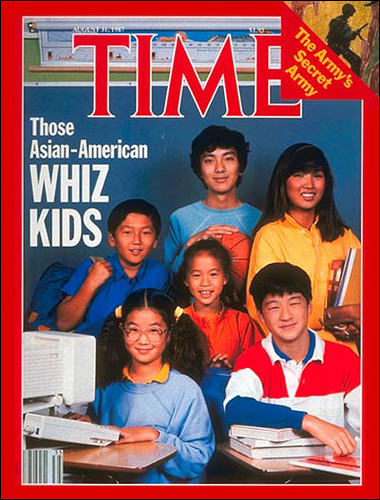
Not all stereotypes are negative, however, suggesting that certain stereotypes might also enhance performance.  With Min Zhou, I looked into how the stereotype that Asian Americans students are particularly smart and high achieving — as illustrated in this TIME magazine cover from 1987 — might shape their performances.

We argue that Asian American students benefit from a “stereotype promise”—the promise of being viewed through the lens of a positive stereotype that leads one to perform in such a way that confirms the positive stereotype, thereby enhancing performance.  The Chinese- and Vietnamese-Americans students we studied described how their teachers assumed that they were smart, hard-working, and high-achieving, which affected the way that their teachers treated them, the grades they received, and their likelihood of being placed into the most competitive academic tracks, like Advanced Placement (AP) and Honors. For many students, stereotype promise exerted an independent effect, and boosted performance.

For example, Ophelia is a 23 year-old second-generation Vietnamese woman who described herself as “not very intelligent” and recalls nearly being held back in the second grade. By her account, “I wasn’t an exceptional student; I was a straight C student, whereas my other siblings, they were quicker than I was, and they were straight A students.”

Despite Ophelia’s C average, she took the AP exam at the end of junior high school, and not surprisingly, failed. Nevertheless, she was placed into the AP track in high school, but once there, something “just clicked,” and Ophelia began to excel in her classes. When we asked her to explain what she meant by this, she elaborated, “I wanted to work hard and prove I was a good student,” and also added, “I think the competition kind of increases your want to do better.” She graduated from high school with a GPA of 4.2, and was admitted into a highly competitive pharmacy program.

Once she was placed in a more challenging setting, then, where teachers’ expectations and peer performance were elevated, she benefited from stereotype promise. Ophelia did not believe at the outset that she was academically exceptional or deserving of being in the AP track (especially because she earned straight C’s in junior high school and failed the AP exam), but once anointed as academically exceptional and deserving, the stereotype promise exerted an independent effect that encouraged her to try harder and prove that she was a good student, and ultimately enhanced her performance.  While it is impossible to know how Ophelia’s academic performance would have differed had she stayed on the school’s “regular track,” that she was given the opportunity to meet her potential attests to the advantage that Asian American students are accorded in the context of U.S. schools.

In future research, I plan to study in what institutional contexts “stereotype promise” may emerge, for which groups, and in what domains. For example, males may benefit from stereotype promise in certain occupational niches where stereotypes about gender and performance prevail.

—————————–

Jennifer Lee is a sociologist at the University of California, Irvine, specializing in intersection of immigration and race and ethnicity. She wrote, with Frank Bean, a book called The Diversity Paradox, that examines patterns of intermarriage and multiracial identification among Asians, Latinos, and African Americans.

Read a Q&A on with Jennifer Lee about “stereotype promise” at the Russell Sage Foundation.