Search results for The

Previous posts related to St. Patrick’s Day:

See also, Gingerism.

Lisa Wade, PhD is an Associate Professor at Tulane University. She is the author of American Hookup, a book about college sexual culture; a textbook about gender; and a forthcoming introductory text: Terrible Magnificent Sociology. You can follow her on Twitter and Instagram.
In honor of St. Patrick’s Day tomorrow, I thought I’d re-post this one from 2010…

Some recent ads making fun of redheads has brought gingerism — or hateful attitudes and behavior towards people with red hair, light skin, and freckles — into the news lately.

It appears to be an ongoing form of discrimination, especially in Britain.  Men and boys appear to be more frequent targets than women and girls, who at least are sometimes seen as uniquely beautiful.  A recent series of verbal and physical attacks  is nicely documented at Wikipedia.  They include a stabbing, a family who has had to move twice after their children were bullied, a woman who won a sexual harassment suit after being targeted for her red hair, and a boy who committed suicide after being teased relentlessly.

The prejudice may be related to the long-standing antagonism between Britain and Ireland; discrimination against the Irish by the British crossed the Atlantic with early Americans.  As late as the 1800s the Irish were demeaned, negatively stereotyped, and compared with apes in the United States.

Katrin brought our attention to this ad for Tesco. Tesco voluntarily withdrew their ad after complaints. And an ad for npower generated a handful of complaints to the Advertising Standards Authority.  The Authority declared that the humor was unlikely to cause widespread offense (BBC).

Katrin also sent in M.I.A.’s video for the song “Born Free.” It was pulled from YouTube for excessive violence and inappropriate content. Among other themes, it shows red-headed, freckled adolescents being rounded up by the police (this becomes clear at about 2:45), taken out to a deserted area, shot at or bombed, and physically attacked. The video is supposed to highlight ethnic cleansing, though a number of critics argue the gratuitous violence overshadows any political point. It’s about 10 minutes long, but you don’t have to watch the whole thing to get the idea:

M.I.A, Born Free from ROMAIN-GAVRAS on Vimeo.

Lisa Wade, PhD is an Associate Professor at Tulane University. She is the author of American Hookup, a book about college sexual culture; a textbook about gender; and a forthcoming introductory text: Terrible Magnificent Sociology. You can follow her on Twitter and Instagram.

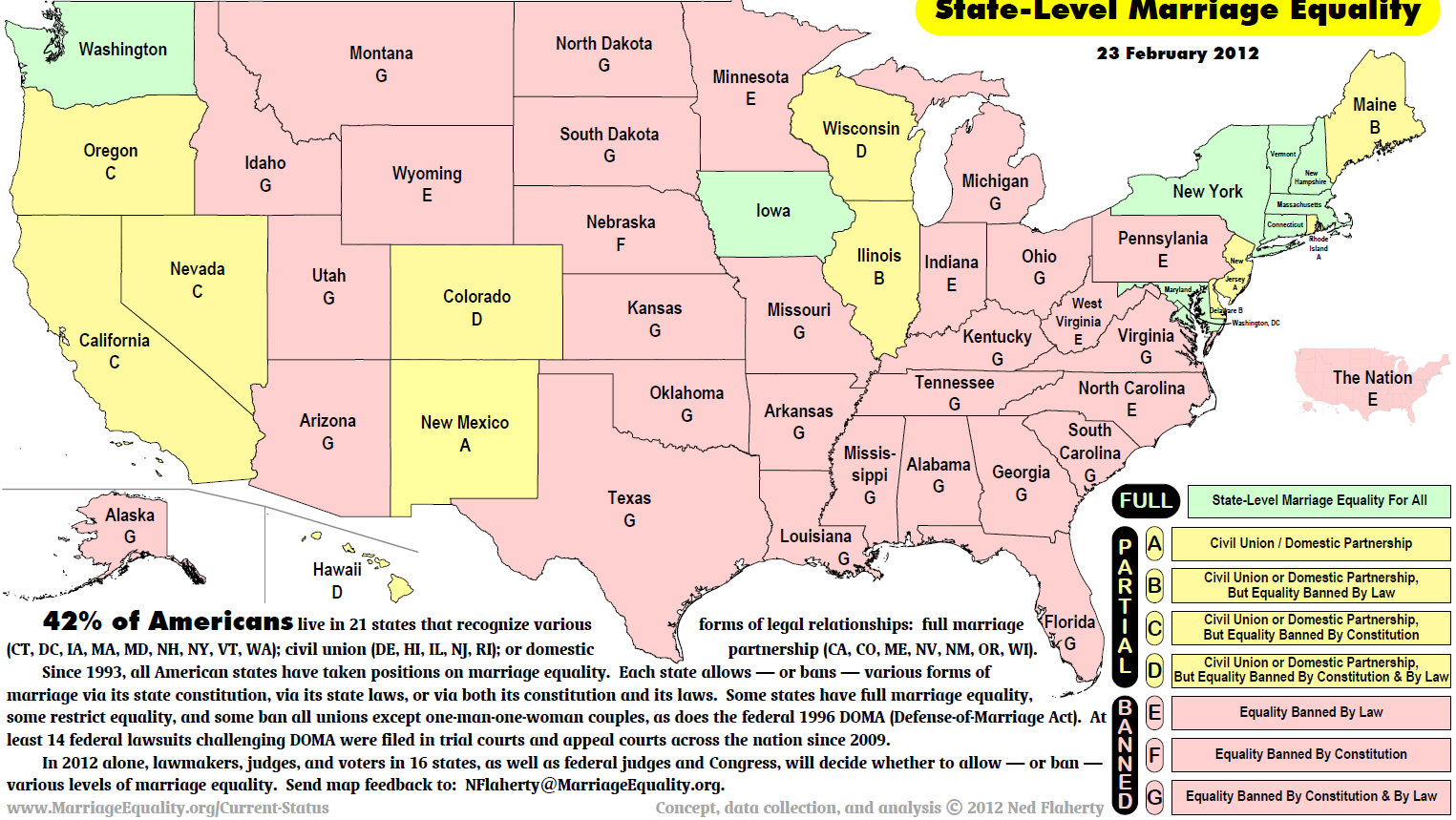
A little over a month ago I posted a map of the legal status of same-sex marriage throughout the U.S. It was soon made obsolete by the legalization of same-sex marriage in the state of Washington. In addition, several readers pointed out that the map hid important differences within categories.

Ned Flaherty, Project Manager of Marriage Equality USA, sent in a link to an updated and more comprehensive map at their site. Green states have fully legalized same-sex marriage; yellow states recognize domestic partnerships or civil unions; and pink states do not allow either. The lettered codes provide more information on exactly what the status is in each state:

Click on the map or go to their website to look at the much larger version; they also have a round-up of pending or possible legislation and court cases in various states.

Amid accusations of racism, the European Union (EU) has withdrawn a two-minute video designed to raise awareness about Neighbourhood Policy,” an approach to establishing “deeper relations” with neighboring state the need for unity among EU nations and acceptance of candidate states hoping to enter.  In the video, sent to us by Claire P., the EU is personified by a white woman, who is facing attacks from all sides.

Bruno Waterfield, writing for the Telegraph, describes the scene:

First the EU heroine… is menaced by a Chinese Kung Fu master. Then a second threat appears as a urbaned practitioner of Kalaripayattu, a southern Indian martial art, levitates towards her brandishing a scimitar.

As she turns to face the new menace, a third black assailant with dreadlocks cartwheels aggressively towards her before striking a Capoeira pose, the Brazilian martial art.

Here’s screenshots of all of them, but for the full effect, you’ve got to watch (if just for the music and sound effects):

At this point, the woman takes a deep breath, multiples to represent the many states in the EU, and models peaceful behavior that her would-be attackers adopt.

The EU is expressing surprise that a video featuring a peaceful white person and violent, dangerous dark-skinned people might be considered racist.  They have released a classic non-apology that privileges intent over impact, denies that the clip was actually racist (it has just been “perceived” so), and identifies the main problem as other people (who got all hypersensitive and “felt offended”):

The clip was absolutely not intended to be racist and we obviously regret that it has been perceived in this way. We apologise to anyone who may have felt offended. Given these controversies, we have decided to stop the campaign immediately and to withdraw the video.

UPDATE: Reader Katrin says the video was about increasing integration and cooperation of states and the European Commission’s enlargement policy, not about the “neighborhood” policy as reported by the Telegraph:,

It was for greater unity of existing EU member states (which is why the video is entitled “Growing Together”) and candidates for membership (which is why it says “the more we are the stronger we are”) in order to show a united front to the rising powers China, India and Brazil. It was intended to portray that if the EU acts united, then China, India and Brazil will be willing to engage with the EU constructively…Current candidates of accession are e.g. Iceland, Macedonia, Montenegro, Turkey and Serbia. Enlargement and unity as a tool for greater power when facing rising economies was the intended message of the clip, not the ENP.

Lisa Wade, PhD is an Associate Professor at Tulane University. She is the author of American Hookup, a book about college sexual culture; a textbook about gender; and a forthcoming introductory text: Terrible Magnificent Sociology. You can follow her on Twitter and Instagram.

The Paris School of Economics has posted a database, compiled by Facundo Alvaredo, Tony Atkinson, Thomas Piketty, and Emmanuel Saez, of the distribution of top incomes in a number of nations, with more on the way. Using income tax records, they provide a quick glance at concentration of income among the wealthy over decades (and in some cases, data extends back over a century). As the authors point out, there are limitations to using tax info to measure inequality, so it’s important to be aware of the limitations of this data series. Most obviously, individuals may take steps to hide their income to evade taxes, and the very wealthy may be particularly able to do so through the use of tax havens, etc. Also, tax policies change, so what counts as “income” at one point might not at another. The authors also had to contend with differences in the taxation unit (households vs. individuals) in different countries to provide some level of comparability.

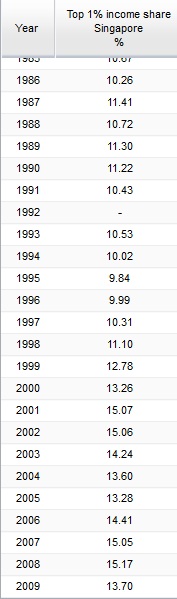
The database allows you to select a country, a time period, and a variable (top 5% income share, etc.), and get a table showing the results for all years in which data were available. Here, for instance, is part of the table for the share of income earned by the top 1% in Singapore:

Of course, this includes only data on income. In many countries, including the U.S., wealth (value of all assets) is significantly more concentrated than income.

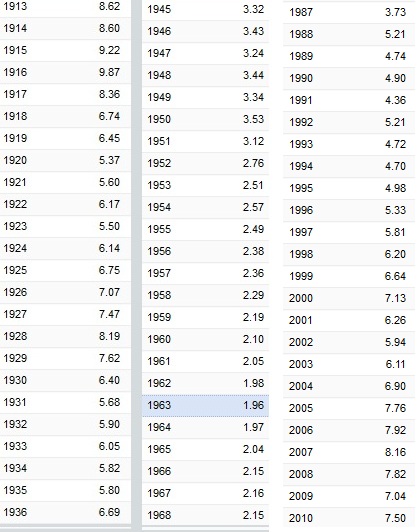
Looking at the dataset, you can see patterns over time. For instance, here’s part of the data from the U.S. (notice there are time gaps between the end of each column and the beginning of the next–I was just grabbing some illustrative screencaps), showing how the percent of income earned by the top 0.1% decreased significantly starting in the 1940s, but began creeping up again by the late 1980s and has grown since then:

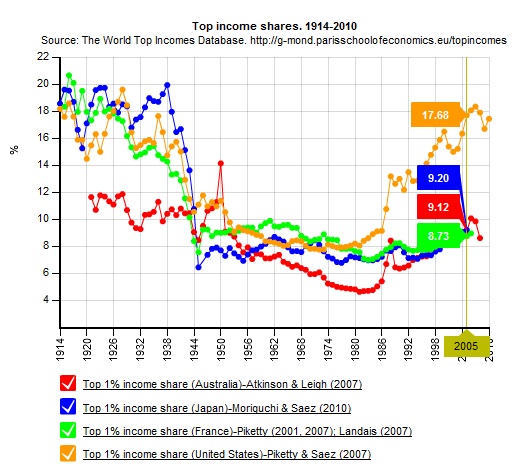
The site also allows you to create graphs. They provide a comparison of the share of income earned by the top 1% in 2005 in the U.S., Japan, Australia, and France, but you can look at data for individual nations:

It’s worth playing around a bit, but keeping in mind the caveats about what these data do and don’t tell us. Thanks to Shamus Khan for the tip!

A recent post on Boing Boing discussed the newly discovered “rules for jazz performers during the Nazi occupation.”  Jewish and Black people — two groups targeted by the Nazis — were also the primary innovators of jazz music. But even as the German state denigrated jazz, jazz musicians, and swing dancers, Nazi soldiers loved jazz!  How to handle such a contradiction? Rules for playing jazz music: no “Jewishy gloomy lyrics,”  no “Negroid excesses in tempo,” and no “hysterical rhythmic reverses characteristic of the barbarian races.”  

It’s well worth a look, as is this post from 2010 explaining how many groups vilified by Nazis survived the Holocaust by playing jazz for Nazi soldiers…

————————–

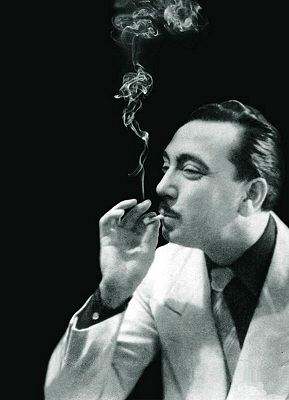
I have a favorite historical musician: Django Reinhardt.

Reinhardt was a Roma jazz musician. During World War II both Roma and jazz musicians were targeted by the Nazi regime. Over a million Roma were exterminated for presumed racial inferiority and jazz was believed to combine the worst of Blacks and Jews (i.e., “musical race defilement”). Just listening to a jazz record could get you sent to a concentration camp.

Reinhardt, however, enjoyed the most lucrative period of his career during the war, while living and playing openly among Nazi soldiers.

How?

Reinhardt biographer Michael Dregni, recently interviewed by NPR, explained:

The Germans used Paris basically as their rest-and-relaxation center, and when the soldiers came, they wanted wine and women and song. And to many of them, jazz was the popular music, and Django was the most famous jazz musician in Paris… And it was really a golden age of swing in Paris, with these [Romas] living kind of this grand irony.

Reinhardt, then, survived because the Nazis loved jazz music, even as Hitler censored the music and, on his orders, people who dared to listen to, dance to, or play it were encamped and members of the groups who invented it were murdered.  Irony indeed.

For more on Reinhardt, jazz, and World War II, here is a clip from a documentary on Reinhardt’s remarkable talent, career, and luck:

—————————

UPDATE: A commenter, Bernardo Soares, offered an interesting critique/clarification in the thread.  Here’s part of what he had to say:

…I think it is grossly misleading to write that Reinhardt “enjoyed the most lucrative period of his career during the war”. He enjoyed the protection of some individuals in the German occupation force. This is not so unusual — the composer Richard Strauss who headed the Reichsmusikkammer used his influence to protect some Jewish composers. But as many other examples show, this was extremely precarious. As long as these individuals had the power to protect him, he was probably relatively safe, but he could still be shot by any soldier at a whim or be accidentally included in a deportation action. Also, these individuals could lose their power, or some higher-ranking officer could order him to be deported. Reinhardt tried several times to escape occupied France.

[Also] …the whole issue of music and art politics in the Third Reich is much more complex than stated in the video. The Reichsmusikkammer (Reich Music Chamber) was not the only institution regulating music politics. As with many other bureaucratic institutions in the Third Reich, several agencies struggled for influence and power. This means that music politics was often contradictory, and the absence of a clear regulation as stated in the video opened the door for arbitrary measures – again emphasizing the precarious situation of musicians. The competition and struggle for power between different agencies led to a radicalisation of racial and cultural politics, and this was even taken further in the occupied countries.

I do love this topic.  I also have a post on racial borrowing and lindy hop, the dance that made me love Django.  A paper I wrote about gender and lindy hop can be found in the journal Ethnography. And I have a talk based on the paper that I love to give in theory classes.

Lisa Wade, PhD is an Associate Professor at Tulane University. She is the author of American Hookup, a book about college sexual culture; a textbook about gender; and a forthcoming introductory text: Terrible Magnificent Sociology. You can follow her on Twitter and Instagram.

Behold, I present to you a video parody of Lady Gaga’s “Bad Romance,” rewritten as “Bad Romance: Women’s Suffrage,” an account of the fight to get voting rights for women in the U.S.:

I just wanted you to know that this exists.

Lyrics and info available here. Thanks to Kristina Killgrove for the tip!

Gwen Sharp is an associate professor of sociology at Nevada State College. You can follow her on Twitter at @gwensharpnv.

Earlier this year we uncritically posted a spoken word poetry performance about prejudice against short men.  Geoffrey Arnold, who uses his blog, The Social Complex, to highlight heightism, had this to say about our tacit approval…

—————————

I’ve gotten some e-mails and criticism lately for an entry on this blog which was recently featured on the Sociological Images website.  In this entry, I posted a video of a Def Poetry Slam entitled “Death From Below” and asked the rhetorical question whether the video depicted “Short guys making fools of themselves?  Or poetry with a message, delivered through humor?”  I should have elaborated further, but I neglected to at the time.

The problem with Dan Sully & Tim Staffor’s poetry slam about being short is that it does not clearly convey the message that heightism is wrong.  In fact, as one commenter put it, the pair seem only to perpetuate numerous false stereotypes about short men.  Quite simply, the commentary which may underline their performance is too subtle for a general audience.  Instead of standing up for those who are the targets of height bigotry, it seems to me that these two are basically playing the role of the short male buffoon.  They are humiliating themselves and their bodies for the entertainment of others.  Any point which they are trying to make (and I’m not so sure that there is a point here) is lost in their performance.  Additionally, beyond their performance itself, some of their comments actually have the effect of supporting heightism instead of undermining it (“little man complex” as motivation for being healthy and “can’t date girls in heels people”).

Just the fact that they attempted to deliver their message through comedy is troubling when one considers that other groups rarely engage in this sort of behavior.  There is already a stigma against short men as people who are not to be taken seriously and so it doesn’t help when a short man publicly presents his body as a target for ridicule.

—————————

Geoffrey Arnold is an associate with a mid-sized corporate law firm’s Business Litigation Practice Group.  When Geoffrey isn’t chasing Billable Hours in the defense of white-collar criminals, he is most likely writing about social justice with a special emphasis on height discrimination at his blog: The Social Complex.  See also Geoffrey’s guest post introducing the concept of heightism as a gendered prejudice.