Search results for The

Cross-posted at Global Policy TV.

A great story at the New York Times, sent in by Katrin, reveals how the evolving science of marketing is creating its own set of challengers for advertisers.  Target, like many companies, tracks its customers purchases and uses the data to send packets of coupons tailored to individuals and households.  In this way, they tempt us into the store by offering us deals on things they know we want.

Target is also in the business of predicting what a person will want.  So the marketing company decided to try to use costumer shopping habits in order to predict pregnancy.  If they could start sending the woman baby-related before she started shopping for them in earnest, the company figured, she might end up always thinking of Target when she needed to spend money on the baby.

Using an algorithm that considered the purchasing patterns typical of newly pregnant women — e.g., prenatal vitamins, scent-free instead of scented lotion, a sudden uptick in the acquisition of cotton balls — they were able to make a pretty good guess as to whether a female customer was expecting.  Suddenly these women were getting coupons like this:
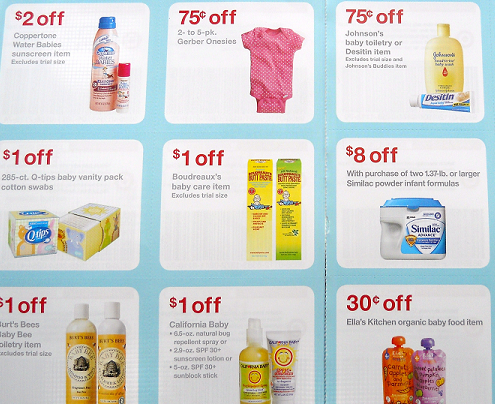
This caused two problems.

First was the father of the teenage girl who started getting coupons for diapers in the mail.  This led to an angry phone call to Target and, later, a chagrined apology by the stunned grandpa-to-be (story here).

The second was the reaction of the intended target, the expectant moms.  Some were pretty freaked out that Target knew they were pregnant!  It’s one thing, it turns out, for Target to know you like vanilla better than chocolate ice cream, or you fancy scented candles; it’s different, perhaps, to suddenly realize that it knows your you’re having a baby.  That could feel like a serious invasion of privacy.

So Target learned that the ability to predict our needs and desires comes with the need to do some psychological management as well. Accordingly, they began sneaking baby-related coupons into coupon books that also included other things.  So far, Target reports, these women are none the wiser… and thinking of Target as their one-stop baby shop.

Lisa Wade, PhD is an Associate Professor at Tulane University. She is the author of American Hookup, a book about college sexual culture; a textbook about gender; and a forthcoming introductory text: Terrible Magnificent Sociology. You can follow her on Twitter and Instagram.
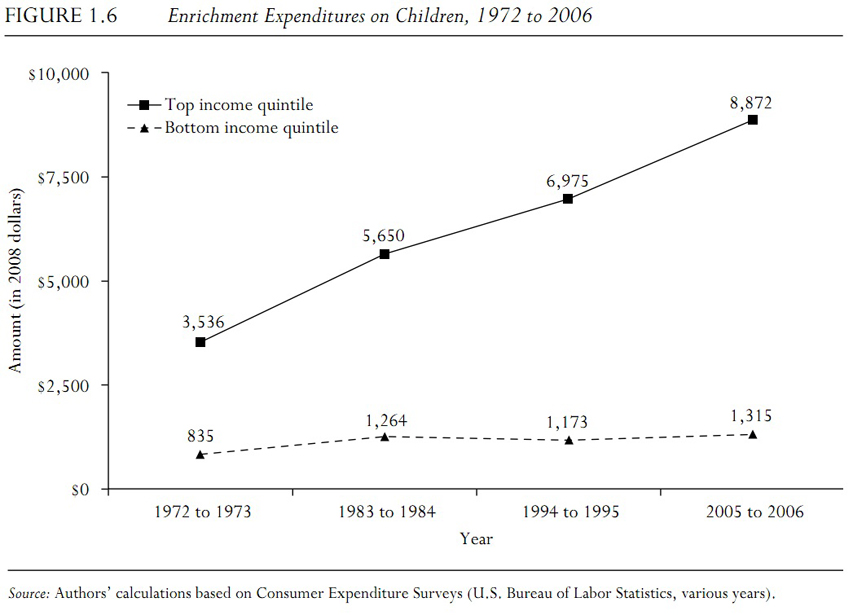
In her excellent article “Invisible Inequality: Social Class and Childrearing in Black Families and White Families,” Annette Lareau looks at differences in childrearing strategies, finding that class differences were more important than racial differences. Lareau argued that childrearing methods are one way in which class-based advantages are reproduced. Middle-class parents use a “concerted cultivation” model, which involved high levels of involvement in extracurricular activities. Working-class parents engaged in what Lareau calls an “accomplishment of natural growth” model, which emphasizes loving children and providing for them and giving children much more leisure time that is self-directed and unstructured. As Lareau writes,

Working-class and poor children spent most of their free time in informal play; middle-class children took part in many adult-organized activities designed to develop their individual talents and interests. (p. 761).

There are downsides to the concerted cultivation model. The range of activities children are involved in “dominate family life and create enormous labor, particularly for mothers” (p. 748). The emphasis on organized activities led to generally weak family ties, as well as weak social ties more generally, since they were based on participation in activities (extracurricular sports, classes, etc.) that have high turnover rates in membership and often last a few weeks regardless. However, Lareau argues that the concerted cultivation model ultimately transmits class advantages, given that the behaviors and assumptions it socializes children into prepare them well for a social world dominated by other middle-class professionals. And she argues that these different models are not just based on preferences; existing class inequalities make it much more difficult for working-class parents to follow the concerted cultivation model:

Enrollment fees that middle-class parents dismissed as “negligible” were formidable expenses for less affluent families…Moreover, families needed reliable private transportation and flexible work schedules to get children to and from events. These resources were disproportionately concentrated in middle-class families. (p. 771)

The Russel Sage foundation recently posted a graph that highlights class differences in spending on activities and products meant to aid child development, learning, and general enrichment. The graph, from Whither Opportunity? Rising Inequality, Schools, and Children’s Life Chances, shows how the gap in spending on such items — which includes things such as tutoring, private schooling, summer camps, high-quality childcare, and computers — has grown between the poorest and wealthiest Americans in recent decades, illustrating Lareau’s argument about differential access to the products and activities central to the concerted cultivation model:

Full cites:

Greg J. Duncan and Richard J. Murnane. 2011. Whither Opportunity? Rising Inequality, Schools, and Children’s Life Chances, ed. Greg Duncan and Richard Murnane. NY: Russell Sage. [Graph from p. 11.]

Annette Lareau. 2002. “Invisible Inequality: Social Class and Childrearing in Black Families and White Families.” American Sociological Review 67(5): 747-776.

Gwen Sharp is an associate professor of sociology at Nevada State College. You can follow her on Twitter at @gwensharpnv.

SocImages Meet Up in the Twin Cities!

On the weekend of April 2oth Gwen and I will be visiting the University of Minnesota to attend the Sociology Research Institute and humbly accept an award on behalf of SocImages.  We’d love it if you’d come and celebrate with us on Saturday, April 21st 6pm to 8pm.  Stay tuned for a location…

Social Media ‘n’ Stuff:

Please feel free to follow SocImages on TwitterFacebookGoogle+, and PinterestGwen and I and most of the team are also on Twitter, too.

Upcoming Lectures and Appearances:

Next month I’ll be giving my talk about hook up culture at CSU Northridge (11:00am on Apr. 26th) and in September I’ll be at Indiana State University to give a featured lecture at the International Crime, Media & Popular Culture Studies Conference (Sept. 17th).

A big thank you to the staff, students, and faculty at Harvard, Dartmouth, and Boston University!  I had a wonderful time sharing my research and ideas last week!  Special thanks to Harvard Sex Week for letting me debut my new talk on media stereotypes and sexual pleasure. Reviews of the talks in The Harvard Crimson and The Dartmouth are linked from my website.

And thanks, too, to Amy Schalet and the rest of the faculty at UMass-Amherst for giving me the opportunity to talk in depth about Sociological Images!  It’s such a treat to be able to talk about our little blog.

SocImages in the News:

Our post on the racially-charged Disney-themed candy raised some eyebrows. The story was covered at The RootBusiness Insider, BabbleGawker, JezebelThe Daily MealThe Week, and in the Phoenix New Times.

Miss Representation, the fantastic documentary featuring SocImages contributor Caroline Heldman, is getting amazing reviews!  Here’s the latest at CNN.

Reuters gave me the opportunity to weigh in on a controversy over a San Antonio mural featuring the “sleepy Mexican” stereotype.

Finally, The Frisky picked up on our post about pink in Saudi Arabia.

We’re happy to announce a new Pinterest Board:

I’m thinking about putting together one that includes subliminal and not-so-subliminal uses of sex in advertising. I’ll try to get to that in April.

Best of March:

Our hard-working intern, Norma Morella, collected the stuff ya’ll liked best from this month. Two of our posts received over 1,000 “likes” on Facebook this month:

Other popular March posts include:

Thanks so much to all our readers!

Laura McD. sent in an extra-disturbing sexist ad from Turkey. The ad, for Biomen shampoo, uses the ever-so-common marketing tactic of shaming men for any association with femininity. The voiceover says:

If you’re not wearing women’s clothes, you shouldn’t be using women’s shampoo either. Here it is. A real man’s shampoo. Biomen. Real men use Biomen.

So far, so predictable. But this ad has drawn intense criticism because the exhortation to avoid girly stuff is recorded over historical footage of Adolf Hitler:

Via AdWeek.

According to Adland, it was still airing as of a couple of days ago, despite complaints from Turkey’s Jewish community and other groups, but JTA reports it was finally pulled.

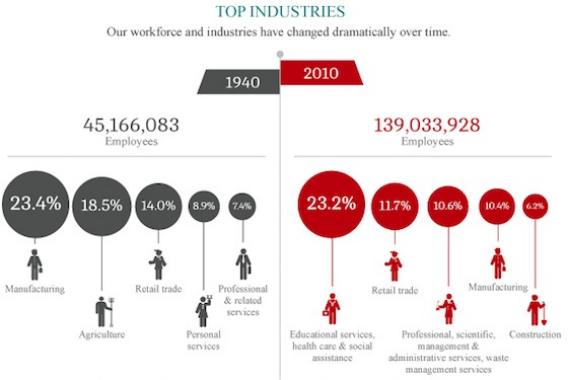
Matthew Yglesias posted an image from an infographic released by the Census Bureau showing differences in the U.S. population between 1940 and 2010. This section of the graphic focuses on changes in the industries in which the U.S. workforce is employed. For instance, in 1940 23.4% of Americans worked in manufacturing, down to 10.4% in 2010:

Education, health, and social services have emerged as a major employment sector. On the other hand, while agriculture is a minor  sector today (in terms of % of people employed), in 1940 nearly 1 in 5 people worked in agriculture. As Yglesias says,

…this drives home the fact that the initial exclusion of agricultural workers from Social Security [as part of the New Deal in the 1930s] was a really major compromise.

Evolutionary psychologists argue that when we find certain traits sexually attractive in others it may be because they signal reproductive fitness.  It goes something like this: People who have been sexually attracted to traits that tell the “truth” about genetic superiority have been more likely to choose mates with superior genetics and, therefore, have been more likely to produce healthy offspring that live to an age where they, in turn, can reproduce themselves.  Accordingly, nature has selected for individuals attracted to people who display signs of genetic excellence.

Culture throws a wrench in this theory because human can create their own systems of meaning, collectively convincing each other that certain traits are desirable regardless of the relationship between the trait and reproductive fitness.  The thinness ideal for women is an excellent example.  Judging by pop culture, heterosexual men have a strong preference for very thin women.  In fact, however, the weight idealized in mass media is not conducive to reproductive fitness; women won’t ovulate or menstruate below a certain weight because their body recognizes that it can’t support a pregnancy.

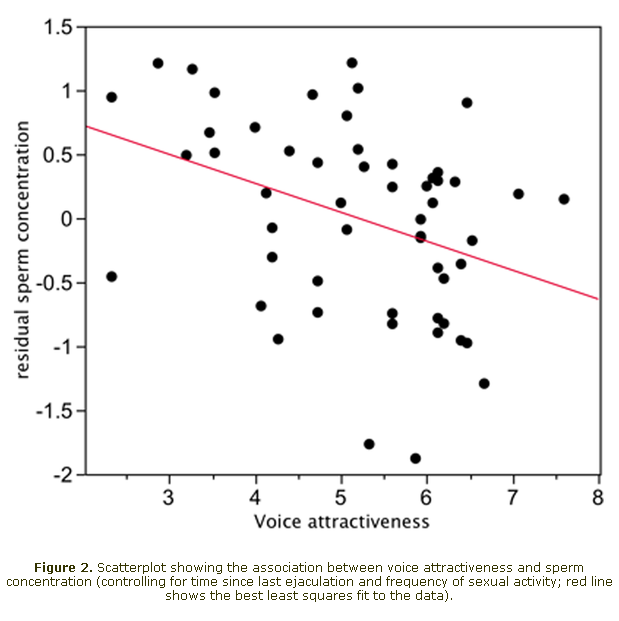
A new study — by Leigh Simmons, Marianne Peters, and Gillian Rhodes — offers another tantalizing piece of information regarding the relationship between attractiveness and reproductive fitness.  Pre-existing research shows that men with lower voices are judged more sexually attractive, so the authors decided to measure one indicator of their reproductive fitness, sperm count.

The results? Voice attractiveness is related  to sperm count, but in the opposite direction expected.  Men with higher voices, in fact, have higher sperm concentration, not lower.

The jury is still out about what this means, but it’s an intriguing addition to the ongoing conversation that social and biological scientists are having about how culture and nature interact to shape human experience.

Lisa Wade, PhD is an Associate Professor at Tulane University. She is the author of American Hookup, a book about college sexual culture; a textbook about gender; and a forthcoming introductory text: Terrible Magnificent Sociology. You can follow her on Twitter and Instagram.

YetAnotherGirl, Andrew, Rosemary, Nathan Jurgens0n, Dolores, and Ann K. all sent in an ad for Belvedere Vodka that should be listed in the annals of bad ideas. The ad shows a gleeful man grabbing a distressed-looking woman who, we are to presume from the text, must not be going down smoothly (via Feministing):

Because how is it not funny to present your product in a context that says sexual assault is funny?

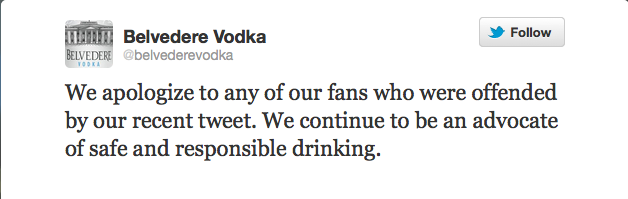
Online criticism of an ad that seems to be making a joke about forcing women to engage in sexual acts led to the company pulling the ad and issuing an apology of the passive “sorry if you were offended” type:

The company’s president also apologized when speaking to CNN about the controversy (via The Consumerist):

It should never have happened. I am currently investigating the matter to determine how this happened and to be sure it never does so again. The content is contrary to our values and we deeply regret this lapse.

The company also made a donation to the Rape, Abuse, and Incest National Network (RAINN).

Phil Villarreal, who posted about the ad and the apology at The Consumerist, suggests that the ad may be even more cynical than it at first appears:

The cynical might wonder whether or not the campaign and apology made up a coordinated effort to draw attention to the brand.

Intentionally invoking outrage, then making an apology and symbolic corporate donation as marketing strategy. Any readers with marketing expertise have any insight here? We often see cases of companies desperately trying to control the negative effects of controversies. When does a controversy hurt a brand and when does it serve as a marketing opportunity?

UPDATE: Reader Tom points out that it turns out to be a still from a parody video that someone at the company then reposted (via Adland):

Somebody on their social media team obviously created (or found) and posted it thinking it was an amusing parody. And that person has probably been found and fired.

But it is unlikely anyone officially *in charge* of the brand actually saw and approved this.

As Tom says, this brings up a separate issue: the challenges to companies of managing brand image in a world where one person in the organization can quickly disseminate something via the company’s social networking sites to thousands or even millions of people with much less oversight than a traditional ad campaign would get, especially when viewers make little distinction between images included in tweets or Facebook updates and those in billboards, print ads, etc.

Cross-posted at Ms.

Abby F. and an anonymous reader let us know about an Acuvue contact lens commercial aimed at teens that reinforces both gender and racial stereotypes. The teens look forward to their futures. For the boys, these involve future career success — notice the African American teen dreams of being a famous athlete, while the White boy’s future involves moving up the corporate career ladder. And what does the girl’s life hold? A boy who currently ignores her will want to dance with her.

As the submitters said, the boys are future role models and leaders, while the height of the girl’s future is that she gets to be desired.

UPDATE: James McRitchie, who posts at Corporate Governance, linked to our post last week and has spoken to someone in the PR department at Johnson & Johnson, the makers of Acuvue. The company has since pulled this particular ad, and provided this explanation, which James posted:

The Acuvue Brand Contact Lenses 1-Day campaign was designed to portray defining moments in teens’ lives that often involve the desire to wear contact lenses rather than glasses, such as when playing sports, in social situations, and at life events (i.e., moving to a new school).  As the campaign evolved, we continued to ask teens and their parents to share their thoughts about how wearing contact lenses could play a role in helping teens achieve their dreams.  We received thousands of responses that helped us add new ideas to the campaign.

We recently received feedback about one ad in the campaign that regrettably appeared to reinforce stereotypes.  While this was clearly not our intent, we appreciate consumer feedback and have removed this ad.  We are currently reassessing elements of this campaign so that we can continue to share how contact lenses can play a role helping teens’ realize their hopes and aspirations.

I think James makes a very good point in his post as well:

I’m sure kids have all kinds of dreams that play into society’s stereotypes. Many little girls love Barbies and dream of being a princess. Many young black boys hope to be NBA stars. How does J&J reflect the dreams of its customers while ensuring they don’t reinforce stereotyping?

There’s nothing inherently wrong with these representations in and of themselves, if they existed among a diverse array images of other dreams boys and girls of all races should aspire to. Unfortunately, however, they don’t exist in a vacuum; they appeared in a cultural context in which young women are told, via a variety of messages that they encounter over and over again, that their primary concern should be their attractiveness to boys and where African American teens often find themselves valued for their athletic ability more than their academic successes. When you live in a society with gender and racial inequality, sometimes messages intersect with existing stereotypes in ways that reinforce negative messages just because of their pervasiveness; figuring out how to negotiate such potential problems is an ongoing challenge for all of us concerned about racial and gender representation.

Gwen Sharp is an associate professor of sociology at Nevada State College. You can follow her on Twitter at @gwensharpnv.