Search results for The

W.W. Norton released a couple two-minute interviews in which I talk about hook up culture, part of their collection of academics talking about their research.

In the first clip, I discuss the difference between hooking up and a hook up “culture.”  In the second, I respond to the concern that there is something “wrong” with casual sex on college campuses.  There is something wrong, I argue, but it’s not unique to casual sex. Instead, the problems students face on campus — heterosexism, gender inequality, and a relentless pressure to be “hot” — don’t go away with graduation.

In that sense, for better or worse, college is a “functional training ground” for the friendships, marriages, workplace interactions, and other types relationships that students will encounter after college; social inequalities threaten the health of all of these relationships.  Instead of shaking our fingers at college students, then, we should recognize that the acute problems we see on campuses are symptoms of the ills that characterize our wider sexual culture as well.

I’m speaking about hook up culture at Harvard and Dartmouth this week. If you’re in the area, please come by and say “hello!”

  • Monday, Mar. 26th at 8:00pm: “Sex Lives and Sex Lies: Hooking Up on Campus” (Harvard University, Science Center D)
  • Wednesday, Mar. 28th at 7:30pm: “Sex Machines vs. Sex Objects: How Stereotypes Subvert Sexual Pleasure” (Harvard University, Fong Auditorium)
  • Thursday, Mar. 29th at 4:30pm: “The Promise & Perils of the Hook-Up Culture”  (Dartmouth University, Rockefeller Center “Rocky” 2)

Lisa Wade, PhD is an Associate Professor at Tulane University. She is the author of American Hookup, a book about college sexual culture; a textbook about gender; and a forthcoming introductory text: Terrible Magnificent Sociology. You can follow her on Twitter and Instagram.
In “Just Walk on By: A Black Man Ponders His Ability to Alter Public Space,” author Brent Staples recounts his realization, in his early 20s, that his mere presence in public often made others uncomfortable or outright fearful, a fact they were not hesitant to make clear. Staples points out that while he poses no threat to  those around him, others’ fear of him — including an instance in which he was assumed to be a robber when visiting his editor’s office to drop of a story and was chased by security — puts him in potential danger:

…I soon gathered that being perceived as dangerous is a hazard in itself. I only needed to turn a corner into a dicey situation, or crowd some frightened, armed person in a foyer somewhere, or make an errant move after being pulled over by a policeman. Where fear and weapons meet—and they often do in urban America—there is always the possibility of death.

I thought of Staples’s essay as soon as I heard about the Trayvon Martin case, and particularly after Fox News ran a segment in which Geraldo Rivera basically blames Trayvon himself for wearing a hoodie:

Rivera removes the focus from the man who shot an unarmed teen and places it instead on what the teen should have done to not get shot. Yes, yes, people shouldn’t shoot unarmed minority teens, but Trayvon’s choice of clothing was, according to Rivera, equally responsible for the shooting. He normalizes prejudice and stereotypes — it’s just normal for people to cross the street when they see a Black or Latino youth in a hoodie on the street. Trayvon should not have “allowed” himself to be seen as a criminal — as though he could individually ensure racial stereotypes and prejudices were not applied to him.

Rivera argues that Trayvon Martin wouldn’t have been shot if he hadn’t been wearing a hoodie. But Staples’s experiences undermine this reasoning; he presumably wasn’t wearing a hoodie the many different times he was taken for a criminal or treated like a threat while trying to carry out his role as a professional reporter. Merely being African American was sufficient to make him scary, as it was enough to make Trayvon Martin “suspicious” to George Zimmerman, and it’s unlikely a cardigan instead of a hoodie would have changed the situation.

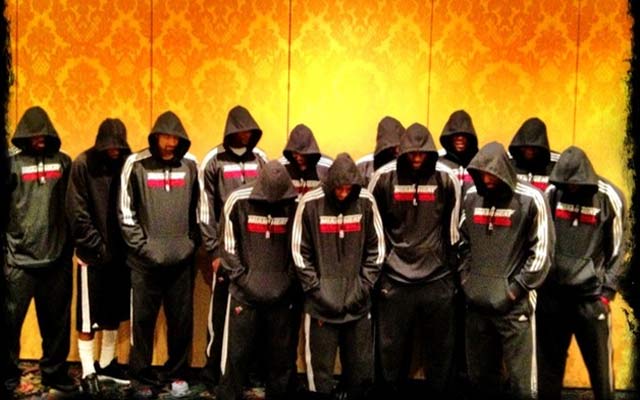
In support of Trayvon Martin, LeBron James tweeted a photo of Miami Heat players in hoodies:

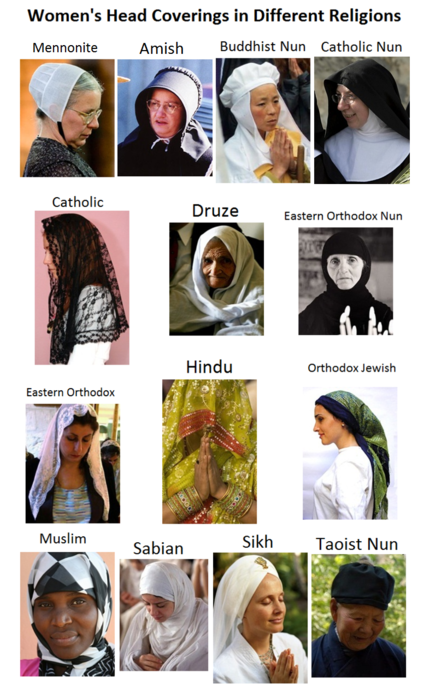
The burqa and headscarf are often identified as symbols of women’s oppression in Muslim countries.  In fact, head covering is a form of religious garb in many sub-cultures.  Some of these subcultures require head covering all of the time, and others only during religious rituals, but all involve this tradition.  Yet, when it comes to Muslims, the discussion often goes forward as if it is a uniquely oppressive, and uniquely Islamic, practice.  Food for thought.

Thanks to Dolores R. for the link.  Found at Socialist Texan.

UPDATE: In the comments, Alastair Roberts suggests that it’s important to consider whether head covering is required for just women, or both women and men.  I agree.

Lisa Wade, PhD is an Associate Professor at Tulane University. She is the author of American Hookup, a book about college sexual culture; a textbook about gender; and a forthcoming introductory text: Terrible Magnificent Sociology. You can follow her on Twitter and Instagram.
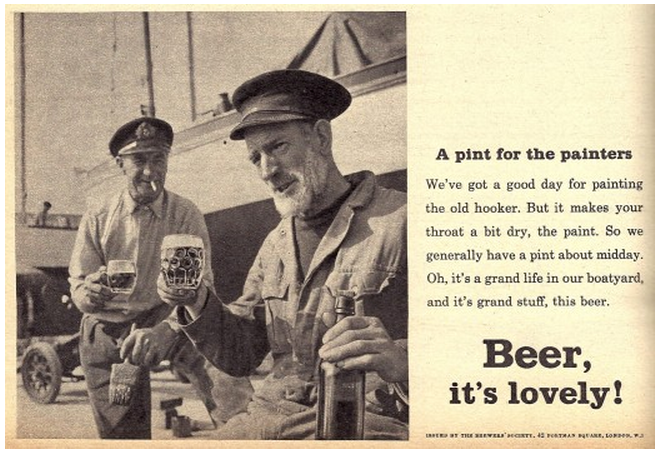
Here we have another great vintage ad (1962) that upsets the idea that today’s norms are trans-historical.  First, the idea of having a “pint about midday” would be considered inappropriate by many U.S. employers (though, as several commenters have pointed out, not necessarily elsewhere).  Second, the large print — “Beer, It’s Lovely!” — sounds unmasculine today, even though these grizzled sea-farers likely would have seemed perfectly masculine enough at the time.

From the RAF Flying Review, found at Retronaut.

Lisa Wade, PhD is an Associate Professor at Tulane University. She is the author of American Hookup, a book about college sexual culture; a textbook about gender; and a forthcoming introductory text: Terrible Magnificent Sociology. You can follow her on Twitter and Instagram.
In 2010 we wrote about how gender ideology inflects even the most “objective” of spheres.  In this case, we featured four examples of anatomical illustration, portrayals of human beings used to educate viewers about biology.  In each case, while the man faced forward with his weight evenly distributed on his two feet, the woman placed her hand on her hip, cocked a knee, or even turned slightly sideways.  In other words, he was posed in a masculine way and she in a feminine way.

When we see this kind of gendered posing in drawings that are ostensibly neutral, we are being told that our particular historically- and culturally-contingent version of masculinity and femininity is natural.

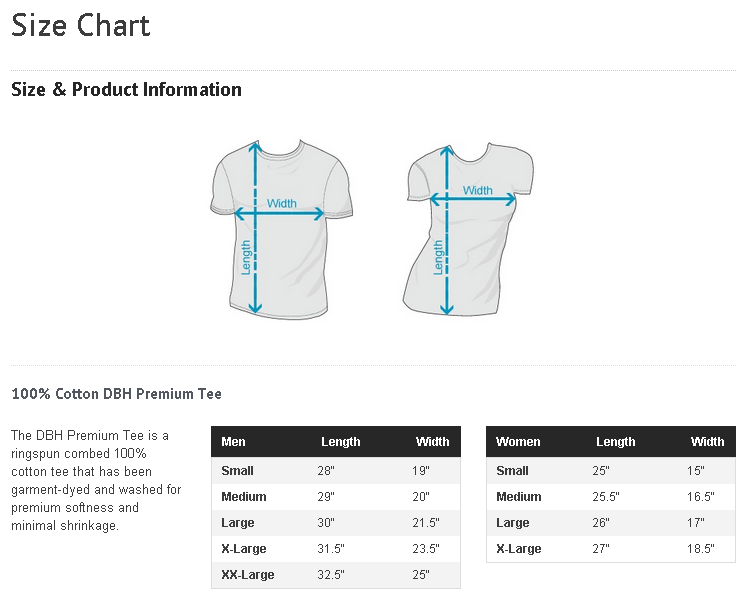
In this vein, Courtney S. sent in a Design by Hümans Size Chart.  The chart is supposed to help buyers decide what size to purchase, but the accompanying images do more than just illustrate how measurements are made; by torquing the female torso, they send a message about gender too:

Lisa Wade, PhD is an Associate Professor at Tulane University. She is the author of American Hookup, a book about college sexual culture; a textbook about gender; and a forthcoming introductory text: Terrible Magnificent Sociology. You can follow her on Twitter and Instagram.
In an earlier post we reviewed research by epidemiologists Richard Wilkinson and Kate Pickett showing that income inequality contributes to a whole host of negative outcomes, including higher rates of mental illness, drug use, obesity, infant death, imprisonment, and interpersonal trust.

In the six-minute video below, Kate Pickett talks about how more equal societies are kinder to each other, give more in foreign aid, are less status-conscious, consume less, and even recycle more.  Based on this, she argues that reducing inequality within societies is a good strategy towards addressing climate change.

How to increase equality? It turns out there are lots of options.

See Dr. Pickett making similar arguments as to why raising the average national income in developed countries doesn’t make people happier or enable them to live longerwhy unequal societies are more violent, and how status inequality increases stress.

And see more about income inequality and national well-being at Equality Trust.

Lisa Wade, PhD is an Associate Professor at Tulane University. She is the author of American Hookup, a book about college sexual culture; a textbook about gender; and a forthcoming introductory text: Terrible Magnificent Sociology. You can follow her on Twitter and Instagram.

Over at Bloomer Girls Blog, a site devoted to sports and gender, Lydia posted about ESPN’s online resources for the NCAA March Madness basketball tournaments. The layout of the site, and the format of the brackets, makes the women’s basketball tournament relatively invisible.

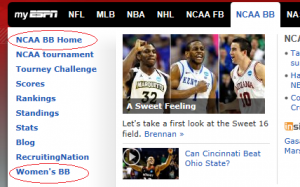
As we often see in sports, the men’s version is taken as the default. The apparently neutral “NCAA BB Home” link goes to the men’s tournament, specifically. To get information on the women’s tournament, you have to choose the “Women’s BB link” lower on the page:

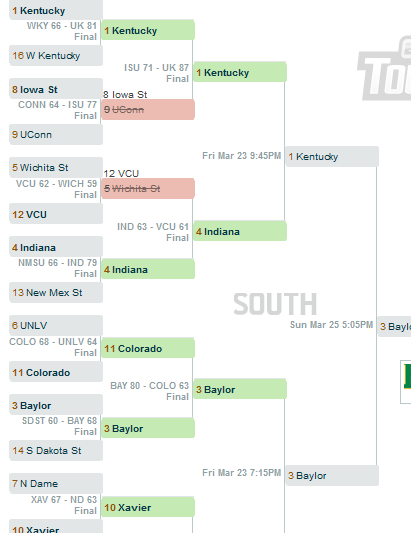
Lydia also found differences in the features available on the brackets you can fill out. The men’s bracket provides a range of features that encourage ongoing participation. While a game is occurring, the bracket is updated with the current score and how much time is left in the game, cluing potential viewers in to particularly close (and exciting) games. After a game, the final score is posted; you can also see the scheduled time of upcoming games:

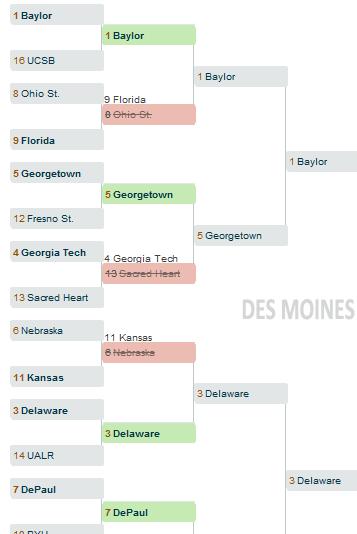
None of these features that add to the value of the bracket were integrated into the women’s brackets — no updates of the scores of games that are in progress (so no chance of drawing in viewers to a particularly exciting or intense game), no schedule to tell you when the next game is, not even the final scores of past games:

Lydia argues that by making the men’s tournament resources more engaging and informative, it reinforces the sense that the women’s tournament is a side event, not worth the same level of attention as the men’s. As she points out, ESPN probably devoted less time and energy to the women’s tournament website because they assume fewer people will sign up and use it. But by creating less engaging resources, they provide less incentive for fans to bother signing up, creating a self-fulfilling prophecy.

Flickr Creative Commons, Lau

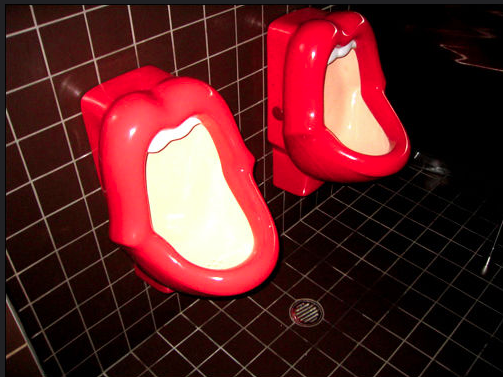
Stephanie Medley-Rath sent in a new example of urinals shaped like women’s mouths (source).

Liz B. sent in a slide show of “innovative” urinals that included this example.

Urinals at the Rosenmeer restaurant in Moenchengladbach, Germany, are shaped like women’s bodies (source).

Others are shaped like nuns urinals (more nun or maybe the Virgin Mary urinals here).


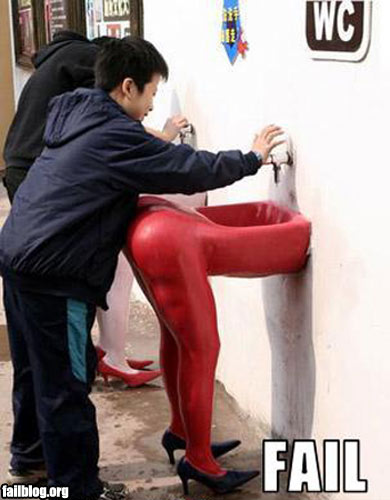
Emma B. sent in this image of sinks:

fail-owned-sink-design-fail

Gwen Sharp is an associate professor of sociology at Nevada State College. You can follow her on Twitter at @gwensharpnv.